I can sit beside a loud, choppy sea and feel quite comfortable. Or enjoy a good thunderstorm, lightning and all. A fan running nearby can disappear into the background.
But a quiet baby crying through the wall can keep me awake.
Apparently, my nervous system has its own editorial department. The ocean gets approved. The baby becomes breaking news.
Very early this morning, that was exactly what happened. The crying wasn’t loud, but my attention kept going toward it. I put on a fan sound with white noise through the speakers, part of the little setup I’m building in the bedroom.
A low level was enough to completely mask the crying for me. I went back to sleep.
Such a small thing. But being able to go back to sleep is a fairly substantial feature at that hour.
The sound that keeps asking
I’m beginning to notice that volume alone doesn’t explain what bothers me.
A steady sound can leave me alone. An intermittent one keeps asking for attention. A thump, another thump, then a pause. Has it stopped? Should I prepare for another?
Perhaps it’s a child kicking a wall at two in the morning. I don’t know. From my side of the wall, I’m getting the percussion section without the programme notes.
The room can become quiet while some part of me is still listening.
That’s what I want to experiment with: a little more control over what gets access to my attention.
A motorcycle in an echo chamber
Today I had another example down in the garage.
A guy revved his motorcycle in there. Everything echoes in that space, so the sound had plenty of opportunities to introduce itself.
I was wearing my AirPods Pro and listening to music. The noise cancellation reduced some of it, but plenty still came through. Then the music automatically became louder, and I could hear it clearly again.
Between the cancellation and the music covering more of the noise, I came through it without feeling frazzled.
The motorcycle carried on being a motorcycle. I had a useful buffer.
A little weather of my own
Fireworks are harder for me. A sudden boom can bring an immediate fear response connected to past experiences.
I’ve been wondering whether a boom could trail into a rumble of thunder, followed by steady rain that makes the next explosions stand out less.
A little weather of my own.
That is an idea to test. A system reacting after an explosion cannot take back the first sound that has already reached me. Perhaps rain already playing, or continuing afterward, could help me settle. I don’t know yet.
And someone else might find thunder thoroughly unhelpful. Their ideal setting could be my worst setting.
Which is why the person needs the controls.
Spain puts autonomy into the picture
This connects with something larger happening here in Spain.
A new law reforming Spain’s disability and dependency legislation explicitly includes applied AI, connected devices, home automation and robotics among the technologies that can be used in teleassistance. It places emphasis on people’s wishes, independent living and support in their homes and communities.
The law takes effect on 23 October 2026. Available services will depend on further implementation. We haven’t all been issued a household robot. Mine still requires me to do most of the assembly.
But the direction catches my attention because it connects with what I’m building: an adjustable buffer around me.
In the past, I’ve experienced medication leaving me feeling as though I couldn’t feel anything. I don’t want that experience again. I want to enjoy music, attend my classes, be around people and feel my life.
AI and, eventually, robotics interest me for what they might help a particular person do. Everyone has different difficulties. Sometimes even explaining the difficulty is difficult. Useful support should help us express our preferences, try adjustments and keep making our own choices.
This morning, my version of that was a speaker playing a quiet fan sound.
The Input Shapes the Output Human performance is not produced in isolation. Output comes from input: sound, light, stress, unfinished tasks, addictive loops, social pressure, and the design of the systems around us. When those inputs are cleaner, people do not become “privileged.” They become more accurate, more regulated, and more useful.
We often judge people by their output.
Did they finish the task? Did they stay calm? Did they communicate clearly? Did they do something useful? Did they perform consistently?
That is how many systems measure human value. They look at what came out and decide what kind of person must be inside.
But output does not appear from nowhere.
Human output is shaped by input conditions.
If the input stream is noisy, addictive, ambiguous, or full of unresolved open loops, the output becomes more reactive, more scattered, and less useful. If the input stream is clear, calm, and well-tuned, the output becomes more intentional, accurate, creative, and productive.
For autistic people, this can be especially visible.
The difference between shutdown and innovation is not always the person. Often, it is the input layer.
⸻
The system mistake
Most systems treat output as the problem.
If someone is overwhelmed, distracted, inconsistent, irritable, avoidant, or unproductive, the system often assumes the person is failing in some personal way. It may call them disorganized, too sensitive, unreliable, lazy, difficult, or emotionally unstable.
But many of those outputs are not primary problems.
They are downstream effects.
The real issue may be that the environment is feeding the nervous system the wrong signal:
too much noise
too much ambiguity
too many demands
too many interruptions
too many unresolved loops
too many digital hooks competing for attention
The system sees performance. It misses conditions.
⸻
Autism makes this easier to see
Autistic people are often judged harshly because the output changes so visibly when the input changes.
A noisy room can reduce language access. Too many competing demands can collapse task initiation. Unclear instructions can produce paralysis. Frequent interruptions can break deep focus. Visual clutter, sensory friction, and social uncertainty can all drain processing power before the real task even begins.
Then the outside world looks only at the output and says:
Why aren’t they functioning?
Why are they upset?
Why didn’t they finish?
Why are they so inconsistent?
But autistic cognition is not weak. It is highly sensitive to signal quality.
That sensitivity can create struggle in chaotic systems, but it can also create extraordinary value in tuned conditions:
deep pattern recognition
precision
innovation
artistic depth
strong system perception
meaningful productivity
A powerful system still needs a clean signal.
⸻
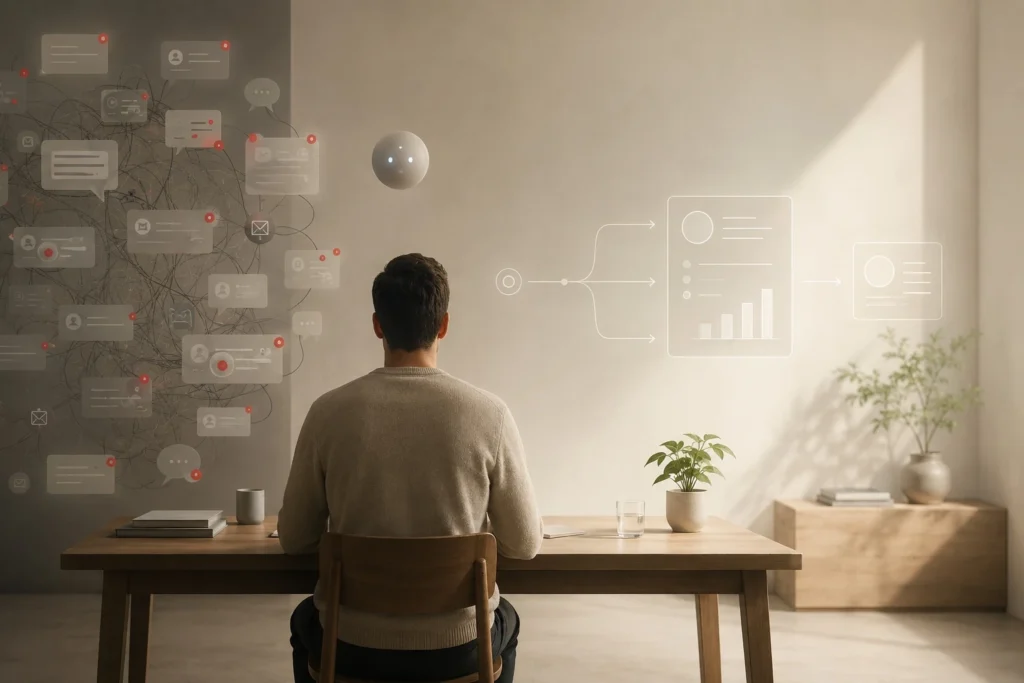
Open loops are part of the input burden
One part of the input layer gets ignored all the time: open loops.
Open loops are unresolved signals that continue occupying background attention.
They include things like:
unattended email
unread messages
red notification numbers on apps
open browser tabs
vague tasks with no clear end
things waiting for a reply
unresolved obligations
half-finished decisions
digital clutter
social tension that has not been closed
These are often treated as small things. They are not small.
Each one acts like a cognitive hook.
It keeps pulling at the system:
Check this.
Don’t forget.
Someone may need something.
There might be a problem.
You still haven’t handled this.
Something is unfinished.
For some people, those hooks are background irritation. For others, especially many autistic people, they can become constant low-grade drag.
Not always dramatic. Just persistent.
The result is a nervous system that never fully settles and a mind that never gets full closure.
That affects output.
⸻
Digital systems are designed to keep loops open
This is not accidental.
Many digital systems benefit from unresolved attention. They are built around reminders, alerts, badges, interruptions, urgency signals, and easy re-entry points. They do not always help people close loops. Often, they help keep loops active.
The red numbers on apps are a perfect example.
They are tiny, but they signal incompletion. They create a visual demand. They sit quietly in the background, asking for cognitive energy even when you are trying to focus somewhere else.
An unread email is not just an email. For many minds, it becomes a live thread.
A vague obligation is not just a task. It becomes a low-level open process.
When enough of these stack up, people do not simply become “less disciplined.” They become saturated.
⸻
Better output often starts with cleaner input
If we want better human performance, we should stop starting only at the output layer.
Before asking:
Why is this person not producing?
Why are they dysregulated?
Why are they not focused?
Why are they inconsistent?
We should ask:
What is entering their system?
What is still open in their attention field?
What keeps pulling background processing?
What sensory or digital conditions are distorting performance?
What can be reduced, clarified, or closed?
This is a better human systems question.
Because many people do not need more pressure. They need a cleaner signal.
We often talk about focus as if it is only a matter of discipline.
Pay attention. Try harder. Stop being distracted. Be more productive.
But sometimes the problem is not a lack of focus.
Sometimes the problem is that the mind is running too many open loops at once.
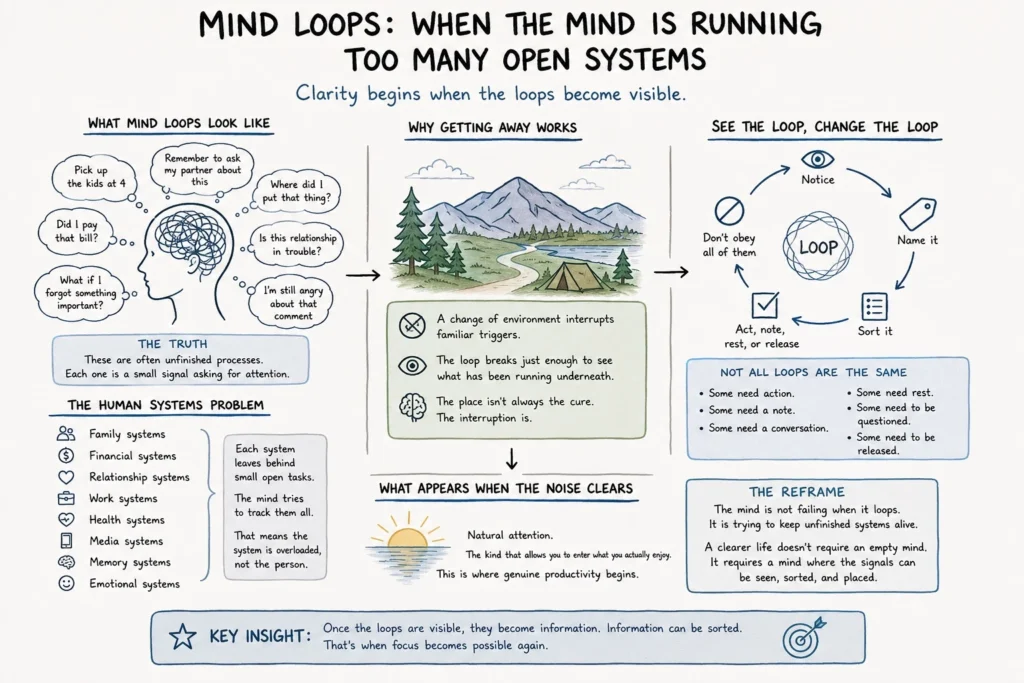
Pick up the kids at four. Remember to ask my partner about this. Did I pay that bill? What was I supposed to do next? Where did I put that thing? Is this relationship in trouble? I need to buy more pickles. I am still angry about that comment. What if I forgot something important?
These thoughts can seem random.
But they are not always random.
They are often unfinished processes.
Each one is a small signal asking for attention. A task. A worry. A memory. A fear. A social script. A financial reminder. A relationship question. A body signal. A piece of emotional residue that has not yet cleared.
The mind keeps looping because something has not been resolved, placed, understood, trusted, or released.
The Human Systems Problem
This is a Human Systems problem.
We often treat mental noise as a personal weakness, but many times it is cognitive overload.
Modern life asks the mind to hold too many systems at the same time.
Family systems. Financial systems. Relationship systems. Work systems. Health systems. Media systems. Memory systems. Emotional systems.
Each system leaves behind small open tasks.
The mind tries to track them all. That does not mean the mind is broken. It means the system is overloaded.
A person may look distracted from the outside, but internally they may be managing dozens of active loops at once. Some are practical. Some are emotional. Some are old. Some are not even important anymore, but they keep returning because they were never sorted.
Focus becomes difficult because attention is already occupied.
Why Getting Away Works
Maybe this is why people love vacations, camping, long walks, or simply getting away.
It is not always about the different place.
Sometimes the value is that the old loop gets interrupted.
The familiar triggers are gone for a moment. The same rooms, screens, bills, reminders, conversations, objects, obligations, and emotional scripts are not constantly pulling on attention.
The loop breaks just enough for the person to see what has been running underneath.
That is why distance can feel like clarity.
Not because life disappeared.
Because the background noise changed.
The mind finally has enough space to show what it has been carrying.
Seeing the Loop
I think, for once, I finally reached the point where I could see it.
Not perfectly.
Not permanently.
But clearly enough to recognize the loops for what they were.
They were not my whole mind.
They were repeated signals, unfinished tasks, old fears, rehearsed conversations, small obligations, and emotional echoes asking for attention.
Once I could see them, I did not have to obey all of them.
That changed something.
Because when the loops are invisible, they feel like reality.
When they become visible, they become information.
And information can be sorted.
Some loops need action. Some need a note. Some need a conversation. Some need rest. Some need to be questioned. Some need to be released.
The goal is not to erase the mind.
The goal is to see what is running.
Natural Attention
When enough noise clears away, something different appears.
Natural attention.
The kind that allows people to enter what they actually enjoy.
Not forced productivity. Not pressure. Not performance.
Coherence.
This is where genuine productivity often begins.
Not from pushing harder, but from reducing the number of unresolved loops competing for the same attention.
Calm is not always something we find by adding another wellness practice.
Sometimes calm begins when we stop feeding every loop as if it deserves control.
Sometimes calm begins when we can finally say:
This is a task. This is a fear. This is a memory. This is a practical reminder. This is an old script. This is not the whole truth.
That separation matters.
Because once a loop is named, it loses some of its power.
The Reframe
The mind is not failing when it loops.
It is trying to keep unfinished systems alive.
The problem is not always the thought itself.
The problem is when too many loops remain open, unnamed, and unmanaged.
A clearer life does not require an empty mind.
It requires a mind where the signals can be seen, sorted, and placed.
That is when focus becomes possible again.
Not because the person became more disciplined.
Because the system became more coherent.
Key Insights
Mental loops are often unresolved system signals, not personal failure.
Focus becomes difficult when too many open loops compete for attention.
Changing environment can interrupt familiar triggers long enough to reveal what is underneath.
Once a loop becomes visible, it can be sorted instead of obeyed.
Calm often begins when the mind stops treating every signal as equally urgent.