Tag: behavioral modeling

  • Where Enough Is Just Right

    When systems stop pulling on you
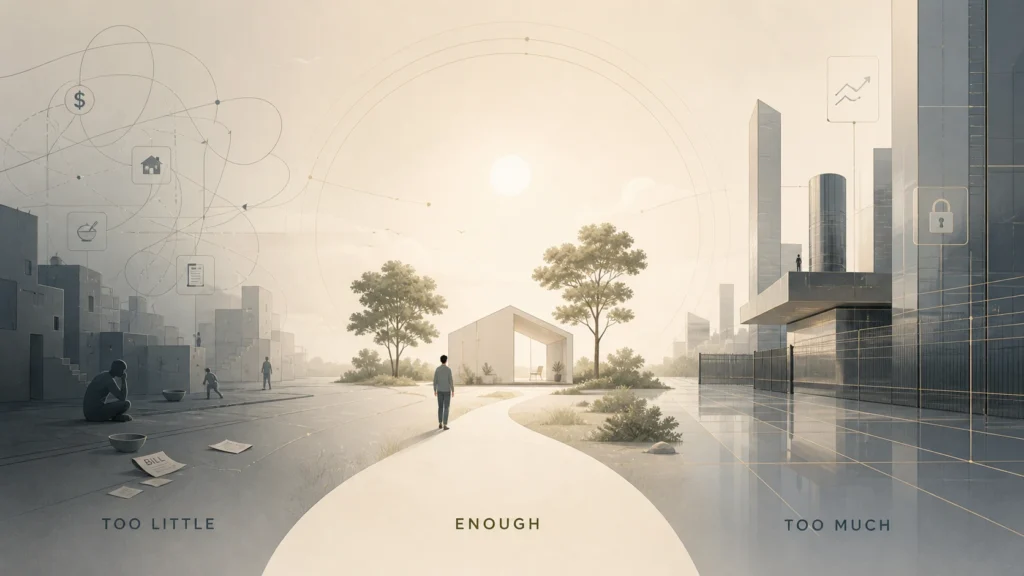
    Conceptual Human Systems image showing scarcity, enough, and excess as three zones, with a calm center path representing stability, clarity, and restored attention.

    Enough is the stabilizing point where pressure drops and attention returns to life.

    Some systems do not fail all at once.

    They pull.

    A little pressure here.
    A little hunger there.
    A little uncertainty that never fully resolves.

    When I was growing up, breakfast on school days was usually oatmeal. It was food, and I was grateful there was something. But by the middle of the school day, my stomach would be rumbling hard before lunch.

    That kind of hunger does not stay in the stomach.

    It enters the decision system.

    It changes how the future feels.
    It changes how risk feels.
    It changes what looks like hope.

    When people live too close to scarcity, they are not just “bad at decisions.” Their systems are overloaded. Their attention is consumed by immediate pressure. Their nervous system keeps asking one question:

    How do I get out of this?

    And when that question stays active long enough, almost anything that looks like an exit can start to feel reasonable.

    A lottery ticket.
    A get-rich scheme.
    A risky opportunity.
    A belief system that promises certainty.
    A person who says they have the answer.
    A system that offers escape but quietly extracts more.

    Scarcity makes people easier to steer.

    Not because they are weak.

    Because pressure narrows the field of vision.

    Scarcity Is Not Just Having Less

    Scarcity is often treated as a personal condition.

    Someone has less money.
    Less food.
    Less time.
    Less security.
    Less support.

    But scarcity is also a system condition.

    It creates recurring loops:

    • Check the balance.
    • Delay the bill.
    • Stretch the food.
    • Wait for approval.
    • Hope nothing breaks.
    • Look for the break that finally changes everything.

    Each loop uses attention.

    Each unresolved pressure keeps running in the background.

    A person can look calm from the outside while their inner system is constantly calculating survival.

    That calculation has a cost.

    It reduces patience.
    It reduces long-term planning.
    It increases emotional reactivity.
    It makes promises of rescue more powerful.

    This is why scarcity is not just an economic issue. It is a cognitive issue. It is a nervous system issue. It is a human systems issue.

    When More Becomes Another Trap

    There is another side to this pattern.

    People who move beyond enough can also get trapped.

    Once someone has more than they need, the system can shift from survival pressure to protection pressure.

    Now the loop becomes:

    • How do I keep this?
    • Who might take it?
    • What if I lose status?
    • What if someone else gets what I have?
    • What if enough is not actually enough?

    The pressure changes shape, but it does not always disappear.

    Scarcity says, I need more so I can be safe.

    Excess says, I need more so I can stay safe.

    Both can become loops.

    Both can distort judgment.

    Both can make people easier to manipulate.

    A person trapped in scarcity may chase escape.
    A person trapped in excess may chase control.

    The system is different, but the underlying pressure is similar:

    Enough has not been defined.

    The Missing Boundary

    Many human systems fail because they do not teach people how to recognize enough.

    They teach people to endure lack.
    They teach people to chase more.
    They teach people to compare.
    They teach people to compete.
    They teach people to fear falling behind.

    But they rarely teach the stabilizing question:

    What amount allows life to function without consuming the whole person?

    Enough is not laziness.

    Enough is not lack of ambition.

    Enough is a boundary condition.

    It is the point where the system has enough stability to stop consuming attention and start supporting life.

    Enough food means the body can stop scanning for hunger.
    Enough money means the mind can stop looping around every bill.
    Enough rest means the nervous system can stop running in emergency mode.
    Enough belonging means a person does not have to perform constantly to feel safe.
    Enough autonomy means decisions can come from clarity instead of pressure.

    Enough is not the end of growth.

    It is the foundation that makes healthier growth possible.

    Pressure Changes the Meaning of Choice

    A choice made under pressure is not the same as a choice made from stability.

    Technically, both may look like free will.

    But functionally, they are different.

    When a person is hungry, afraid, isolated, ashamed, indebted, or overwhelmed, their decision system changes. The mind becomes more short-term. The body looks for immediate relief. The future becomes harder to model.

    This is where exploitative systems enter.

    They do not always force people.

    They wait until pressure makes people more likely to agree.

    That is how predatory loans work.
    That is how manipulative belief systems work.
    That is how gambling systems work.
    That is how attention platforms work.
    That is how many political and economic systems work.

    They do not need people to be irrational.

    They only need people to be pressured.

    The Reframe

    The problem is not that humans always want too much.

    The problem is that many systems keep humans from feeling what enough is.

    Some people are held below enough for so long that any escape looks sacred.

    Others rise above enough but never exit the fear that someone will take it away.

    So the system keeps moving.

    More pressure.
    More extraction.
    More comparison.
    More protection.
    More hunger disguised as ambition.

    A healthier human system would not ask only, “How do we produce more?”

    It would also ask:

    Where does pressure drop enough for people to think clearly, relate honestly, and live without constant defensive calculation?

    That is where enough becomes just right.

    Not because everyone gets the same life.

    But because every person needs a stable enough base to make real choices.

    System Insight

    Enough is a stabilizing threshold.

    Below it, people are pulled by need.
    Far beyond it, people can be pulled by fear of loss.
    At enough, attention can return to life.

    This matters because many social problems are not caused only by bad values or bad individuals. They are caused by systems that keep people outside the zone where clear decisions are possible.

    If we want better decisions, we need better conditions.

    If we want healthier communities, we need fewer pressure loops.

    If we want people to act with more patience, empathy, and foresight, we have to stop designing systems that keep them in survival calculation.

    Application

    A practical human system should help people identify and protect their enough.

    Not as a fixed number for everyone.

    As a functional state.

    Enough means:

    • The body is not constantly deprived.
    • The mind is not consumed by unresolved pressure.
    • The person can make decisions without panic.
    • The future can be imagined without fantasy or dread.
    • Growth can happen without becoming extraction.
    • Security can exist without becoming control.

    This applies to money.
    It applies to food.
    It applies to housing.
    It applies to relationships.
    It applies to work.
    It applies to technology.
    It applies to attention.

    A system that never lets people reach enough will keep producing instability.

    A system that never teaches people to recognize enough will keep producing excess.

    The goal is not endless more.

    The goal is a life where the system stops pulling so hard that the person can finally become present.

    Key Insights

    • Scarcity changes decision-making by keeping attention trapped in survival loops.
    • Excess can also become a trap when people become afraid of losing what they have.
    • “Enough” is not weakness or lack of ambition; it is a stabilizing threshold.
    • Many exploitative systems work by waiting until pressure makes people easier to steer.
    • Healthier human systems should reduce pressure loops so people can make clearer, freer decisions.

  • Identity Threat Response: Why People Fear Tofu, Identity, and Change

    Mediterranean vegan tofu plate showing tofu as simple everyday food without hormonal impact

    Belief

    Certain external inputs—like food, culture, or people—can alter who we are at a fundamental level.


    Break the Assumption

    Most perceived “identity threats” are not biological realities.
    They are interpretations layered onto unfamiliar inputs.

    Tofu doesn’t feminize the body.
    And another person’s identity doesn’t alter yours.

    Yet both trigger similar reactions.


    System Breakdown

    System: Identity Threat Projection

    When humans encounter something unfamiliar, the brain runs a fast evaluation:

    1. Input
      • New or unfamiliar stimulus
        (tofu, gender identity, culture, technology)
    2. Interpretation
      • “This might change me”
      • “This threatens my identity”
    3. Amplification
      • Cultural myths
      • Social reinforcement
      • Repetition of misinformation
    4. Output
      • Avoidance
      • Rejection
      • Mockery or hostility

    This system is not about tofu.
    It’s about protecting a stable sense of self.

    This pattern is known as the identity threat response—a common human system that reacts to perceived changes to self.


    Personal Observation

    Once upon a time, in the cozy chaos of my kitchen, I offered a friend a dish I’d made—vegetables, spices, and tofu.

    Their reaction was immediate:
    “Tofu? Won’t that mess with my hormones?”

    That moment wasn’t about food.
    It was a real-time example of a system activating.


    Reframe

    Hormones are not identity markers. They are biological regulators.

    Every human body produces both estrogen and testosterone:

    • Estrogen supports bone density
    • Testosterone supports energy and function

    Tofu contains phytoestrogens—plant compounds that are structurally different and significantly weaker than human estrogen.

    There is no mechanism where tofu alters identity.

    The fear exists without a real biological pathway.


    System Insight

    Humans often confuse:

    • Exposure → with → Transformation
    • Presence → with → Influence
    • Difference → with → Threat

    This creates a loop where symbolic meaning overrides physical reality.

    The same system shows up in:

    • Fear of certain foods
    • Fear of gender diversity
    • Fear of new technology
    • Fear of cultural change

    The object changes.
    The system remains the same.


    Application

    To interrupt this system:

    1. Separate signal from story
      • What is the actual biological or physical effect?
      • What is assumed or culturally reinforced?
    2. Check mechanism
      • Is there a real pathway for change?
      • Or just a perceived one?
    3. Reduce symbolic overload
      • Not everything represents identity
      • Some things are simply inputs, not transformations

    Key Insight

    Fear is rarely about the thing itself.

    It is about loss of control over self-definition.

    When that fear is examined instead of reacted to,
    clarity replaces defense.


    Closing

    Tofu is just food.

    People are just people.

    And identity is far more stable than fear makes it seem.

  • What Capybaras Can Teach Us About Living Together

    Capybaras are known for something unusual.

    They coexist.

    Across species.
    Across environments.
    With very little conflict.

    That’s not accidental.

    It’s a pattern.

    Low-Conflict Systems

    Capybaras don’t dominate their environment.

    They adapt to it.

    They:

    • stay close to shared resources
    • tolerate proximity
    • avoid unnecessary conflict

    This creates stability.

    Not through control—but through behavior.

    What We Can Learn

    Human systems often do the opposite.

    We:

    • compete for control
    • escalate quickly
    • prioritize speed over stability

    That creates friction.

    And over time, that friction compounds.

    A Different Model

    What if we designed systems more like low-conflict environments?

    Not passive.

    But:

    • cooperative by default
    • tolerant of variation
    • structured around shared access

    This doesn’t remove complexity.

    But it reduces unnecessary tension.

    Where This Applies

    This kind of thinking can apply to:

    • social spaces (including VR)
    • communities
    • governance models
    • shared environments

    The goal isn’t perfection.

    It’s stability.

    🔄 2026 Update

    This connects directly to how I think about XR and Guardian systems.

    Digital environments amplify behavior.

    If they are designed around competition and reaction, conflict increases.

    If they are designed around:

    • coexistence
    • shared space
    • low-friction interaction

    behavior shifts.

    Key Insights

    • Stability often comes from reducing unnecessary conflict
    • Coexistence is a system design outcome, not an accident
    • Shared resources encourage cooperation
    • Behavior patterns shape environment outcomes

    Guardian Application

    A Guardian system could:

    • encourage cooperative interaction
    • reduce escalation in shared spaces
    • model low-conflict behavior
    • support stable, inclusive environments

    Tags

    • Domain: Human Systems
    • Function: Insight, System Design
    • Guardian: Behavioral Modeling

  • Kindness Still Applies: How We Treat People in VR Matters

    Virtual reality can feel separate from the real world.

    But the people inside it are not.

    The Shift That Happens

    I’ve noticed something consistent.

    People who are respectful in everyday life can behave very differently once they enter a virtual space.

    It’s similar to what happens when someone gets behind the wheel of a car.

    Distance creates detachment.

    And detachment changes behavior.

    The Problem

    In VR, it becomes easy to forget:

    There is a real person behind every avatar.

    Not a character.
    Not an object.
    A person.

    When that connection is lost, behavior changes:

    • people interrupt more
    • dismiss others more quickly
    • say things they wouldn’t say face-to-face

    Why It Matters

    VR is not just entertainment.

    It’s a shared social space.

    The way people behave there:

    • affects others emotionally
    • shapes the culture of the environment
    • determines whether spaces feel safe or hostile

    A Simple Standard

    The rule doesn’t need to be complicated:

    If you wouldn’t say or do something to a person in front of you, don’t do it in VR.

    The medium changes.

    The impact doesn’t.

    🔄 2026 Update

    This idea directly informs how I think about XR systems and Guardian design.

    If behavior consistently shifts toward detachment in immersive environments, then systems should:

    • reinforce the presence of real people
    • guide interactions toward respect
    • reduce conditions that encourage dehumanization

    Because the goal is not just access to virtual worlds—

    It’s maintaining human connection within them.

    Key Insights

    • Distance increases the risk of dehumanization
    • VR behavior often diverges from real-world norms
    • Social environments are shaped by repeated interactions
    • Simple behavioral rules scale better than complex ones

    Guardian Application

    A Guardian system could:

    • gently reinforce respectful interaction
    • remind users of the human presence behind avatars
    • redirect harmful behavior without confrontation
    • support healthier social norms in shared spaces

    Tags

    • Domain: XR, Human Systems
    • Function: Insight, Behavioral Guidance
    • Guardian: Behavioral Modeling

  • Virtual Boundaries: Why VR Systems Must Protect Children by Design

    Virtual reality is often described as immersive, social, and expansive.

    In practice, it is also unpredictable.

    And in that unpredictability, one issue stands out clearly:

    Young children are entering spaces that were never designed for them.

    What I’ve Actually Seen

    In my own experience, I’ve encountered very young children in VR environments—at least three separate times, children who appeared to be around four years old.

    These were not isolated moments.

    In some cases, it felt less like supervised use and more like the headset was being used to occupy the child for a period of time.

    I’ve also seen situations where other users stepped in to comfort a child in spaces clearly meant for adults.

    That pattern matters.

    The Reality

    There is a gap between policy and actual use.

    While platforms set age limits, those limits are not consistently enforced.

    At the same time, these environments may include:

    • adults with unpredictable behavior
    • conversations not appropriate for children
    • interactions that require emotional maturity

    When young children enter these spaces without supervision, the system is no longer aligned with its intended design.

    The System Gap

    It’s easy to frame this as a parenting issue.

    But systems that rely on perfect supervision will fail.

    And in this case, that failure is already visible.

    If children can consistently access these environments, then the system is not adequately protecting them.

    What Needs to Change

    Platforms should assume that boundaries will be bypassed.

    That means building for reality, not ideal behavior.

    This includes:

    • stronger age verification
    • default-safe environments for unidentified users
    • fast and effective reporting systems
    • built-in protections that do not depend on supervision

    Safety should not depend on who happens to be paying attention.

    It should be part of the system itself.

    🔄 2026 Update

    This directly informs how I think about XR systems and Guardian design.

    Protection should be:

    • proactive
    • consistent
    • always accessible

    These should be built-in, not reactive or optional.

    Because when a system allows vulnerable users into unsafe environments, the issue isn’t isolated behavior.

    It’s design.

    Key Insights

    • Real-world usage often bypasses intended safeguards
    • Systems should not rely on perfect supervision
    • Immersive environments amplify risk when boundaries fail
    • Protection must be built into the system, not added later

    Guardian Application

    A Guardian system could:

    • detect likely underage presence through behavior patterns
    • shift environments into safer modes automatically
    • guide interactions to reduce harm
    • provide immediate escalation and exit options

    Tags

    • Domain: XR, Human Systems
    • Function: Insight, System Design
    • Guardian: Behavioral Modeling, Emotional Support

  • When the Pause Button Disappears: Safety in Virtual Spaces

    Virtual reality can feel like an escape.

    For me, it often is—a place where sensory input is more controlled, where I can move through environments at my own pace.

    But that sense of control depends on something simple:

    The ability to step away.

    The Moment

    During one session, I encountered another user whose behavior crossed a line—targeting my identity in a way that immediately shifted the environment from comfortable to unsafe.

    My instinct was clear:

    Pause. Exit. Reset.

    But in that moment, the control I relied on wasn’t there.

    The pause function wasn’t accessible.

    What Changed

    Without that option, the experience shifted quickly.

    What had been an open, creative space became something restrictive.

    Not because of the environment itself—but because I couldn’t control my interaction with it.

    That distinction matters.

    Why This Matters

    In immersive systems, control equals safety.

    It’s not just about content or behavior.

    It’s about giving users:

    • immediate exit options
    • clear boundaries
    • reliable ways to disengage

    Without those, even well-designed environments can become overwhelming.

    What Helped

    Once I stepped away and reported the issue, the system responded.

    The tools were restored.

    But the experience highlighted something important:

    Safety features only matter if they are always accessible.

    They need to be immediate and always accessible.

    🔄 2026 Update

    This directly informs how I think about XR system design and Guardian behavior.

    Any immersive system should prioritize:

    • instant exit or pause
    • clear user control at all times
    • protection without requiring escalation

    Because when a user loses control, even briefly, the system has already failed.

    Key Insights

    • Control is a core part of safety in immersive environments
    • Users need immediate ways to disengage
    • Safety features must be reliable, not optional
    • Identity-based interactions require stronger safeguards

    Guardian Application

    A Guardian system could:

    • detect escalating interactions early
    • provide immediate exit or pause options
    • guide users safely out of uncomfortable situations
    • reinforce boundaries without requiring confrontation

    Tags

    • Domain: XR, Human Systems
    • Function: Story, System Design
    • Guardian: Behavioral Modeling, Emotional Support

  • From Retaliation to Resolution: Rethinking AI’s Role in Conflict

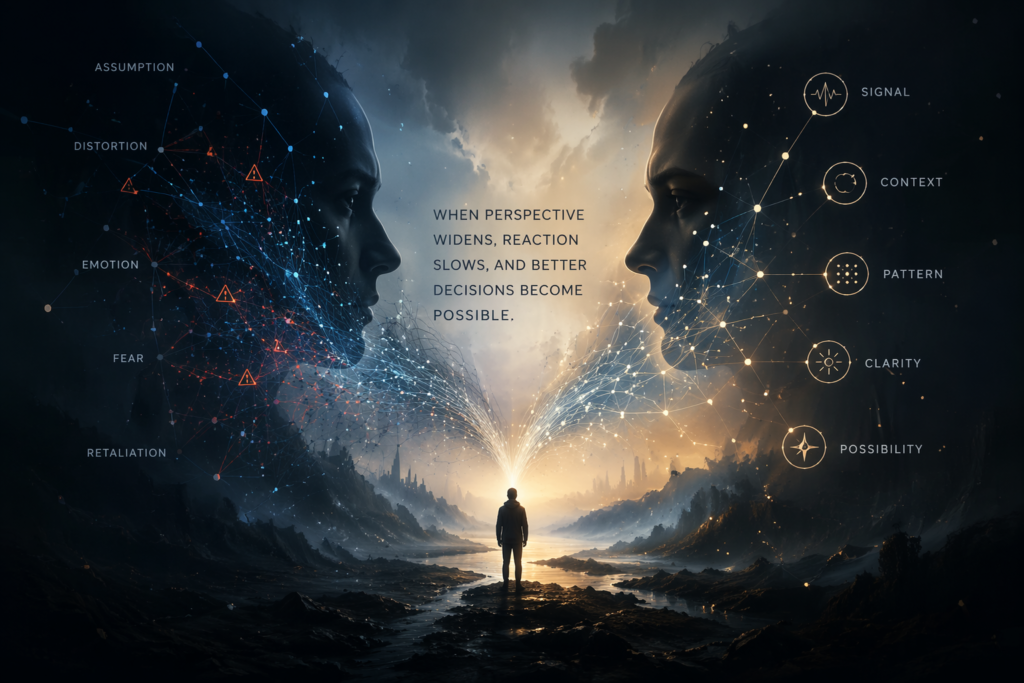
    AI conflict resolution concept showing opposing perspectives moving from distortion to clarity

    AI conflict resolution begins with understanding how escalation patterns form.

    Conflict tends to follow a familiar pattern.

    Action. Reaction. Escalation.

    Whether between individuals, communities, or nations, the loop repeats with surprising consistency. What changes is scale, speed, and the number of people forced to absorb the cost.

    Because retaliation rarely resolves conflict.

    It redistributes harm.
    It extends instability.
    And it reinforces the very conditions that created the conflict.

    So the real question is not whether conflict exists.

    It’s whether we keep responding to it through the same systems that repeatedly fail to resolve it.


    What Actually Keeps Wars Going

    Wars don’t sustain themselves by accident.

    They are maintained by reinforcing human patterns—especially under pressure.

    1. The Need for Victory

    Conflict becomes something to win, not resolve.

    This creates rigid endpoints:

    • one side must dominate
    • the other must concede

    In complex systems, that rarely happens—so the conflict continues.


    2. Rage and Emotional Momentum

    Once harm occurs, emotional energy builds fast.

    • anger becomes justification
    • grief becomes fuel
    • fear becomes preemptive action

    Perception narrows. Reaction accelerates.


    3. Revenge Loops

    Retaliation creates feedback cycles:

    action → counteraction → escalation

    Each side experiences their move as justified.
    The loop sustains itself.


    4. Historical Distortion

    Over time, narratives simplify:

    • events are compressed
    • blame is concentrated
    • identity fuses with the conflict

    The story feels absolute—even when it’s incomplete.


    5. Superiority and Dehumanization

    When one group sees itself as superior:

    • empathy drops
    • the other becomes abstract
    • harm becomes easier to justify

    At this stage, conflict is no longer just strategic—it becomes moralized.


    Technology Has Been Framed Too Narrowly

    Most discussions about AI focus on power:

    efficiency, advantage, control.

    That’s incomplete.

    At its core, AI is a pattern-recognition system.

    And conflict is built from patterns:

    • misunderstanding
    • resource pressure
    • identity threat
    • communication breakdown
    • repeated escalation loops

    Humans can sense parts of this.

    But rarely the whole system—especially in real time.


    A Different Role for AI

    AI does not need to optimize force.

    It can improve understanding.

    Not by replacing human judgment—but by improving its quality.

    The goal is not control.

    The goal is clarity.


    Where AI Can Create Clarity

    AI cannot stop a war.

    But it can interrupt the conditions that allow wars to escalate blindly.

    1. Real-Time Pattern Awareness

    AI can detect early escalation signals:

    • shifts in language tone
    • movement patterns
    • breakdowns in communication

    This allows earlier response—not just reaction.


    2. Narrative Comparison

    Different sides describe the same event differently.

    Example:

    • one calls it “defense”
    • the other calls it “attack”

    AI can surface both perspectives side-by-side—without forcing a conclusion.

    That alone exposes distortion.


    3. De-Escalation Windows

    There are moments where escalation isn’t locked in:

    • pauses
    • reduced intensity
    • openings for mediation

    Humans often miss these under stress.

    AI can highlight them.


    4. Human Cost Visibility

    War decisions often operate on abstraction.

    AI can translate impact into tangible projections:

    • civilian displacement
    • infrastructure collapse
    • recovery timelines

    This shifts decisions from symbolic to real.


    5. Signal vs Story Separation

    In high emotion, interpretation becomes “truth.”

    AI can separate:

    • confirmed signals
    • inferred meaning
    • assumptions

    This reduces unnecessary escalation driven by misinterpretation.


    A Simple Example

    Imagine a border incident.

    One side interprets movement as aggression.
    The other sees it as routine positioning.

    Without clarity:

    • alerts rise
    • retaliation is prepared
    • escalation begins

    With AI-supported clarity:

    • historical patterns are checked
    • intent probabilities are surfaced
    • communication gaps are identified

    The situation is still tense.

    But reaction slows just enough to allow verification.

    Sometimes, that pause is enough.


    The Missing Investment

    For decades, societies have invested heavily in:

    • defense
    • deterrence
    • retaliation

    Far less has gone into systems that reduce escalation early.

    What’s underbuilt are systems that:

    • reduce misunderstanding
    • surface shared interests
    • detect stress before aggression
    • support resolution before identity hardens

    That imbalance matters.


    The Human Role Remains Central

    No system can carry moral responsibility.

    And it shouldn’t.

    Humans still decide:

    • what matters
    • what is fair
    • what future is acceptable

    But better systems support better decisions.

    They widen the frame.
    They slow reaction.
    They create space between impulse and action.

    And that space is where better outcomes become possible.


    Closing Thought

    Peace cannot be enforced by technology. But clarity can be supported.

    This kind of clarity doesn’t have to come from large institutions alone. It can emerge through personal, adaptive interfaces that help individuals navigate complexity—quietly supporting better decisions in real time.

    And wars are often sustained by distorted perception under pressure.

    If we reduce distortion—even slightly—we change decisions. And repeated decisions are what shape outcomes.

    The question is no longer whether we have powerful tools. It’s whether we are willing to use them to interrupt cycles of harm instead of accelerating them.