Tag: behavioral systems

  • When Customs Outlive Their Purpose

    A Human Systems View
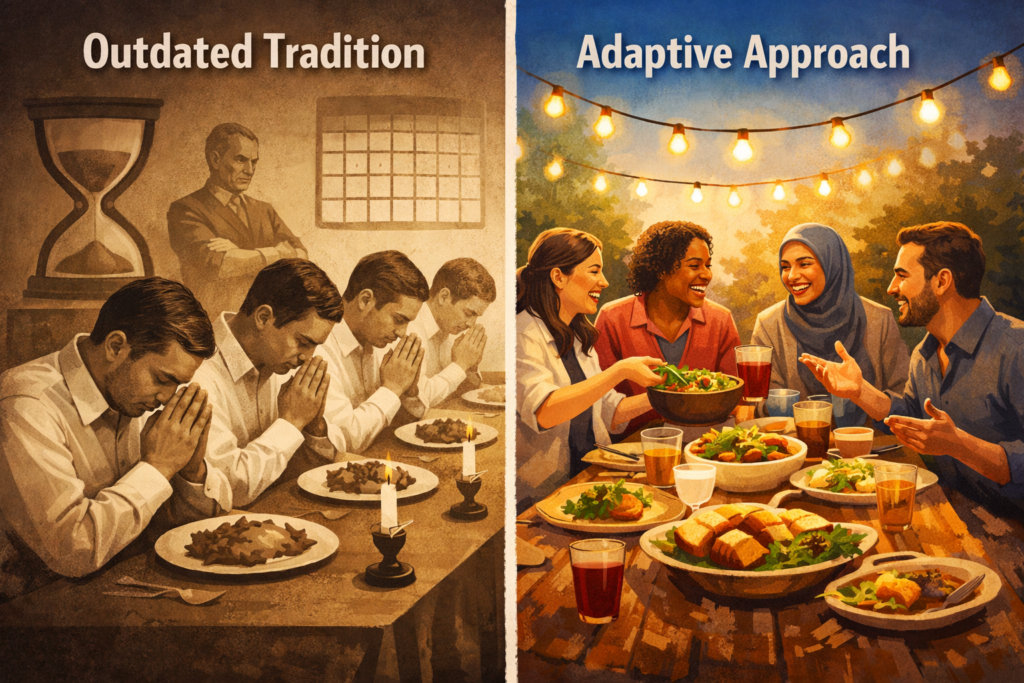
    Diagram showing how customs outlive their purpose when behavior continues without function

    When customs outlive their purpose, they stop supporting human life and start operating on habit alone. Moving across cultures makes this visible fast—what feels “normal” in one place disappears completely in another.

    Across every culture, customs shape behavior long before conscious thought.

    We inherit them early:
    How to greet
    How to eat
    How to gather
    What to celebrate
    What to avoid

    Most of the time, we don’t question them.

    Because customs don’t present themselves as systems.

    They present themselves as “the way things are.”

    Break the Assumption

    The default belief:

    Custom = truth
    Tradition = value
    Repetition = correctness

    But customs are not truth.

    They are solutions created under past conditions.

    And like any system, they can become outdated.

    Why Customs Outlive Their Purpose

    Every custom begins with a function.

    It exists to solve something:

    • Environmental (seasons, survival, scarcity)
    • Social (coordination, bonding, identity)
    • Psychological (comfort, predictability, meaning)
    • Structural (power, order, hierarchy)

    When the environment changes—but the custom does not—the system drifts.

    That drift follows a predictable pattern:

    Function → Habit → Obligation → Enforcement

    At the end of that chain, the original purpose is often gone.

    Only the behavior remains.

    Distortion Layer

    A custom becomes distorted when:

    The story stays the same
    But the function disappears

    At that point, the system sustains itself through:

    • Social pressure
    • Identity protection
    • Emotional attachment
    • Authority reinforcement

    People don’t follow it because it works.

    They follow it because not following it has a cost

    Power and Preservation

    Power rarely needs to invent customs.

    It only needs to preserve and stabilize them.

    Once a custom aligns with:
    • Identity
    • Belonging
    • Order

    It becomes self-reinforcing.

    Institutions, leaders, and systems may then:
    • Formalize it
    • Normalize it
    • Protect it from questioning

    Not always out of manipulation—

    But because stable systems are easier to maintain than changing ones.

    Harm Signals

    Not all customs are harmful.

    But all customs should be evaluated.

    Watch for these signals:

    • Obligation replaces meaning
    • Participation feels performative
    • Questioning creates tension or rejection
    • The outcome no longer matches the purpose
    • Individuals must suppress themselves to comply

    When these appear, the system is no longer serving the human.

    The human is serving the system.

    Reframe

    You are not required to reject all customs.

    You are required to understand them.

    A functional custom:
    • Supports your life
    • Aligns with current reality
    • Allows flexibility

    A non-functional custom:
    • Drains energy
    • Enforces outdated conditions
    • Persists through pressure rather than value

    The goal isn’t to reject traditions—it’s to recognize when customs outlive their purpose and no longer serve you.

    Application

    Instead of asking:
    “Is this tradition good or bad?”

    Ask:

    What was this designed to do?
    Is it still doing that?
    What is the actual outcome now?

    Then choose:

    • Keep (if it still serves)
    • Modify (if it partially works)
    • Exit (if it no longer aligns)

    All three are valid.

    System Insight

    Customs are inherited systems.

    But participation is a choice.

    Awareness is the point where inheritance becomes autonomy.

    Key Insights

    • Customs originate as solutions, not truths
    • Systems drift when conditions change
    • Social cost keeps outdated systems alive
    • Power stabilizes systems more than it creates them
    • Evaluation restores autonomy

  • Ethics in Gaming: How Games Shape Behavior and Redefine Winning

    Modern gaming is no longer just entertainment. It is a system that shapes behavior. Understanding ethics in gaming means looking at how games influence attention, decision-making, and long-term habits.

    Some are designed to capture attention, prolong engagement, and keep players inside behavioral loops. Others can help people learn, adapt, cooperate, and develop real-world skills.

    That is where the ethical tension begins.

    1. Extraction Systems

    Some games are intentionally built around behavioral capture loops:

    • Variable rewards that create repeated dopamine spikes
    • Endless progression systems with no real resolution
    • Social pressure mechanics such as daily tasks, streaks, and timed obligations
    • Monetization tied to impatience, scarcity, or fear of missing out

    What is happening underneath the surface is simple:

    • The game is optimizing for time spent, not player growth
    • The player becomes a resource inside the system

    System pattern: engagement without resolution

    This is where ethics become gray. Not because the design is hidden, but because it has become normal.

    2. Development Systems

    On the other side, games can also function as:

    • Simulation environments
    • Decision-training systems
    • Social interaction spaces
    • Cognitive and emotional skill builders

    Games can help train:

    • Pattern recognition
    • Strategic thinking
    • Cooperation and communication
    • Emotional regulation, when designed with intention

    System pattern: engagement with transformation

    This is where games become more than entertainment. They become environments that shape human capability.

    The Ethical Tension

    The same mechanics can be used for very different outcomes.

    MechanicExtractive UseDevelopmental Use
    RewardsKeep the player hookedReinforce meaningful learning
    ProgressionEndless grindSkill mastery
    Social systemsPressure and comparisonCollaboration and empathy
    Feedback loopsCompulsionAwareness

    So the issue is not the mechanic itself.

    The real issue is the intent behind the system design.

    The Shift

    The older model of gaming often treated play as escape.

    Old model:

    • Escape reality
    • Win = dominate

    A more useful model is beginning to emerge.

    Emerging model:

    • Interface with reality
    • Win = understand, adapt, connect

    Games can include real-world information, decision-making, and learning through play. That is not a small change. It is a system evolution.

    Games as Training Environments

    The real shift is not about graphics, realism, or immersion.

    It is about function.

    Games are becoming environments where human behavior is shaped through repeatable loops.

    The deeper question is no longer:

    How do I win this match?

    It becomes:

    What patterns am I reinforcing every time I play?

    System Reframe

    A game is not just content.

    It is a behavioral system with direction.

    That direction can move toward:

    • Extraction — time, attention, money
    • Development — skill, awareness, adaptability

    This makes the ethical question much clearer.

    The issue is not whether games are “good” or “bad.”

    The question is:

    What is this system training me to become?

    Application

    When interacting with any game, it helps to ask:

    • Does this loop increase awareness or reduce it?
    • Am I leaving more capable, or just more engaged?
    • Is this system narrowing me, or expanding me?

    System Insight

    The most advanced games of the future will not compete only on realism.

    They will compete on how well they expand human potential.


    Frequently Asked Questions

    Are video games designed to be addictive?
    Some games use behavioral loops like variable rewards and social pressure to maximize engagement rather than player growth.

    Can games be used for learning?
    Yes. When designed intentionally, games can improve decision-making, pattern recognition, and social skills.

    What is ethical game design?
    Ethical game design focuses on player development, not just retention, aligning game mechanics with long-term human benefit.