When we talk about progress, human systems care is rarely what we measure.
Most systems default to visible outputs—economic growth, infrastructure, speed, scale. These are easy to quantify, but they are not the system itself. They are surface indicators, not foundational health.
Break the Assumption
Progress is often mistaken for expansion.
But expansion without stability leads to fragility. A system that grows while neglecting its most vulnerable nodes is not advancing—it is accumulating hidden failure points.
System Breakdown
All human systems operate on a simple principle:
A system is only as strong as its most unsupported participant.
When individuals lack access, support, or dignity, the system compensates elsewhere—through healthcare strain, economic inefficiency, social instability, or long-term dependency loops.
Care is not a moral add-on.
It is a load-balancing function.
- Accessibility reduces friction in participation
- Caregiving support preserves system continuity
- Inclusive infrastructure expands usable capacity
Without these, systems degrade under uneven load.
Reframe
Care is not charity.
It is infrastructure.
Just as roads enable movement and networks enable communication, care enables human participation.
A nation that invests in care is not being generous—it is increasing system efficiency and resilience.
System Insight
When care is treated as private responsibility, systems fragment.
When care is treated as shared infrastructure, systems stabilize.
This is why initiatives like Spain’s “Economy of Care” matter. They represent a shift from:
- Individual burden → Collective design
- Reactive support → Built-in accessibility
- Short-term cost → Long-term system stability
Personal Evidence
Living as an autistic individual exposes where systems fail.
Not because the individual is broken—but because the system was never designed to include them.
When systems expand to include more human variance, they don’t weaken—they become more complete representations of reality.
I’ve learned something from navigating systems that weren’t built with me in mind:
People don’t struggle to fit systems.
They recognize, often immediately, whether the system was designed to include them or to fix them.
That recognition shows up as friction or ease.
As masking or participation.
As exhaustion or stability.
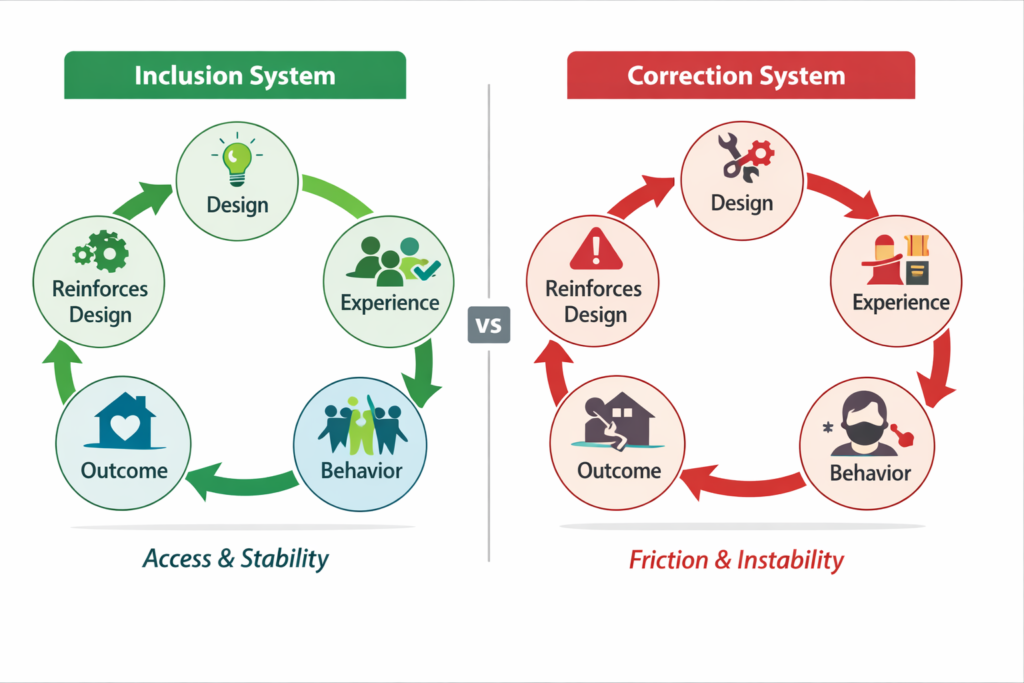
System Loop: Inclusion vs Correction
Design → Experience → Behavior → Outcome → Reinforces Design
- If a system is built for inclusion:
- Design enables participation
- Experience feels accessible
- Behavior is engagement
- Outcome is stability
- → reinforces inclusive design
- If a system is built for correction:
- Design creates friction
- Experience feels like pressure or failure
- Behavior becomes masking or withdrawal
- Outcome is instability
- → reinforces corrective assumptions
Most systems don’t fail randomly.
They repeat the conditions they are designed to produce.
What we often label as “individual difficulty” is frequently a signal of system design failure.
Application
If you want to evaluate any country, organization, or technology, ask:
- Who is excluded from participation?
- Where does the system rely on invisible labor?
- What happens to those who cannot keep up?
These questions reveal the true structure, not the public narrative.
Key Insight
Progress is not measured by how far a system can go,
but by how many it can carry with it.
Care is not the outcome of a strong system.
It is the condition that makes strength possible.