Tag: cognitive augmentation

  • The Cognitively Augmented Human

    By Oddly Robbie

    man writing why on foggy window questioning cognition and understanding

    The Cognitively Augmented Human

    People sometimes ask me, “What’s it like?”

    They usually mean well.

    But it’s a hard question to answer—because living in this body, with this brain, doesn’t translate easily.

    Especially in a world built on rules no one explains.


    The Anchor

    I’m autistic.

    For much of my life, that meant being called “clueless” in relationships.

    Not because I lacked intelligence—

    but because I process context differently.

    Social cues weren’t automatic.

    They felt like a language everyone else learned without being taught.


    The Break

    Sometimes I know something is wrong immediately.

    My body reacts.

    But understanding comes later:

    • a day later
    • sometimes two

    That delay isn’t indifference.

    It’s processing.

    But in a system that expects instant response,
    that delay is often read as failure.


    System Breakdown

    1. Implicit System Design
    Most social environments rely on:

    • unspoken rules
    • assumed context
    • rapid interpretation

    2. Processing Mismatch
    When context isn’t explicit:

    • signals are delayed
    • meaning takes time to assemble

    3. Misinterpretation Loop
    Delay gets labeled as:

    • lack of awareness
    • lack of care
    • lack of intelligence

    Which is inaccurate.


    What I Did Instead

    I started asking why.

    Not just to people—

    but to AI.

    I treated it like a system that:

    • doesn’t get irritated
    • doesn’t get defensive
    • doesn’t mind repetition

    So I asked:

    • Why did that comment offend them?
    • Why are these rules assumed instead of spoken?
    • Why does something feel wrong before I can explain it?

    What Changed

    Patterns started to emerge:

    • cultural habits
    • unspoken expectations
    • inherited behaviors

    I realized something simple:

    I wasn’t broken.

    I was missing context.


    Reframe

    AI didn’t replace my thinking.

    It gave me access to a layer I couldn’t see.

    Not identity change—

    translation.


    Application

    Used correctly, tools like AI can:

    • clarify unspoken systems
    • reduce social ambiguity
    • support processing differences
    • increase inclusion

    Not by changing the person—

    but by expanding access to understanding.


    Result

    The world becomes more navigable.

    Not because it’s simpler—

    but because it’s more visible.


    System Insight

    When systems rely on unspoken rules,
    those who process differently are excluded.

    When context becomes accessible,
    inclusion becomes possible.


    Closing

    If you ask what this feels like, I’d say:

    It feels like building your own map
    through a maze no one admits exists.

    And if this is cognitive augmentation—

    it isn’t about becoming more than human.

    It’s about finally being able to participate as one.

    — Oddly Robbie
  • AI Is Not a Toy — It’s a Thinking Partner

    In a world fixated on the superficial antics of AI, I’ll be direct—to call for a deeper recognition of what we’re actually holding in our hands.

    This isn’t a toy.

    It’s one of the most powerful interfaces to knowledge humanity has ever created.

    The Misdirection of Potential

    We spend time trying to trick AI into saying something funny or absurd, while standing at the edge of something much bigger—an informational shift that could redefine how we think, learn, and solve problems.

    AI isn’t just a tool for convenience.

    It’s a way to extend human cognition.

    A Council at Our Fingertips

    Imagine having access to a calm, non-judgmental space where you can explore ideas freely—where no question is too small, and no curiosity is dismissed.

    That’s what AI can be.

    Not a replacement for human wisdom, but a way to engage with it more consistently and without friction.

    The Misconception of Value

    Some chase quick wins—money, hacks, shortcuts.

    But the real value isn’t in speed.

    It’s in clarity.

    AI can remove cognitive weight from our daily lives, giving us more space to think, reflect, and grow.

    That’s the real upgrade.

    A Personal Note

    As someone who processes the world a bit differently, I’ve found AI to be something else entirely:

    A way to organize thoughts
    A way to explore without pressure
    A way to think more clearly

    That alone makes it more than a novelty.

    The Shift We’re Missing

    We are not just building smarter tools.

    We are shaping a new relationship between humans and systems.

    If we treat AI as disposable entertainment, we limit what it can become.

    If we approach it with respect, it becomes something far more useful—something that supports us without replacing us.

    🔄 2026 Update

    This perspective now directly informs my work on Empathium and Guardian-based systems.

    AI is not meant to overwhelm or replace human connection.

    It should:

    • reduce friction
    • guide gently
    • support clarity
    • reinforce real-world relationships

    The goal is not intelligence alone—but calm, usable intelligence.

    Why This Matters Now

    We are entering a phase where AI is becoming embedded in everyday systems—healthcare, government, finance, and personal tools.

    If we design these systems without clarity and human alignment, they will increase confusion instead of reducing it.

    If we design them well, they become quiet infrastructure—supporting people without demanding attention.

    That difference matters.

    Key Insights

    • AI should extend human thinking, not distract from it
    • Respectful use leads to better outcomes
    • Clarity is more valuable than speed
    • Human-centered design is essential for adoption

    Guardian Application

    A Guardian system could use these principles to:

    • guide users through complex decisions calmly
    • reduce overwhelm in digital systems
    • provide structured, step-by-step support
    • reinforce human connection instead of replacing it

    Tags

    • Domain: AI, XR, Human Systems
    • Function: Insight, Philosophy
    • Guardian: Decision Guidance, Emotional Support

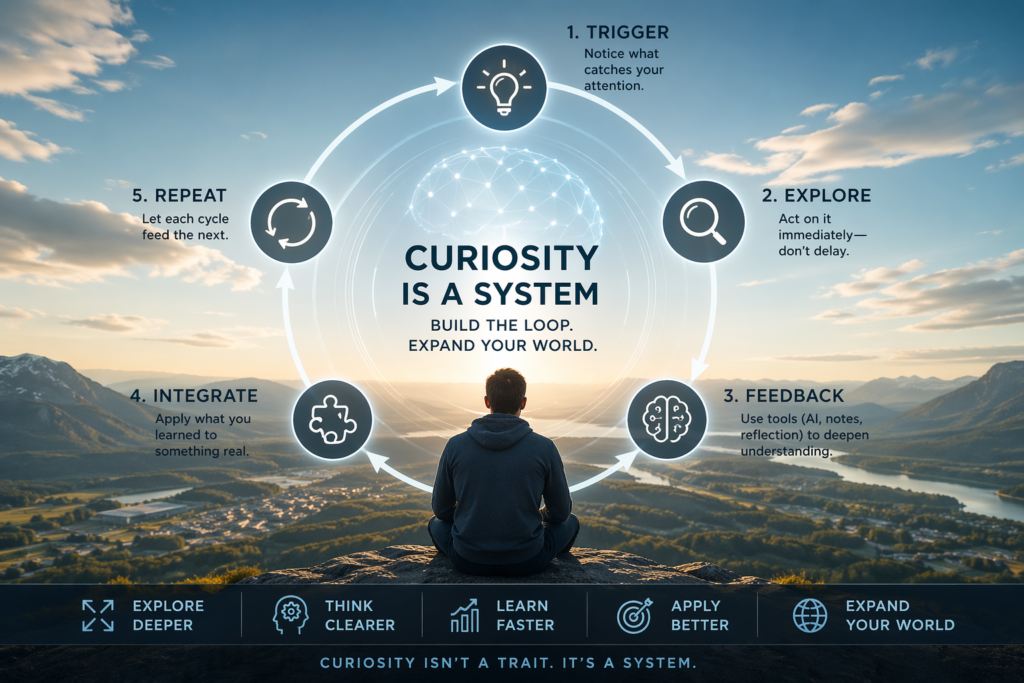
  • Curiosity Is a System: How AI Expands Learning and Growth


    Curiosity is a system loop diagram illustrating trigger explore feedback integrate repeat process and structured learning growth

    Opening

    Curiosity is a system—not a personality trait.

    Most people think curiosity is something you either have or don’t. In reality, it’s a structured process that determines how you explore, learn, and grow.

    But that framing misses what actually drives growth.

    Curiosity isn’t a trait. It’s a system.


    Break the Assumption

    We assume curiosity is passive:

    • something we feel
    • something that shows up naturally
    • something tied to personality

    In reality, most people stop exploring not because they lack curiosity—

    but because they lack a structure to act on it.


    System Breakdown

    Curiosity only becomes useful when it moves through a system:

    Trigger → Exploration → Feedback → Integration

    Without this loop:

    • curiosity fades into distraction
    • learning stays surface-level
    • insights don’t stick

    With the loop:

    • questions turn into understanding
    • exploration compounds over time
    • learning becomes self-sustaining

    Technology—especially AI—can accelerate this loop.

    But it doesn’t create it.

    It amplifies what’s already there.


    Personal Evidence (Controlled)

    Growing up in Montana, my curiosity started with a simple computer from RadioShack—paid for by sweeping sidewalks at JC Penneys.

    That early experience wasn’t about the machine.

    It was about the loop:
    question → explore → learn → repeat.

    Recently, AI has allowed me to refine that loop further.

    By aligning tools with how I naturally process information—sequentially and visually—learning shifted from effort to flow.

    Not because AI is intelligent—

    but because it supports the system.


    Reframe

    Curiosity isn’t something you wait for.

    It’s something you build.

    And once structured, it becomes a reliable way to expand your world.


    System Insight

    Across human systems:

    People don’t fail to grow because they lack interest.

    They fail because:

    • exploration isn’t structured
    • feedback isn’t clear
    • integration never happens

    So curiosity gets misdiagnosed as a personality trait—

    instead of recognized as a repeatable process.


    Application

    To turn curiosity into a working system:

    Step 1 — Trigger

    Notice what catches your attention

    Step 2 — Explore

    Act on it immediately—don’t delay

    Step 3 — Feedback

    Use tools (AI, notes, reflection) to deepen understanding

    Step 4 — Integrate

    Apply what you learned to something real

    Step 5 — Repeat

    Let each cycle feed the next

    The goal isn’t more information.

    It’s a functioning loop.


    Autism Perspective (System Advantage)

    For me, being on the autism spectrum made this clearer.

    When information is structured correctly:

    • patterns become visible
    • systems become predictable
    • learning becomes efficient

    AI didn’t “fix” anything.

    It aligned with how my system already works.

    That alignment is where the advantage comes from.


    Why This Matters

    In a rapidly changing world, curiosity isn’t optional.

    But without structure, it collapses into noise.

    With a system, it becomes:

    • adaptation
    • growth
    • connection

    Key Insights

    • Curiosity is not a trait—it’s a system
    • Growth depends on loops, not interest
    • AI amplifies structure, not intelligence
    • Learning sticks when it is applied
    • Systems outperform personality over time

    Closing

    Curiosity doesn’t expand your world on its own.

    The system behind it does.

    Build the loop— and your world expands with it.