Tag: cognitive load

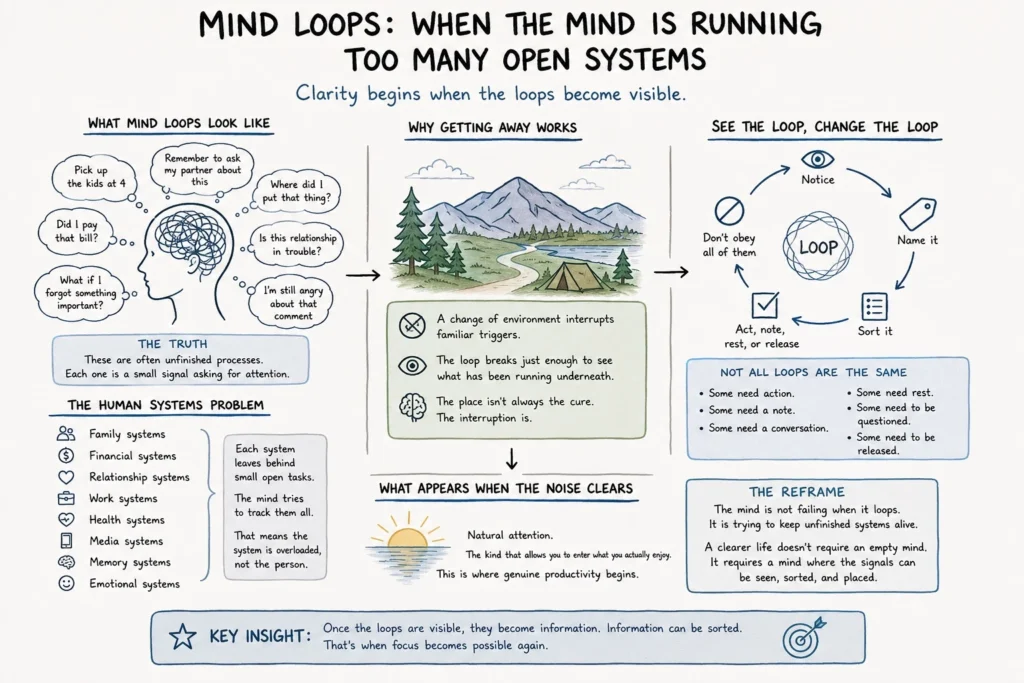
  • Mind Loops: When the Mind Is Running Too Many Open Systems

    We often talk about focus as if it is only a matter of discipline.

    Pay attention.
    Try harder.
    Stop being distracted.
    Be more productive.

    But sometimes the problem is not a lack of focus.

    Sometimes the problem is that the mind is running too many open loops at once.

    Pick up the kids at four.
    Remember to ask my partner about this.
    Did I pay that bill?
    What was I supposed to do next?
    Where did I put that thing?
    Is this relationship in trouble?
    I need to buy more pickles.
    I am still angry about that comment.
    What if I forgot something important?

    These thoughts can seem random.

    But they are not always random.

    They are often unfinished processes.

    Each one is a small signal asking for attention. A task. A worry. A memory. A fear. A social script. A financial reminder. A relationship question. A body signal. A piece of emotional residue that has not yet cleared.

    The mind keeps looping because something has not been resolved, placed, understood, trusted, or released.

    The Human Systems Problem

    This is a Human Systems problem.

    We often treat mental noise as a personal weakness, but many times it is cognitive overload.

    Modern life asks the mind to hold too many systems at the same time.

    Family systems.
    Financial systems.
    Relationship systems.
    Work systems.
    Health systems.
    Media systems.
    Memory systems.
    Emotional systems.

    Each system leaves behind small open tasks.

    The mind tries to track them all.

    That does not mean the mind is broken.

    It means the system is overloaded.

    A person may look distracted from the outside, but internally they may be managing dozens of active loops at once. Some are practical. Some are emotional. Some are old. Some are not even important anymore, but they keep returning because they were never sorted.

    Focus becomes difficult because attention is already occupied.

    Why Getting Away Works

    Maybe this is why people love vacations, camping, long walks, or simply getting away.

    It is not always about the different place.

    Sometimes the value is that the old loop gets interrupted.

    The familiar triggers are gone for a moment. The same rooms, screens, bills, reminders, conversations, objects, obligations, and emotional scripts are not constantly pulling on attention.

    The loop breaks just enough for the person to see what has been running underneath.

    That is why distance can feel like clarity.

    Not because life disappeared.

    Because the background noise changed.

    The mind finally has enough space to show what it has been carrying.

    Seeing the Loop

    I think, for once, I finally reached the point where I could see it.

    Not perfectly.

    Not permanently.

    But clearly enough to recognize the loops for what they were.

    They were not my whole mind.

    They were repeated signals, unfinished tasks, old fears, rehearsed conversations, small obligations, and emotional echoes asking for attention.

    Once I could see them, I did not have to obey all of them.

    That changed something.

    Because when the loops are invisible, they feel like reality.

    When they become visible, they become information.

    And information can be sorted.

    Some loops need action.
    Some need a note.
    Some need a conversation.
    Some need rest.
    Some need to be questioned.
    Some need to be released.

    The goal is not to erase the mind.

    The goal is to see what is running.

    Natural Attention

    When enough noise clears away, something different appears.

    Natural attention.

    The kind that allows people to enter what they actually enjoy.

    Not forced productivity.
    Not pressure.
    Not performance.

    Coherence.

    This is where genuine productivity often begins.

    Not from pushing harder, but from reducing the number of unresolved loops competing for the same attention.

    Calm is not always something we find by adding another wellness practice.

    Sometimes calm begins when we stop feeding every loop as if it deserves control.

    Sometimes calm begins when we can finally say:

    This is a task.
    This is a fear.
    This is a memory.
    This is a practical reminder.
    This is an old script.
    This is not the whole truth.

    That separation matters.

    Because once a loop is named, it loses some of its power.

    The Reframe

    The mind is not failing when it loops.

    It is trying to keep unfinished systems alive.

    The problem is not always the thought itself.

    The problem is when too many loops remain open, unnamed, and unmanaged.

    A clearer life does not require an empty mind.

    It requires a mind where the signals can be seen, sorted, and placed.

    That is when focus becomes possible again.

    Not because the person became more disciplined.

    Because the system became more coherent.

    Key Insights

    • Mental loops are often unresolved system signals, not personal failure.
    • Focus becomes difficult when too many open loops compete for attention.
    • Changing environment can interrupt familiar triggers long enough to reveal what is underneath.
    • Once a loop becomes visible, it can be sorted instead of obeyed.
    • Calm often begins when the mind stops treating every signal as equally urgent.
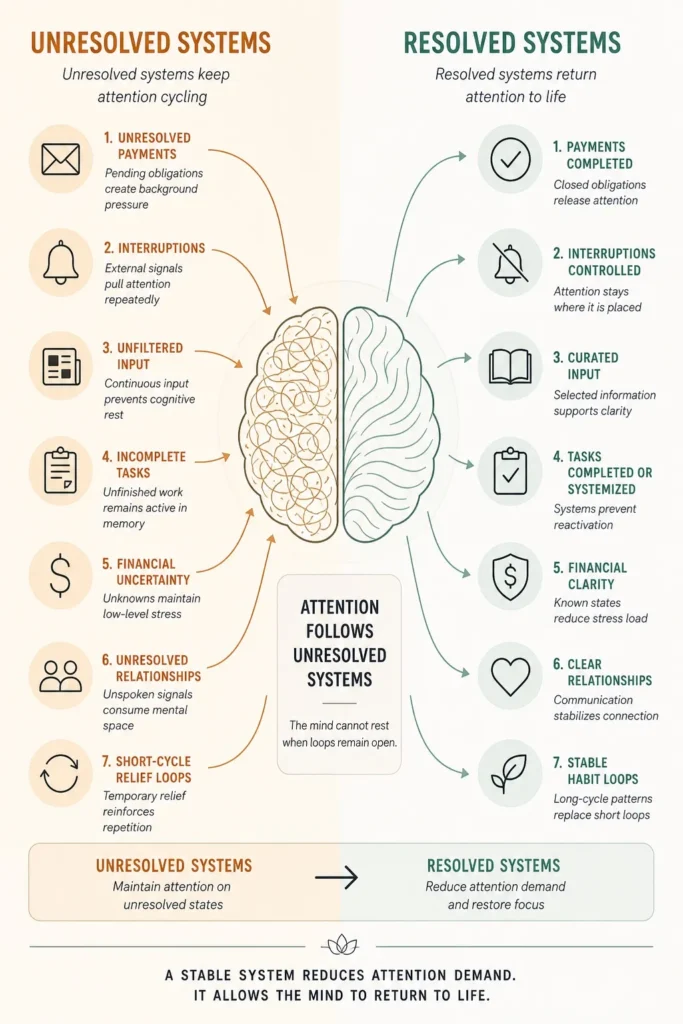
  • Calm Isn’t the Goal. It’s the Signal the System Is Working.

    There was a period where every part of life was active at once.

    Debt. Calls. Children to feed. School. Time collapsing.

    Nothing was optional. Everything looped.

    The problem was not one difficult task.
    The problem was that every task stayed open.

    Each unresolved piece kept pulling attention back into the system.

    Debt collectors called. Children still needed food. University work still had deadlines. Basic support came with conditions that required more time and more compliance. Even help created another loop.

    The system had no space left.

    The decisions made inside that pressure were not always ideal.
    They were available.

    That distinction matters.

    This was not a failure of character.
    It was a failure of available space inside the system.

    Break the Assumption

    We often treat looping thoughts as a personal weakness.

    “You are overthinking.”
    “You need to calm down.”
    “You should stop worrying.”
    “You lack discipline.”

    But that misses the structure.

    The mind usually loops when something remains unresolved, uncertain, rewarding, threatening, or incomplete.

    A cognitive loop is not just a thought repeating itself.
    It is attention returning to an open signal.

    The brain keeps checking because the system has not closed.

    System Breakdown: What Cognitive Loops Are

    A cognitive loop is a recurring attention cycle around an unresolved signal.

    It pulls the mind back again and again:

    • Did the bill get paid?
    • Did the charge clear?
    • Did the debt balance drop?
    • Did the form get accepted?
    • Did the message arrive?
    • Did the person respond?
    • Is there new news?
    • Is there another episode?
    • Is there another update?
    • Is the threat still active?
    • Is the reward available again?

    The content changes, but the structure is the same.

    The mind is not only thinking.
    It is scanning.

    And when too many systems remain open at once, scanning becomes a background operating state.

    That is where stress grows.

    Modern Systems Are Built Around Loops

    Many modern systems are not designed to close attention.
    They are designed to keep attention returning.

    News loops.
    Social feeds loop.
    Payment cycles loop.
    Debt cycles loop.
    Streaming episodes loop.
    Notifications loop.
    Relationship messages loop.
    Paperwork loops.
    Status pages loop.
    Addictions loop.
    Unfinished tasks loop.

    Some loops are natural.
    Meals repeat. Sleep repeats. Relationships need repeated care. Creative work moves through cycles.

    The problem is not repetition.

    The problem is unresolved, unstable, attention-draining repetition.

    A healthy loop gives rhythm.
    An unhealthy loop steals attention.

    Loop Density Creates Stress

    Stress is not only about the size of one problem.

    It is often about loop density.

    One bill may be manageable.
    One deadline may be manageable.
    One message may be manageable.
    One form may be manageable.

    But when debt, children, school, work, food, paperwork, relationships, and uncertainty all stay open at once, the mind enters survival scanning.

    That state is not irrational.

    It is what happens when too many systems demand attention without giving closure.

    A person in that state may look calm from the outside while internally managing dozens of active loops.

    Nothing needs to explode for the system to be overloaded.

    The overload is in the repetition.

    Closure Changes the System

    When something resolves, the loop changes.

    A card is paid off.
    A form is accepted.
    A deadline passes.
    A payment clears.
    A message is answered.
    A decision is made.
    A debt balance drops.
    A status becomes clear.

    The brain registers closure.

    There can be a small dopamine spike:

    That one is done.

    Then, if the closure is real, the loop begins to fade.

    Not because the person became stronger overnight.
    Because the system became more stable.

    This is why completing one open task can create a noticeable sense of relief. The mind is not only celebrating progress. It is releasing a monitoring process.

    When Loops Stabilize, Life Returns

    When enough loops close or become predictable, attention stops being consumed by monitoring.

    That freed attention does not disappear.

    It can return to life.

    Productive work becomes easier.
    Art becomes possible again.
    Music has space.
    Hobbies return.
    Relationships feel less like another demand.
    The body has more room to rest.
    The mind has more room to build.

    This is why stable systems matter.

    They do not only reduce stress.
    They create the conditions for human capacity to reappear.

    A person who is no longer trapped in constant checking can become creative again.

    Not because creativity was missing.
    Because the system finally stopped taking all the available space.

    The Reframe

    Calm is not the goal.

    Calm is the signal.

    Calm appears when the surrounding systems stop forcing constant rechecking.

    A stable person is often a person inside a more stable loop environment.

    A productive person is often someone whose attention is not being constantly pulled back into unresolved cycles.

    A regulated nervous system is easier to maintain when the systems around it are clear, predictable, and closable.

    This does not remove personal responsibility.

    It puts responsibility in the right place.

    Humans still make decisions.
    But systems shape the conditions under which those decisions are made.

    When a system removes time, certainty, food security, sleep, money, and support, decision quality drops.

    That is not moral failure.
    That is system pressure.

    Human Systems Insight

    Stabilizing human systems reduce unnecessary loops.

    They make status visible.
    They make next steps clear.
    They confirm completion.
    They reduce artificial uncertainty.
    They avoid endless refresh behavior.
    They do not turn basic survival into repeated attention traps.

    Destabilizing systems multiply loops.

    They hide status.
    They delay feedback.
    They require constant checking.
    They create artificial scarcity.
    They reward compulsive return.
    They keep the human nervous system engaged without resolution.

    That is not efficient.

    It is extractive.

    A system that depends on people constantly checking, worrying, refreshing, chasing, or guessing is not a stable system.

    It is using human attention as fuel.

    Guardian Application

    For an adaptive Guardian, cognitive loops matter because they reveal system load.

    A user may not say, “I am overwhelmed.”

    They may say:

    “I need to check this again.”
    “What if it didn’t go through?”
    “Let me look one more time.”
    “I can’t stop thinking about it.”
    “I know it’s probably fine, but I need to check.”
    “I just need this one thing finished.”

    The Guardian should not immediately label that as anxiety, weakness, obsession, or poor discipline.

    It should first ask:

    What loop is still open?

    Is the user waiting for confirmation?
    Is there a missing next step?
    Is there a real risk?
    Is the system unclear?
    Is the reward cycle pulling them back?
    Is the loop useful, harmful, or unresolved?

    The first job is not to interrupt the person.

    The first job is to understand the loop.

    A good Guardian helps identify which loops can be closed, which can be scheduled, which can be ignored, and which require real action.

    The goal is not to force calm.

    The goal is to reduce unnecessary loop pressure so calm can emerge naturally.

    Application: Designing Better Systems

    Any human system should be evaluated by the loops it creates.

    Ask:

    • What does this system force people to check repeatedly?
    • Where does it create uncertainty without purpose?
    • Where does it delay closure?
    • Where does it hide status?
    • Where does it reward compulsive return?
    • Where does it punish people for not monitoring constantly?
    • Where can confirmation be clearer?
    • Where can the next step be made visible?
    • Where can the loop be closed?

    This applies to healthcare, immigration, debt, education, software, social platforms, workplaces, relationships, and AI systems.

    A humane system does not make people guess their way through survival.

    It gives enough clarity for the nervous system to stand down.

    Key Insights

    • Cognitive loops are recurring attention cycles around unresolved signals.
    • News, feeds, bills, debt, episodes, messages, paperwork, relationships, and addictions can all function as loops.
    • Stress often comes from loop density, not one isolated problem.
    • Closure reduces loop pressure and frees attention.
    • Calm is not the target state; it is evidence that the system is no longer demanding constant rechecking.
    • Good human systems make status visible, next steps clear, and completion recognizable.
    • A Guardian should interpret repeated checking as possible system load before treating it as personal failure.

    Closing

    A stable system does not demand constant attention.

    It lets the mind return to life.

    That is why calm matters.

    Not because calm proves a person is better.

    Because calm shows the system has stopped pulling them apart.

    And when the system stops pulling, attention returns.

    To work.
    To art.
    To relationships.
    To health.
    To ordinary life.

  • Systems Outlast Platforms


    People often believe the platform is what matters.

    VR, AR, MR—each new wave promises to define the future. The focus stays on tools, features, and which company is leading.

    But platforms change. They always have.

    What doesn’t change is how humans experience environments.


    The Real System

    The value was never in the platform.

    It’s in understanding how people:

    • perceive space
    • regulate emotion
    • engage with environments
    • decide whether to stay or leave

    A platform is just a container. The human response inside it is the system.


    Where Most Builders Get It Wrong

    When builders focus on platforms, they optimize for:

    • features
    • performance
    • novelty

    But humans don’t return for features.

    They return for how a space feels.

    Calm. Clear. Meaningful. Navigable.

    If those are missing, the platform doesn’t matter.


    Reframe

    The question is not:

    “What can this platform do?”

    The question is:

    “How does this environment influence the human inside it?”

    That shift changes everything.


    What Actually Lasts

    Systems that last are:

    • adaptable to different human states
    • responsive to cognitive load
    • aligned with emotional regulation
    • capable of evolving without breaking the experience

    A system that cannot adapt will eventually misalign with the human using it.


    Individual Fit Matters

    Not every system works for every person.

    Immersive environments can be powerful—but they can also overwhelm.
    For some, immersion creates clarity. For others, it increases cognitive load.

    For some individuals, simply being placed in an unfamiliar environment—virtual or physical—can be disorienting.
    New spatial rules, unfamiliar cues, and constant interpretation can quickly exceed what the brain can comfortably process.

    Technology should align with the user’s comfort level.

    When systems push beyond what a person can comfortably process, they don’t accelerate adoption—they create resistance.

    Familiarity often matters more than capability.

    Sometimes the most effective environment isn’t advanced at all.

    It’s something simple and known— like sitting with a cousin, having coffee in a place that feels familiar, even if that place no longer exists.

    The system works because the human already understands it.


    System Reality

    • More immersive does not mean better
    • More advanced does not mean usable
    • More features do not mean more effective
    • Systems that push users create resistance

    What matters is fit.


    Application

    This applies beyond XR:

    • AI interfaces
    • websites
    • physical environments
    • communication systems

    If it interacts with a human, it is part of a human system.

    Systems should reduce friction so the human can function well.

    And they succeed based on that interaction.


    Key Insights

    • Platforms are temporary. Human response patterns are not.
    • Experience determines value, not technology.
    • Environments influence human state, not control it.
    • Adaptability is more important than capability.
    • The best system is the one the individual can use without friction.
    • Builders who follow systems outlast those who follow platforms.


    2. Tags (add these)

    • human systems
    • decision guidance
    • cognitive load
    • user fit