Tag: crisis response

  • When Systems Stall, People Move — A Human Systems View of Crisis Response

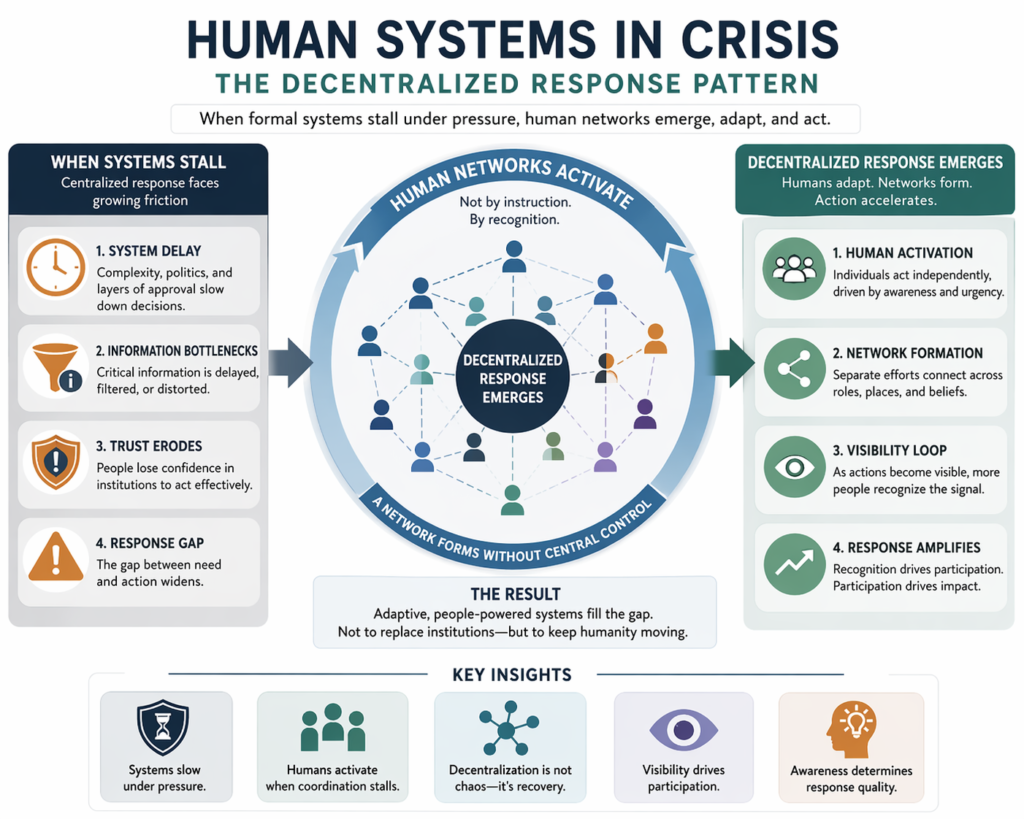
    human systems in crisis decentralized response diagram

    Opening

    Watching events unfold from the Mediterranean, something becomes clear:

    Human systems in crisis reveal something most people don’t expect:

    Systems are designed to coordinate response.

    But when pressure rises beyond their capacity, they hesitate.

    People don’t.

    They move.


    Break the Assumption

    We tend to believe large-scale action must come from:

    • governments
    • institutions
    • official organizations

    These systems are built to:

    • manage risk
    • maintain control
    • move deliberately

    That works under normal conditions.

    But when urgency exceeds system speed, a gap forms.


    System Breakdown

    This pattern appears consistently across crisis environments:

    1. System Delay
    Formal systems slow under complexity, politics, and layered decision-making.

    2. Human Activation
    Individuals begin acting independently.
    Not coordinated at first—just responsive.

    3. Convergence
    Separate efforts begin to connect:

    • across countries
    • across roles
    • across beliefs

    A network forms without central control.

    4. Visibility Loop
    As actions become visible, more people recognize the signal.

    Recognition → participation
    Participation → amplification


    Case Signal (Observed Pattern)

    In moments of visible crisis, individuals organize themselves:

    • civilians
    • doctors
    • artists
    • workers

    Not because they were instructed to.

    Because something aligns:

    this matters.

    This is not unique to one place or event.
    It is a repeatable human response pattern.


    Reframe

    The question is not:

    “Why aren’t systems solving this?”

    The better question is:

    “What happens when systems can’t move fast enough?”


    System Insight

    Human systems are not dependent on formal systems.

    They are adaptive.

    When institutions pause, human networks don’t disappear.

    They reorganize.

    Decentralized action is not disorder.

    It is recovery.


    Application

    This pattern extends far beyond any single crisis:

    • disaster response
    • mutual aid networks
    • grassroots coordination
    • community survival systems

    What this changes:

    • Don’t assume systems will hold under pressure
    • Build awareness, not just reliance
    • Support distributed response capability
    • Recognize early signals before systems react

    Key Insights

    • Systems slow under pressure
    • Humans activate when coordination stalls
    • Decentralization is a recovery mechanism
    • Visibility drives participation
    • Awareness determines response quality

    Closing

    What we are seeing is not just reaction.

    It is structure revealing itself.

    Human systems have always been there—
    quiet, distributed, waiting.

    The real question is:

    What would happen if we supported these systems intentionally?

    Not to replace institutions—
    but to complement them.

    This is where emerging tools matter.

    Not to make decisions for us—
    but to help us see clearly, coordinate faster, and act with awareness.

    That’s the difference between reaction and design.

    And it’s where the next layer of human systems begins.

  • When Systems Destabilize: What Happens to Human Behavior Under Stress

    Opening — The Assumption

    When systems begin to fail, people look for explanations in culture, politics, or morality.

    They ask:
    Why are people acting like this?
    Why is this happening here?

    But this framing misses the deeper pattern.

    Across countries, histories, and systems, human behavior under instability follows consistent rules.

    The surface changes.

    The underlying system does not.


    Break the Assumption

    Instability does not create random behavior.

    It reveals how the human system responds under stress.

    When large systems destabilize—economic, political, social, or environmental—humans do not become irrational.

    They become adaptive to survival conditions.


    System Breakdown

    When stability drops, the human system recalibrates:

    Uncertainty rises → perception narrows
    Trust drops → control behaviors increase
    Coordination weakens → fragmentation begins
    Fear increases → reaction replaces decision-making

    This pattern appears everywhere:

    Economic collapse
    Conflict zones
    Natural disasters
    Institutional failure
    Rapid technological disruption

    Different environments. Same system response.


    Clarification — Fear Is Not the Cause

    It’s easy to assume fear breaks systems.

    More accurate:

    Fear is the signal.

    It reflects that the system has already lost stability.

    When predictability disappears, the human system shifts into protection mode.

    This is not failure.

    It is function.


    System Insight

    Stable systems are not defined by power, size, or authority.

    They are defined by:

    Trust continuity
    Predictable response systems
    Shared reality (agreement on what is happening)
    Capacity to absorb stress without fragmentation

    When these degrade, behavior changes.

    Not because people are worse—

    But because the conditions no longer support stable behavior.


    Reframe

    The wrong question:

    Why are people behaving this way?

    The better question:

    What conditions caused the human system to shift into survival mode?


    Application

    If you want to understand—or design—resilient systems:

    Watch trust erosion early, not just visible collapse
    Reduce unnecessary uncertainty signals
    Maintain clear, shared communication
    Design systems that degrade gracefully, not abruptly
    Support human regulation capacity, not just control mechanisms

    Focus on conditions, not blame.


    Key Insight

    Humans do not break systems.

    Systems that cannot regulate stress shift humans into states where breakdown becomes inevitable.


    Closing

    When systems hold, humans expand.

    When systems destabilize, humans contract.

    Not by choice—

    By design.