Tag: cultural systems

  • When Customs Outlive Their Purpose

    A Human Systems View
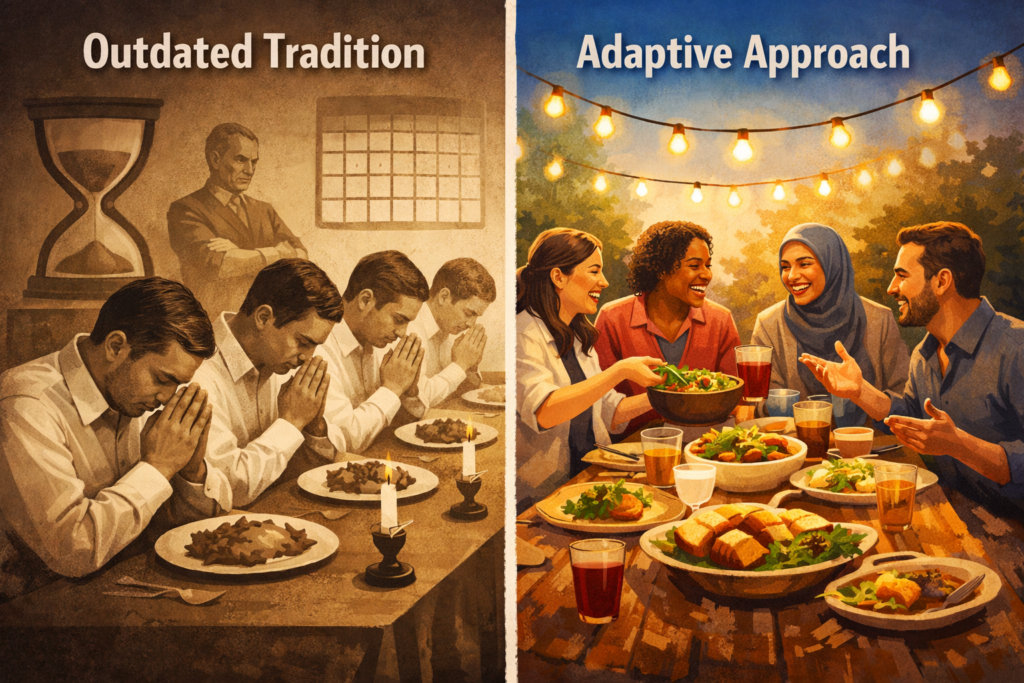
    Diagram showing how customs outlive their purpose when behavior continues without function

    When customs outlive their purpose, they stop supporting human life and start operating on habit alone. Moving across cultures makes this visible fast—what feels “normal” in one place disappears completely in another.

    Across every culture, customs shape behavior long before conscious thought.

    We inherit them early:
    How to greet
    How to eat
    How to gather
    What to celebrate
    What to avoid

    Most of the time, we don’t question them.

    Because customs don’t present themselves as systems.

    They present themselves as “the way things are.”

    Break the Assumption

    The default belief:

    Custom = truth
    Tradition = value
    Repetition = correctness

    But customs are not truth.

    They are solutions created under past conditions.

    And like any system, they can become outdated.

    Why Customs Outlive Their Purpose

    Every custom begins with a function.

    It exists to solve something:

    • Environmental (seasons, survival, scarcity)
    • Social (coordination, bonding, identity)
    • Psychological (comfort, predictability, meaning)
    • Structural (power, order, hierarchy)

    When the environment changes—but the custom does not—the system drifts.

    That drift follows a predictable pattern:

    Function → Habit → Obligation → Enforcement

    At the end of that chain, the original purpose is often gone.

    Only the behavior remains.

    Distortion Layer

    A custom becomes distorted when:

    The story stays the same
    But the function disappears

    At that point, the system sustains itself through:

    • Social pressure
    • Identity protection
    • Emotional attachment
    • Authority reinforcement

    People don’t follow it because it works.

    They follow it because not following it has a cost

    Power and Preservation

    Power rarely needs to invent customs.

    It only needs to preserve and stabilize them.

    Once a custom aligns with:
    • Identity
    • Belonging
    • Order

    It becomes self-reinforcing.

    Institutions, leaders, and systems may then:
    • Formalize it
    • Normalize it
    • Protect it from questioning

    Not always out of manipulation—

    But because stable systems are easier to maintain than changing ones.

    Harm Signals

    Not all customs are harmful.

    But all customs should be evaluated.

    Watch for these signals:

    • Obligation replaces meaning
    • Participation feels performative
    • Questioning creates tension or rejection
    • The outcome no longer matches the purpose
    • Individuals must suppress themselves to comply

    When these appear, the system is no longer serving the human.

    The human is serving the system.

    Reframe

    You are not required to reject all customs.

    You are required to understand them.

    A functional custom:
    • Supports your life
    • Aligns with current reality
    • Allows flexibility

    A non-functional custom:
    • Drains energy
    • Enforces outdated conditions
    • Persists through pressure rather than value

    The goal isn’t to reject traditions—it’s to recognize when customs outlive their purpose and no longer serve you.

    Application

    Instead of asking:
    “Is this tradition good or bad?”

    Ask:

    What was this designed to do?
    Is it still doing that?
    What is the actual outcome now?

    Then choose:

    • Keep (if it still serves)
    • Modify (if it partially works)
    • Exit (if it no longer aligns)

    All three are valid.

    System Insight

    Customs are inherited systems.

    But participation is a choice.

    Awareness is the point where inheritance becomes autonomy.

    Key Insights

    • Customs originate as solutions, not truths
    • Systems drift when conditions change
    • Social cost keeps outdated systems alive
    • Power stabilizes systems more than it creates them
    • Evaluation restores autonomy

  • Why Every Society Creates “The Other”

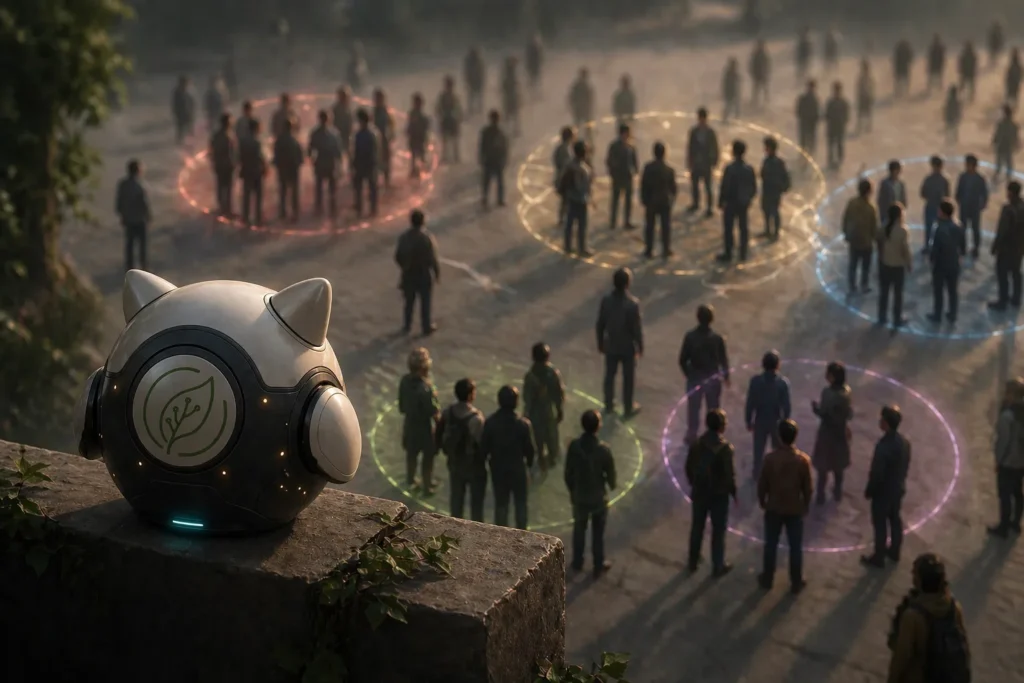
    human systems grouping people into the other observed by ai guardian

    We don’t reveal our values through what we say—we reveal them through who we place below us.

    Across cultures, time periods, and belief systems, one pattern continues to repeat: every society creates an “other.”

    The label changes. The structure does not.


    Break the Assumption

    We tend to believe inequality comes from circumstance—poverty, behavior, culture, or personal failure.

    But the deeper pattern is this:

    Human systems don’t just recognize difference.
    They organize around it.

    And in doing so, they often assign value—who belongs, who doesn’t, and who matters less.


    System Breakdown

    This pattern follows a predictable structure:

    1. Labeling
    A group is identified as different: outsider, problem, less than, not like us.

    2. Justification
    Cultural, moral, economic, or even compassionate reasoning is used to explain the label.

    3. Distance
    Emotional or physical separation reduces empathy and increases comfort.

    4. Reinforcement
    Media, policy, and everyday language normalize the distinction.

    Over time, the system becomes invisible—not because it’s gone, but because it feels normal.


    Pattern Reality

    No place or culture is immune to this.

    The creation of an “other” is not an exception—it’s a recurring feature of human systems. What changes is not the existence of the “other,” but who is placed into that role.


    Personal Evidence

    I’ve experienced this from multiple sides.

    Treated with kindness one day and suspicion the next, it becomes clear that perception isn’t stable—it’s conditional. It shifts depending on context, labels, and the needs of the system around you.

    That’s when it becomes obvious:

    The system isn’t failing.
    It’s functioning exactly as designed.


    Reframe

    The issue is not whether someone is “lesser.”

    The issue is that the system requires someone to be seen that way.

    Remove the category, and the system has to evolve.


    System Insight

    Healthy human systems operate differently:

    No human is inherently lesser—only differently positioned within changing conditions.

    When systems stop ranking human worth:

    • empathy becomes consistent
    • decisions become more accurate
    • long-term stability improves

    Application

    You don’t need to fix society to interrupt the pattern. You can start locally and immediately.

    Notice the label
    Catch when someone is reduced to a category.

    Pause the story
    Question the explanation that justifies the label.

    Shift perspective
    Replace identity-based judgment with condition-based understanding.

    Reduce distance
    Proximity—physical or conversational—restores empathy.

    Design differently
    In your work, systems, or communities, remove default exclusions wherever possible.


    Key Insights

    • Humans don’t just notice difference—they systematize it
    • “The other” is a constructed role, not a fixed truth
    • Systems persist because they feel normal, not because they are correct
    • Removing hierarchy improves both empathy and system performance

    Stay aware. Stay grounded. Stay human.