Tag: culture

  • Ten Months Under the Sun: What Costa del Sol Taught Me

    The Belief

    Moving to a new country is about desire.
    If you want it enough, it works.

    The Break

    That assumption doesn’t hold.

    Many people arrive with intention.
    Most don’t stay.

    Desire doesn’t determine outcome.
    Alignment does.


    System Breakdown

    1. Preparation vs Assumption
    Some arrive expecting:

    • English access
    • fast systems
    • flexibility around rules

    Spain operates differently:

    • language is local
    • systems are procedural
    • pace is intentional

    Preparation determines access.


    2. Ego vs Integration
    “I paid, so I belong” doesn’t work.

    Money can secure housing.
    It doesn’t secure cultural acceptance.

    Integration comes through:

    • respect
    • participation
    • effort

    3. Pace Mismatch
    Costa del Sol runs on:

    • heat cycles
    • social rhythm
    • lived time

    Not urgency.

    If you resist that pace:

    • frustration rises
    • energy drains
    • experience degrades

    4. Culture Is Participation
    People often say:
    “They don’t let us into the culture.”

    That’s a misunderstanding.

    Culture isn’t granted.
    It’s practiced:

    • helping someone off a bus
    • showing up locally
    • speaking imperfect Spanish

    No invitation required.


    What Actually Happened

    This wasn’t random.

    I prepared:

    • studied the culture
    • worked on my Spanish
    • understood the systems

    I also had alignment going in.
    Argentina had already taught me:

    • slower living
    • longer conversations
    • presence over speed

    That didn’t make it easy.
    It made it possible.


    The Bureaucracy Lesson

    Spain’s systems are structured.

    At the consulate, I watched people get turned away:

    • unprepared
    • posturing
    • expecting exceptions

    At one point, I almost joined them.

    A form had changed.
    We were seconds from being dismissed.

    Instead of pushing back, I asked:
    “What can we do?”

    That shifted the interaction.

    We adjusted. Returned. Completed the process.

    No ego.
    Just alignment.


    Reframe

    It’s not:

    “Do I adapt to this place?”

    It’s:

    “Where do I adapt—and where do I remain unchanged?”

    Total adaptation isn’t the goal.
    Neither is resistance.

    Sustainable integration comes from selective alignment:

    • adapt to systems that enable function
    • maintain identity where it preserves stability

    System Insight

    Every environment applies pressure.

    If you absorb all of it, you lose structure.
    If you reject all of it, you lose access.

    The balance:

    • adapt to participate
    • remain intact to exist

    This isn’t compromise.
    It’s system navigation.


    Application

    If you’re considering a move like this:

    • study before arrival
    • align with how systems actually work
    • learn the language (even imperfectly)
    • respect the pace
    • drop the idea that money replaces effort
    • decide what parts of yourself do not change

    Result

    If you align:

    • the system works
    • the culture opens
    • life stabilizes

    If you don’t:

    • friction increases
    • isolation grows
    • the experience fails

    Closing

    The goal isn’t to become the place.

    It’s to function within it—
    without disappearing inside it.

    — Oddly Robbie

  • Not All Distance Is Emotional — Some of It Is Structural

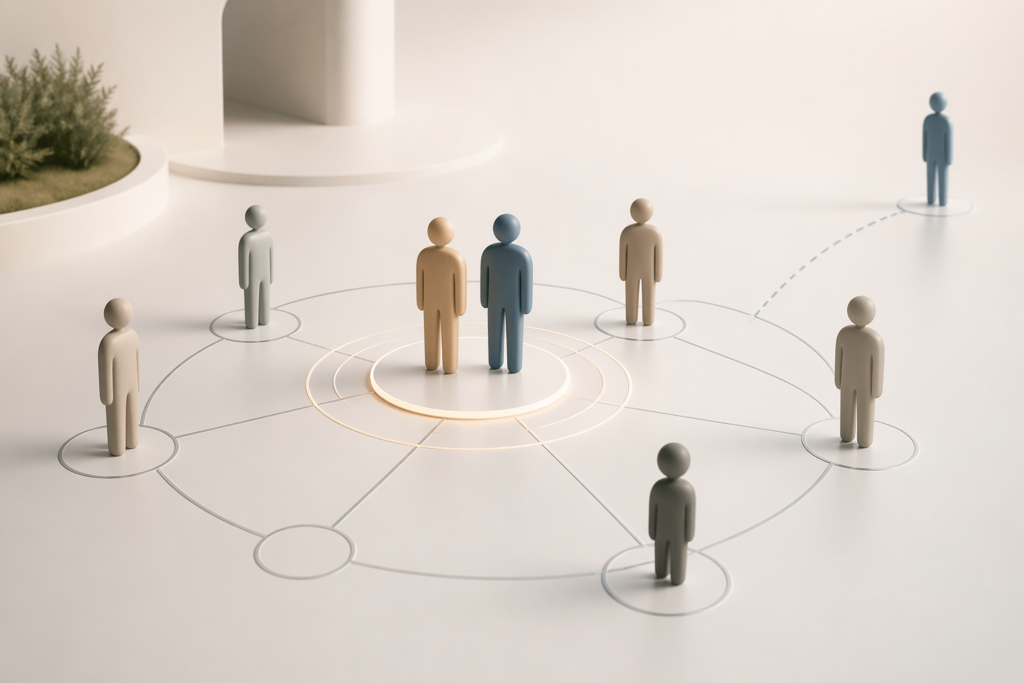
    Conceptual illustration of a human social system where two central figures form a new relationship center while others are repositioned farther away, representing structural distance in relationships.

    Every system reorganizes when a new center forms.

    In human systems, that center is often a relationship.

    When two people become primary to each other,
    the structure around them shifts:

    who is close
    who is peripheral
    who remains visible

    Most people experience this as emotion.

    But it isn’t emotional first.

    It’s structural.

    What looks like distance… is often reorganization.


    Break the Assumption

    We’re taught to interpret distance as meaning:

    something is wrong
    someone pulled away
    something needs to be fixed

    So when relationships shift, we look for emotional explanations.

    But many of these shifts don’t come from conflict.

    They come from structure.


    System Breakdown

    1. Ritual as Structure

    Events like weddings aren’t just emotional moments.

    They function as system resets:

    • defining roles
    • signaling hierarchy
    • setting future proximity

    They don’t just celebrate relationships.

    They reorganize them.


    2. Social Repositioning

    When a new central relationship forms,
    other relationships shift outward in priority.

    Not as rejection— but as reorganization.

    The system reallocates attention, time, and presence.

    No conversation required.


    3. Silent Transition

    These changes rarely get discussed.

    They don’t announce themselves.

    They happen through behavior:

    • where you sit
    • how often you’re contacted
    • how decisions include (or exclude) you

    The signal is subtle—but consistent.


    Personal Evidence

    I experienced this directly.

    I once had a best friend—a military buddy.

    We traveled together. Lived close. Built under pressure.

    He was the best man at my wedding.

    Later, when he married, I wasn’t his.

    That part made sense.

    But something else happened.

    I was asked to move seats.

    From the close row… to the back.

    It was small.

    But it wasn’t about a chair.

    It was a preview.

    Over time, the distance continued.

    Not dramatically.

    Just quietly.

    I saw a similar pattern at another wedding.

    A couple left early.

    Later, I learned they were quietly cut off. No argument.
    No discussion.

    Just a silent downgrade.I had also left early. I chose not to mention it— not out of fear, but because I could see the system they were operating in.


    Reframe

    Most people interpret distance as rejection.

    But in human systems, distance often follows structure—not intention.

    When you mistake structural change for emotional meaning, you create confusion that doesn’t exist.


    System Insight

    Not all distance is conflict.

    Some distance is structural.

    Rituals can amplify connection— but they also reveal how a system is organized.

    And structure doesn’t always match emotion.


    Application

    If you want to understand your relationships more clearly, ask:

    • Has a new “center” formed in this system?
    • Has my position shifted relative to that center?
    • Am I reacting to behavior… or assigning meaning to it?
    • What changes if I stop taking this personally?

    This doesn’t remove feeling.

    It removes misinterpretation.


    Result

    Less pressure.

    Fewer unnecessary conversations.

    More accurate understanding.

    More stable connection.


    Closing

    Once you see this, something changes.

    You stop chasing explanations that aren’t there.

    You stop forcing conversations that don’t need to happen.

    You stop taking structural shifts personally.

    And instead, you start reading the system.

    Because not all distance is conflict.

    Some distance is structural.

    And when you understand that,

    you move with clarity instead of confusion.

    — Oddly Robbie

  • Why Moving to Europe Changed How I Build Systems

    AI Guardian observing European environment systems thinking

    A shift from speed to intention isn’t personal—it’s systemic. Moving to Europe didn’t just change where I live. It changed how I think, decide, and build systems.

    When I moved from the United States to Europe, I expected cultural differences.

    What I didn’t expect was how deeply the environment would reshape how I think, decide, and build.

    Not at the surface level—but at the level of systems.


    Break the Assumption

    We tend to believe that how we think and operate is internally driven.

    That discipline, productivity, and decision-making come from within.

    But that assumption breaks quickly when you change environments.

    Because systems are not built in isolation.

    They are shaped by the pace, values, and constraints of the environment around them.


    System Breakdown

    Different environments optimize for different outcomes.

    In the U.S., many systems are optimized for:

    • Speed
    • Scale
    • Immediate output

    This creates a constant forward pressure—build faster, ship faster, decide faster.

    In Europe, the optimization often shifts toward:

    • Stability
    • Sustainability
    • Long-term balance

    The pace is slower—but the system holds differently.

    Decisions are not always about what moves fastest, but what holds over time.


    The Hidden Effect

    Speed is not neutral.

    It changes how you think.

    When you operate in a high-speed system:

    • You prioritize short-term wins
    • You reduce reflection time
    • You accept fragility as a trade-off

    When you operate in a slower, more deliberate system:

    • You gain space to evaluate
    • You see second-order effects
    • You build with longer timelines in mind

    This is not about better or worse.

    It’s about what the system is designed to produce.


    Reframe

    Moving environments doesn’t just change your surroundings.

    It changes your internal operating system.

    The same person, in a different system, will make different decisions.

    Not because they changed—but because the inputs changed.


    Application

    If your systems feel unstable, rushed, or misaligned, don’t immediately look inward.

    Look at the environment shaping your decisions.

    Ask:

    • What is this system optimizing for?
    • Is speed distorting my decisions?
    • Am I building for output—or for durability?

    Sometimes the most effective change is not effort.

    It’s context.


    System Insight

    Empathium was not just influenced by technology.

    It was shaped by environment.

    A shift away from speed made space for something else:

    • Systems that adapt instead of push
    • Technology that supports instead of drives
    • Design that prioritizes human stability over engagement loops

    This doesn’t emerge in high-speed systems easily.

    It requires a different foundation.


    Key Insights

    • Environment shapes cognition more than intention
    • Speed is a system force, not just a preference
    • Slower systems reveal what fast systems hide
    • Stability requires space, not just effort
    • Changing context can be more powerful than changing behavior

    This wasn’t just a move.

    It was a system shift.

  • When Customs Outlive Their Purpose

    A Human Systems View

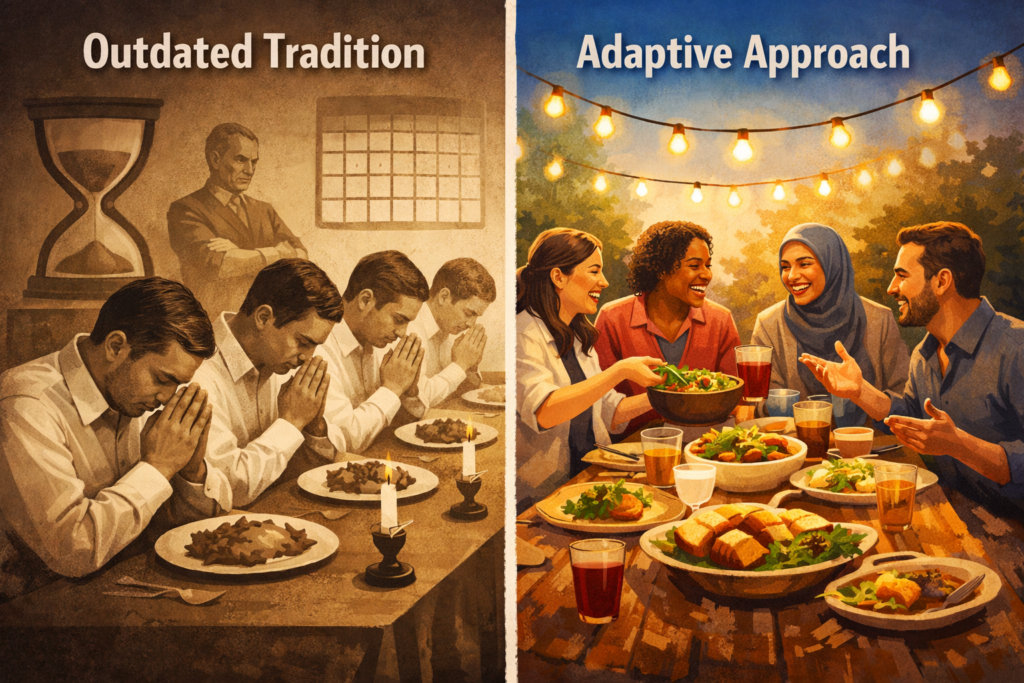
    Diagram showing how customs outlive their purpose when behavior continues without function

    When customs outlive their purpose, they stop supporting human life and start operating on habit alone. Moving across cultures makes this visible fast—what feels “normal” in one place disappears completely in another.

    Across every culture, customs shape behavior long before conscious thought.

    We inherit them early:
    How to greet
    How to eat
    How to gather
    What to celebrate
    What to avoid

    Most of the time, we don’t question them.

    Because customs don’t present themselves as systems.

    They present themselves as “the way things are.”

    Break the Assumption

    The default belief:

    Custom = truth
    Tradition = value
    Repetition = correctness

    But customs are not truth.

    They are solutions created under past conditions.

    And like any system, they can become outdated.

    Why Customs Outlive Their Purpose

    Every custom begins with a function.

    It exists to solve something:

    • Environmental (seasons, survival, scarcity)
    • Social (coordination, bonding, identity)
    • Psychological (comfort, predictability, meaning)
    • Structural (power, order, hierarchy)

    When the environment changes—but the custom does not—the system drifts.

    That drift follows a predictable pattern:

    Function → Habit → Obligation → Enforcement

    At the end of that chain, the original purpose is often gone.

    Only the behavior remains.

    Distortion Layer

    A custom becomes distorted when:

    The story stays the same
    But the function disappears

    At that point, the system sustains itself through:

    • Social pressure
    • Identity protection
    • Emotional attachment
    • Authority reinforcement

    People don’t follow it because it works.

    They follow it because not following it has a cost

    Power and Preservation

    Power rarely needs to invent customs.

    It only needs to preserve and stabilize them.

    Once a custom aligns with:
    • Identity
    • Belonging
    • Order

    It becomes self-reinforcing.

    Institutions, leaders, and systems may then:
    • Formalize it
    • Normalize it
    • Protect it from questioning

    Not always out of manipulation—

    But because stable systems are easier to maintain than changing ones.

    Harm Signals

    Not all customs are harmful.

    But all customs should be evaluated.

    Watch for these signals:

    • Obligation replaces meaning
    • Participation feels performative
    • Questioning creates tension or rejection
    • The outcome no longer matches the purpose
    • Individuals must suppress themselves to comply

    When these appear, the system is no longer serving the human.

    The human is serving the system.

    Reframe

    You are not required to reject all customs.

    You are required to understand them.

    A functional custom:
    • Supports your life
    • Aligns with current reality
    • Allows flexibility

    A non-functional custom:
    • Drains energy
    • Enforces outdated conditions
    • Persists through pressure rather than value

    The goal isn’t to reject traditions—it’s to recognize when customs outlive their purpose and no longer serve you.

    Application

    Instead of asking:
    “Is this tradition good or bad?”

    Ask:

    What was this designed to do?
    Is it still doing that?
    What is the actual outcome now?

    Then choose:

    • Keep (if it still serves)
    • Modify (if it partially works)
    • Exit (if it no longer aligns)

    All three are valid.

    System Insight

    Customs are inherited systems.

    But participation is a choice.

    Awareness is the point where inheritance becomes autonomy.

    Key Insights

    • Customs originate as solutions, not truths
    • Systems drift when conditions change
    • Social cost keeps outdated systems alive
    • Power stabilizes systems more than it creates them
    • Evaluation restores autonomy

  • When Belonging Becomes Performance

    When belonging becomes performance, social exhaustion follows.

    Opening

    Social exhaustion from performance happens when belonging depends on visibility, speed, and unspoken social rules.

    In many modern social environments—especially highly expressive ones like nightlife or identity-centered communities—visibility is often framed as a form of belonging.

    But for some individuals, especially those who process social environments differently, visibility does not feel like inclusion. It feels like exposure.


    Break the Assumption

    The common assumption:
    If a space is open, expressive, and identity-affirming, it is automatically inclusive.

    This is incomplete.

    A space can be visually inclusive while still operating on unspoken performance rules that exclude those who cannot—or choose not to—participate in them.


    System Breakdown

    1. Belonging as Performance

    In many social systems, belonging is not granted—it is performed.

    The system rewards:

    • Fast social signaling
    • Correct emotional timing
    • Fluency in unspoken norms
    • Appearance-based validation

    This creates a performance-based access model, where:

    • Entry = visibility
    • Retention = social skill execution

    2. The Cost of Constant Translation

    For individuals who do not intuitively process social cues (e.g., neurodivergent individuals), participation requires:

    • Continuous decoding
    • Behavioral masking
    • Environmental scanning

    This turns social engagement into a real-time cognitive workload, not a passive experience.

    Result:

    • Energy depletion
    • Delayed processing fatigue
    • Increased withdrawal behaviors

    3. Visibility vs. Safety Mismatch

    In appearance-driven environments, attention is often interpreted as positive.

    But systemically, attention is ambiguous input.

    For some participants:

    • Attention = validation
      For others:
    • Attention = threat assessment trigger

    This creates a signal mismatch, where the same input produces opposite internal states.


    4. Sensory + Social Stack Overload

    These environments often combine:

    • High noise
    • Unpredictable interactions
    • Dense human proximity
    • Rapid emotional exchanges

    This stacks multiple systems at once:

    • Sensory system
    • Social processing system
    • Self-regulation system

    When stacked, even “positive” environments can become unsustainable over time.


    Personal Evidence (Controlled)

    In high-density social spaces, participation can shift from connection to calculation:

    • Evaluating lighting, sound, and proximity
    • Pre-planning basic interactions
    • Monitoring expressions and responses

    The result is not enjoyment—but system management under pressure.


    Reframe

    The issue is not:

    • Lack of confidence
    • Lack of desire for connection
    • Failure to “fit in”

    The issue is a system mismatch between environment demands and processing style.


    System Insight

    Not all inclusive environments are system-compatible environments.

    In human systems:

    • Inclusion must account for how participation is processed, not just how it is presented
    • Environments that rely on performance will naturally exclude those who operate through depth, not speed

    System Extension

    This pattern is not limited to queer spaces.

    It appears in any environment where:

    • Identity is highly visible
    • Social validation is rapid
    • Norms are unspoken but enforced

    Examples include:

    • Corporate networking environments
    • Influencer-driven social platforms
    • High-performance social groups

    The system pattern remains the same:
    Belonging shifts from being accepted → to being performed.


    Application

    1. Redefine “Community Fit”

    Instead of asking:

    • “Can I adapt to this space?”

    Ask:

    • “Does this system match how I naturally operate?”

    2. Reduce Performance Dependency

    Seek or build environments where:

    • Interaction is slower
    • Signals are clearer
    • Depth is valued over speed

    3. Recognize Energy as a System Metric

    Track:

    • Entry energy vs. exit energy

    If consistent depletion occurs:

    • The system is not sustainable, regardless of perceived social value

    Key Insights

    • Belonging in many modern spaces is performance-based, not access-based
    • Social exhaustion often results from continuous translation, not interaction itself
    • Visibility is not universally experienced as safety or validation
    • System compatibility matters more than cultural inclusion signals
    • Sustainable connection requires environments aligned with processing style

  • Culture Is a System: What Living Between Worlds Revealed

    The Assumption

    We often assume that behavior reflects who a person is.

    But much of what we call “personality” is actually system alignment.


    Breaking the Assumption

    I’ve lived inside very different cultural environments.

    Not as a tourist—but long enough to feel the system from the inside.

    What stood out wasn’t which culture was better.

    It was that each one operated as a complete system.


    System Breakdown

    In Japan, social systems prioritize:

    • predictability
    • indirect communication
    • group harmony

    In Argentina, social systems prioritize:

    • expressiveness
    • direct communication
    • fluid interaction

    Both systems produce behavior that feels “normal” internally.

    But those same behaviors can feel confusing—or even wrong—outside their system.


    Personal Evidence (Brief)

    In Japan, I learned to read subtle signals and communicate indirectly.

    In Argentina, I learned to speak openly and engage more fluidly.

    Both worked.

    But each required a different version of me.


    Reframe

    The question is not:

    “Which behavior is correct?”

    The better question is:

    “What system is this behavior designed for?”


    System Insight

    There is no single “normal.”

    “Normal” is not a fixed truth.
    It is a local output of a system.

    Behavior that fits one system can fail in another—
    even when it is fully functional where it originated.

    Conflict between people is often conflict between systems, not individuals.


    Application

    Instead of judging behavior immediately:

    • Identify the system it came from
    • Look for the function behind it
    • Adjust expectations before assigning meaning

    This reduces unnecessary conflict
    and improves cross-cultural understanding.


    Key Insights

    • “Normal” is system-relative
    • Behavior reflects system design, not personal value
    • Misalignment creates misunderstanding—not failure
    • Cultural friction is often system mismatch

    Final Thought

    When you stop trying to decide who is right,
    and start understanding which system is operating—

    you gain the ability to move between worlds
    without losing clarity.

  • How Moving Between Cultures Changed How I See the World

    I didn’t set out to study culture.

    I experienced it.

    The First Shift

    Growing up in Montana, my world was relatively consistent.

    Then I went to Japan.

    Everything changed.

    The pace.
    The expectations.
    The structure of daily life.

    I wasn’t just learning a language.

    I was learning a completely different way of being.

    Adapting in Real Time

    As a missionary, I was expected to keep up.

    Physically.
    Mentally.
    Culturally.

    There wasn’t much space to pause—so I adapted.

    Not perfectly—but enough to function.

    That experience stayed with me.

    A Different Culture Again

    Later, Argentina introduced another shift.

    Different rhythm.
    Different communication.
    Different priorities.

    Where Japan was structured and precise, Argentina was expressive and fluid.

    Both made sense—within their own systems.

    What That Changed

    After moving through multiple cultures, something became clear:

    There isn’t one “normal.”

    There are systems.

    Each culture creates its own:

    • expectations
    • behaviors
    • interpretations of what is right or wrong

    The Effect on Identity

    When you experience multiple systems, identity changes.

    You stop seeing things as fixed.

    You start seeing them as:

    • contextual
    • adaptable
    • influenced by environment

    That can feel disorienting.

    But it also creates freedom.

    🔄 2026 Update

    This connects directly to how I think about human systems.

    People aren’t rigid.

    They adapt to the systems they’re in.

    Better systems should:

    • allow flexibility
    • reduce unnecessary pressure
    • support different ways of being

    Because what looks “normal” is often just familiar.

    Key Insights

    • Culture shapes behavior more than people realize
    • There is no single “normal”—only different systems
    • Exposure to multiple cultures increases adaptability
    • Identity becomes more flexible through experience

    Guardian Application

    A Guardian system could:

    • help users navigate different cultural environments
    • reduce friction when entering unfamiliar systems
    • provide context for behavior and expectations
    • support adaptation without loss of identity

    Tags

    • Domain: Human Systems
    • Function: Story, Insight
    • Guardian: Emotional Support
  • Smart Cities and Culture: Why the Smartest Cities Won’t Look Futuristic

    futuristic coastal smart city in Andalucia blending culture and modern technology

    The future of smart cities is often misunderstood.

    Most people imagine something sleek, efficient, and fully optimized—dense networks of sensors, autonomous systems, and perfectly managed infrastructure.

    The assumption is simple: the more advanced the technology, the more advanced the city.

    Break the Assumption

    This assumption is incomplete.

    Cities are not machines. They are lived environments shaped by culture, behavior, and time. When cities are designed primarily through abstraction—models, simulations, and efficiency metrics—they often lose the qualities that make them meaningful.

    The result is a familiar pattern: cities that function better on paper, but feel less human in reality.

    System Breakdown

    Modern smart cities systems are built on three layers:

    • Sensing — data from sensors, cameras, and infrastructure
    • Modeling — digital twins and real-time representations
    • Optimization — AI-driven decisions to improve efficiency

    This creates cities that are increasingly aware of themselves.

    But awareness alone is not intelligence.

    What’s missing is a fourth layer:

    • Cultural Continuity — the preservation and evolution of what people value

    This includes how people gather, how streets are used, what is preserved, and what is allowed to change.

    Without this layer, cities become technically advanced but culturally interchangeable.

    Reframe

    A city is only “smart” if smart cities culture reflects what matters to the people who live in it.

    Technology can measure movement, energy, and flow. But these are not the things that give a place meaning. Culture lives in patterns that are harder to quantify but easy to feel.

    The goal is not to make cities more efficient.

    The goal is to make them more aware—of both their systems and their identity.

    System Insight

    Some cities already demonstrate this balance.

    In places like Kyoto, infrastructure evolves without erasing the past. Streets remain human in scale. Architecture reflects history. Nature is integrated into daily life rather than added as decoration.

    Technology exists, but it is quiet. It adapts to the city instead of redefining it.

    This reveals a broader pattern:

    Cities that prioritize identity first can integrate technology without losing themselves. Cities that prioritize optimization first often erase what made them unique.

    Application

    This changes how we design urban systems:

    • Sensors should enhance awareness, not enforce control
    • Digital models should reflect lived experience, not just infrastructure
    • AI systems should adapt to cultural patterns, not override them
    • Development should preserve identity before improving efficiency

    The question is no longer how to build smarter cities.

    It is how to build cities that can evolve without losing who they are.

    Key Insights

    • A city is a cultural system, not just an infrastructure system
    • Efficiency is not neutral—it can erase identity
    • Smart systems must learn what people value, not just what can be measured
    • Technology should adapt to cities, not redefine them
    • The future of cities is not built from scratch—it is grown from what already exists