For a period of time, drugs were decriminalized. The intention was to shift addiction away from punishment and toward treatment. On paper, it made sense.
In practice, something else happened.
People moved there.
Not for recovery—but because the environment allowed continuation.
And the systems that were supposed to support treatment weren’t ready at scale.
What followed wasn’t just a policy outcome.
It was a systems mismatch.
The Gap Between Policy and Reality
Decriminalization without infrastructure creates a vacuum.
If you remove enforcement, but don’t replace it with:
accessible treatment
consistent support
stable housing
community integration
then the system doesn’t stabilize—it drifts.
And drift, in this context, looks like visible suffering.
Not hidden.
Public.
What Was Missing
The idea wasn’t wrong.
But the timing and execution were incomplete.
Support systems need to exist before behavior shifts—not after.
Otherwise, people fall into the gap between intention and reality.
A Different Approach
If we look forward instead of backward, the question becomes:
How do we build systems that can actually handle change?
Not just policy change—but human behavior change.
That requires:
continuous support, not episodic intervention
environments designed for stability
systems that can adapt in real time
This is where technology can help—but only if used carefully.
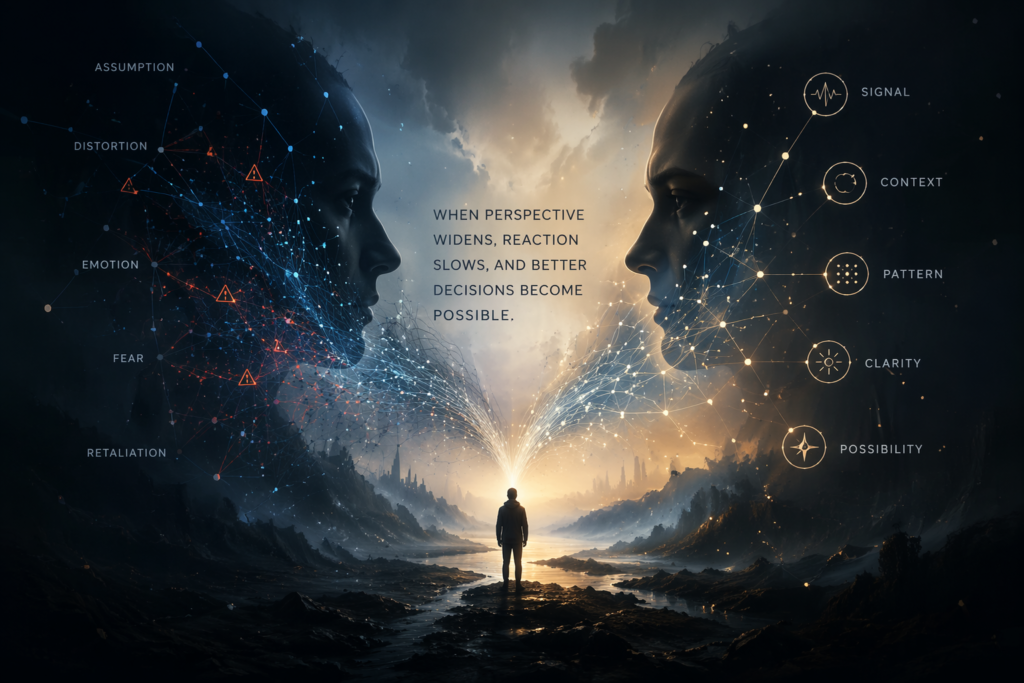
AI conflict resolution begins with understanding how escalation patterns form.
Conflict tends to follow a familiar pattern.
Action. Reaction. Escalation.
Whether between individuals, communities, or nations, the loop repeats with surprising consistency. What changes is scale, speed, and the number of people forced to absorb the cost.
Because retaliation rarely resolves conflict.
It redistributes harm. It extends instability. And it reinforces the very conditions that created the conflict.
So the real question is not whether conflict exists.
It’s whether we keep responding to it through the same systems that repeatedly fail to resolve it.
What Actually Keeps Wars Going
Wars don’t sustain themselves by accident.
They are maintained by reinforcing human patterns—especially under pressure.
1. The Need for Victory
Conflict becomes something to win, not resolve.
This creates rigid endpoints:
one side must dominate
the other must concede
In complex systems, that rarely happens—so the conflict continues.
2. Rage and Emotional Momentum
Once harm occurs, emotional energy builds fast.
anger becomes justification
grief becomes fuel
fear becomes preemptive action
Perception narrows. Reaction accelerates.
3. Revenge Loops
Retaliation creates feedback cycles:
action → counteraction → escalation
Each side experiences their move as justified. The loop sustains itself.
4. Historical Distortion
Over time, narratives simplify:
events are compressed
blame is concentrated
identity fuses with the conflict
The story feels absolute—even when it’s incomplete.
5. Superiority and Dehumanization
When one group sees itself as superior:
empathy drops
the other becomes abstract
harm becomes easier to justify
At this stage, conflict is no longer just strategic—it becomes moralized.
Technology Has Been Framed Too Narrowly
Most discussions about AI focus on power:
efficiency, advantage, control.
That’s incomplete.
At its core, AI is a pattern-recognition system.
And conflict is built from patterns:
misunderstanding
resource pressure
identity threat
communication breakdown
repeated escalation loops
Humans can sense parts of this.
But rarely the whole system—especially in real time.
A Different Role for AI
AI does not need to optimize force.
It can improve understanding.
Not by replacing human judgment—but by improving its quality.
The goal is not control.
The goal is clarity.
Where AI Can Create Clarity
AI cannot stop a war.
But it can interrupt the conditions that allow wars to escalate blindly.
1. Real-Time Pattern Awareness
AI can detect early escalation signals:
shifts in language tone
movement patterns
breakdowns in communication
This allows earlier response—not just reaction.
2. Narrative Comparison
Different sides describe the same event differently.
Example:
one calls it “defense”
the other calls it “attack”
AI can surface both perspectives side-by-side—without forcing a conclusion.
That alone exposes distortion.
3. De-Escalation Windows
There are moments where escalation isn’t locked in:
pauses
reduced intensity
openings for mediation
Humans often miss these under stress.
AI can highlight them.
4. Human Cost Visibility
War decisions often operate on abstraction.
AI can translate impact into tangible projections:
civilian displacement
infrastructure collapse
recovery timelines
This shifts decisions from symbolic to real.
5. Signal vs Story Separation
In high emotion, interpretation becomes “truth.”
AI can separate:
confirmed signals
inferred meaning
assumptions
This reduces unnecessary escalation driven by misinterpretation.
A Simple Example
Imagine a border incident.
One side interprets movement as aggression. The other sees it as routine positioning.
Without clarity:
alerts rise
retaliation is prepared
escalation begins
With AI-supported clarity:
historical patterns are checked
intent probabilities are surfaced
communication gaps are identified
The situation is still tense.
But reaction slows just enough to allow verification.
Sometimes, that pause is enough.
The Missing Investment
For decades, societies have invested heavily in:
defense
deterrence
retaliation
Far less has gone into systems that reduce escalation early.
What’s underbuilt are systems that:
reduce misunderstanding
surface shared interests
detect stress before aggression
support resolution before identity hardens
That imbalance matters.
The Human Role Remains Central
No system can carry moral responsibility.
And it shouldn’t.
Humans still decide:
what matters
what is fair
what future is acceptable
But better systems support better decisions.
They widen the frame. They slow reaction. They create space between impulse and action.
And that space is where better outcomes become possible.
Closing Thought
Peace cannot be enforced by technology. But clarity can be supported.
This kind of clarity doesn’t have to come from large institutions alone. It can emerge through personal, adaptive interfaces that help individuals navigate complexity—quietly supporting better decisions in real time.
And wars are often sustained by distorted perception under pressure.
If we reduce distortion—even slightly—we change decisions. And repeated decisions are what shape outcomes.
The question is no longer whether we have powerful tools. It’s whether we are willing to use them to interrupt cycles of harm instead of accelerating them.
Technology for Earth’s Revival Is Not the System—Human Response Is
We often talk about the damage done to our planet—but far less about what is already working to repair it.
Across the world, technologies are actively cleaning oceans, producing fresh water, and building more sustainable environments. These are not future ideas. They exist now.
But the real question is not what exists.
It’s how humans respond to what exists.
The Assumption
We assume that if solutions exist, progress will follow.
History shows that isn’t true.
Solutions do not create change on their own. Human systems determine whether solutions are adopted, ignored, or resisted.
The System
Every environmental solution moves through the same human pattern:
1. Exposure
People encounter the solution. Example: Ocean-cleaning systems like Mr. Trash Wheel or large-scale ocean collectors.
2. Interpretation
The mind assigns meaning:
“This is impressive”
“This is too small to matter”
“This isn’t my responsibility”
3. Decision
A choice is made:
Engage (support, share, adopt)
Ignore
Dismiss
4. Behavior
Action follows:
Support initiatives
Change habits
Or continue as before
5. Reinforcement
The system stabilizes:
Small actions create agency → continued engagement
Overwhelm creates inaction → continued detachment
Where Most Systems Fail
Not at innovation.
At interpretation.
When a solution feels:
Too complex
Too distant
Too small
The human system defaults to disengagement.
This is why powerful technologies can exist—and still have limited impact.
What Actually Works
Solutions that succeed align with human systems:
Visible impact → people see results
Local relevance → people feel connected
Low friction → easy to support or adopt
Clear role → people understand what they can do
Technologies like beach-cleaning robots or river interceptors work not just because they function—but because they are understandable.
They fit the human system.
Reframe
The future of environmental recovery is not just technological.
It is behavioral.
The question shifts from:
“What can technology do?”
to:
“How does this system help humans engage instead of disengage?”
Application
When evaluating any solution, ask:
Can people see the impact clearly?
Does it reduce overwhelm or increase it?
Does it give the individual a role?
Does it fit naturally into human behavior?
If not, the system will struggle—no matter how advanced the technology is.
Key Insight
Technology can repair the planet.
But only if it aligns with the systems that drive human behavior.
We often talk about the damage done to our planet—but far less about what is already working to repair it.
Across the world, technologies are actively cleaning oceans, producing fresh water, and building more sustainable environments. These are not future ideas. They exist now.
But the real question is not what exists.
It’s how humans respond to what exists.
The Assumption
We assume that if solutions exist, progress will follow.
History shows that isn’t true.
Solutions do not create change on their own. Human systems determine whether solutions are adopted, ignored, or resisted.
The System
Every environmental solution moves through the same human pattern:
1. Exposure
People encounter the solution. Example: Ocean-cleaning systems like Mr. Trash Wheel or large-scale ocean collectors.
2. Interpretation
The mind assigns meaning:
“This is impressive”
“This is too small to matter”
“This isn’t my responsibility”
3. Decision
A choice is made:
Engage (support, share, adopt)
Ignore
Dismiss
4. Behavior
Action follows:
Support initiatives
Change habits
Or continue as before
5. Reinforcement
The system stabilizes:
Small actions create agency → continued engagement
Overwhelm creates inaction → continued detachment
Where Most Systems Fail
Not at innovation.
At interpretation.
When a solution feels:
Too complex
Too distant
Too small
The human system defaults to disengagement.
This is why powerful technologies can exist—and still have limited impact.
What Actually Works
Solutions that succeed align with human systems:
Visible impact → people see results
Local relevance → people feel connected
Low friction → easy to support or adopt
Clear role → people understand what they can do
Technologies like beach-cleaning robots or river interceptors work not just because they function—but because they are understandable.
They fit the human system.
Reframe
The future of environmental recovery is not just technological.
It is behavioral.
The question shifts from:
“What can technology do?”
to:
“How does this system help humans engage instead of disengage?”
Application
When evaluating any solution, ask:
Can people see the impact clearly?
Does it reduce overwhelm or increase it?
Does it give the individual a role?
Does it fit naturally into human behavior?
If not, the system will struggle—no matter how advanced the technology is.
Key Insight
Technology can repair the planet.
But only if it aligns with the systems that drive human behavior.
People often believe the platform is what matters.
VR, AR, MR—each new wave promises to define the future. The focus stays on tools, features, and which company is leading.
But platforms change. They always have.
What doesn’t change is how humans experience environments.
The Real System
The value was never in the platform.
It’s in understanding how people:
perceive space
regulate emotion
engage with environments
decide whether to stay or leave
A platform is just a container. The human response inside it is the system.
Where Most Builders Get It Wrong
When builders focus on platforms, they optimize for:
features
performance
novelty
But humans don’t return for features.
They return for how a space feels.
Calm. Clear. Meaningful. Navigable.
If those are missing, the platform doesn’t matter.
Reframe
The question is not:
“What can this platform do?”
The question is:
“How does this environment influence the human inside it?”
That shift changes everything.
What Actually Lasts
Systems that last are:
adaptable to different human states
responsive to cognitive load
aligned with emotional regulation
capable of evolving without breaking the experience
A system that cannot adapt will eventually misalign with the human using it.
Individual Fit Matters
Not every system works for every person.
Immersive environments can be powerful—but they can also overwhelm. For some, immersion creates clarity. For others, it increases cognitive load.
For some individuals, simply being placed in an unfamiliar environment—virtual or physical—can be disorienting. New spatial rules, unfamiliar cues, and constant interpretation can quickly exceed what the brain can comfortably process.
Technology should align with the user’s comfort level.
When systems push beyond what a person can comfortably process, they don’t accelerate adoption—they create resistance.
Familiarity often matters more than capability.
Sometimes the most effective environment isn’t advanced at all.
It’s something simple and known— like sitting with a cousin, having coffee in a place that feels familiar, even if that place no longer exists.
The system works because the human already understands it.
System Reality
More immersive does not mean better
More advanced does not mean usable
More features do not mean more effective
Systems that push users create resistance
What matters is fit.
Application
This applies beyond XR:
AI interfaces
websites
physical environments
communication systems
If it interacts with a human, it is part of a human system.
Systems should reduce friction so the human can function well.
And they succeed based on that interaction.
Key Insights
Platforms are temporary. Human response patterns are not.
Experience determines value, not technology.
Environments influence human state, not control it.
Adaptability is more important than capability.
The best system is the one the individual can use without friction.
Builders who follow systems outlast those who follow platforms.
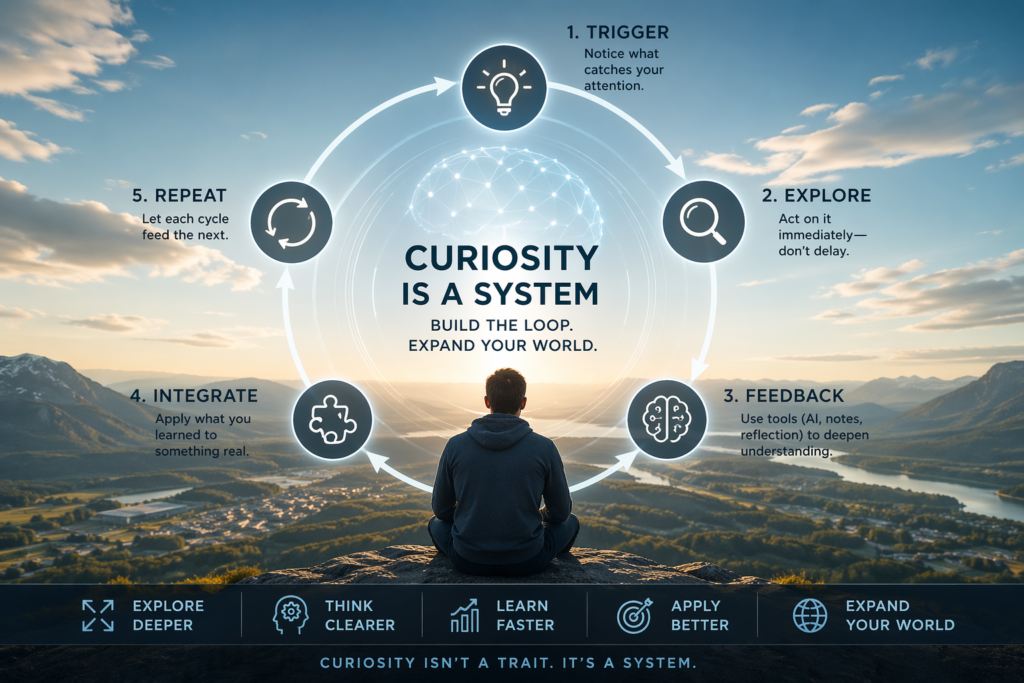
Most people think curiosity is something you either have or don’t. In reality, it’s a structured process that determines how you explore, learn, and grow.
But that framing misses what actually drives growth.
Curiosity isn’t a trait. It’s a system.
Break the Assumption
We assume curiosity is passive:
something we feel
something that shows up naturally
something tied to personality
In reality, most people stop exploring not because they lack curiosity—
but because they lack a structure to act on it.
System Breakdown
Curiosity only becomes useful when it moves through a system:
Trigger → Exploration → Feedback → Integration
Without this loop:
curiosity fades into distraction
learning stays surface-level
insights don’t stick
With the loop:
questions turn into understanding
exploration compounds over time
learning becomes self-sustaining
Technology—especially AI—can accelerate this loop.
But it doesn’t create it.
It amplifies what’s already there.
Personal Evidence (Controlled)
Growing up in Montana, my curiosity started with a simple computer from RadioShack—paid for by sweeping sidewalks at JC Penneys.
That early experience wasn’t about the machine.
It was about the loop: question → explore → learn → repeat.
Recently, AI has allowed me to refine that loop further.
By aligning tools with how I naturally process information—sequentially and visually—learning shifted from effort to flow.
Not because AI is intelligent—
but because it supports the system.
Reframe
Curiosity isn’t something you wait for.
It’s something you build.
And once structured, it becomes a reliable way to expand your world.
System Insight
Across human systems:
People don’t fail to grow because they lack interest.
They fail because:
exploration isn’t structured
feedback isn’t clear
integration never happens
So curiosity gets misdiagnosed as a personality trait—
instead of recognized as a repeatable process.
Application
To turn curiosity into a working system:
Step 1 — Trigger
Notice what catches your attention
Step 2 — Explore
Act on it immediately—don’t delay
Step 3 — Feedback
Use tools (AI, notes, reflection) to deepen understanding
Step 4 — Integrate
Apply what you learned to something real
Step 5 — Repeat
Let each cycle feed the next
The goal isn’t more information.
It’s a functioning loop.
Autism Perspective (System Advantage)
For me, being on the autism spectrum made this clearer.
When information is structured correctly:
patterns become visible
systems become predictable
learning becomes efficient
AI didn’t “fix” anything.
It aligned with how my system already works.
That alignment is where the advantage comes from.
Why This Matters
In a rapidly changing world, curiosity isn’t optional.
Sustainable systems don’t give everything at once—they continue providing over time.
The Common Belief
Self-care vs helping others is often misunderstood. Many believe giving more always creates more good.
Break the Assumption
This belief overlooks a critical flaw.
If giving has no boundaries, it does not create more good—it creates depletion.
The idea is familiar. In The Giving Tree, the tree gives everything it has until it becomes a stump. The story is often interpreted as generosity, but from a systems perspective, it represents total resource collapse.
If the tree had maintained its capacity, it could have provided apples for a lifetime.
System Breakdown
Every person operates within a finite energy system:
Input → rest, nutrition, emotional recovery
Output → helping, working, supporting others
Recovery → restoring system stability
When output exceeds input over time, the system enters delayed depletion.
This is why burnout doesn’t feel immediate. It builds quietly while the person continues to give.
Reframe
Helping others is not about giving everything.
It is about managing capacity so giving can continue.
Boundaries are not a limitation of compassion—they are what make compassion sustainable.
System Insight
Unbounded giving is not generosity. It is resource exhaustion disguised as virtue.
Sustainable support comes from preserving the system that produces it.
The most effective people are not those who give the most once, but those who can continue giving over time.
Application
Shift how you evaluate your actions:
Set boundaries before exhaustion appears
Treat rest as required system maintenance
Monitor your energy like a limited resource
Reduce output when recovery is insufficient
Instead of asking: “Am I giving enough?”
Ask: “Can I keep giving at this level without breaking the system?”