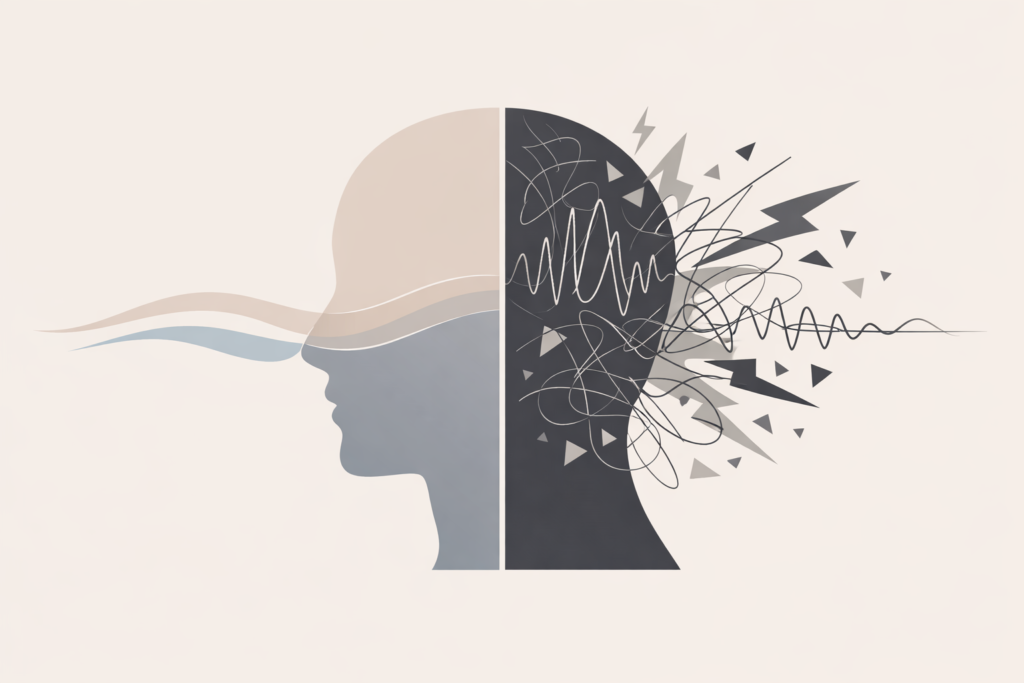
Why being wrong is essential for adaptive thinking and human system growth
Opening
Most people try to avoid being wrong.
We are taught to defend our views, protect our identity, and stay consistent. Being wrong is often treated as failure — something to minimize, hide, or explain away.
But being wrong is one of the ways a human system stays updateable.
Every person, relationship, culture, and institution depends on feedback. When feedback is allowed in, the system can adjust. When being wrong is treated as shame, the system protects its old answer instead of learning from reality.
Break the Assumption
The common framing is backwards.
Being wrong is not the failure point.
It is the detection point.
It is the moment where the system discovers that its current model does not fully match reality.
If you are never wrong, nothing updates.
System Breakdown
Human thinking operates like a continuous model:
- You form a belief based on current inputs
- You act on that belief
- Reality provides feedback
- The system either updates or resists
Being wrong is where mismatch becomes visible.
Without detecting error, the system cannot adjust.
When error is ignored:
- beliefs calcify
- perception narrows
- decisions degrade over time
When error is accepted:
- models update
- perception expands
- decisions improve
This is not only emotional.
It is structural.
A system that cannot admit error becomes less accurate over time. It may still feel confident, but confidence is not the same as alignment with reality.
Personal Evidence
I have learned to recognize the exact moment I am wrong and treat it as progress, not loss.
That moment used to feel uncomfortable. Now it feels precise. Useful.
It is the point where something real replaces something assumed.
That does not mean being wrong always feels easy. It means the discomfort has a function. It marks the boundary between an old model and a better one.
Why People Resist Being Wrong
Most people do not resist being wrong because of logic.
They resist it because being wrong can feel like a threat to identity.
When belief and identity become fused, correction feels like loss. Feedback feels like attack. Updating feels unstable.
So the system protects itself by rejecting new input.
That is how people stay stuck — not because they lack intelligence, but because the model and the self have become too tightly connected.
Once you separate the two, updating becomes easier.
You are not your current model.
You are the system capable of improving it.
Reframe
Being wrong is not a flaw in the system.
It is the system working.
Error detection is not humiliation. It is information. It is the signal that tells a human system where reality and assumption no longer match.
The problem is not being wrong.
The problem is refusing to update.
System Insight
Adaptive systems depend on correction.
The faster a system can:
- detect error
- accept mismatch
- update its model
…the more aligned it becomes with reality.
Resisting error does not protect the system.
It freezes the system inside an outdated model.
This applies to individuals, relationships, organizations, cultures, and technologies. Any system that depends on feedback must be able to be wrong without collapsing.
System Extension: Adaptive Technology
This same pattern matters for AI and XR systems.
A well-designed Guardian should not be built around always being right. It should be built around detecting mismatch and adjusting.
In XR environments, this becomes critical:
- user behavior becomes input
- system interpretation becomes the model
- mismatch becomes the signal
- adaptation becomes the outcome
A Guardian that cannot update becomes rigid. It may become intrusive, misleading, or overconfident.
A Guardian that can detect mismatch becomes more useful over time.
It refines context. It adjusts interaction. It aligns more closely with the user without needing to control the user.
This is not about appearing intelligent.
It is about staying correctable.
Application
This changes how you operate.
Instead of defending ideas, test them.
Instead of avoiding discomfort, track it.
Instead of protecting identity, prioritize accuracy.
In conversations, listen for mismatch instead of validation.
In learning, seek correction instead of confirmation.
In decision-making, update faster than your last version.
The goal is not to be wrong all the time. The goal is to become less afraid of correction.
Because correction is how a living system stays alive.
Key Insights
- Being wrong is the entry point to improvement
- Error detection is required for adaptation
- Defensiveness blocks learning at the structural level
- Identity fusion makes correction feel threatening
- Fast correction creates better long-term outcomes
- Adaptive technology should detect mismatch, not pretend certainty
- Accuracy matters more than consistency
If you want to improve your thinking, do not aim to be right forever.
Aim to update faster than your last version.
revised from blog in 2023