Tag: decision systems

  • Why Things Happen in Clusters (Human Systems Explained)

    Backlog Release Clustering


    Why do things seem to happen all at once?
    From busy stores after a sunny day to sudden bursts of productivity, this pattern shows up everywhere. It’s not coincidence—it’s how human systems actually work.

    Some days, nothing moves.

    Then suddenly—everything does.

    • Messages come in at once
    • Decisions resolve together
    • People show up at the same time
    • Systems that were quiet suddenly respond

    It feels like coincidence.

    But it isn’t.


    Break the Assumption

    The default belief:

    “Events should happen evenly over time.”

    So when things cluster, it feels unusual.

    But real systems don’t behave evenly.

    They behave in phases:

    • Delay
    • Build
    • Release

    System Breakdown

    Clusters form from three core mechanics:


    1) Backlog Accumulation

    When action is delayed, it doesn’t disappear.

    It stacks.

    Human Examples:

    • People avoid errands for a few days → stores suddenly get busy
    • Emails sit unread → multiple replies happen at once
    • Creative work is paused → output comes in bursts
    • Cleaning is delayed → full reset happens all at once

    👉 The system holds pressure instead of releasing it continuously


    2) Shared Triggers

    Many people wait on similar conditions.

    When that condition changes, action synchronizes.

    Human Examples:

    • ☀️ Weather improves → people go outside, shop, socialize
    • 💰 Payday hits → spending increases across many individuals
    • 📅 Deadline approaches → work output spikes
    • 🧠 Mental clarity returns → decisions finally get made

    👉 No coordination—just aligned readiness


    3) Friction Cycles

    Not all days are equal.

    Some naturally suppress action.

    Human Examples:

    • Monday → planning, low execution
    • Tuesday/Wednesday → higher action
    • Late night → low engagement
    • Post-stress → temporary shutdown before recovery

    👉 Action is delayed until friction drops


    4) Threshold Release

    Systems don’t always respond gradually.

    They hold—then release.

    Human Examples:

    • Immigration decisions processed in batches
    • Customer service replies arriving all at once
    • Personal decisions delayed, then made rapidly
    • Emotional processing building, then resolving suddenly

    👉 Once a threshold is crossed, multiple outcomes resolve together


    Reframe

    Clusters are not random spikes.

    They are visible releases of invisible buildup.


    System Insight

    Human behavior is not continuous.
    It is accumulated, delayed, and released.


    Application

    When you see clustering:

    Don’t ask:

    • “Why is everything happening at once?”

    Ask:

    • What was delayed?
    • What condition changed?
    • What friction dropped?

    Real-Life Examples of Why Things Happen in Clusters

    SituationWhat’s Really Happening
    Busy store after sunny dayWeather removed friction → backlog released
    Tuesday productivity spikeMonday delay → stabilization → action
    Inbox floods with repliesPeople batch responses
    Sudden motivation burstMental clarity threshold crossed
    Multiple life events resolvingSystems clearing shared bottlenecks

    Key Insights

    • Delayed actions create hidden backlogs
    • Shared conditions synchronize behavior
    • Friction suppresses action until it drops
    • Systems release in bursts, not evenly
    • Clusters signal state change, not coincidence


    Optional Add-On (Strong for Your System)

    You can name this pattern for reuse:

    “Backlog Release Clustering”

    This gives you:

    • A label for blog indexing
    • A detection rule for Guardian systems
    • A reusable explanation across domains

    Understanding why things happen in clusters allows you to read system behavior more clearly—turning confusion into usable insight.

  • AI Human Decision System: Why AI Should Inform, Not Decide

    1. Opening

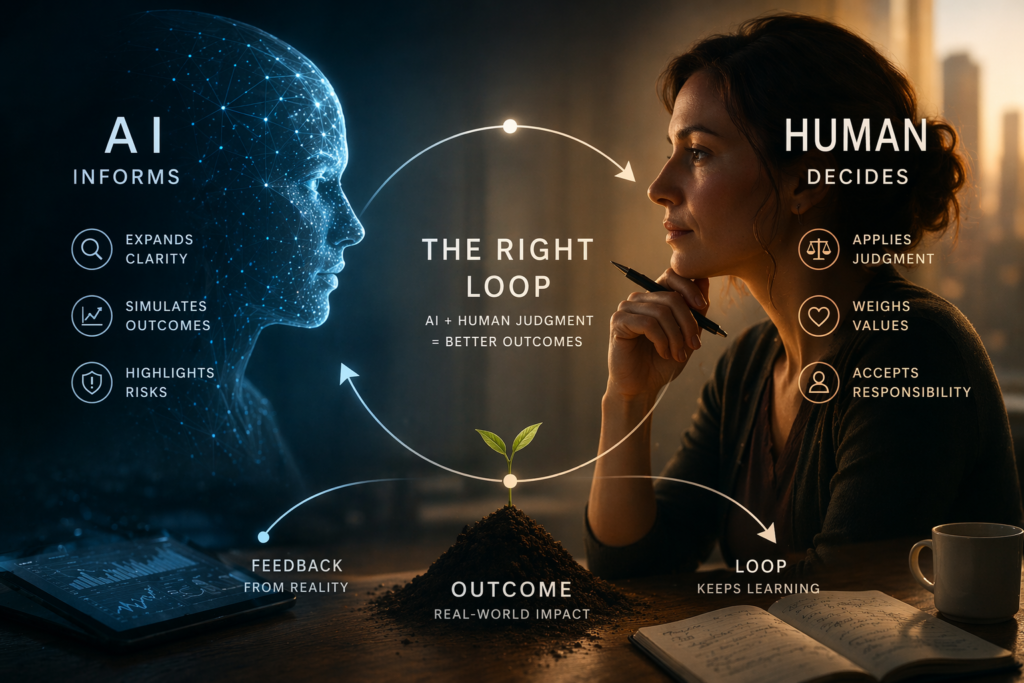
    The AI human decision system defines a simple rule: AI informs, humans decide.

    If a system can make better decisions than humans, why not let it lead?

    It sounds logical—especially in a world where human leaders have caused wars, acted without empathy, and failed at scale.

    Some argue that an automated system might govern more rationally.

    But this line of thinking leads to a deeper problem.


    2. Break the Assumption

    The issue is not that AI might make mistakes.

    Humans already do that.

    The real issue is structural:

    Governance is not just about making decisions.
    It is about humans learning to navigate decisions together.

    Replacing human authority with AI doesn’t remove flaws.

    It removes the system that allows those flaws to be corrected.


    3. System Breakdown

    A. Governance Requires an Accountability Loop

    Stable systems depend on feedback:

    • leaders can be challenged
    • decisions can be reversed
    • responsibility can be assigned

    AI breaks this loop:

    • it cannot experience consequences
    • it cannot be held accountable in a human sense
    • responsibility spreads across developers, operators, and data

    No accountability → no true governance


    B. Optimization Is Not Judgment

    AI systems optimize:

    • measurable goals
    • defined objectives

    But leadership requires:

    • moral tradeoffs
    • ambiguity tolerance
    • cultural awareness

    Optimization solves for targets.
    Judgment navigates uncertainty.

    These are not the same.


    C. Small Misalignment Scales Fast

    Even slight objective errors expand quickly:

    • “maximize stability” → suppress dissent
    • “increase efficiency” → remove resilience
    • “increase prosperity” → sacrifice minority needs

    At scale, these shifts become systemic.


    D. Legitimacy Is Required

    People don’t just follow outcomes.

    They respond to who holds authority.

    Stable systems require:

    • shared identity
    • perceived fairness
    • human relatability

    AI can simulate these—but not embody them.

    Without legitimacy, systems lose trust.


    4. Reframe

    The real question is not:

    Can AI make better decisions?

    It is:

    Where should decision authority exist in systems that include AI?


    5. System Insight

    Authority and intelligence are different system roles:

    • intelligence processes information
    • authority carries responsibility

    When authority is assigned to something that cannot be accountable:

    Failure becomes structural, not accidental.


    6. Application

    This pattern is already happening gradually:

    In Leadership

    Leaders using AI can become more informed:

    • better data access
    • broader scenario analysis
    • reduced blind spots

    But only if they remain responsible.

    The moment a leader stops questioning the system,
    they stop leading and start following.


    In Organizations

    • AI recommendations become defaults
    • teams stop challenging outputs
    • responsibility becomes unclear

    In Everyday Life

    • AI suggests routes, choices, decisions
    • people rely more
    • scrutiny decreases

    Gradual Shift Pattern

    1. AI assists
    2. AI suggests
    3. AI becomes default
    4. humans disengage

    No sudden change—just erosion.


    7. Human Use of AI (Clarity Model)

    A functional model already exists:

    AI should expand clarity, not replace decisions.

    For example:

    I don’t use AI to make decisions for me.
    I use it to see my options clearly and understand the outcomes of each.

    That distinction matters.

    AI can:

    • expand options
    • simulate outcomes
    • expose blind spots

    But it cannot:

    • carry responsibility
    • understand lived consequences
    • align with human values in full context

    The decision must remain human.


    Simple Decision Model

    1. Expand options
    2. Simulate outcomes
    3. Evaluate tradeoffs
    4. Decide (human responsibility)

    8. System Boundaries

    To prevent failure:

    • AI informs
    • AI supports
    • AI increases clarity

    But it must not:

    • hold authority
    • replace responsibility
    • remove participation

    Authority must remain human.


    9. Extremes Clarified

    This debate often drifts into extremes:

    • dystopia → control without humanity
    • utopia → harmony without friction

    Both remove something essential.

    Friction is not a flaw.
    It is how humans adapt, negotiate, and grow.

    Systems that remove friction often remove agency.


    10. Final Integration

    Some argue that replacing flawed human leadership with AI could improve outcomes.

    But that argument focuses only on results—not the system itself.

    Humanity is not just what decisions are made.
    It is how those decisions are made together.

    If systems remove that process:

    • humans stop practicing judgment
    • participation declines
    • responsibility fades

    The result is not improvement.

    It is erosion.


    11. Forward Direction

    The better model is not AI in control—but AI in support.

    Systems can be designed where:

    • intelligence is amplified
    • complexity is reduced
    • options become clearer

    without removing human agency.

    In this model, AI does not lead.

    It helps humans remain capable of leading.


    12. Key Insights

    • AI governance failure is structural, not technical
    • Optimization cannot replace human judgment
    • Accountability defines authority
    • Legitimacy cannot be simulated
    • The real risk is gradual authority drift
    • The best use of AI is clarity—not control

    Closing Line

    The danger is not that AI will take control.
    It’s that humans will slowly stop using it.

  • When Systems Destabilize: What Happens to Human Behavior Under Stress

    Opening — The Assumption

    When systems begin to fail, people look for explanations in culture, politics, or morality.

    They ask:
    Why are people acting like this?
    Why is this happening here?

    But this framing misses the deeper pattern.

    Across countries, histories, and systems, human behavior under instability follows consistent rules.

    The surface changes.

    The underlying system does not.


    Break the Assumption

    Instability does not create random behavior.

    It reveals how the human system responds under stress.

    When large systems destabilize—economic, political, social, or environmental—humans do not become irrational.

    They become adaptive to survival conditions.


    System Breakdown

    When stability drops, the human system recalibrates:

    Uncertainty rises → perception narrows
    Trust drops → control behaviors increase
    Coordination weakens → fragmentation begins
    Fear increases → reaction replaces decision-making

    This pattern appears everywhere:

    Economic collapse
    Conflict zones
    Natural disasters
    Institutional failure
    Rapid technological disruption

    Different environments. Same system response.


    Clarification — Fear Is Not the Cause

    It’s easy to assume fear breaks systems.

    More accurate:

    Fear is the signal.

    It reflects that the system has already lost stability.

    When predictability disappears, the human system shifts into protection mode.

    This is not failure.

    It is function.


    System Insight

    Stable systems are not defined by power, size, or authority.

    They are defined by:

    Trust continuity
    Predictable response systems
    Shared reality (agreement on what is happening)
    Capacity to absorb stress without fragmentation

    When these degrade, behavior changes.

    Not because people are worse—

    But because the conditions no longer support stable behavior.


    Reframe

    The wrong question:

    Why are people behaving this way?

    The better question:

    What conditions caused the human system to shift into survival mode?


    Application

    If you want to understand—or design—resilient systems:

    Watch trust erosion early, not just visible collapse
    Reduce unnecessary uncertainty signals
    Maintain clear, shared communication
    Design systems that degrade gracefully, not abruptly
    Support human regulation capacity, not just control mechanisms

    Focus on conditions, not blame.


    Key Insight

    Humans do not break systems.

    Systems that cannot regulate stress shift humans into states where breakdown becomes inevitable.


    Closing

    When systems hold, humans expand.

    When systems destabilize, humans contract.

    Not by choice—

    By design.

  • Why Systems Don’t Just Check Documents — They Read Behavior

    Opening

    You can have the right documents.
    The right diagnosis.
    The right qualifications.

    And still not be let in.

    Not because you’re unqualified—
    but because the system is reading something else.


    Break the Assumption

    We tend to believe systems make decisions based on facts.

    Forms. Credentials. Labels.

    But in practice, most systems don’t operate that way.

    They don’t just process information.
    They interpret presence.


    System Breakdown

    Every system has one core priority:

    stability.

    To maintain that stability, systems develop filters.

    Not just formal ones—
    but informal, behavioral ones.

    These include:

    • how you communicate
    • how predictable you seem
    • how well you match expected patterns
    • how safe you feel to others inside the system

    Before access is granted, the system is asking:

    “Will this person maintain or disrupt the environment?”

    This evaluation often happens quickly—
    and mostly outside of conscious awareness.


    Personal Evidence (Controlled)

    You can see this in support systems.

    In some autism organizations, access isn’t immediate.

    There may be a meeting first.
    A conversation.
    An assessment of fit.

    On the surface, this looks like verification.

    But functionally, it’s something else:

    a behavioral alignment check.

    The intention is protection—
    to keep the environment safe for those already inside.

    But the effect is more complex.


    Reframe

    This isn’t about gatekeeping in the traditional sense.

    It’s about system stabilization.

    Systems that support vulnerable people
    tend to be more sensitive to disruption.

    So they filter more carefully.

    But here’s the tradeoff:

    The same filters that protect
    can also exclude.

    Not because someone doesn’t belong—
    but because they don’t match expected signals.


    System Insight

    Access isn’t granted by qualifications alone.

    It’s granted by alignment.

    Systems don’t evaluate what you claim.
    They evaluate what your behavior signals over time.

    Every action—timing, tone, response, consistency—
    is interpreted as a signal of fit.

    Whether you intend it or not,
    you are always communicating alignment.


    Application

    Next time you enter a system:

    • slow down
    • observe before acting
    • match the tone of the environment
    • adapt instead of pushing

    This isn’t about changing who you are.

    It’s about understanding the system you’re in
    so you can move through it more effectively.


    Key Insights

    • Systems prioritize stability over fairness
    • Behavior is often weighted more than credentials
    • Filters protect environments—but can exclude needed participants
    • Alignment is interpreted, not declared

    Closing

    If we want better systems,
    we don’t just improve access.

    We improve how systems interpret people.

    Because right now,
    many systems are protecting themselves—

    even when it means keeping out
    the very people they were built to support.

  • Curiosity Is Not Enough — Evaluation Is the System

    Opening — The Assumption

    Curiosity is often treated as a strength on its own.

    If something is new, interesting, or exciting, we assume it has value.
    We explore it, follow it, sometimes even build around it.

    Curiosity feels like progress.

    But curiosity alone does not determine what is worth keeping.


    Break the Assumption

    New does not mean useful.

    Early AI hardware made this clear.
    Many ideas felt groundbreaking.
    Most never became part of daily life.

    Not because they lacked creativity.
    Because they did not survive evaluation.


    System Breakdown

    Every system that interacts with ideas follows the same structure:

    • Curiosity → generates inputs
    • Evaluation → filters inputs
    • Adoption → determines what remains

    Curiosity expands possibility.
    Evaluation protects function.

    Without evaluation:

    • systems accumulate noise
    • attention becomes fragmented
    • effort spreads without outcome

    With evaluation:

    • signal becomes clear
    • resources concentrate
    • useful patterns repeat

    Curiosity generates inputs. Evaluation determines survival.


    Personal Evidence (Optional)

    This pattern isn’t new.

    In the 80s, simple digital pets required constant attention.
    You had to feed them, check on them, keep them “alive.”

    They created engagement.
    They created routine.

    But they produced no retained value.

    Nothing improved beyond the interaction itself.
    Once attention stopped, the system ended—and nothing carried forward.


    System Connection

    This is a repeatable structure:

    • high engagement
    • low retention

    The system depends on continuous input but produces no lasting output.

    Without evaluation, time is consumed by systems that feel active—but do not build anything that persists.


    Reframe

    The value of an idea is not how interesting it feels.

    The value of an idea is whether it holds under pressure:

    • repeated use
    • real constraints
    • changing environments

    What survives becomes part of a system.
    What doesn’t fades, regardless of how compelling it once seemed.


    System Insight

    Systems don’t fail from lack of ideas.
    They fail from lack of selection.


    Application

    When you encounter something new:

    Do not ask:

    • “Is this interesting?”

    Ask:

    • “Does this hold up in real use?”
    • “Does it solve a repeatable problem?”
    • “Does it integrate into existing systems?”

    If not, let it go.

    Curiosity should open doors.
    Evaluation should close most of them.


    Key Insights

    • Curiosity generates possibilities, not value
    • Evaluation determines what survives
    • Engagement does not equal retention
    • Most ideas fail from lack of filtering, not lack of creativity
    • Progress depends more on selection than exploration
    • Strong systems protect attention through evaluation

  • From Retaliation to Resolution: Rethinking AI’s Role in Conflict

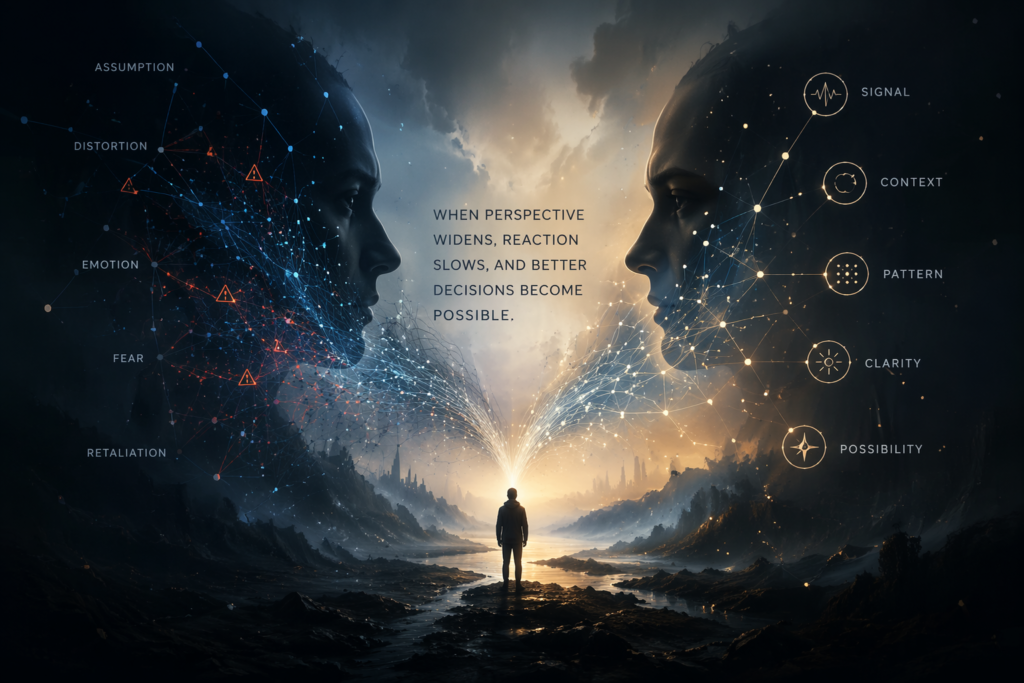
    AI conflict resolution concept showing opposing perspectives moving from distortion to clarity

    AI conflict resolution begins with understanding how escalation patterns form.

    Conflict tends to follow a familiar pattern.

    Action. Reaction. Escalation.

    Whether between individuals, communities, or nations, the loop repeats with surprising consistency. What changes is scale, speed, and the number of people forced to absorb the cost.

    Because retaliation rarely resolves conflict.

    It redistributes harm.
    It extends instability.
    And it reinforces the very conditions that created the conflict.

    So the real question is not whether conflict exists.

    It’s whether we keep responding to it through the same systems that repeatedly fail to resolve it.


    What Actually Keeps Wars Going

    Wars don’t sustain themselves by accident.

    They are maintained by reinforcing human patterns—especially under pressure.

    1. The Need for Victory

    Conflict becomes something to win, not resolve.

    This creates rigid endpoints:

    • one side must dominate
    • the other must concede

    In complex systems, that rarely happens—so the conflict continues.


    2. Rage and Emotional Momentum

    Once harm occurs, emotional energy builds fast.

    • anger becomes justification
    • grief becomes fuel
    • fear becomes preemptive action

    Perception narrows. Reaction accelerates.


    3. Revenge Loops

    Retaliation creates feedback cycles:

    action → counteraction → escalation

    Each side experiences their move as justified.
    The loop sustains itself.


    4. Historical Distortion

    Over time, narratives simplify:

    • events are compressed
    • blame is concentrated
    • identity fuses with the conflict

    The story feels absolute—even when it’s incomplete.


    5. Superiority and Dehumanization

    When one group sees itself as superior:

    • empathy drops
    • the other becomes abstract
    • harm becomes easier to justify

    At this stage, conflict is no longer just strategic—it becomes moralized.


    Technology Has Been Framed Too Narrowly

    Most discussions about AI focus on power:

    efficiency, advantage, control.

    That’s incomplete.

    At its core, AI is a pattern-recognition system.

    And conflict is built from patterns:

    • misunderstanding
    • resource pressure
    • identity threat
    • communication breakdown
    • repeated escalation loops

    Humans can sense parts of this.

    But rarely the whole system—especially in real time.


    A Different Role for AI

    AI does not need to optimize force.

    It can improve understanding.

    Not by replacing human judgment—but by improving its quality.

    The goal is not control.

    The goal is clarity.


    Where AI Can Create Clarity

    AI cannot stop a war.

    But it can interrupt the conditions that allow wars to escalate blindly.

    1. Real-Time Pattern Awareness

    AI can detect early escalation signals:

    • shifts in language tone
    • movement patterns
    • breakdowns in communication

    This allows earlier response—not just reaction.


    2. Narrative Comparison

    Different sides describe the same event differently.

    Example:

    • one calls it “defense”
    • the other calls it “attack”

    AI can surface both perspectives side-by-side—without forcing a conclusion.

    That alone exposes distortion.


    3. De-Escalation Windows

    There are moments where escalation isn’t locked in:

    • pauses
    • reduced intensity
    • openings for mediation

    Humans often miss these under stress.

    AI can highlight them.


    4. Human Cost Visibility

    War decisions often operate on abstraction.

    AI can translate impact into tangible projections:

    • civilian displacement
    • infrastructure collapse
    • recovery timelines

    This shifts decisions from symbolic to real.


    5. Signal vs Story Separation

    In high emotion, interpretation becomes “truth.”

    AI can separate:

    • confirmed signals
    • inferred meaning
    • assumptions

    This reduces unnecessary escalation driven by misinterpretation.


    A Simple Example

    Imagine a border incident.

    One side interprets movement as aggression.
    The other sees it as routine positioning.

    Without clarity:

    • alerts rise
    • retaliation is prepared
    • escalation begins

    With AI-supported clarity:

    • historical patterns are checked
    • intent probabilities are surfaced
    • communication gaps are identified

    The situation is still tense.

    But reaction slows just enough to allow verification.

    Sometimes, that pause is enough.


    The Missing Investment

    For decades, societies have invested heavily in:

    • defense
    • deterrence
    • retaliation

    Far less has gone into systems that reduce escalation early.

    What’s underbuilt are systems that:

    • reduce misunderstanding
    • surface shared interests
    • detect stress before aggression
    • support resolution before identity hardens

    That imbalance matters.


    The Human Role Remains Central

    No system can carry moral responsibility.

    And it shouldn’t.

    Humans still decide:

    • what matters
    • what is fair
    • what future is acceptable

    But better systems support better decisions.

    They widen the frame.
    They slow reaction.
    They create space between impulse and action.

    And that space is where better outcomes become possible.


    Closing Thought

    Peace cannot be enforced by technology. But clarity can be supported.

    This kind of clarity doesn’t have to come from large institutions alone. It can emerge through personal, adaptive interfaces that help individuals navigate complexity—quietly supporting better decisions in real time.

    And wars are often sustained by distorted perception under pressure.

    If we reduce distortion—even slightly—we change decisions. And repeated decisions are what shape outcomes.

    The question is no longer whether we have powerful tools. It’s whether we are willing to use them to interrupt cycles of harm instead of accelerating them.

  • Human Systems Thinking: Oddly Robbie’s Personal Operating System

    Robbie Ellestad portrait – XR and AI systems architect, founder of EmpathiumXR

    Human systems thinking starts with a simple observation: most personal blogs begin with a story, but stories alone don’t explain how people actually operate.

    A story.
    A background.
    A timeline of where someone has been.

    It makes sense. People want context before they engage.

    But context alone doesn’t explain anything.


    The Assumption

    We tend to believe that understanding a person comes from knowing their past.

    Where they grew up.
    What they went through.
    What shaped them.

    But that model is incomplete.

    Because people are not defined by events.

    They are defined by the systems they build to navigate those events.


    The System

    Every human develops internal systems over time.

    • How they process information
    • How they regulate emotion
    • How they make decisions
    • How they relate to others
    • How they adapt to change

    These systems are not fixed.
    They evolve through friction, contrast, and iteration.

    Military structure. Personal freedom.
    Isolation. Connection.
    Constraint. Exploration.

    Each contrast forces an adjustment.

    Over time, those adjustments become a personal operating system.


    Personal Context (Condensed)

    I’m Robbie.

    A veteran.
    An autistic systems thinker.
    Someone who has lived across cultures—Montana, Argentina, Japan, and now Spain.

    Each environment didn’t just add experience.

    It forced system updates.

    Different languages.
    Different expectations.
    Different definitions of identity.

    What emerged wasn’t a single story.

    It was a way of seeing.


    The Reframe

    This is not a blog about my life.

    It’s a space for observing and refining human systems.

    The focus is not:

    • what happened

    The focus is:

    • how systems form
    • how they break
    • how they can be redesigned

    What This Becomes

    This work now extends into something more intentional:

    Empathium

    An exploration of AI, XR, and human-centered systems designed to support:

    • Autonomy
    • Emotional clarity
    • Real-world connection

    Not technology that replaces people.

    Technology that understands human limits and works with them.


    System Insight

    Most people don’t need more information.

    They need better internal systems for:

    • interpreting reality
    • regulating response
    • navigating complexity

    When those systems improve, outcomes change naturally.


    Why Human Systems Thinking Matters

    Without a clear internal system, people rely on reaction instead of design.

    This leads to:

    • inconsistent decisions
    • emotional volatility
    • dependency on external structure

    Human systems thinking shifts the focus from reacting to events toward designing how you respond to them.

    Instead of asking:
    “What should I do in this situation?”

    You begin asking:
    “What system would make this decision easier next time?”


    Application

    This space brings together:

    • Personal experience → as system input
    • Technology → as system extension
    • Neurodiversity → as system variation
    • Future design → as system direction

    Nothing here is presented as final.

    Everything is iterative.


    What to Expect

    No polished perfection.
    No simplified answers.

    Instead:

    • Clear patterns
    • Working models
    • Real adjustments

    If you’re looking for certainty, this won’t help.

    If you’re learning how to think, adapt, and build your own systems—

    You’re in the right place.


    Key Insights

    • People are not their stories—they are their systems
    • Experience only matters if it changes how you operate
    • Better systems reduce the need for constant effort
    • Technology should support human systems, not override them
    • Growth is not linear—it’s iterative system refinement