Modern work often feels normal because we inherited it, not because it was designed around the human body.
A person sits upright.
A desk holds the tools.
A screen faces forward.
The spine stays compressed.
The neck holds position.
The eyes stay fixed.
Movement becomes interruption.
This is not just a work habit. It is a human system.
For centuries, tools shaped posture. Factories, schools, offices, vehicles, and computer work trained people into repeated body geometry. Sit here. Face forward. Keep still. Pay attention. Use the desk. Look at the screen. Stay in position until the task is done.
Over time, this became “normal.”
But normal does not always mean natural. Many modern work postures are better understood as industrial compatibility postures. They exist because the tools required them.
The Chair Became Infrastructure
A chair is not only furniture. It is part of a built environment that trains the body.
Homes, classrooms, offices, restaurants, waiting rooms, airports, buses, cars, and meeting rooms are organized around sitting. Once a space is designed around chairs, the body has limited choices. Standing becomes temporary. Stretching becomes awkward. Reclining becomes inappropriate. Floor-based posture becomes unusual. Movement becomes something separate from work.
That matters because the body is not only carrying the mind. The body is part of how attention, calm, fatigue, discomfort, and thought are regulated.
When work forces one posture for too long, the body has to spend energy managing that posture. The spine, neck, shoulders, hips, circulation, and nervous system all participate. Physical compression can become background stress.
And background stress affects the mind.
Digital Work Does Not Have to Stay Attached to Furniture
This is where XR becomes interesting.
XR may not simply create new behaviors. It may allow humans to recover older body patterns that industrial systems suppressed.
Before industrial standardization, people often shifted posture more naturally. They rested while working. They worked closer to the ground. They alternated movement. They adapted environments fluidly. The body had more permission to change shape.
Then modern systems narrowed the range.
Factories standardized motion.
Schools standardized attention.
Offices standardized desk posture.
Vehicles standardized seated travel.
Screens standardized forward-facing gaze.
The body adapted because the tools demanded it.
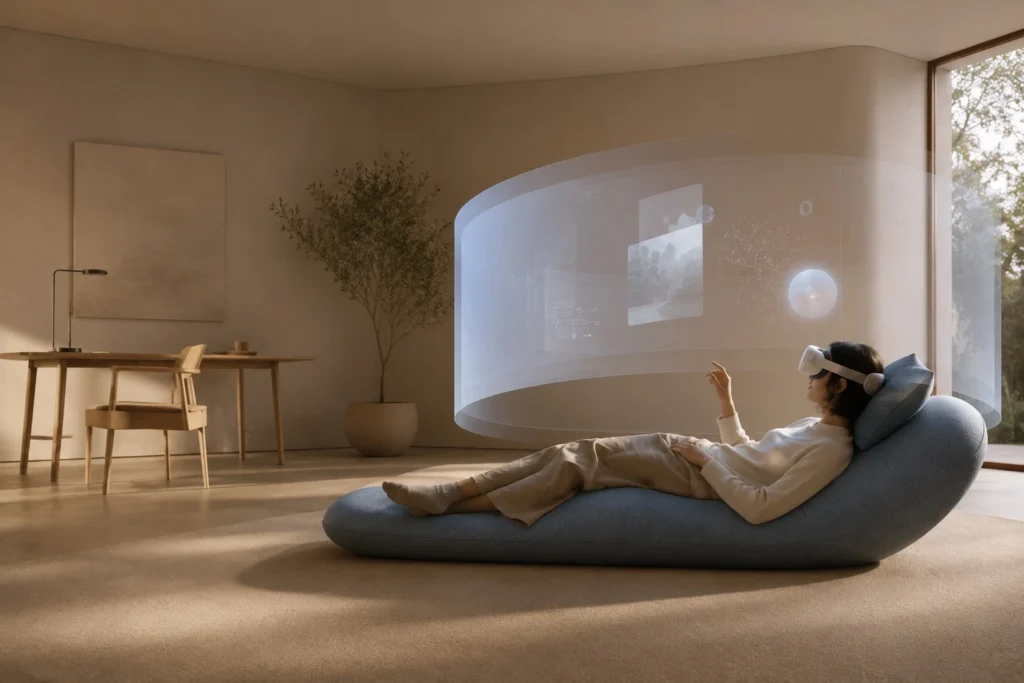
XR changes that equation because the workspace no longer has to be physically attached to a desk.
A screen can float.
It can follow gaze.
It can resize.
It can move with the body.
It can remain visible while reclined.
It can exist in a low-stimulation room.
It can support focus without demanding one fixed posture.
That breaks centuries of workstation assumptions.
Body-First Computing
I notice this in my own work. I am often supine, with a large wraparound screen in VR and my Mac resting on my chest. I do not need to see the keys, so the old desk-and-chair geometry becomes optional.
The screen can move with the body instead of forcing the body to stay fixed around the screen.
That changes the question.
The issue is not whether everyone should work lying down, standing up, or sitting on the floor. The larger point is that digital work no longer has to obey one inherited posture. XR can let the workspace adapt to the nervous system, the body, and the moment.
This is body-first computing instead of furniture-first computing.
Calm Attention Needs a Supported Body
A relaxed body can change the quality of attention.
When work is built around an upright chair, a desk, and a fixed screen, the body is often asked to hold one shape for too long. For some people, that creates unnecessary strain. The person may still be productive, but part of their attention is quietly spent managing discomfort.
If digital work can happen in a more comfortable, supported, and less spine-compressed posture, the body may not need to spend as much energy managing tension.
That can make work feel calmer.
Not easier in a lazy sense. Calmer in a systems sense. Less energy wasted on fighting the workstation. More energy available for thought, creativity, regulation, and sustained attention.
For autistic people, chronic pain users, fatigue-sensitive workers, mobility-limited people, and anyone with a sensitive nervous system, this distinction matters even more.
The future of computing should not only ask:
What can the machine do?
It should also ask:
What does the machine require from the body?
The Human Systems Reframe
Industrial systems standardized posture because tools demanded it.
XR may be the first major computing shift that lets posture become human again.
That does not mean abandoning chairs. It means questioning why so much of modern life assumes the chair is the default container for attention.
A better system would allow more variation:
reclining work, standing work, floor-based work, movement-integrated work, low-stimulation work, gaze-based work, voice-supported work, and adaptive screen placement.
The goal is not novelty. The goal is restoring choice.
When the workspace adapts to the human body, the person may become calmer, more comfortable, and more capable of sustained attention.
That is not just a health idea.
It is a design principle.
Key Insights
- Many modern work postures are industrial compatibility postures, not necessarily biologically optimal ones.
- Chairs became part of a built environment that trains stillness, posture, and attention.
- XR can separate digital work from fixed desks, fixed screens, and fixed gaze direction.
- A supported, less compressed body may reduce background stress and improve calm attention.
- The future of work should move from furniture-first computing toward body-first computing.