Tag: emotional regulation

  • The Human in Stability

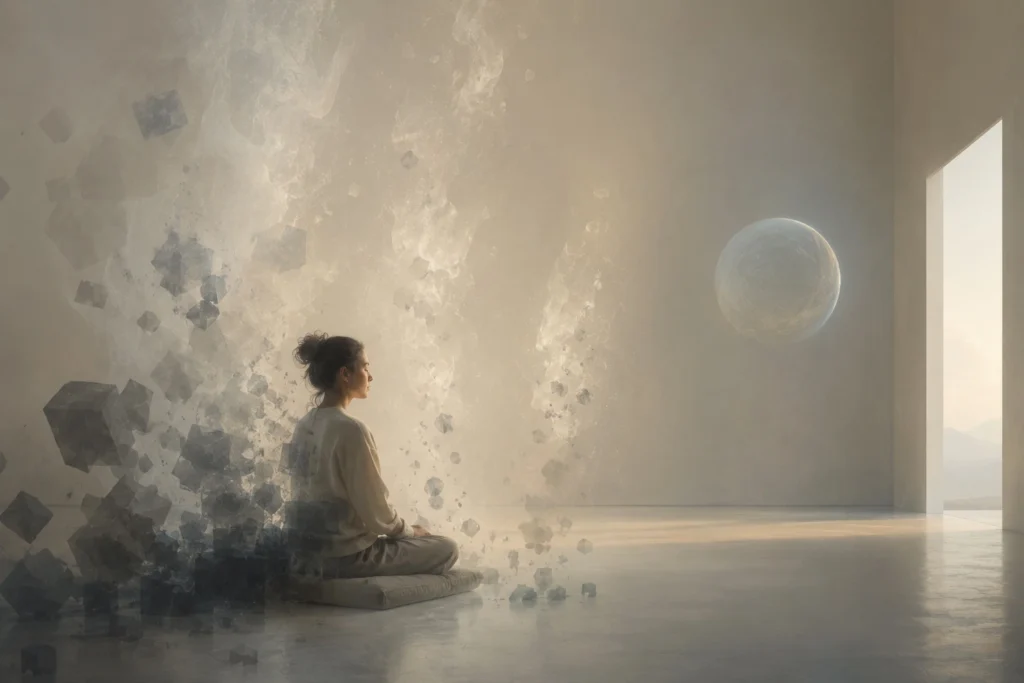
    Minimalist scene of a calm person surrounded by dissolving abstract pressure, representing the body adjusting to stability after long stress.

    The Human in Stability

    Opening

    Most human systems are designed around instability.

    Deadlines.
    Bills.
    Status pressure.
    Social expectations.
    Fear of failure.
    Fear of exclusion.
    Fear of losing security.

    Many people spend so long adapting to pressure that they begin mistaking pressure for normal human existence.

    When instability becomes constant, the nervous system reorganizes around survival.

    Break the Assumption

    We often assume that when pressure disappears, a person will immediately feel free.

    But that is not always what happens.

    Sometimes peace feels unfamiliar.
    Sometimes safety feels suspicious.
    Sometimes stability feels empty at first, not because something is wrong, but because the system has never had to operate there before.

    A person who has lived under constant pressure may not relax immediately when the pressure is removed.

    They may scan for the next problem.

    They may feel disoriented.

    They may wonder whether calm is safe.

    That reaction is not weakness.

    It is adaptation.

    System Breakdown

    Human beings are not only emotional creatures.

    We are regulatory systems.

    When a person lives under repeated stress, the body learns patterns:

    • anticipate problems
    • prepare for loss
    • monitor threats
    • manage consequences
    • stay ready for interruption
    • treat relief as temporary

    Over time, pressure becomes part of the operating environment.

    The system does not simply experience stress.

    It begins to organize around it.

    This affects attention, planning, sleep, decision-making, and identity.

    A person may begin to feel useful only when solving problems.
    They may feel grounded only when managing risk.
    They may feel familiar with pressure and unfamiliar with ease.

    So when the pressure finally drops, the body may not celebrate right away.

    It may hesitate.

    Because the nervous system is asking a practical question:

    Is this real?

    Personal Evidence

    There are moments in life when a problem disappears and the mind does not know where to go next.

    A debt gets resolved.
    A document arrives.
    A feared outcome does not happen.
    A system that was creating pressure finally stops creating pressure.

    From the outside, this should feel simple.

    Relief.

    But internally, it can feel strange.

    Not bad.
    Not wrong.
    Just unfamiliar.

    The mind reaches for the next worry and finds nothing obvious to hold.

    That empty space can feel almost disorienting when worry has been acting like structure.

    Reframe

    Stability is not the absence of life.

    Stability is a condition where the human system can stop operating from emergency mode.

    It creates room for better functions:

    • deeper attention
    • clearer decisions
    • slower interpretation
    • healthier relationships
    • creative thought
    • actual rest
    • long-term planning

    But stability must be learned if instability was the previous normal.

    A person may need time to trust it.

    Peace is not always instantly comfortable.

    Sometimes peace is a new skill.

    System Insight

    A human system shaped by pressure does not automatically become free when pressure ends.

    It must recalibrate.

    This is why stable environments matter.

    People do not only need motivation.
    They do not only need discipline.
    They do not only need better habits.

    They need conditions where the nervous system can stop defending itself.

    When pressure is constant, intelligence gets redirected toward survival.

    When stability becomes real, intelligence can return to growth.

    Application

    When stability appears, do not rush to fill it with new pressure.

    Let the system notice what has changed.

    Ask:

    • What problem is actually gone?
    • What pressure no longer needs my attention?
    • What am I still carrying out of habit?
    • What would I choose if I were not organizing around fear?
    • What can I now build slowly instead of urgently?

    The goal is not to become passive.

    The goal is to stop confusing emergency energy with purpose.

    A stable human is not a lazy human.

    A stable human has access to more of themselves.

    Key Insights

    • Constant pressure can become a person’s default operating system.
    • Relief may feel unfamiliar when the nervous system is used to survival.
    • Stability is not emptiness; it is capacity returning.
    • Calm may need to be practiced before it feels normal.
    • Human systems improve when people are not forced to organize their lives around fear.

    Closing

    When nothing is pressing down, the human does not disappear.

    The human becomes more visible.

    Not the defensive version.
    Not the over-adapted version.
    Not the version built around fear.

    The quieter human underneath.

    The one who can finally ask:

    What do I want to build now that I am not only surviving?

  • Music Isn’t Expression — It’s a System for Moving Experience

    Opening — The Assumption

    Music as a system explains why it works across time.

    Most people think music is about expression.

    Something you use to:

    • say something
    • feel something
    • release something

    But that framing misses what’s actually happening.

    Music isn’t just expression.

    It’s structure.


    Break the Assumption

    When something carries emotional weight, most people respond in two ways:

    • push it away
    • or replay it

    Neither changes the structure of the experience.

    So it stays unresolved.

    Not because it’s still happening externally—
    but because it’s still active internally.


    System Breakdown

    Here’s what actually changes the structure of an experience:

    1. Capture

    A real experience is taken as it is—without pushing it away or replaying it.

    It’s held as a signal, not a story.

    No explanation.
    No judgment.

    Just recognition.


    2. Translate

    That experience is converted into structure.

    Not explained.
    Not analyzed.

    Structured.

    This is where music comes in.


    Why Music Works

    Music functions as a translation system because it aligns with how the human system already operates:

    • Rhythm organizes internal chaos into timing
    • Pattern makes the experience predictable
    • Progression allows movement and release

    Without structure, experience loops.
    With structure, experience moves.

    The more precisely the music matches the state,
    the more efficiently the system moves.


    3. Move With It

    Once structured, the experience is no longer stuck.

    It can be:

    • felt without overwhelm
    • repeated without looping
    • released without force

    You’re not escaping it.

    You’re giving it a form the system can process.


    Why Certain Music Works in Specific Situations

    This isn’t preference—it’s alignment.

    Breakups

    The system is processing:

    • loss
    • identity shift
    • unresolved loops

    Breakup songs work because they:

    • mirror the emotional pattern
    • provide structure
    • move through progression (pain → reflection → release)

    They help the system complete a process.


    Productivity

    The system needs:

    • stability
    • low interruption
    • predictable flow

    Music helps when it:

    • repeats
    • avoids surprise
    • maintains steady rhythm

    This reduces internal noise and stabilizes focus.


    Workouts

    The system needs:

    • drive
    • synchronization
    • momentum

    Music supports this by:

    • increasing tempo
    • reinforcing rhythm with movement
    • creating clear peaks and progression

    The body begins to move with the rhythm instead of resisting effort.


    System Pattern

    Across all cases:

    • The state determines the need
    • The music provides structure
    • The system aligns and moves

    Music doesn’t create the state.

    It organizes it.


    Reframe

    Music isn’t something you turn to for relief.

    It’s a system that converts experience into movement.


    System Insight

    Because the human system hasn’t fundamentally changed:

    • rhythm still regulates the body
    • pattern still drives cognition
    • progression still processes emotion

    That’s why music works across time.

    Not because it’s remembered.

    Because it still fits.


    Application

    Use this intentionally:

    • Need calm → slower, steady rhythm
    • Need focus → repetition and simple patterns
    • Need release → clear build and resolution

    Or create:

    • start with the experience
    • translate into rhythm
    • shape into progression

    You’re not making music.

    You’re structuring experience.


    Key Insights

    • Unresolved experiences persist because their structure doesn’t change
    • Music provides structure where none exists
    • Rhythm, pattern, and progression map directly to human systems
    • The closer the match between music and state, the more effective the result
    • Music works across time because the human system is stable

    Closing

    Music doesn’t remove what happened.

    It makes it workable.

    And once something is workable—

    it can finally move.