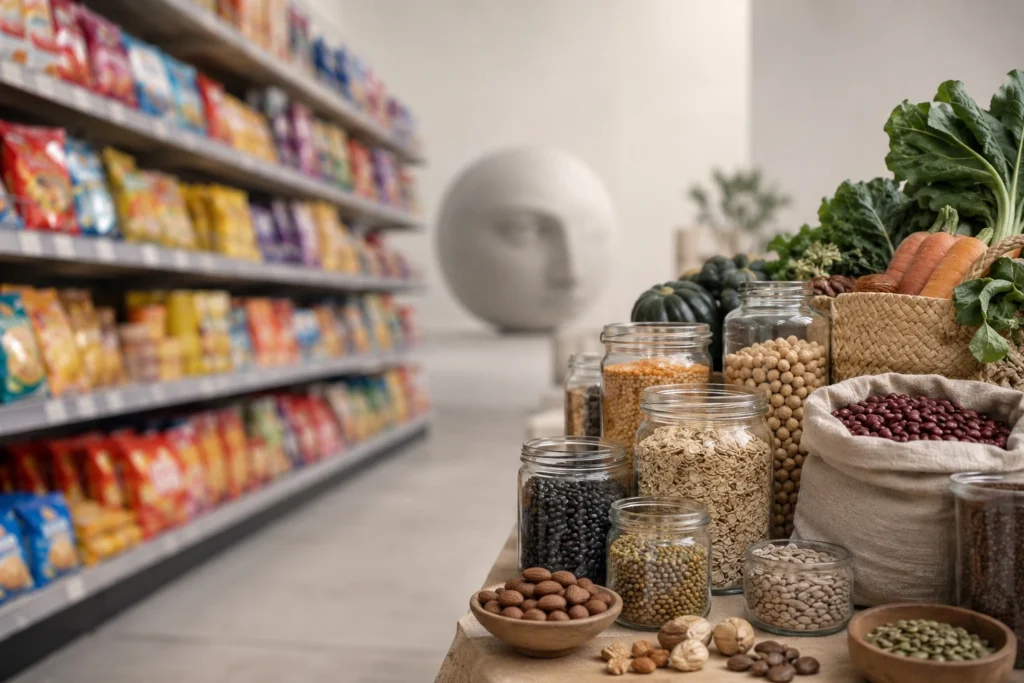
Walk through many modern grocery stores and a strange pattern appears.
Some of the most heavily marketed foods in the building are often among the least nutritionally useful.
Bright packaging.
Engineered flavors.
Convenience products.
Impulse snacks.
Lifestyle branding.
Meanwhile, some of the most biologically stable foods are sitting quietly on lower shelves in plain bags with almost no marketing at all:
- dry beans
- lentils
- oats
- seeds
- rice
- seasonal produce
- local legumes
Some of the most nutritionally useful foods in modern stores are also among the least marketed.
Break the Assumption
We often unconsciously assume that price, branding, and visibility reflect nutritional value.
But modern food systems are not optimized primarily around long-term biological stability.
They are optimized around:
- scalability
- shelf life
- repeat purchasing
- stimulation
- convenience
- emotional appeal
- profit margins
This changes how humans perceive value.
Highly processed foods begin to feel “important” simply because they dominate visual attention.
Simple foods begin to feel outdated, low-status, or incomplete.
System Breakdown
For most of human history, stable food systems depended on:
- storage
- preservation
- preparation
- seasonality
- local agriculture
- nutrient density
- long-duration energy
Humans soaked beans.
Sprouted seeds.
Stored grains.
Cooked in batches.
Ate regionally available foods.
Used fermentation and preservation to extend stability across seasons.
These behaviors were not primitive accidents.
They were adaptive system solutions.
Modern industrial food systems increased convenience dramatically, but they also created separation:
- food detached from season
- food detached from region
- food detached from preparation
- food detached from biological pacing
The result is a system where stimulation often becomes more visible than nourishment.
A heavily marketed processed snack may cost several times more than a bag of legumes while providing far less long-term biological support.
Meanwhile, simple foods continue quietly delivering:
- protein
- fiber
- mineral density
- stable energy
- gut support
- long storage life
- affordability
without needing sophisticated marketing campaigns.
Reframe
Many older food practices are quietly returning:
- soaking beans
- pressure cooking
- sprouting
- seasonal eating
- buying staple foods in dry form
- cooking larger shared meals
- rotating grains and legumes
Not because people are moving backward.
Because many modern systems drifted away from human biological realities.
Humans still respond well to:
- stable nutrition
- slower digestion
- diverse plant intake
- lower food volatility
- preparation rituals
- predictable nourishment
The body never fully adapted to the speed of industrial food systems.
System Insight
Food systems affect far more than physical health.
They influence:
- cognitive stability
- emotional regulation
- household stress
- financial resilience
- family continuity
- long-term autonomy
A household that understands simple food systems gains leverage.
Knowledge of:
- soaking
- storage
- sprouting
- pressure cooking
- ingredient rotation
- seasonal adaptation
reduces dependence on highly processed convenience systems and creates resilience during periods of instability or inflation.
This is not about perfection or rejecting modern life.
It is about recognizing that many low-cost foundational foods still contain enormous biological value despite receiving very little attention.
Application
Small shifts can meaningfully improve both cost stability and nutritional quality:
- replacing some processed snacks with legumes or oats
- adding seeds to simple meals
- rotating local seasonal produce
- learning one or two staple pressure cooker meals
- sprouting small amounts of seeds or beans at home
- buying dry staples instead of highly processed convenience foods
These changes are often less expensive than people expect because many foundational foods remain among the cheapest items in the store.
Key Insights
- Modern food systems often market stimulation more aggressively than nourishment.
- Price and visibility do not always reflect biological usefulness.
- Many traditional food practices were adaptive stability systems.
- Simple staple foods remain some of the most nutrient-dense and affordable foods available.
- Food literacy increases household resilience and autonomy.
- Some of the most valuable nutritional systems are hiding in plain sight.