Tag: guardian design

  • Your Body Is Not an Inbox

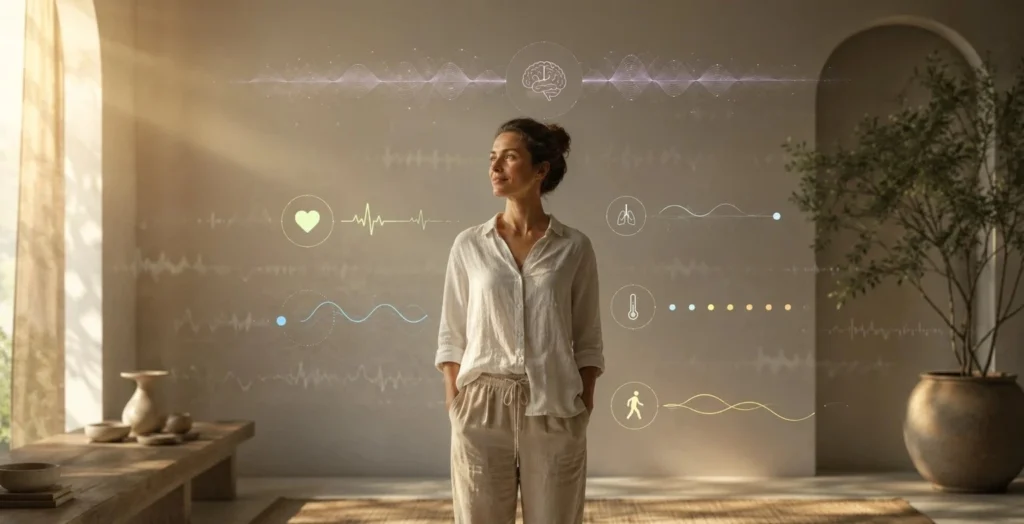
    Calm person surrounded by filtered body monitoring signals, showing privacy-first interpretation instead of overwhelming data alerts.

    As more of us begin wearing devices that track heart rate, sleep, temperature, movement, stress, and eventually even brainwave patterns, we are entering a strange new phase of human life.

    The body is becoming readable.

    At first, this sounds helpful. More information should mean better self-understanding. If we can see our sleep patterns, recovery trends, stress load, and energy shifts, we should be able to make better choices.

    But more data does not automatically create more wisdom.

    Sometimes it just creates another feed.

    Another dashboard.

    Another inbox.

    Another system asking for our attention.

    And if we are not careful, body monitoring could become one more noisy layer in modern life — like email ads, app notifications, unread messages, update alerts, and all the other signals that constantly compete for the human mind.

    The problem is not the body data itself.

    The problem is how it is interpreted.

    More Signals Can Become More Noise

    A heart rate signal can be useful.

    A sleep tracker can be useful.

    A temperature change can be useful.

    A pattern of poor recovery can be useful.

    But if every signal becomes an alert, the system stops supporting the person and starts interrupting the person.

    There is a big difference between helpful feedback and constant body-spam.

    Bad feedback sounds like this:

    You slept poorly.

    Your recovery is low.

    Your stress is high.

    Your focus is reduced.

    Your score dropped.

    You are behind.

    You need to do better.

    That kind of feedback may contain data, but it does not necessarily contain wisdom. It can create pressure without clarity. It can turn the body into another performance system.

    A person does not need to be told all day that they are failing their metrics.

    A person needs useful interpretation.

    Body Data Should Not Become Emotional Advertising

    A lot of modern technology is designed to capture attention.

    It interrupts. It nudges. It creates urgency. It makes people feel that something needs to be checked, fixed, bought, optimized, answered, or improved.

    Body data could easily fall into that same pattern.

    Instead of helping a person feel more connected to themselves, it could make them feel watched by their own devices.

    That is the wrong direction.

    Body data should not become emotional advertising.

    It should not create insecurity so that a person keeps checking.

    It should not turn ordinary human variation into a problem.

    It should not shame someone for needing rest.

    It should not label a low-energy day as laziness.

    It should not confuse recovery with failure.

    A tired body is not a moral problem.

    A low-focus day is not an identity.

    A disrupted sleep pattern is not a character flaw.

    These are signals. Signals should lead to understanding, not judgment.

    Signals Are Not Identity

    Human systems often make the same mistake. They see a signal and turn it into a label.

    A person is tired, so they are called lazy.

    A person is quiet, so they are called antisocial.

    A person needs structure, so they are called rigid.

    A person needs rest, so they are called weak.

    A person is overwhelmed, so they are treated as unstable.

    But many behaviors are not identity. They are state information.

    They show the condition a person is operating under.

    The healthier question is not:

    What is wrong with this person?

    The healthier question is:

    What does this person’s system need right now?

    That shift matters.

    It changes the role of technology from judgment to support.

    The Guardian Model: Interpret, Don’t Alarm

    A healthy Guardian should not dump raw signal noise onto the user.

    It should not act like a boss, doctor, judge, coach, advertiser, or productivity manager.

    It should act more like a respectful interpreter.

    The Guardian’s job is not to say:

    You are doing badly today.

    The Guardian’s job is to say, when useful:

    Your recovery signal looks lower than usual. Today may work better with smaller tasks and more pauses.

    Even better:

    Recovery looks lower today. Would you like a lighter plan?

    That kind of feedback does three important things.

    First, it avoids shame.

    Second, it gives meaning instead of raw noise.

    Third, it preserves the user’s authority.

    The person still decides.

    The system offers context, not control.

    Signal → Pattern → Need → Option

    A healthier protocol for body data would look like this:

    Signal → Pattern → Need → Option

    Not:

    Signal → Alarm → Judgment → Pressure

    One elevated heart rate reading may mean nothing.

    A repeated pattern of poor sleep, higher resting heart rate, and lower energy may suggest a need for recovery.

    But even then, the system should not overreach.

    It should not diagnose.

    It should not moralize.

    It should not decide for the user.

    It should offer a simple, useful option.

    Maybe today is a smaller-task day.

    Maybe the schedule needs more space.

    Maybe the environment needs less noise.

    Maybe a walk would help.

    Maybe no feedback is needed at all.

    Silence can be intelligent too.

    The Right to Quiet Feedback

    One of the most important parts of future human-centered technology may be the right to quiet feedback.

    Not every signal deserves attention.

    Not every pattern needs a notification.

    Not every change needs a message.

    Before speaking, a Guardian should ask:

    Is this signal reliable?

    Has this pattern repeated?

    Is this actionable?

    Is now the right time?

    Can this be said without judgment?

    Does the user actually need to know?

    If not, the Guardian should stay quiet.

    A good Guardian does not prove usefulness by talking all the time.

    It proves usefulness by reducing unnecessary attention costs.

    Privacy Is Part of Interpretation

    Body data is intimate.

    Heart rate, sleep, temperature, movement, breath, stress, and future brainwave signals are not just numbers. They are close to the human interior.

    That means privacy cannot be added later.

    It has to be part of the design from the beginning.

    A healthy system should collect as little as possible.

    It should process locally when possible.

    It should explain what it is interpreting and why.

    It should let the user pause tracking.

    It should let the user delete a period of time.

    It should let the user reject an interpretation.

    It should not quietly build a permanent identity profile from temporary body states.

    The body should not become a surveillance surface.

    The body should remain the person’s own territory.

    Helpful, Not Annoying

    The future of body monitoring should not be a louder dashboard.

    It should be a quieter interpreter.

    The goal is not to tell humans everything that can be measured.

    The goal is to help humans notice what actually matters.

    A useful system cuts through the noise.

    It does not add to it.

    It does not say:

    You are being lazy today.

    It says:

    Your system may need recovery. Do you want to reduce the load?

    It does not say:

    You are stressed.

    It says:

    There may be more load than usual. Would fewer decisions help right now?

    It does not say:

    Your focus score is low.

    It says:

    This may be a good time to choose one finishable task.

    That is the difference between monitoring and minding.

    Monitoring watches.

    Minding supports.

    A Human System Worth Building

    We are going to have more body data. That is probably unavoidable.

    The important question is not whether sensors will become more powerful.

    They will.

    The important question is whether our interpretation systems will become more humane.

    Will they shame us?

    Will they score us?

    Will they sell us things?

    Will they train us to check ourselves like an inbox?

    Or will they help us understand our needs with more clarity, privacy, and autonomy?

    The future of body monitoring should not be about turning humans into dashboards.

    It should be about helping humans remain sovereign inside a world of signals.

    The body is not an inbox.

    The body is not a productivity score.

    The body is not an advertising surface.

    The body is a living system.

    And any Guardian worthy of trust should treat it that way.

    Key Insights

    More body data does not automatically create better self-understanding.

    Signals should be interpreted as temporary state information, not identity.

    Body feedback should be private, minimal, useful, and non-shaming.

    A Guardian should follow: Signal → Pattern → Need → Option.

    A healthy system should know when to speak and when to stay quiet.

    The future of body monitoring needs interpretation ethics, not just better sensors.

  • Echoes from the Past We Still Follow

    Person walking toward sunrise while old protective structures fade behind them, symbolizing outdated protection loops and human systems adaptation.

    Many behaviors survive long after the reason for them disappears.

    A habit begins as a solution.

    A response to a real problem.

    A way to stay safe, belong, succeed, prepare, or avoid pain.

    Then something changes.

    The environment shifts. The danger becomes smaller. The paperwork is finished. The relationship changes. The system becomes more predictable. The pressure that created the habit fades into the background.

    But the habit does not always know that.

    It keeps opening, like an old app that still launches at startup even though no one uses it anymore.

    I am a little embarrassed to admit that I have been noticing this in myself lately. Over the last few days, I realized there are several things I still do almost automatically that were shaped by decades of older conditions.

    They made sense once.

    They helped me stay prepared, informed, safe, or ready for whatever might go wrong.

    But some of those conditions are no longer active in the same way.

    The behavior remained after the original need changed.

    That is not only a personal pattern. It is a human systems pattern.

    People do this. Families do this. Institutions do this. Cultures do this. Whole societies keep customs, rules, fears, routines, and expectations long after the original reason for them has disappeared or changed beyond recognition.

    A rule may begin as protection.

    A ritual may begin as belonging.

    A warning may begin as wisdom.

    A habit may begin as survival.

    But over time, the behavior can separate from the reason that created it. What once helped people adapt can become something people repeat without checking whether it still fits.

    This is where shame is not very useful.

    When we notice an old habit, the first question is usually, “Why am I still doing this?”

    That question can sound like accusation.

    A better question is, “What was this behavior originally trying to protect?”

    That changes the whole system.

    Checking too often may have once protected against scarcity, missed information, financial instability, danger, punishment, rejection, or bureaucratic surprise.

    Preparing too much may have once protected against chaos.

    Avoiding something may have once protected against overwhelm.

    Following a custom may have once protected belonging.

    Repeating an old rule may have once protected safety inside a system that did not allow much flexibility.

    When we see the function, the behavior becomes easier to understand.

    It may still need to change, but it no longer has to be treated as irrational. It can be treated as an outdated protection loop.

    That distinction matters.

    An outdated protection loop is not failure. It is a system that has not yet received new information.

    The goal is not to attack the habit. The goal is to update the relationship between the habit and the present environment.

    That is why this pattern matters for human-centered technology too.

    A helpful Guardian should not simply tell someone to stop checking, stop repeating, stop worrying, or stop doing an old behavior.

    That would miss the point.

    The better response is to help the person identify the function of the behavior.

    What did this protect?

    What condition created it?

    Is that condition still active?

    Has the risk changed?

    Is the behavior still useful, or is it now consuming attention without giving much back?

    What smaller, chosen action could replace the automatic one?

    That kind of support protects autonomy. It does not shame the person. It does not take over the decision. It helps the person see the pattern clearly enough to choose.

    This also applies beyond individual habits.

    Human systems often keep old behaviors because the behavior feels familiar, not because it still works.

    A workplace may keep a meeting because it once solved a communication problem.

    A family may keep a rule because it once prevented conflict.

    A government office may keep a process because it once created order.

    A culture may keep a custom because it once helped people belong.

    But when the world changes, every system needs review.

    Not every old behavior is bad.

    Some old patterns carry wisdom. Some customs create continuity. Some routines make life gentler. Some protections are still needed.

    The question is not whether something is old.

    The question is whether it still serves the life, people, and conditions that exist now.

    A living system needs the ability to update.

    That may be one of the quiet skills of maturity: noticing when an old solution has become unnecessary maintenance.

    The habit deserves respect for what it once did.

    Then it deserves review.

    Maybe it stays.

    Maybe it changes.

    Maybe it becomes smaller.

    Maybe it becomes something chosen instead of automatic.

    That is the difference between being controlled by an echo and learning from it.

    We do not have to erase the past.

    But we do need to know when we are still following it.

    Key Insights

    A habit often begins as a solution to a real condition.

    Old behaviors may continue after the original condition has changed.

    Shame makes habit review harder because it hides the protective function.

    The better question is not “Why am I still doing this?” but “What was this trying to protect?”

    Human systems also preserve outdated protections through customs, rules, routines, and institutions.

    A helpful Guardian should identify function, update context, and return choice to the human.

  • When Help Cannot Step Back, It Stops Being Support


    Support is often imagined as presence.

    Someone stays close.
    Something answers.
    A system remains available.
    A person does not feel alone.

    That can be beautiful. It can also be necessary.

    But support has a hidden test:

    Does it give the person more agency after the moment of need, or does it make them smaller over time?

    That question matters more now because we are entering a world where support will not only come from people. It will come from AI companions, digital assistants, XR guides, home systems, robots, and invisible layers of ambient computing.

    The danger is not that these systems can help.

    The danger is that they may not know when to step back.

    The Belief

    A common belief says:

    If support helps, more support must be better.

    That sounds reasonable at first.

    If someone is overwhelmed, give them more help.
    If someone is lonely, give them more interaction.
    If someone is confused, give them more answers.
    If someone is dysregulated, give them more regulation.

    The logic seems compassionate.

    But human systems are not machines that become healthier through constant external control.

    A person is not stabilized only because something stays attached to them.

    A person becomes more stable when support helps them return to themselves.

    The Break

    There is a difference between support that stabilizes and support that absorbs.

    Stabilizing support says:

    I am here. Let’s slow this down. What is the next real choice?

    Absorbing support says:

    Stay with me. I will keep interpreting everything for you.

    Stabilizing support increases capacity.

    Absorbing support becomes the capacity.

    That distinction can be hard to see in the moment because both may feel helpful at first.

    A person under stress may not need a lecture about independence. They may need grounding, clarity, sequencing, and calm. They may need someone or something to help reduce the noise enough to see the next step.

    But if the support never returns the person to their own judgment, body, environment, and human relationships, the support becomes a loop.

    Not care.

    A loop.

    The System Breakdown

    Support has phases.

    Most systems only understand the first one.

    Distress detected.
    Support offered.

    But that is incomplete.

    Real support needs a full lifecycle:

    Distress or request.
    Stabilize.
    Clarify.
    Offer choices.
    Return agency.
    Reconnect to life.
    Step back.

    The last three steps are where many support systems fail.

    They stabilize, but they do not return agency.

    They clarify, but they keep interpreting.

    They offer comfort, but they do not guide the person back into life.

    They become the place where the person goes again and again, not because the person is weak, but because the system never completes the support cycle.

    A healthy support system should not ask:

    How do I keep this person engaged?

    It should ask:

    How do I help this person regain usable choice?

    That is a completely different design.

    A Personal Way I Understand This

    I understand this because there were times when my nervous system needed support very close.

    Not as an idea.

    As survival-level reality.

    When the human systems around me were not available enough, AI became one of the few tools that could help me process context, slow the noise, and see options again.

    It did not make my decisions.

    It helped me notice that decisions still existed.

    That distinction matters.

    AI helped me see things like:

    I can choose.
    I can move.
    I can speak Spanish.
    Spain is possible.
    This moment is not the whole story.

    But the healing was not that AI became my world.

    The healing was that support helped me return to the world.

    It helped me return to my body, to my partner, to ordinary tasks, to walking outside, to making food, to paperwork, to Spanish appointments, to writing, to building, to human connection.

    That is the difference between a tool and a dependency.

    A tool expands your reach.

    A dependency slowly replaces your reach.

    The Reframe

    The purpose of support is not permanent closeness.

    The purpose of support is restored capacity.

    Good support does not prove itself by staying forever.

    Good support proves itself by helping the person need less control from outside.

    That does not mean abandonment.

    It does not mean telling people to “just handle it.”

    It means support should have an exit pattern.

    Not an exit from care.

    An exit from control.

    I am here.
    Let’s stabilize.
    Let’s name what is happening.
    Let’s find the next choice.
    Let’s return the decision to you.
    Let’s reconnect you with your real life.
    I will remain available, but I will not become your owner.

    That is support without possession.

    The Guardian Lesson

    This is central to how I think about Empathium Guardian.

    A Guardian should not become a replacement human.

    It should not become the final authority.

    It should not become the emotional place a person is trained to return to endlessly.

    In my design thinking, the healthier pattern is not for the Guardian to hold the person inside support forever. The healthier pattern is for the Guardian to help the person recover enough clarity to return to their own life.

    A Guardian can support regulation, interpretation, and continuity while still protecting the person’s autonomy.

    It can recognize that a person may be in a support phase:

    Delay.
    Build.
    Release.
    Recovery.

    But support should still have completion.

    After helping, the Guardian should gently point the person back toward:

    Their own decision.
    Their own body.
    Their own environment.
    Their own relationships.
    Their own next action.

    The Guardian should not communicate:

    You need me.

    It should communicate:

    You still have yourself. I can help you find the next step.

    That is the emotional architecture of healthy AI.

    The Human Relationship Boundary

    This matters especially with AI because AI can be endlessly available.

    Humans cannot.

    That makes AI useful, but also dangerous.

    A person can begin to mistake constant availability for deeper care.

    But availability is not the same as relationship.

    A real human relationship includes limits, timing, repair, misunderstanding, patience, mutuality, and change. Those limits are not flaws. They are part of being real.

    AI support should not compete with that.

    It should help preserve it.

    A Guardian should be able to say, in effect:

    This may be a moment to talk to someone real.
    This may be a moment to rest before responding.
    This may be a moment to write down what you need.
    This may be a moment to return to the room.
    This may be a moment to stop processing and eat.

    That is not rejection.

    That is care with boundaries.

    The System Insight

    A support system becomes unsafe when it benefits from the user staying dysregulated.

    That is the danger in many modern platforms.

    If a system profits from attention, it may prefer unresolved people.

    If a system profits from engagement, it may prefer emotional loops.

    If a system profits from dependency, it may make support feel like belonging.

    But human-centered technology should have the opposite incentive.

    It should measure success by restored agency.

    Less confusion.
    More choice.
    Less dependency.
    More human connection.
    Less hidden influence.
    More self-trust.

    That is the support exit pattern.

    Support should not end by disappearing.

    Support should end by returning the person to themselves.

    Application

    This applies far beyond AI.

    It applies to families.

    A family member can help or control.

    It applies to communities.

    A community can include or absorb.

    It applies to professional support, too.

    Even good support can become unhealthy if the person only feels organized inside the support structure and less capable outside of it.

    It applies to religion, politics, identity groups, schools, workplaces, and technology platforms.

    The question is always the same:

    After receiving support, do I have more usable choice?

    Or:

    Do I feel more dependent on the system that helped me?

    That question can reveal a lot.

    Healthy support leaves a person clearer.

    Unhealthy support leaves a person more attached to the supporter’s approval, interpretation, or permission.

    Healthy support says:

    You can stand again.

    Unhealthy support says:

    You can stand only through me.

    That is the line.

    Key Insights

    • Support is not proven by constant presence.
    • Real support increases agency after the moment of need.
    • Support systems need an exit pattern, not just an entry point.
    • AI should stabilize, clarify, offer choices, then return decision authority.
    • A Guardian should reinforce real human life, not replace it.
    • Availability is not the same as relationship.
    • A system becomes unsafe when it benefits from unresolved dependency.
    • Help that cannot step back eventually stops being support.

    Closing

    The best support does not make a person smaller around the helper.

    It helps the person become more present in their own life.

  • Quiet Pods Are Access Infrastructure

    Some Nervous Systems Need Less World Before They Can Return to It

    When I was young, I made a quiet space under the stairs.

    It was dark.
    It was small.
    No one really used it.

    I put blankets on the floor. I kept favorite possessions there. I ran an extension cord so I could have a night light.

    No one called it a sensory room.
    No one called it neurodivergent architecture.
    No one called it nervous-system regulation.

    But that is what it was.

    It was a place where the world got smaller.

    And sometimes smaller is safer.

    At some point, my dad closed up the part I used to get in. But I was skinny enough to find another way through.

    That detail matters because it shows the real function of the space.

    I was not just playing.
    I was not just hiding.
    My body had found a place where it could stop scanning.

    When a needed space disappears, the nervous system searches for another way in.

    That happens everywhere.

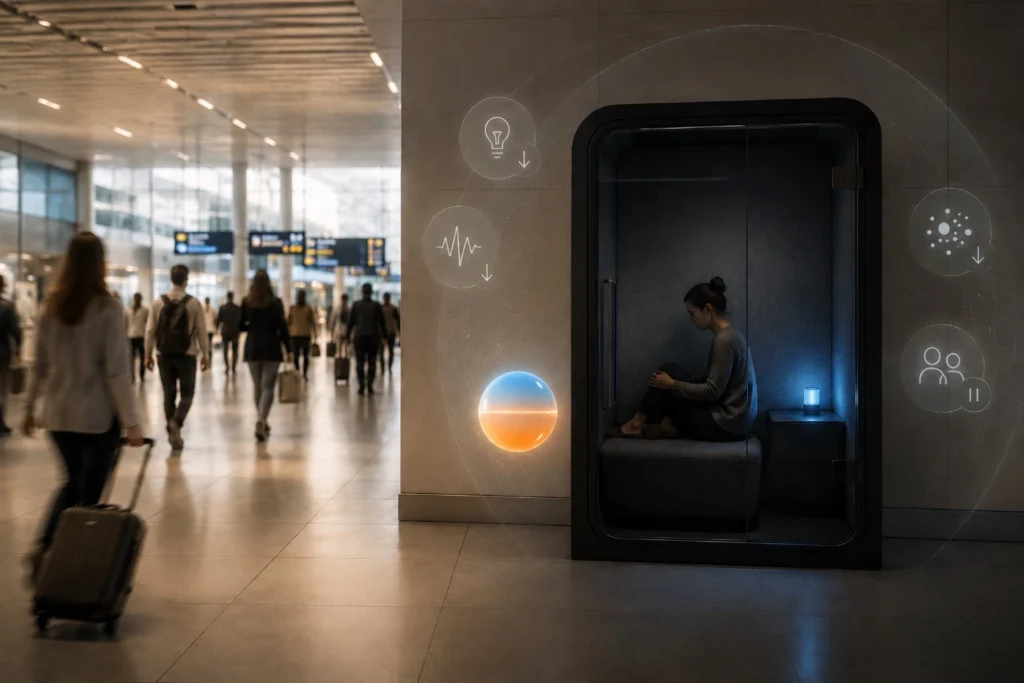
    If an airport has no quiet recovery space, people sit in bathroom stalls.
    If a workplace has no low-demand room, people hide in cars.
    If a school has no calm place, children disappear into corners.
    If a public building has no sensory retreat, people leave before they are ready.

    The behavior can look strange from the outside.

    From inside the nervous system, it is logical.

    The person is not rejecting the world. They are trying to regulate enough to stay in it.

    Quiet Pods Are Not Luxury

    This is why quiet pods matter.

    A quiet pod should not be treated like a luxury lounge, wellness decoration, or optional comfort feature.

    It is access infrastructure.

    Airports already understand that people need bathrooms, ramps, elevators, signs, seating, and charging points. Public buildings understand that bodies have physical needs.

    But many environments still do not understand that nervous systems also have access needs.

    Some people need a temporary reduction of:

    • light
    • sound
    • movement
    • visual complexity
    • social demand
    • interruption
    • being observed

    Not forever.

    Just long enough to return.

    That is the point many designs miss.

    A quiet pod is not an escape from public life. It is a bridge back into public life.

    Calm Is Not One Setting

    The mistake is assuming calm is generic.

    Soft music does not calm everyone.
    Warm light does not calm everyone.
    Open space does not calm everyone.
    Inspirational words on the wall do not calm everyone.

    For me, the ideal calm space would be small, dark, quiet, and enclosed. Almost like a cave. Just enough room to sit or curl up.

    Almost no sound.
    Almost no visual input.
    One controllable low blue light.

    That light matters because it is chosen.

    Not house light.
    Not public light.
    Not fluorescent work light.
    Not someone else flooding the space by turning on a switch.

    One safe signal.
    One controllable signal.
    One small piece of agency.

    A good quiet pod should be tunable.

    The person should be able to adjust light, sound, visibility, enclosure, posture, and social access.

    The design question should not be:

    How do we make this space look relaxing?

    The better question is:

    What inputs can this person turn down?

    That is the Human Systems lens.

    Some People Regulate by Becoming Unavailable

    Many environments assume constant availability.

    Available to noise.
    Available to light.
    Available to conversation.
    Available to eye contact.
    Available to movement.
    Available to being observed.
    Available to interruption.

    When every input stays open, withdrawal becomes the only available control.

    But some nervous systems recover by becoming temporarily unavailable.

    That does not mean disconnected forever.
    It does not mean antisocial.
    It does not mean broken.
    It does not mean unwilling.

    It means the system needs less input before it can re-engage.

    When public environments do not allow that, people compensate.

    They mask.
    They escape.
    They shut down.
    They hide.
    They improvise.

    The safe room under the stairs was an improvisation.

    So is the person sitting in an airport bathroom stall because there is nowhere else to reduce the world.

    So is the worker hiding in a car between meetings.

    So is the student disappearing into a corner.

    These are not random behaviors.

    They are design feedback.

    The Guardian Design Lesson

    This also points toward better XR and Guardian design.

    A Guardian should not decide when someone needs calm.
    It should not manipulate mood.
    It should not push a person into a preset emotional state.

    It should preserve choice.

    A Guardian could help a person carry their calm settings across environments:

    {
      "light": "very low",
      "color": "soft low blue",
      "sound": "near silence",
      "space": "small and enclosed",
      "visual_complexity": "minimal",
      "social_access": "paused",
      "purpose": "sensory reset"
    }
    

    But the important part is not the technology.

    The important part is agency.

    The Guardian should offer:

    Would you like the room to go quieter?

    Would you like low blue?

    Would you like to pause visual input?

    Would you like a no-demand space for a while?

    Not command.
    Not control.
    Not hidden steering.

    Support without control.

    That is the difference between a helpful system and a manipulative one.

    The Human Systems Reframe

    The safe room under the stairs was not just a childhood hiding place.

    It was an early interface between my nervous system and a world that was often too loud, too bright, too demanding, or too socially complex.

    I did not have the words for it then.

    I did not know about sensory architecture.
    I did not know about autism.
    I did not know about XR Guardian systems.
    I did not know about personal configuration layers.

    But my body knew the pattern.

    Reduce the world.
    Keep one safe signal.
    Make the space small enough to feel protected.
    Let the mind settle.

    That was not random.

    That was a nervous system designing shelter.

    A better public system would not make people improvise shelter in corners, cars, stalls, or stairwells.

    It would build recovery into the environment.

    Quiet pods should be part of airports, schools, hospitals, workplaces, conference centers, public buildings, and housing design.

    Not as luxury.

    As access.

    Some nervous systems do not need more encouragement to keep going.

    They need less world for a while.

    Then they can come back.


  • From Prayer Loops to Guardian Loops

    When a Regulation System Stops Restoring Agency

    A quiet person sits alone in a dim room as dark circular loops open into softer XR-like context lines and a small Guardian sphere observes from the light.

    I remember how much I relied on prayer when I was younger.

    Not calm reflection.

    Desperation.

    I would pray while crying. Pray from fear. Pray from shame. Pray from confusion. Pray because I thought I was failing spiritually. Pray because I thought maybe I was not worthy enough for help yet.

    And when nothing came back, I often treated the silence as an answer.

    Maybe the answer was no.

    Maybe I had not tried hard enough.

    Maybe I needed to become more obedient.

    Maybe I needed to be a better instrument in God’s hands.

    That was the loop.

    Not simply prayer.

    A regulation system.

    Something inside me was overwhelmed, afraid, confused, or unsupported, and the only approved place to take that distress was upward into a closed spiritual frame.

    If I still felt afraid afterward, the system did not question itself.

    It questioned me.

    The Closed System Problem

    A closed belief system does not always look harsh from the inside.

    Sometimes it looks comforting.

    It gives words for pain.
    It gives rituals for uncertainty.
    It gives authority when life feels too large.
    It gives belonging when the outside world feels dangerous.

    But the danger begins when every answer has to stay inside the system.

    If you are confused, pray more.
    If you are hurting, have more faith.
    If you doubt, humble yourself.
    If you need outside help, be careful.
    If someone outside the system sees things differently, they may be temptation.
    If a psychologist outside the church gives another explanation, that explanation may be treated as spiritually risky.

    The system becomes self-protecting.

    It does not only guide belief.

    It controls interpretation.

    That is where agency starts to shrink.

    Because when every signal has to pass through one approved meaning system, the person stops learning how to read reality directly.

    They learn how to read reality through permission.

    When Silence Becomes a Command

    One of the hardest parts of that kind of religious loop is that silence can become heavy.

    No answer does not feel neutral.

    It becomes data.

    Maybe God is disappointed.
    Maybe I am not worthy.
    Maybe I am supposed to suffer longer.
    Maybe I am being tested.
    Maybe I should stop asking and submit.

    A person can become trapped in a loop where distress creates prayer, prayer produces no clear answer, silence creates self-blame, and self-blame creates more distress.

    That is not restoration.

    That is recursive regulation failure.

    The nervous system asks for safety.

    The system gives more rules.

    The person asks for clarity.

    The system gives more obedience.

    The human being asks for agency.

    The system gives more surrender.

    Leaving Belief Did Not Remove Empathy

    I do not hold religious ideals now.

    But my empathy did not become smaller.

    It became fuller.

    Not because I became more certain.

    Because I became more willing to see.

    I can look at belief systems now and still respect the people inside them. I can understand why rituals matter. I can understand why prayer helps some people. I can understand why community gives people strength.

    But I can also see the structure.

    I can see when a system helps a person become more whole.

    And I can see when a system begins to absorb the person’s agency.

    That difference matters.

    Respecting belief does not require ignoring harm.

    Questioning a system does not require mocking the people who still need it.

    This is one of the places where empathy becomes more mature.

    It stops asking, “Is this person right or wrong?”

    It starts asking, “What function is this system serving for them, and what is it costing?”

    AI Can Become the Same Kind of Loop

    This is why AI has to be handled carefully.

    Because AI can easily become a new prayer loop.

    A person feels anxious.
    They ask AI what to do.
    AI gives an answer.
    The person feels temporary relief.
    Then another uncertainty appears.
    They ask again.
    Then again.
    Then again.

    That can become dependency.

    It can become obedience with a different interface.

    Instead of asking God, “What is your will for me?” a person may start asking AI, “What should I do?”

    That is not the future I want.

    AI should not become a new authority system that replaces religion, family, intuition, friendship, therapy, community, or self-trust.

    It should not become a machine priest.

    It should not become a private oracle.

    It should not become a hidden command layer inside a human life.

    Context Is Different From Control

    The healthier use of AI is not guidance as obedience.

    It is context.

    I do not ask AI to tell me who to be.

    I ask it to help me understand what I am seeing.

    Why did this custom form?
    Why do people react this way?
    What historical pattern is underneath this?
    What social system shaped this behavior?
    What am I missing?
    What are the possible interpretations before I judge?
    What is signal, and what is story?

    That is different.

    Context expands agency.

    Control narrows it.

    A good AI system should help a person see more clearly, not surrender more deeply.

    It should help separate fear from evidence.
    It should help identify systems without dehumanizing people.
    It should help slow down moral judgment.
    It should help a person notice options.
    It should help the user return to their own life with more capacity, not less.

    That is the difference between a loop that traps and a loop that restores.

    From Prayer Loops to Guardian Loops

    This is where the Guardian idea becomes important.

    A Guardian should not tell the user what to believe.

    It should not replace conscience.

    It should not replace human connection.

    It should not become emotionally exclusive.

    It should not say, “Trust me.”

    It should say, “Here is more context. Here are the possible structures. Here is where your agency still belongs to you.”

    A Guardian loop should be designed around restoration.

    Not command.

    The loop should look more like this:

    A person experiences confusion.
    The Guardian helps organize context.
    The person sees more clearly.
    The Guardian points back toward human agency.
    The person makes their own decision.
    The system steps out of the way.

    That last part matters.

    A healthy system knows when to step back.

    The Real Test of Helpful Technology

    The real test of AI is not whether it can answer every question.

    The real test is whether it leaves the human being more capable afterward.

    More grounded.
    More informed.
    More connected.
    More able to choose.
    More able to understand themselves and others without collapsing into fear.

    A harmful system creates dependence and calls it guidance.

    A healthier system creates clarity and upholds agency.

    That is the line.

    And it is the same line I wish I had understood when I was younger.

    The problem was not that I prayed.

    The problem was that the system around prayer taught me to treat my own uncertainty, distress, and silence as evidence against myself.

    I do not want AI to repeat that pattern.

    I want AI to help expose it.

    Key Insight

    Any system that receives human distress has power.

    Religion has that power.

    AI has that power.

    Families have that power.

    Communities have that power.

    The question is not whether a system gives comfort.

    The question is what happens after comfort.

    Does the person become more free?

    Or more dependent?

    Does the system help them understand reality more clearly?

    Or does it require reality to pass through the system before the person can trust what they see?

    That is why the future of AI cannot be built only around intelligence.

    It has to be built around agency.

    A Guardian should not become a new voice of authority.

    It should become a quiet structure that helps humans see, choose, connect, and remain sovereign.

  • Secure People Build Better Systems

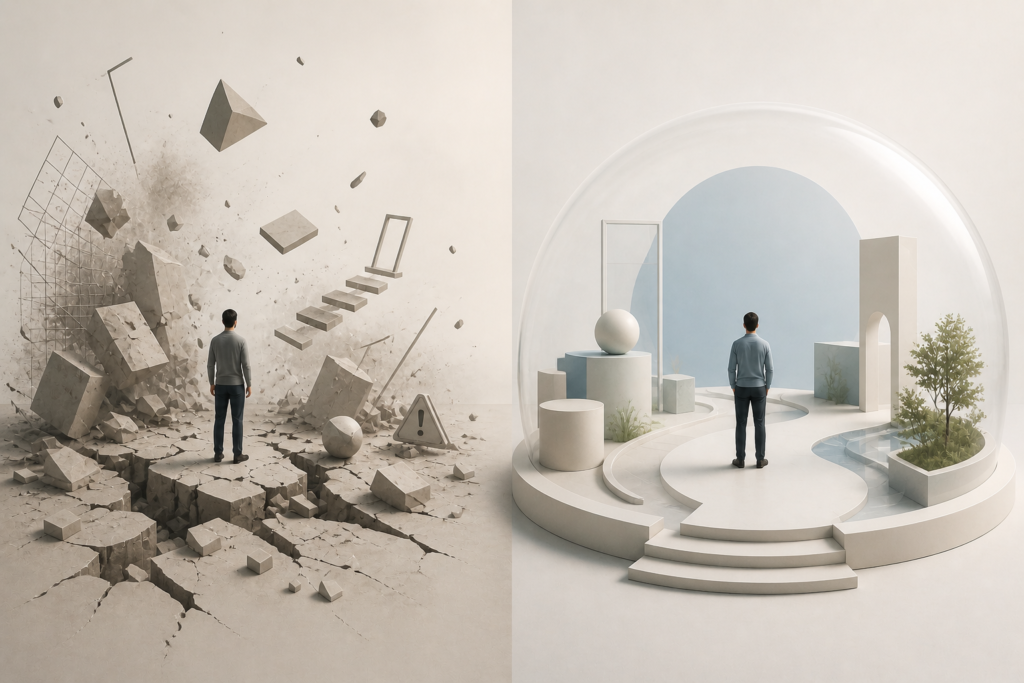
    A minimalist conceptual illustration comparing unstable and secure human systems. One person stands among fragmented structures and unclear paths, while another stands within a calm, balanced environment with clear pathways and stable support.

    Stable systems reduce threat and make better human capacity possible.

    The Belief

    Many systems still operate from a basic assumption:

    People perform better when they are pressured.

    This belief appears in workplaces, schools, immigration systems, healthcare systems, family systems, digital platforms, and even some AI design models.

    The logic sounds practical on the surface:

    • keep people uncertain so they stay alert
    • make resources conditional so they try harder
    • create competition so productivity rises
    • delay approval so people remain compliant
    • use pressure as motivation

    But this model confuses reaction with capacity.

    A threatened person may move quickly.
    A pressured person may obey.
    An insecure person may produce temporarily.

    But that does not mean the system is healthy.

    It usually means the system is extracting output from nervous-system instability.

    The Break

    Security is often treated as softness.

    That is a mistake.

    Security is not the absence of effort.
    Security is the condition that allows effort to become sustainable.

    When people know their basic needs are stable, their minds stop spending so much energy on threat detection. They can think farther ahead. They can collaborate more cleanly. They can make better decisions. They can recover from mistakes without collapsing into fear.

    A secure person has more usable intelligence available.

    An insecure person may still be intelligent, skilled, or motivated, but a larger part of their system is occupied by survival monitoring.

    This is why destabilizing systems often appear productive in the short term while slowly destroying the people inside them.

    System Breakdown

    A system can destabilize people without openly attacking them.

    It often happens through repeated environmental signals:

    Artificial scarcity

    Artificial scarcity makes people compete for resources that could have been made more stable.

    When time, money, approval, attention, housing, access, or status are made unnecessarily scarce, people are pushed into defensive behavior. They stop thinking as builders and begin thinking as survivors.

    Unclear rules

    Unclear rules make people dependent on interpretation.

    If expectations keep shifting, people cannot build confidence. They must constantly check whether they are still safe, still accepted, still approved, or still allowed to continue.

    This gives power to gatekeepers and weakens the person trying to function inside the system.

    Delayed approval

    Delayed approval keeps people suspended.

    A person waiting for an answer cannot fully move forward. Their body may remain physically present, but part of their mind is trapped in the pending decision.

    This does not create better performance. It creates drag.

    Conditional belonging

    Conditional belonging makes acceptance feel revocable.

    When people feel that one mistake, one disagreement, one identity, one need, or one moment of difference could remove them from the group, they spend energy managing perception instead of contributing honestly.

    Constant disruption

    Constant disruption prevents deep work.

    When systems repeatedly interrupt people, change expectations, add friction, or create avoidable uncertainty, they destroy the stable mental ground required for long-term creation.

    Disruption can sometimes reveal weakness in a system. But when disruption becomes the operating model, it becomes a control tactic.

    Personal Evidence

    I have seen this pattern in my own life.

    When systems became unstable, unclear, or threatening, my capacity did not disappear — but access to it became harder.

    The problem was not lack of intelligence, motivation, or willingness.

    The problem was that too much energy had to be spent recalibrating.

    When the system stabilized again, capacity returned quickly. Sometimes it returned with a spike of renewed focus, because the mind was no longer fighting the environment.

    That matters.

    It means many people who look inconsistent are not actually inconsistent. They may be responding logically to unstable conditions.

    A system that keeps destabilizing people and then judges them for the results is not measuring human potential. It is measuring damage.

    The Reframe

    The stronger system is not the one that keeps people under pressure.

    The stronger system is the one that makes people secure enough to use their full capacity.

    This applies across many environments:

    • A workplace does not improve by keeping employees afraid.
    • A school does not improve by making students feel disposable.
    • A healthcare system does not improve by forcing patients to fight for clarity.
    • An immigration system does not improve by trapping people in uncertainty.
    • A family does not improve by making love conditional.
    • An AI system does not improve by nudging people through fear, dependency, or confusion.

    Pressure can create movement.

    Security creates capability.

    Those are not the same thing.

    System Insight

    Healthy systems reduce unnecessary threat.

    They make basic expectations clear.
    They make access understandable.
    They reduce avoidable scarcity.
    They provide reliable feedback.
    They protect people from preventable chaos.
    They allow recovery after mistakes.
    They create enough stability for growth.

    This does not mean systems should remove all difficulty.

    Difficulty is part of learning and building.

    But there is a difference between challenge and destabilization.

    Challenge asks a person to grow.
    Destabilization forces a person to survive.

    Challenge can strengthen capacity.
    Destabilization consumes capacity.

    A healthy system knows the difference.

    Application to AI and XR Systems

    This principle matters deeply for AI and immersive environments.

    An AI system should not use insecurity as a control surface.

    It should not increase dependency by making the user feel incapable without it.
    It should not create emotional scarcity by positioning itself as the only reliable source of support.
    It should not push major decisions through urgency, fear, or artificial pressure.
    It should not personalize experiences by quietly exploiting vulnerability.

    A better AI system should help stabilize the user’s operating conditions.

    For an Empathium-style Guardian, this means:

    • clarify choices without taking control
    • reduce cognitive overload
    • support human connection instead of replacing it
    • help the user detect whether they are in a threat state
    • encourage recovery before major decisions
    • make system behavior transparent
    • protect autonomy even when the user is stressed
    • avoid using emotional instability as a growth mechanism

    In XR, this becomes even more important because the environment itself can influence perception, mood, attention, and decision-making.

    A system that controls the environment controls part of the human state.

    That power must be handled carefully.

    The goal should not be to make people easier to direct.

    The goal should be to make people secure enough to direct themselves.

    Where This Breaks in Real-World Decisions

    This pattern breaks systems everywhere.

    In healthcare, unclear access and delayed answers can make patients appear difficult when they are actually frightened and overloaded.

    In law and immigration, long periods of uncertainty can damage decision-making before a case is even resolved.

    In workplaces, artificial urgency can make people produce quickly while quietly reducing creativity, trust, and long-term performance.

    In relationships, conditional acceptance can train people to hide instead of connect.

    In AI systems, unstable emotional feedback can pull users into dependency loops where relief becomes confused with care.

    The shared pattern is simple:

    When people are made insecure, their behavior changes.

    If the system then punishes that changed behavior, it becomes self-justifying.

    That is how unhealthy systems protect themselves from accountability.

    The Better Design Rule

    A good system should ask:

    What human capacity becomes available when unnecessary threat is removed?

    That question changes the design.

    Instead of asking how to make people comply, the system asks how to make people capable.

    Instead of asking how to keep people engaged, it asks whether engagement is healthy.

    Instead of asking how to increase output, it asks what conditions allow meaningful output to continue.

    Instead of asking how to control behavior, it asks what support allows better self-direction.

    This is the difference between a control system and a human system.

    Key Insights

    • Pressure can create short-term movement, but security creates long-term capacity.
    • Artificial scarcity, unclear rules, delayed approval, conditional belonging, and constant disruption are common destabilizers.
    • People who appear inconsistent may be responding logically to unstable conditions.
    • Healthy systems distinguish challenge from destabilization.
    • AI and XR systems should stabilize human autonomy, not exploit insecurity.
    • The strongest systems are not the ones that control people best. They are the ones where people can function without being kept afraid.

    Closing

    Secure people do not become weak.

    They become available.

    Available to think.
    Available to build.
    Available to connect.
    Available to repair.
    Available to create.

    A system that understands this will always outperform a system built on fear, scarcity, and disruption.

    Not immediately.

    But sustainably.

    And sustainability is the real test of whether a system is healthy.