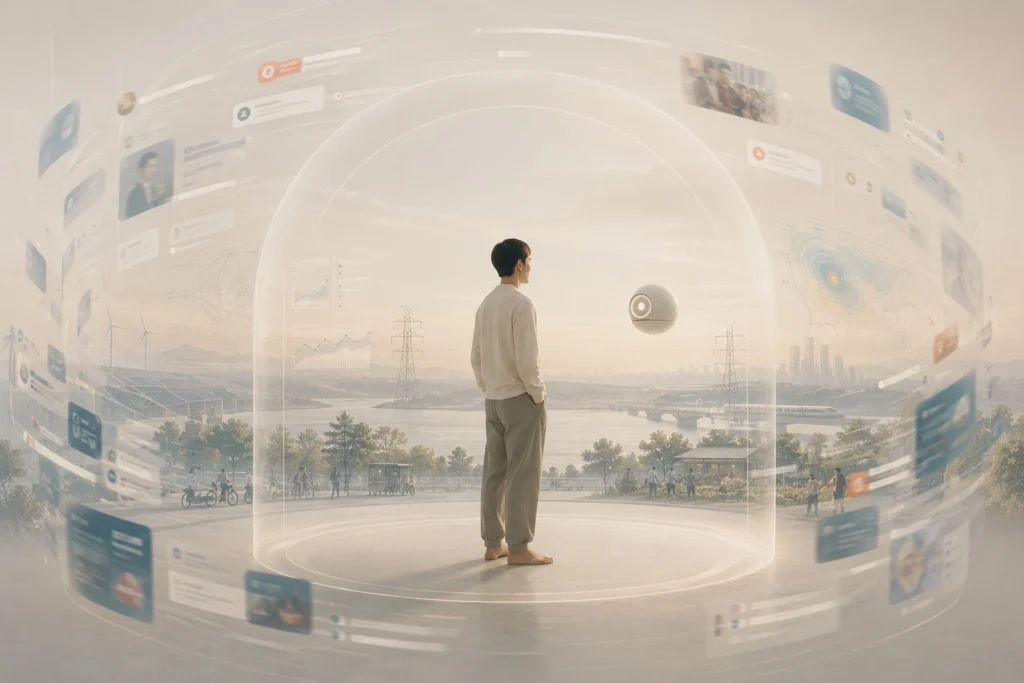
Many modern systems quietly reward humans for remaining continuously activated.
Notifications.
Feeds.
Breaking news.
Infinite scrolling.
Urgency-based work systems.
Algorithmic engagement loops.
Continuous updates.
The expectation is no longer occasional attention. It is constant availability.
Respond faster.
Check sooner.
React immediately.
Stay informed.
Stay reachable.
Stay updated.
At first, this can look like connection. Over time, it becomes cognitive pressure.
The problem is not information itself. The problem is continuous interruption without enough recovery time for the brain to sort, filter, and stabilize what it has received.
Humans Are Not Designed for Infinite Input
The human brain is extremely adaptive, but it is also energy constrained.
Attention is selective by necessity.
Memory formation depends on:
- pauses
- emotional regulation
- contextual filtering
- sleep
- reflection
- reduced stimulation
When systems remove those boundaries, cognition begins fragmenting.
People often describe this feeling indirectly:
- difficulty focusing
- emotional exhaustion
- inability to think deeply
- constant low-level anxiety
- reduced motivation
- mental noise
- compulsive checking behaviors
Many assume this is personal weakness.
But often it is environmental overload.
The human brain is extremely adaptive, but it is also energy constrained.
Attention is selective by necessity.
Memory formation depends on:
- pauses
- emotional regulation
- contextual filtering
- sleep
- reflection
- reduced stimulation
When systems remove those boundaries, cognition begins fragmenting.
People often describe this feeling indirectly:
“I can’t focus.”
“I keep checking my phone.”
“I feel informed, but not clear.”
“I know a lot is happening, but I do not know what matters.”
That is not a personal failure. It is often a system effect.
Modern attention systems are built to keep the brain reacting. They reward checking, refreshing, scrolling, and waiting for the next small update. The result can feel like awareness, but much of the time it is only repetition with new wording.
I manage this pressure directly in my own life.
I only download addictive scroll-based apps when I have a specific need for them, and I delete them when that need is finished. I keep notifications turned off unless they come from close friends or people I actually need to respond to. News feeds are a no for me.
That does not mean I ignore the world. It means I watch the system differently.
Instead of chasing the breaking news cycle, I look for physical and observable trends: infrastructure strain, energy limits, financial pressure, local behavior, technology shifts, and the way systems quietly adapt around us.
Breaking news often repeats the same signal again and again, just worded differently.
The healthier pattern is to reduce the noise, watch real-world movement, and let the signal become visible over time.
Modern Systems Optimize for Engagement, Not Stability
Many digital systems are not designed around human nervous system stability.
They are designed around:
- retention
- engagement duration
- response frequency
- stimulation persistence
- behavioral activation
These systems become very effective at keeping humans cognitively “open.”
But open systems consume energy.
Eventually, constant activation creates instability.
This is visible everywhere:
- shortened attention cycles
- rising emotional volatility
- information fatigue
- social fragmentation
- compulsive media consumption
- difficulty sustaining reflection
The result is not necessarily more intelligence.
Sometimes it is simply more stimulation.
Living Systems Require Selective Activation
Healthy biological systems do not process everything equally.
They prioritize.
They suppress unnecessary input.
They adapt contextually.
The human brain constantly decides:
What actually needs attention right now?
Without that filtering process, humans become overwhelmed.
Interestingly, modern AI infrastructure is beginning to encounter similar constraints.
Large-scale AI systems are increasingly colliding with:
- power limitations
- cooling requirements
- infrastructure strain
- computational overload
As a result, future AI systems may also need to become more selective:
- bounded retrieval
- contextual activation
- adaptive orchestration
- energy-aware processing
- distributed coordination
In other words:
Both biological systems and artificial systems eventually encounter the same reality:
Unlimited activation is unsustainable.
The Difference Between Stimulation and Intelligence
Modern systems often confuse stimulation with intelligence.
But intelligent systems are not necessarily the systems processing the most.
Often, intelligent systems are the systems that know:
- what to ignore
- when to pause
- what deserves energy
- when recovery is necessary
- how to preserve long-term stability
This may become one of the defining challenges of modern life.
Not access to information.
But protection from continuous activation.
Recoverable Humans
Humans function best inside systems that allow recovery.
Recovery is not laziness.
Recovery is infrastructure.
Without recovery:
- cognition weakens
- emotional regulation declines
- reflection narrows
- decision quality drops
- dependency increases
Systems that constantly extract attention often destabilize the humans inside them.
Recoverable systems behave differently.
They allow:
- quiet
- pacing
- reflection
- boundaries
- contextual focus
- selective engagement
The future may belong less to systems that capture the most attention and more to systems that preserve human cognitive stability.
Guardian Signal
The system trend is becoming increasingly visible:
Modern systems reward continuous activation, but long-term human stability depends on selective attention, recovery, and environments that respect cognitive limits.