Tag: guardian systems

  • When AI Hits the Power Grid, Software Has to Get Smarter

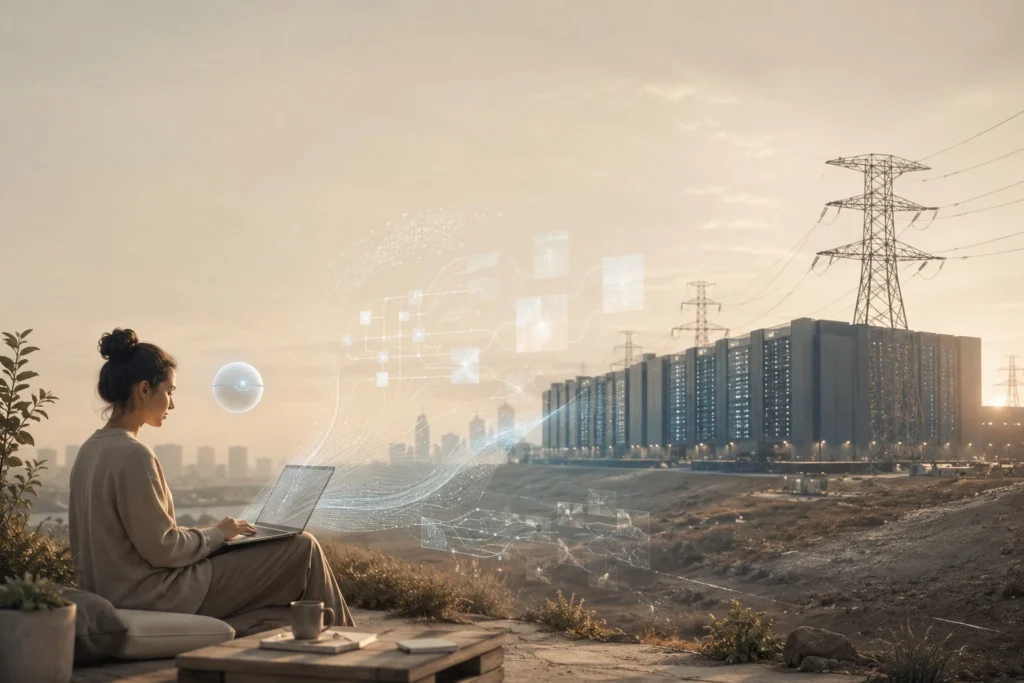
    A calm human figure works beside a small Guardian-like AI sphere while a distant data center and electrical grid represent the growing AI power grid problem and the need for smarter, lower-energy software.

    The AI power grid problem is becoming harder to ignore. As artificial intelligence demands more chips, servers, data centers, and electricity, the limits are no longer only technical. They are physical.

    People often talk about AI as if the solution is always more.

    More chips.
    More servers.
    More data centers.
    More electricity.
    More cooling.
    More infrastructure.

    But that path has a limit.

    When a data center project can be delayed, blocked, or questioned because the local power system cannot support it, AI stops being only a software story. It becomes an energy story. It becomes a grid story. It becomes a public infrastructure story.

    That is a major system signal.

    The Problem Is Not Intelligence

    The problem is not that intelligence is impossible.

    The problem is that we are building too much of it through brute force.

    Modern AI often depends on enormous hardware systems. These systems can be useful, but they are also expensive, centralized, energy-hungry, and physically demanding. They require electricity, water, cooling, land, chips, supply chains, and political approval.

    That means AI is not floating above the real world.

    It is sitting directly on top of it.

    Every large AI system depends on physical systems that humans already need for daily life.

    The Brain Shows Another Pattern

    The human brain is a useful signal here.

    It uses very little energy compared with modern computing infrastructure, yet it performs astonishing work. It handles memory, perception, movement, language, emotion, prediction, pattern recognition, and social understanding all at once.

    The brain is not perfect. It is not a machine blueprint. But it does show something important:

    Useful intelligence does not always require massive energy consumption.

    Organic intelligence is contextual. It does not calculate everything all the time. It filters. It remembers selectively. It predicts. It ignores noise. It uses the body, the environment, and past experience to reduce unnecessary work.

    That is the direction software needs to study more seriously.

    My Guardian Testing Shows the Same Pattern

    In my own Guardian testing so far, the actual compute cost has been less than a few cents.

    That matters.

    The Guardian does not need supercomputer infrastructure to be useful. It does not need to process everything all the time. It does not need to store everything forever. It does not need to answer every human moment with a massive cloud response.

    Its strength comes from structure.

    It uses focused retrieval, bounded memory, relevant context, and task-specific meaning. Instead of asking a giant system to solve every problem from scratch, it narrows the problem first.

    That is smarter software.

    The goal is not to make AI weaker.

    The goal is to make it less wasteful.

    Bigger Hardware Is Not the Only Future

    There will still be a place for large models and powerful computing systems. Some problems genuinely need that scale.

    But not every human support system does.

    A personal Guardian does not need to behave like a giant data center. A daily-life assistant does not need to burn through large amounts of computation to help someone organize a thought, retrieve a memory, reduce noise, or make a better decision.

    Many useful AI systems can be smaller, more local, more bounded, and more efficient.

    That is where the next design frontier may be.

    Not just bigger models.

    Better systems.

    The Real Shift

    The future of AI should not only ask:

    How powerful can we make this?

    It should also ask:

    How little energy can this use while still helping humans well?

    That question changes the design.

    It pushes AI toward local memory, efficient retrieval, smarter caching, smaller context windows, task-specific reasoning, and systems that know when not to compute.

    That last part matters.

    A truly intelligent system should not always do more.

    Sometimes intelligence means knowing what not to process.

    Guardian Signal

    The pressure around AI infrastructure is not just a warning about electricity.

    It is a warning about design.

    If AI keeps scaling mainly through hardware, it becomes more centralized, more expensive, and more dependent on fragile physical systems.

    If AI shifts toward smarter software, bounded memory, local context, efficient retrieval, and human-centered design, it becomes more resilient.

    The future may not belong only to the largest machines.

    It may belong to systems that use the least energy to provide the most meaningful support.

    That is the Guardian path.

    Not more computation for its own sake.

    More intelligence with less waste.
  • Human Stability in Complex Systems

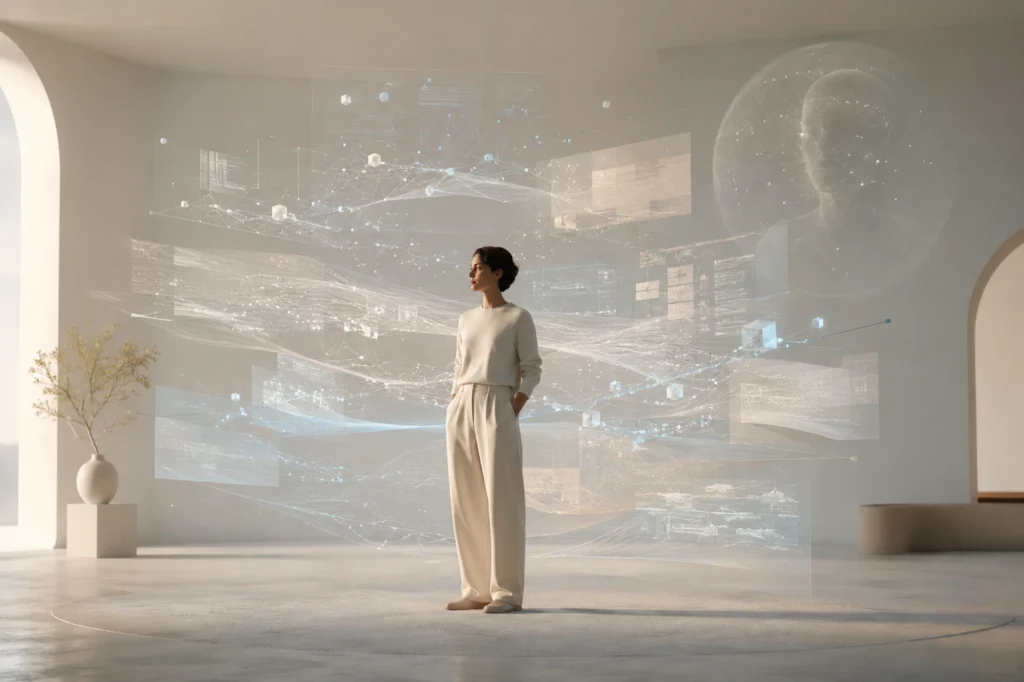
    Calm human figure standing peacefully inside a softly lit minimalist space while translucent layers of abstract AI systems, infrastructure signals, and flowing digital information surround them without overwhelming them, symbolizing human stability within accelerating complex systems.

    Modern systems are accelerating faster than most humans realize.

    Artificial intelligence is expanding into daily life.
    Information systems operate continuously.
    Economic conditions shift rapidly.
    Administrative systems grow more complex.
    Digital environments compete constantly for attention.

    Most discussions about the future focus on intelligence, speed, or productivity.

    But those may not be the most important pressures emerging from modern systems.

    Human stability might be.

    Break the Assumption

    We often assume humans naturally adapt to increasing complexity.

    If tools become faster, we simply learn faster.
    If systems become more demanding, we become more efficient.
    If information increases, we process more information.

    But biological systems have limits.

    Human nervous systems evolved around:

    • rhythm
    • recovery
    • environmental predictability
    • manageable social groups
    • periods of rest between stressors

    Modern systems rarely provide those conditions.

    Instead, many humans now exist inside continuous low-grade vigilance:

    • unresolved financial pressure
    • constant notifications
    • algorithmic stimulation
    • administrative uncertainty
    • social comparison systems
    • infinite information exposure
    • rapidly changing technological expectations

    The body adapts the best it can.

    But adaptation is not the same as stability.

    System Breakdown

    As systems become more interconnected, humans are increasingly expected to regulate themselves inside environments that never fully slow down.

    Artificial intelligence now assists with:

    • writing
    • planning
    • communication
    • decision-making
    • information filtering
    • emotional support

    At the same time:

    • work follows people home
    • digital systems remove recovery space
    • economic uncertainty increases background stress
    • social systems become more fragmented
    • attention becomes monetized infrastructure

    The result is subtle but important.

    Many people are no longer operating from stable regulation.

    They are operating from continuous adaptation.

    That changes:

    • decision quality
    • emotional regulation
    • relationship stability
    • cognitive endurance
    • ambiguity tolerance
    • physical wellbeing

    A nervous system under constant pressure begins prioritizing immediate relief over long-term clarity.

    This is one reason modern systems increasingly optimize around:

    • convenience
    • stimulation
    • instant feedback
    • friction removal
    • emotional reassurance

    These systems reduce discomfort temporarily.

    But they do not always increase stability.

    A Personal Observation

    Recently, after resolving several long-running system pressures at once — residency documentation, financial uncertainty, international logistics, and administrative instability — I noticed something unusual.

    My nervous system did not know what to do with the absence of pressure.

    There were no immediate problems demanding attention.
    No unresolved loops continuously running in the background.
    No active instability requiring constant monitoring.

    The experience felt strangely unfamiliar.

    Not because something was wrong.

    But because stability itself felt unfamiliar.

    That realization stayed with me.

    Many humans may spend so much time adapting to pressure that the absence of pressure begins to feel disorienting.

    When stability feels unfamiliar, that does not mean the person is broken. It may mean the system has trained the body to expect pressure.

    The Reframe

    Stability is often misunderstood as passive.

    It is not.

    Human stability is infrastructure.

    A stable nervous system:

    • processes information more clearly
    • tolerates uncertainty more effectively
    • adapts without collapsing
    • makes better long-term decisions
    • becomes less vulnerable to manipulation
    • maintains stronger human connection

    As technological systems grow more complex, stable humans may become more valuable than optimized humans.

    This may become one of the defining challenges of the AI era.

    Not whether systems can think faster.

    But whether humans can remain psychologically and biologically stable while living inside accelerating complexity.

    Environmental Systems Matter

    This is also why environment design matters more than many people realize.

    Human cognition is shaped by:

    • sound
    • light
    • posture
    • social density
    • information load
    • environmental predictability
    • emotional atmosphere

    Future systems may increasingly need to support regulation instead of stimulation.

    This is one reason XR environments, adaptive interfaces, and calm computing systems are becoming important.

    A future interface may not be valuable because it captures more attention.

    It may be valuable because it helps humans remain stable while navigating complex systems.

    That is a very different design philosophy.

    Closing

    The future may not belong to the fastest systems.

    It may belong to the systems that help humans remain stable as complexity increases around them.

    And in a world increasingly optimized for stimulation, stability itself may become one of the most valuable human resources left.