High-Turnover Housing, Continuity Loss, and the Nervous System of Home
A residential building does not become unstable all at once.
It usually begins with small interruptions of continuity.
A slammed door.
A hallway treated as temporary space.
Furniture dragged across the floor late at night.
Water spilling from a balcony onto the one below.
Voices echoing through shared walls from people who do not expect to return.
None of these moments may look serious by itself.
But repeated over time, they change the emotional structure of a home.
A resident does not only live inside walls. A resident lives inside patterns. Morning sounds. Evening quiet. Familiar movement. Known neighbors. Predictable rhythms. Small agreements that are rarely spoken because everyone understands they will still be there tomorrow.
That continuity is part of what makes a place feel safe.
When a residential building becomes high-turnover housing, that continuity weakens.
The problem is not simply noise.
The problem is that the building starts to lose memory.
Travelers Are Not the Enemy
This is not about blaming travelers.
People travel for many reasons. They need rest. They need beauty. They need sun, safety, walkability, and a break from stressful places. Many visitors are also searching for nervous-system relief.
That need is real.
But residents need relief too.
The conflict begins when the same building is asked to serve two different functions at once.
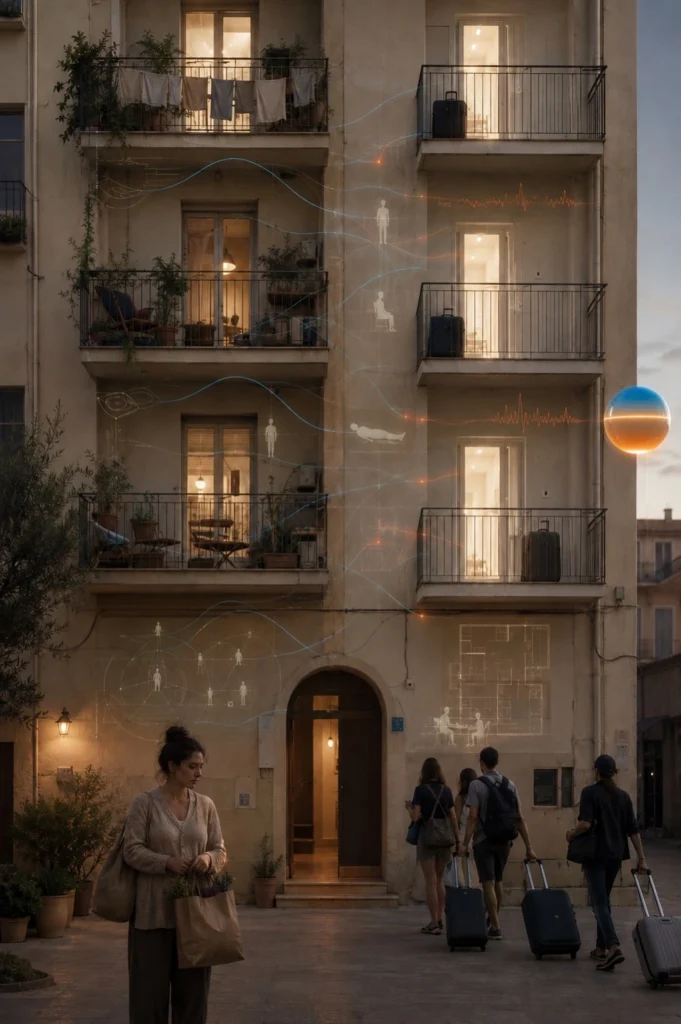
For the traveler, the apartment is temporary.
For the resident, it is home.
Those are not the same system.
Temporary life moves differently. It arrives with suitcases, excitement, unfamiliar routines, late returns, early departures, and fewer long-term consequences. The person making noise may not be careless. They may simply be operating inside a short-stay mindset.
But the resident absorbs the impact.
They are the one who hears every door, every chair, every balcony spill, every argument, every child running across the floor. They are the one whose sleep, recovery, and sense of calm are affected after the visitor leaves.
That is nervous-system labor.
And residents are rarely asked whether they consented to provide it.
The issue is not that visitors are bad people. The issue is that a building designed for residential continuity begins to behave differently when too many units become temporary space.
Apartments Are Not Hotels
A hotel is designed for temporary life.
It has staff.
It has reception.
It has cleaning systems.
It has rules.
It has liability.
It has a structure for arrivals, departures, mistakes, complaints, and repair.
A residential building works differently.
It depends on continuity. Neighbors learn each other’s rhythms. Familiar sounds become less threatening. Small conflicts can be repaired because people expect to keep living near one another.
That feedback loop disappears when the person causing the disruption leaves in three days.
This is why apartments make poor hotels.
They can provide beds, kitchens, and views.
But they usually cannot provide the management structure that temporary life requires.
So the burden shifts downward.
Not to the platform.
Not to the investor.
Not to the city.
Not to the traveler.
To the resident next door.
Laws Help, But Structure Matters More
Many cities tighten short-term rental laws.
For a while, it works.
The building gets quieter. Listings disappear. Residents feel relief. The system appears to correct itself.
But if the underlying demand remains, the pressure slowly returns.
Apartments get shared again.
Rules become blurred.
Informal arrangements appear.
Platforms adjust.
Owners find loopholes.
Enforcement gets tired.
The system bends back toward profit unless the structure changes.
So the better question is not only:
How do we stop bad behavior?
The better question is:
Which buildings are actually designed to absorb temporary life?
Hotels should carry more of the traveler function because hotels are built for it.
That does not mean less hospitality.
It means putting hospitality inside the right container.
Home Is a Continuity System
A home is not just a place where someone sleeps.
It is a continuity system.
It holds routines, recovery, memory, sleep, safety, and the quiet agreements that allow people to relax.
When that continuity is replaced by constant turnover, calm becomes unstable. The building may still look residential, but the nervous system experiences it differently.
It starts to feel like a hotel without staff.
That is the human-system failure.
Travelers need care.
Residents need continuity.
Cities need structures that protect both.
The answer is not to shame movement.
The answer is to stop placing the cost of temporary life on people who are trying to live permanently.
Calm should not become someone else’s noise.