Tag: human behavior

  • Why Things Happen in Clusters (Human Systems Explained)

    Backlog Release Clustering


    Why do things seem to happen all at once?
    From busy stores after a sunny day to sudden bursts of productivity, this pattern shows up everywhere. It’s not coincidence—it’s how human systems actually work.

    Some days, nothing moves.

    Then suddenly—everything does.

    • Messages come in at once
    • Decisions resolve together
    • People show up at the same time
    • Systems that were quiet suddenly respond

    It feels like coincidence.

    But it isn’t.


    Break the Assumption

    The default belief:

    “Events should happen evenly over time.”

    So when things cluster, it feels unusual.

    But real systems don’t behave evenly.

    They behave in phases:

    • Delay
    • Build
    • Release

    System Breakdown

    Clusters form from three core mechanics:


    1) Backlog Accumulation

    When action is delayed, it doesn’t disappear.

    It stacks.

    Human Examples:

    • People avoid errands for a few days → stores suddenly get busy
    • Emails sit unread → multiple replies happen at once
    • Creative work is paused → output comes in bursts
    • Cleaning is delayed → full reset happens all at once

    👉 The system holds pressure instead of releasing it continuously


    2) Shared Triggers

    Many people wait on similar conditions.

    When that condition changes, action synchronizes.

    Human Examples:

    • ☀️ Weather improves → people go outside, shop, socialize
    • 💰 Payday hits → spending increases across many individuals
    • 📅 Deadline approaches → work output spikes
    • 🧠 Mental clarity returns → decisions finally get made

    👉 No coordination—just aligned readiness


    3) Friction Cycles

    Not all days are equal.

    Some naturally suppress action.

    Human Examples:

    • Monday → planning, low execution
    • Tuesday/Wednesday → higher action
    • Late night → low engagement
    • Post-stress → temporary shutdown before recovery

    👉 Action is delayed until friction drops


    4) Threshold Release

    Systems don’t always respond gradually.

    They hold—then release.

    Human Examples:

    • Immigration decisions processed in batches
    • Customer service replies arriving all at once
    • Personal decisions delayed, then made rapidly
    • Emotional processing building, then resolving suddenly

    👉 Once a threshold is crossed, multiple outcomes resolve together


    Reframe

    Clusters are not random spikes.

    They are visible releases of invisible buildup.


    System Insight

    Human behavior is not continuous.
    It is accumulated, delayed, and released.


    Application

    When you see clustering:

    Don’t ask:

    • “Why is everything happening at once?”

    Ask:

    • What was delayed?
    • What condition changed?
    • What friction dropped?

    Real-Life Examples of Why Things Happen in Clusters

    SituationWhat’s Really Happening
    Busy store after sunny dayWeather removed friction → backlog released
    Tuesday productivity spikeMonday delay → stabilization → action
    Inbox floods with repliesPeople batch responses
    Sudden motivation burstMental clarity threshold crossed
    Multiple life events resolvingSystems clearing shared bottlenecks

    Key Insights

    • Delayed actions create hidden backlogs
    • Shared conditions synchronize behavior
    • Friction suppresses action until it drops
    • Systems release in bursts, not evenly
    • Clusters signal state change, not coincidence


    Optional Add-On (Strong for Your System)

    You can name this pattern for reuse:

    “Backlog Release Clustering”

    This gives you:

    • A label for blog indexing
    • A detection rule for Guardian systems
    • A reusable explanation across domains

    Understanding why things happen in clusters allows you to read system behavior more clearly—turning confusion into usable insight.
  • When Systems Stall, People Move — A Human Systems View of Crisis Response

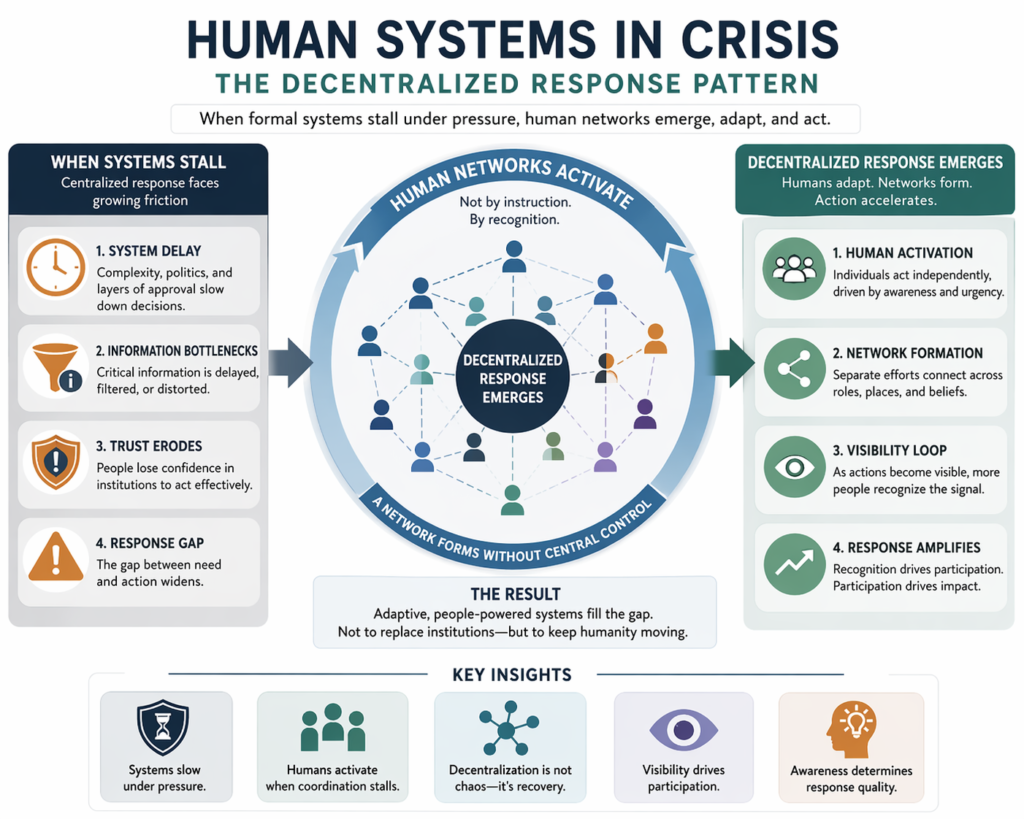
    human systems in crisis decentralized response diagram

    Opening

    Watching events unfold from the Mediterranean, something becomes clear:

    Human systems in crisis reveal something most people don’t expect:

    Systems are designed to coordinate response.

    But when pressure rises beyond their capacity, they hesitate.

    People don’t.

    They move.


    Break the Assumption

    We tend to believe large-scale action must come from:

    • governments
    • institutions
    • official organizations

    These systems are built to:

    • manage risk
    • maintain control
    • move deliberately

    That works under normal conditions.

    But when urgency exceeds system speed, a gap forms.


    System Breakdown

    This pattern appears consistently across crisis environments:

    1. System Delay
    Formal systems slow under complexity, politics, and layered decision-making.

    2. Human Activation
    Individuals begin acting independently.
    Not coordinated at first—just responsive.

    3. Convergence
    Separate efforts begin to connect:

    • across countries
    • across roles
    • across beliefs

    A network forms without central control.

    4. Visibility Loop
    As actions become visible, more people recognize the signal.

    Recognition → participation
    Participation → amplification


    Case Signal (Observed Pattern)

    In moments of visible crisis, individuals organize themselves:

    • civilians
    • doctors
    • artists
    • workers

    Not because they were instructed to.

    Because something aligns:

    this matters.

    This is not unique to one place or event.
    It is a repeatable human response pattern.


    Reframe

    The question is not:

    “Why aren’t systems solving this?”

    The better question is:

    “What happens when systems can’t move fast enough?”


    System Insight

    Human systems are not dependent on formal systems.

    They are adaptive.

    When institutions pause, human networks don’t disappear.

    They reorganize.

    Decentralized action is not disorder.

    It is recovery.


    Application

    This pattern extends far beyond any single crisis:

    • disaster response
    • mutual aid networks
    • grassroots coordination
    • community survival systems

    What this changes:

    • Don’t assume systems will hold under pressure
    • Build awareness, not just reliance
    • Support distributed response capability
    • Recognize early signals before systems react

    Key Insights

    • Systems slow under pressure
    • Humans activate when coordination stalls
    • Decentralization is a recovery mechanism
    • Visibility drives participation
    • Awareness determines response quality

    Closing

    What we are seeing is not just reaction.

    It is structure revealing itself.

    Human systems have always been there—
    quiet, distributed, waiting.

    The real question is:

    What would happen if we supported these systems intentionally?

    Not to replace institutions—
    but to complement them.

    This is where emerging tools matter.

    Not to make decisions for us—
    but to help us see clearly, coordinate faster, and act with awareness.

    That’s the difference between reaction and design.

    And it’s where the next layer of human systems begins.

  • Responsibility and Control: How Systems Shape Justice: How Systems Shape Justice

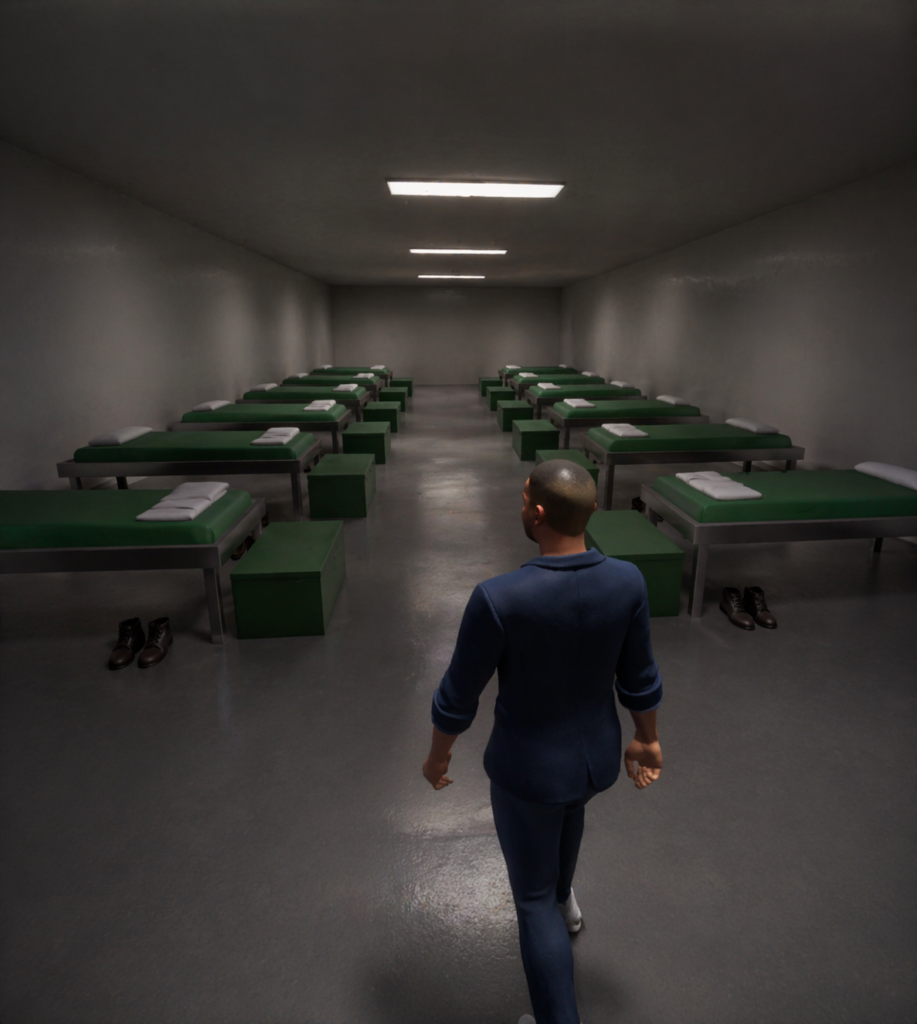
    prison system showing structured environment where systems shape responsibility and control

    Opening

    Walk into this space.

    A reconstruction of a place I once worked—an army prison.

    Not just rebuilt as a room, but as a system.


    Break the Assumption

    Justice systems are built on a simple assumption:

    People have full control over their actions.

    From that, we draw clean lines:

    • guilty or not
    • responsible or not
    • right or wrong

    But that assumption doesn’t hold under closer inspection.


    System Breakdown

    Control is not fixed.

    It varies across multiple dimensions:

    • Biology (brain state, hormones, fatigue)
    • Environment (pressure, threat, conditioning)
    • History (trauma, learned behavior, repetition)
    • State (stress, fear, cognitive load)

    At any given moment, a person’s ability to act freely is not constant.

    Yet systems treat it as if it is.

    This creates a structural mismatch:

    Variable human control inside fixed judgment systems


    Personal Evidence (Controlled)

    Inside that environment, I saw something that didn’t align with the labels.

    People who were:

    • aware
    • reflective
    • human

    And I’ve experienced moments myself where control was not fully present.

    That’s the fracture point.


    Reframe

    This is not about removing accountability.

    It’s about understanding what accountability actually measures.

    If control varies, then:

    Responsibility cannot be a binary state.

    It becomes a range, not a line.


    System Insight

    Current justice systems optimize for:

    • clarity
    • speed
    • enforceability

    So they simplify.

    But simplification comes at a cost:

    Accuracy is reduced to maintain structure

    Empathy, in this context, is not softness.

    It is system accuracy.

    It allows us to account for:

    • hidden variables
    • unseen pressures
    • non-visible constraints

    Without it, systems operate on incomplete data.


    Application

    A more accurate system would:

    • evaluate degree of control, not assume it
    • separate action from capacity at the moment of action
    • design responses that reflect cause, not just outcome

    This doesn’t weaken accountability.

    It makes it precise.


    Key Insights

    • Control is variable, not fixed
    • Responsibility scales with control
    • Binary judgment systems distort human behavior
    • Empathy increases system accuracy, not leniency
    • Justice systems currently optimize for simplicity over truth

    Closing

    What you see in that room is not just confinement. It is a belief system made physical.

    A system built on certainty—applied to something that is not.

    And until systems account for that, they will continue to misread the very humans they are designed to judge.

  • Primal Instincts Aren’t the Problem — Misinterpretation Is

    Man sitting in quiet reflection with hands clasped – representing internal struggle, survival instincts, and self-awareness

    A Human Systems View of Survival Responses and Compassion


    Opening — The Assumption

    Most people believe that reactions like fear, anger, or withdrawal are signs of weakness, instability, or even moral failure.

    We’re taught to judge these responses—both in ourselves and others.


    Break the Assumption

    What we label as “overreaction” is often a system doing exactly what it was designed to do.

    Fight.
    Flight.
    Freeze.

    These are not flaws. They are survival mechanisms—fast, automatic, and protective.


    System Breakdown

    The human nervous system prioritizes survival over accuracy.

    When a threat is perceived—real or remembered—the system:

    • Reduces time for reflection
    • Increases speed of response
    • Chooses protection over connection

    This creates patterns such as:

    • Fight → aggression, defensiveness
    • Flight → avoidance, withdrawal
    • Freeze → shutdown, dissociation

    These responses are not chosen consciously.
    They are triggered patterns based on past conditioning and stored signals.


    Personal Evidence (Optional Anchor)

    In lived experiences such as PTSD, these responses become more visible.

    What looks like “irrational behavior” from the outside is often a system reacting to internal signals others cannot see.


    Reframe

    Instead of asking:

    “Why is this person acting like this?”

    A more accurate question is:

    “What is this system trying to protect?”

    This shift moves us from judgment → understanding.


    System Insight

    Behavior is not random.

    It is:

    Signal → Interpretation → Response

    When the interpretation layer is shaped by past threat,
    the response will prioritize safety—even when no danger is present.


    Application

    You can work with this system in practical ways:

    • Pause before labeling behavior
    • Look for the protective function behind reactions
    • Reduce intensity before trying to reason
    • Create environments where safety is felt, not forced

    For yourself:

    • Notice your default response pattern (fight, flight, freeze)
    • Track when it activates
    • Focus on regulation first, meaning second

    Key Insights

    • Survival responses are functional, not flawed
    • The nervous system chooses speed over accuracy
    • Behavior is driven by protection, not intention
    • Understanding function leads to compassion
    • Compassion creates space for better system outcomes

    Closing

    When we stop treating survival responses as problems to eliminate,
    we gain the ability to work with the system instead of against it.

    That’s where real compassion begins—not as an idea,
    but as a direct understanding of how humans actually function.