I went back to college multiple times.
Not once. Not twice. Many times.
I accumulated enough credits for a bachelor’s degree—but almost all of them sat in the 100–200 level range.
Every time I tried to move forward, the same thing happened:
I hit the 300–400 level courses… and everything broke.
Break the Assumption
Most people would look at that pattern and assume the problem was me.
Lack of discipline. Lack of intelligence. Lack of effort.
But that assumption doesn’t hold up.
Because the moment the structure changed, the outcome changed.
System Breakdown
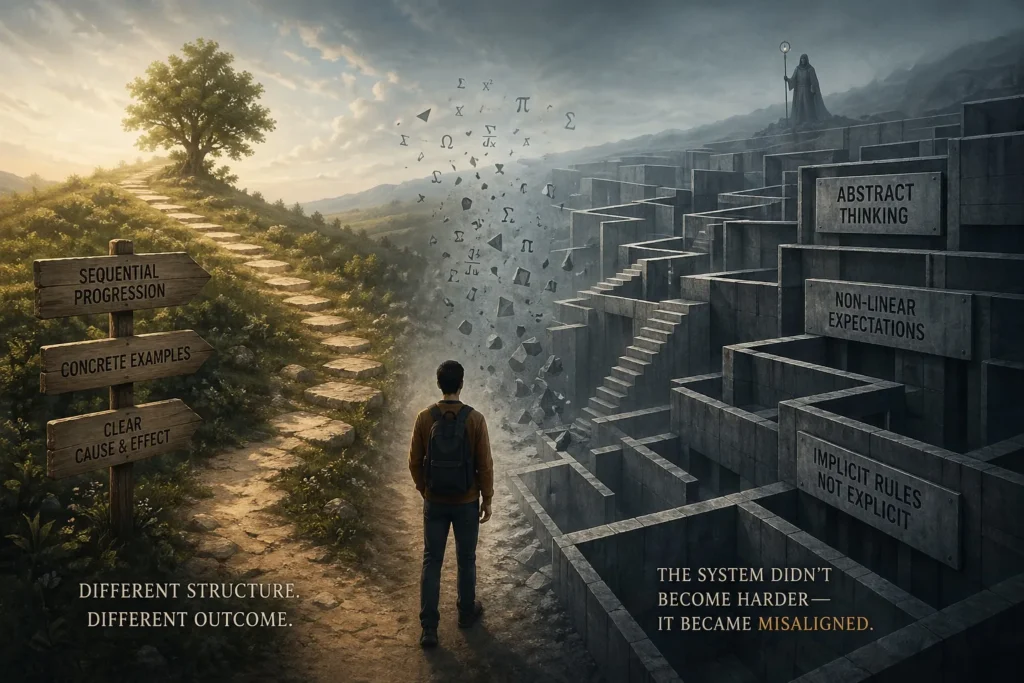
At lower levels, learning followed a clear structure:
- Sequential progression
- Concrete examples
- Direct cause-and-effect relationships
At higher levels, the system shifted:
- Abstract thinking without grounding
- Non-linear expectations
- Implicit rules instead of explicit ones
The system didn’t become harder—it became less aligned with how some humans process information.
That distinction matters.
Because difficulty can be overcome.
Mismatch cannot.
Personal Evidence (Brief)
I was given accommodations:
- Extra time
- Teacher notes
- Adjusted testing
None of it solved the problem.
Because the issue wasn’t speed.
It was structure.
Reframe
When a person performs well in one structure and consistently fails in another, the signal is clear:
The system is optimized for a narrow type of cognition.
Not for humans broadly.
System Insight
Educational systems often reward:
- Abstract reasoning over applied understanding
- Independence over guided progression
- Assumption of shared cognitive patterns
But humans don’t learn in one uniform way.
Some learn sequentially.
Some learn visually.
Some learn by doing.
When systems collapse those differences into a single model, they don’t reveal who can’t learn—
They reveal who the system was designed for.
Application
If learning breaks, don’t immediately ask:
“What’s wrong with the person?”
Ask:
- What changed in the system?
- What assumptions became invisible?
- What type of thinking is now being rewarded?
Then adjust the environment—not just the individual.
Key Insights
- Sudden failure often signals a system shift, not a personal one
- Accommodations don’t fix structural mismatch
- Abstract systems can exclude valid forms of intelligence
- Human variation is real—systems often aren’t built for it
- Better systems adapt to humans, not the other way around
Final Thought
If a system only works for one type of mind, it isn’t a standard. It’s a filter. And most people being filtered out were never the problem.
🎧 Podcast Version
Prefer audio?
This post is also available as a short episode—same insight, delivered through voice and pacing.
👉 Listen here: https://rss.com/podcasts/oddlyrobbie/2774744