Tag: living abroad

  • When Safe Feels Boring

    When Safe Feels Boring

    Chaos has a way of disguising itself as normal.

    When someone lives for years surrounded by unpredictability — sirens, arguments, crises, emergencies, or people whose moods can change without warning — the nervous system quietly adapts. Constant vigilance becomes the background state. The body learns to scan, anticipate, translate, manage, and prepare.

    After enough time, danger does not always feel like danger. It can feel familiar.

    Then life changes.

    The neighborhood is quiet. The phone rarely rings with bad news. The loudest interruption might be birds outside a window, children playing in the distance, or the ordinary sound of neighbors moving through their day. The crisis does not arrive. The emergency does not need solving. Days begin to resemble one another.

    At first, this can feel strangely empty.

    For people who move from louder or more unstable places into a quieter life, that emptiness can be confusing. Peace may not immediately feel like peace. It may feel like a blank space that needs to be filled quickly: another trip, another visitor, another plan, another reason to keep moving. None of those things are wrong. Travel can be beautiful. Visitors can be meaningful. Activity can be healthy.

    But sometimes constant motion becomes a substitute for older chaos.

    The nervous system may still be asking for stimulation after the danger has passed. It may still expect interruption. It may still interpret quiet as absence, boredom, or waiting. A safer life can feel suspicious simply because it does not demand the same level of defense.

    This is one of the hidden adjustments of becoming safe. The external situation may change before the body fully understands that it has changed.

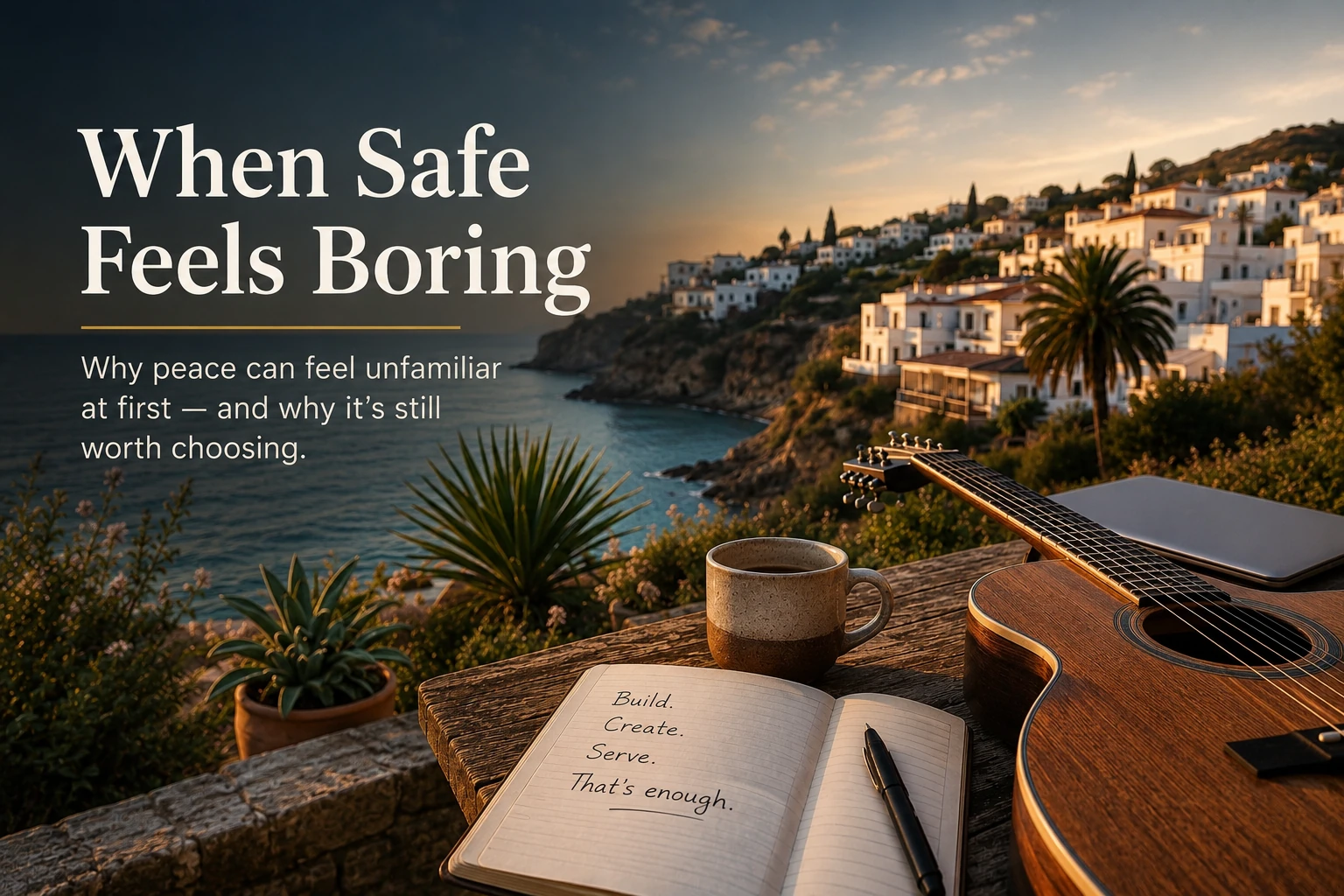
    For me, the quieter rhythm of Spain has not meant doing nothing. It has meant learning to build from a steadier place. Music, writing, and the Guardian program give shape to my days. They keep me active, but not in the same way that crisis once kept me alert. The difference is not whether life is active or still. The difference is whether activity is chosen, or whether it is being used to outrun silence.

    Safe can feel boring at first because safe does not constantly announce itself.

    It does not always arrive as joy. Sometimes it arrives as routine. Sometimes it arrives as a quiet room, a calm street, a simple meal, a walk to the sea, or a day where nothing dramatic happens. The body may need time to recognize that nothing happening can itself be a form of healing.

    A healthy system is not one that keeps people permanently stimulated. A healthy system is one that creates enough stability for people to stop surviving and begin directing their energy toward something chosen.

    Perhaps that is one of civilization’s least celebrated accomplishments: creating places where nothing remarkable happens most days, allowing people to become remarkable instead.

  • Why Moving to Europe Changed How I Build Systems

    AI Guardian observing European environment systems thinking

    A shift from speed to intention isn’t personal—it’s systemic. Moving to Europe didn’t just change where I live. It changed how I think, decide, and build systems.

    When I moved from the United States to Europe, I expected cultural differences.

    What I didn’t expect was how deeply the environment would reshape how I think, decide, and build.

    Not at the surface level—but at the level of systems.


    Break the Assumption

    We tend to believe that how we think and operate is internally driven.

    That discipline, productivity, and decision-making come from within.

    But that assumption breaks quickly when you change environments.

    Because systems are not built in isolation.

    They are shaped by the pace, values, and constraints of the environment around them.


    System Breakdown

    Different environments optimize for different outcomes.

    In the U.S., many systems are optimized for:

    • Speed
    • Scale
    • Immediate output

    This creates a constant forward pressure—build faster, ship faster, decide faster.

    In Europe, the optimization often shifts toward:

    • Stability
    • Sustainability
    • Long-term balance

    The pace is slower—but the system holds differently.

    Decisions are not always about what moves fastest, but what holds over time.


    The Hidden Effect

    Speed is not neutral.

    It changes how you think.

    When you operate in a high-speed system:

    • You prioritize short-term wins
    • You reduce reflection time
    • You accept fragility as a trade-off

    When you operate in a slower, more deliberate system:

    • You gain space to evaluate
    • You see second-order effects
    • You build with longer timelines in mind

    This is not about better or worse.

    It’s about what the system is designed to produce.


    Reframe

    Moving environments doesn’t just change your surroundings.

    It changes your internal operating system.

    The same person, in a different system, will make different decisions.

    Not because they changed—but because the inputs changed.


    Application

    If your systems feel unstable, rushed, or misaligned, don’t immediately look inward.

    Look at the environment shaping your decisions.

    Ask:

    • What is this system optimizing for?
    • Is speed distorting my decisions?
    • Am I building for output—or for durability?

    Sometimes the most effective change is not effort.

    It’s context.


    System Insight

    Empathium was not just influenced by technology.

    It was shaped by environment.

    A shift away from speed made space for something else:

    • Systems that adapt instead of push
    • Technology that supports instead of drives
    • Design that prioritizes human stability over engagement loops

    This doesn’t emerge in high-speed systems easily.

    It requires a different foundation.


    Key Insights

    • Environment shapes cognition more than intention
    • Speed is a system force, not just a preference
    • Slower systems reveal what fast systems hide
    • Stability requires space, not just effort
    • Changing context can be more powerful than changing behavior

    This wasn’t just a move.

    It was a system shift.