When Homes Become Lifestyle Inventory
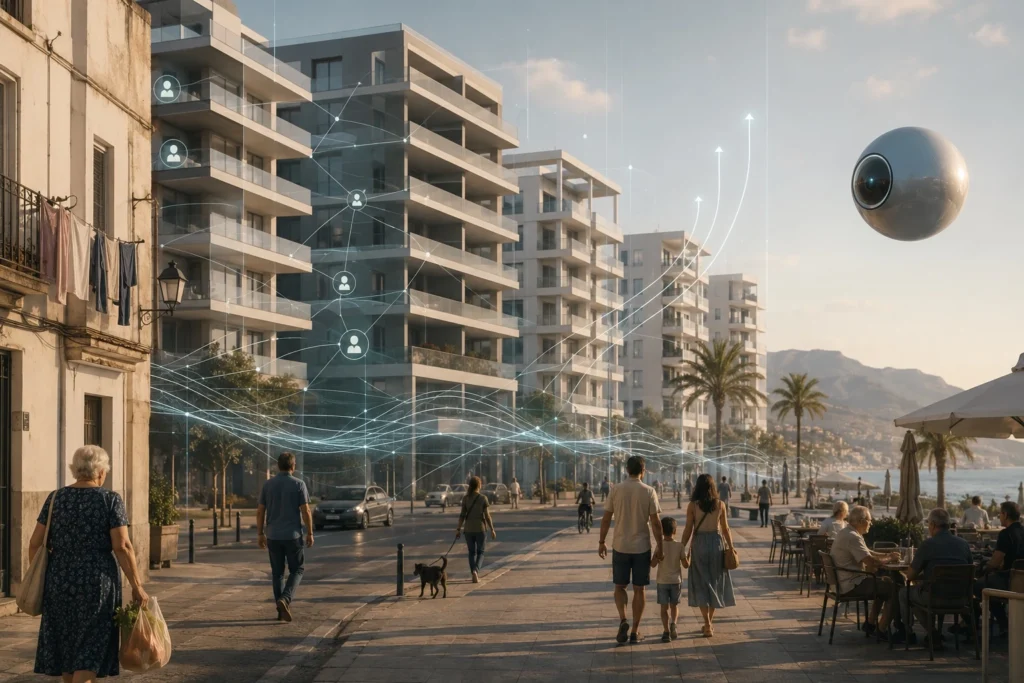
Spend half a day walking around the Costa del Sol and you may hear a North American accent once or twice. Canadian. American. Not common.
What you hear far more often is ordinary life.
People walking dogs. Older residents carrying groceries. Families sitting at cafés. Workers heading home. Joggers along the paseo. Laundry hanging from balconies. Quiet conversation drifting through open windows.
The surprising thing about much of the Costa del Sol is that it does not feel especially luxurious.
It feels simple.
And that simplicity may be exactly why global housing pressure is arriving so aggressively.
People are not only searching for fantasy anymore. They are searching for nervous-system relief.
Walkability. Sunlight. Public life. Lower tension. Slower pacing. Human-scale streets. Places where daily existence feels less combative.
Continuous high-alert urban environments increase cognitive fatigue and long-term emotional load. Over time, people begin to prioritize places with lower nervous-system friction.
That shift matters.
Because when calm places become desirable, they do not stay outside the market for long.
The System Under the Calm
Underneath the calm surface, another system is becoming visible.
The cranes.
They are everywhere now along parts of the coast.
Not just small local construction projects. Large residential developments. New complexes. New ownership models. New ways of turning homes into financial products.
At first glance, this can look like prosperity.
More homes. More investment. More international interest. More construction. More visible growth.
But a different signal appears when you walk slowly and look carefully.
The unused balcony.
No plants. No chairs. No towels. No coffee cup. No small signs of daily life.
A beautiful apartment may exist physically, but not socially.
It may be owned, marketed, rented, shared, reserved, or held as an asset.
But it is not fully lived in.
That is the dead-balcony signal.
What the Dead Balcony Reveals
The dead balcony is not just about rich people buying second homes.
It is also about ordinary people participating in a system that turns livable places into lifestyle inventory.
Fractional ownership. Short-term rentals. Investment apartments. Holiday-use properties. Remote-worker escapes. Retirement plans. Lifestyle branding. Real estate packaged as access to calm.
Many of the people entering this system are not villains.
They may also be tired.
They may also be leaving places that feel too expensive, too aggressive, too noisy, too politically tense, or too emotionally exhausting.
They may be looking for the same thing local residents value:
A calmer life.
That is what makes the system difficult.
The problem is not only greed.
The problem is that human nervous systems are under pressure in many places at the same time.
When enough people seek relief, the places that offer relief become targets for extraction.
The Pattern
The pattern is simple:
- A place becomes emotionally livable.
- People notice the relief.
- Global attention arrives.
- Housing becomes an asset category.
- Livability becomes monetized.
- Local continuity begins thinning underneath the surface.
The result is not always dramatic at first.
The streets may still feel calm.
The cafés may still be full.
The sea may still look beautiful.
But the social fabric begins to change.
Homes become less connected to daily life. Buildings become less connected to communities. Neighborhoods become more connected to outside capital than to the people who actually live there.
This is how a place can look successful while quietly becoming less livable for the people who made it livable in the first place.
This Is Not Only Southern Spain
This pattern is not unique to the Costa del Sol.
Versions of it are appearing in many emotionally livable places, including:
- Portugal
- Barcelona
- the Canary Islands
- parts of Italy
- coastal Greece
- other walkable, sunny, or calmer urban zones around the world
The details change by location.
But the system pattern repeats.
A place becomes desirable because it reduces human stress. Then the market extracts value from that relief. Eventually, the same pressure that people were trying to escape begins to follow them into the place they escaped to.
Why This Is a Human Systems Problem
Housing is usually discussed through money.
Prices. Rent. Supply. Demand. Investment. Regulation.
Those things matter.
But they are not the whole system.
Housing is also nervous-system infrastructure.
A home is not only a private asset. It is part of the emotional stability of a person, a family, a street, and a community.
When housing becomes unstable, people do not only lose affordability.
They lose continuity.
They lose predictability.
They lose the ability to imagine staying.
That loss creates cognitive and emotional load.
People begin to live in a state of background alertness. They wonder if rent will rise. If the neighborhood will change. If their children can stay. If local workers can remain. If ordinary life is being priced out by people who only visit.
A housing system can appear functional on paper while quietly increasing emotional strain in daily life.
The Real Signal
The dead balcony is a small visual clue.
It shows the difference between financial occupancy and human occupancy.
A unit can be sold but not lived in.
A building can be full on a spreadsheet but empty in daily life.
A place can be valuable to investors while becoming less available to residents.
That gap is the signal.
The balcony is there.
The view is there.
The property exists.
But the human continuity is missing.
The Better Question
The question is not whether outsiders should ever move somewhere calmer.
Movement is part of human life.
The better question is:
Can a place remain emotionally livable after the market discovers why people want it?
That is the real challenge.
Because if every calm place becomes a financial product, then calm itself becomes harder to access.
And when calm becomes scarce, housing pressure becomes more than an economic issue.
It becomes a human systems issue.
Key Insight
People are not only searching for better homes.
They are searching for environments that reduce cognitive fatigue, emotional load, and nervous-system friction.
But when those environments are turned into lifestyle inventory, the relief that made them valuable begins to disappear.
The dead balcony is not just an empty balcony.
It is a warning signal.
It shows what happens when homes remain physically present, but human life begins to thin out underneath them.