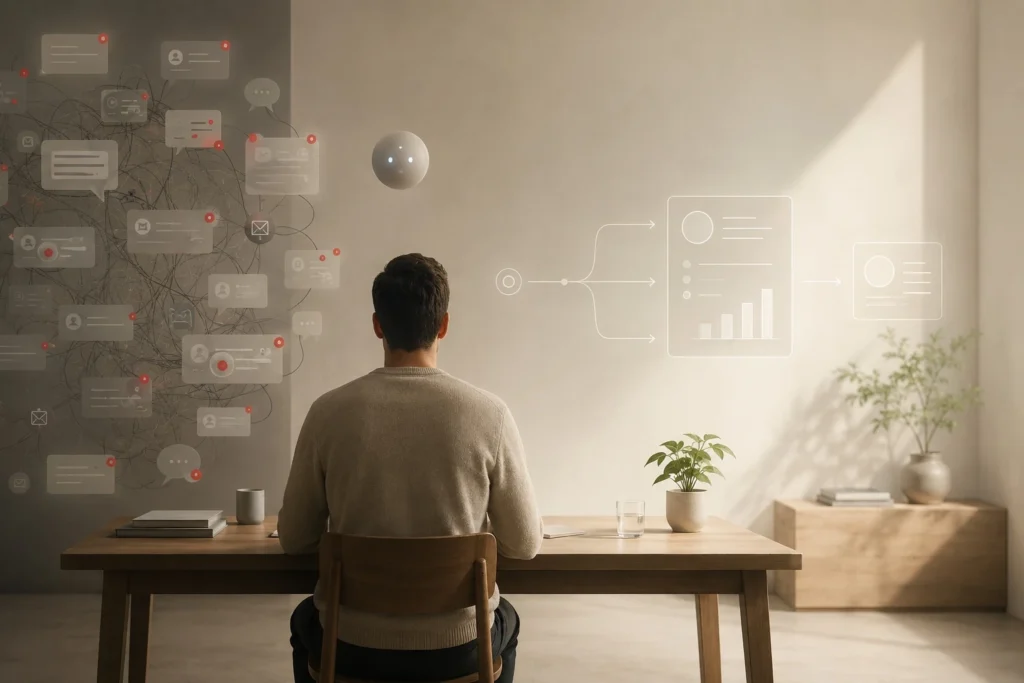
The Input Shapes the Output
Human performance is not produced in isolation. Output comes from input: sound, light, stress, unfinished tasks, addictive loops, social pressure, and the design of the systems around us. When those inputs are cleaner, people do not become “privileged.” They become more accurate, more regulated, and more useful.
We often judge people by their output.
Did they finish the task?
Did they stay calm?
Did they communicate clearly?
Did they do something useful?
Did they perform consistently?
That is how many systems measure human value. They look at what came out and decide what kind of person must be inside.
But output does not appear from nowhere.
Human output is shaped by input conditions.
If the input stream is noisy, addictive, ambiguous, or full of unresolved open loops, the output becomes more reactive, more scattered, and less useful. If the input stream is clear, calm, and well-tuned, the output becomes more intentional, accurate, creative, and productive.
For autistic people, this can be especially visible.
The difference between shutdown and innovation is not always the person.
Often, it is the input layer.
⸻
The system mistake
Most systems treat output as the problem.
If someone is overwhelmed, distracted, inconsistent, irritable, avoidant, or unproductive, the system often assumes the person is failing in some personal way. It may call them disorganized, too sensitive, unreliable, lazy, difficult, or emotionally unstable.
But many of those outputs are not primary problems.
They are downstream effects.
The real issue may be that the environment is feeding the nervous system the wrong signal:
- too much noise
- too much ambiguity
- too many demands
- too many interruptions
- too many unresolved loops
- too many digital hooks competing for attention
The system sees performance.
It misses conditions.
⸻
Autism makes this easier to see
Autistic people are often judged harshly because the output changes so visibly when the input changes.
A noisy room can reduce language access.
Too many competing demands can collapse task initiation.
Unclear instructions can produce paralysis.
Frequent interruptions can break deep focus.
Visual clutter, sensory friction, and social uncertainty can all drain processing power before the real task even begins.
Then the outside world looks only at the output and says:
- Why aren’t they functioning?
- Why are they upset?
- Why didn’t they finish?
- Why are they so inconsistent?
But autistic cognition is not weak.
It is highly sensitive to signal quality.
That sensitivity can create struggle in chaotic systems, but it can also create extraordinary value in tuned conditions:
- deep pattern recognition
- precision
- innovation
- artistic depth
- strong system perception
- meaningful productivity
A powerful system still needs a clean signal.
⸻
Open loops are part of the input burden
One part of the input layer gets ignored all the time: open loops.
Open loops are unresolved signals that continue occupying background attention.
They include things like:
- unattended email
- unread messages
- red notification numbers on apps
- open browser tabs
- vague tasks with no clear end
- things waiting for a reply
- unresolved obligations
- half-finished decisions
- digital clutter
- social tension that has not been closed
These are often treated as small things.
They are not small.
Each one acts like a cognitive hook.
It keeps pulling at the system:
- Check this.
- Don’t forget.
- Someone may need something.
- There might be a problem.
- You still haven’t handled this.
- Something is unfinished.
For some people, those hooks are background irritation.
For others, especially many autistic people, they can become constant low-grade drag.
Not always dramatic.
Just persistent.
The result is a nervous system that never fully settles and a mind that never gets full closure.
That affects output.
⸻
Digital systems are designed to keep loops open
This is not accidental.
Many digital systems benefit from unresolved attention. They are built around reminders, alerts, badges, interruptions, urgency signals, and easy re-entry points. They do not always help people close loops. Often, they help keep loops active.
The red numbers on apps are a perfect example.
They are tiny, but they signal incompletion.
They create a visual demand.
They sit quietly in the background, asking for cognitive energy even when you are trying to focus somewhere else.
An unread email is not just an email.
For many minds, it becomes a live thread.
A vague obligation is not just a task.
It becomes a low-level open process.
When enough of these stack up, people do not simply become “less disciplined.” They become saturated.
⸻
Better output often starts with cleaner input
If we want better human performance, we should stop starting only at the output layer.
Before asking:
- Why is this person not producing?
- Why are they dysregulated?
- Why are they not focused?
- Why are they inconsistent?
We should ask:
- What is entering their system?
- What is still open in their attention field?
- What keeps pulling background processing?
- What sensory or digital conditions are distorting performance?
- What can be reduced, clarified, or closed?
This is a better human systems question.
Because many people do not need more pressure.
They need a cleaner signal.
⸻
Input conditions that commonly distort output
Here are some common examples:
| Input condition | Likely output effect |
| Noise and sensory overload | irritability, shutdown, reduced language, mistakes |
| Ambiguity | hesitation, paralysis, over-processing |
| Constant interruptions | broken focus, slower recovery, unfinished work |
| Addictive digital loops | compulsive checking, scattered attention |
| Red badges and unattended email | background tension, reduced clarity, mental drag |
| Vague obligations | lingering stress, low task initiation |
| Clear tasks and calm space | precision, regulation, useful production |
| Reduced open loops | more intentional action, deeper focus |
The pattern is simple:
better inputs tend to create better outputs.
⸻
The reframe
Autism is often framed as an output problem.
But many autistic struggles are actually input problems.
And that changes everything.
It means the person may not be broken.
The environment may be misaligned.
It means support is not only about teaching the person to “cope better.”
It is also about designing better conditions:
- quieter spaces
- clearer expectations
- less visual and digital clutter
- fewer interruptions
- stronger closure systems
- reduced addictive loops
- interfaces that respect attention instead of harvesting it
This is not lowering standards.
It is improving system design.
⸻
Practical application
If you want to improve your own output, or support someone else’s, start here:
1. Reduce sensory noise
Identify obvious friction:
- background sound
- visual clutter
- competing screens
- unnecessary stimulation
2. Clarify the task
Make the next action visible and concrete.
Not “work on this.”
Better: “open the file and write the first paragraph.”
3. Close open loops
Pick a few active drains:
- clear the red badges
- archive or sort key email
- close extra tabs
- define unresolved tasks
- remove unnecessary pending decisions
4. Reduce interruption points
Turn off nonessential notifications.
Protect deeper work windows.
5. Respect recovery
A system under strain may need quiet before it can produce strong output again.
6. Judge output more fairly
Before blaming the person, inspect the conditions that shaped the output.
⸻
Why this matters beyond autism
Autism makes the pattern more visible, but the principle is human-wide.
Everyone is shaped by what enters their system.
Noisy inputs create noisy outputs.
Fragmented attention creates fragmented behavior.
Unresolved loops create mental drag.
Clear conditions create clearer action.
The difference is that some people can mask the effects longer, while others show them sooner.
That does not make the pattern less real.
It only makes it easier to ignore.
⸻
Final insight
Many systems are trying to improve people without improving the inputs surrounding them.
That is backwards.
Before judging the output, inspect the input.
A mind may not be failing.
The signal may simply be wrong.
And sometimes the most effective intervention is not motivation, discipline, or pressure.
Sometimes it is this:
reduce the noise, close the loops, and let the system think.
⸻
Key Insights
- Human output is shaped by input conditions.
- Noise, ambiguity, addiction loops, and unresolved open loops all affect performance.
- For autistic people, small input changes can create dramatically different outputs.
- Red notification badges, unattended email, and digital clutter are not trivial; they act as ongoing cognitive hooks.
- Many performance problems are better understood as environmental or systems problems before they are treated as personal failures.
- Better human systems start by improving signal quality, not just demanding better output.