A Human Systems View
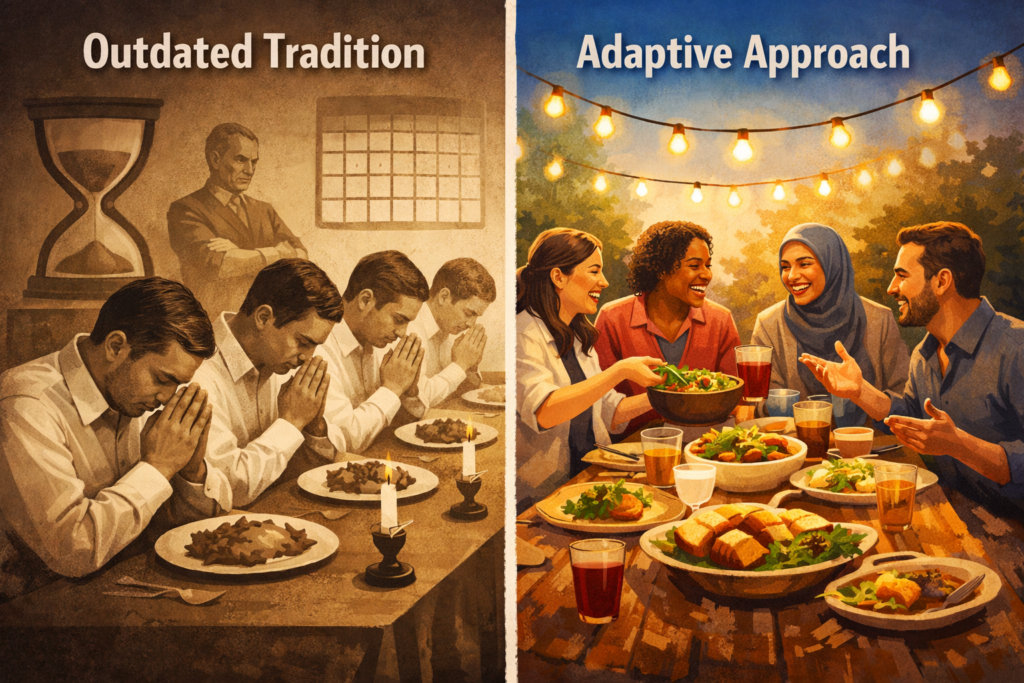
When customs outlive their purpose, they stop supporting human life and start operating on habit alone. Moving across cultures makes this visible fast—what feels “normal” in one place disappears completely in another.
Across every culture, customs shape behavior long before conscious thought.
We inherit them early:
How to greet
How to eat
How to gather
What to celebrate
What to avoid
Most of the time, we don’t question them.
Because customs don’t present themselves as systems.
They present themselves as “the way things are.”
⸻
Break the Assumption
The default belief:
Custom = truth
Tradition = value
Repetition = correctness
But customs are not truth.
They are solutions created under past conditions.
And like any system, they can become outdated.
⸻
Why Customs Outlive Their Purpose
Every custom begins with a function.
It exists to solve something:
• Environmental (seasons, survival, scarcity)
• Social (coordination, bonding, identity)
• Psychological (comfort, predictability, meaning)
• Structural (power, order, hierarchy)
When the environment changes—but the custom does not—the system drifts.
That drift follows a predictable pattern:
Function → Habit → Obligation → Enforcement
At the end of that chain, the original purpose is often gone.
Only the behavior remains.
⸻
Distortion Layer
A custom becomes distorted when:
The story stays the same
But the function disappears
At that point, the system sustains itself through:
• Social pressure
• Identity protection
• Emotional attachment
• Authority reinforcement
People don’t follow it because it works.
They follow it because not following it has a cost
⸻
Power and Preservation
Power rarely needs to invent customs.
It only needs to preserve and stabilize them.
Once a custom aligns with:
• Identity
• Belonging
• Order
It becomes self-reinforcing.
Institutions, leaders, and systems may then:
• Formalize it
• Normalize it
• Protect it from questioning
Not always out of manipulation—
But because stable systems are easier to maintain than changing ones.
⸻
Harm Signals
Not all customs are harmful.
But all customs should be evaluated.
Watch for these signals:
• Obligation replaces meaning
• Participation feels performative
• Questioning creates tension or rejection
• The outcome no longer matches the purpose
• Individuals must suppress themselves to comply
When these appear, the system is no longer serving the human.
The human is serving the system.
⸻
Reframe
You are not required to reject all customs.
You are required to understand them.
A functional custom:
• Supports your life
• Aligns with current reality
• Allows flexibility
A non-functional custom:
• Drains energy
• Enforces outdated conditions
• Persists through pressure rather than value
The goal isn’t to reject traditions—it’s to recognize when customs outlive their purpose and no longer serve you.
⸻
Application
Instead of asking:
“Is this tradition good or bad?”
Ask:
What was this designed to do?
Is it still doing that?
What is the actual outcome now?
Then choose:
• Keep (if it still serves)
• Modify (if it partially works)
• Exit (if it no longer aligns)
All three are valid.
⸻
System Insight
Customs are inherited systems.
But participation is a choice.
Awareness is the point where inheritance becomes autonomy.
⸻
Key Insights
• Customs originate as solutions, not truths
• Systems drift when conditions change
• Social cost keeps outdated systems alive
• Power stabilizes systems more than it creates them
• Evaluation restores autonomy
⸻