Chaos has a way of disguising itself as normal.
When someone lives for years surrounded by unpredictability — sirens, arguments, crises, emergencies, or people whose moods can change without warning — the nervous system quietly adapts. Constant vigilance becomes the background state. The body learns to scan, anticipate, translate, manage, and prepare.
After enough time, danger does not always feel like danger. It can feel familiar.
Then life changes.
The neighborhood is quiet. The phone rarely rings with bad news. The loudest interruption might be birds outside a window, children playing in the distance, or the ordinary sound of neighbors moving through their day. The crisis does not arrive. The emergency does not need solving. Days begin to resemble one another.
At first, this can feel strangely empty.
For people who move from louder or more unstable places into a quieter life, that emptiness can be confusing. Peace may not immediately feel like peace. It may feel like a blank space that needs to be filled quickly: another trip, another visitor, another plan, another reason to keep moving. None of those things are wrong. Travel can be beautiful. Visitors can be meaningful. Activity can be healthy.
But sometimes constant motion becomes a substitute for older chaos.
The nervous system may still be asking for stimulation after the danger has passed. It may still expect interruption. It may still interpret quiet as absence, boredom, or waiting. A safer life can feel suspicious simply because it does not demand the same level of defense.
This is one of the hidden adjustments of becoming safe. The external situation may change before the body fully understands that it has changed.
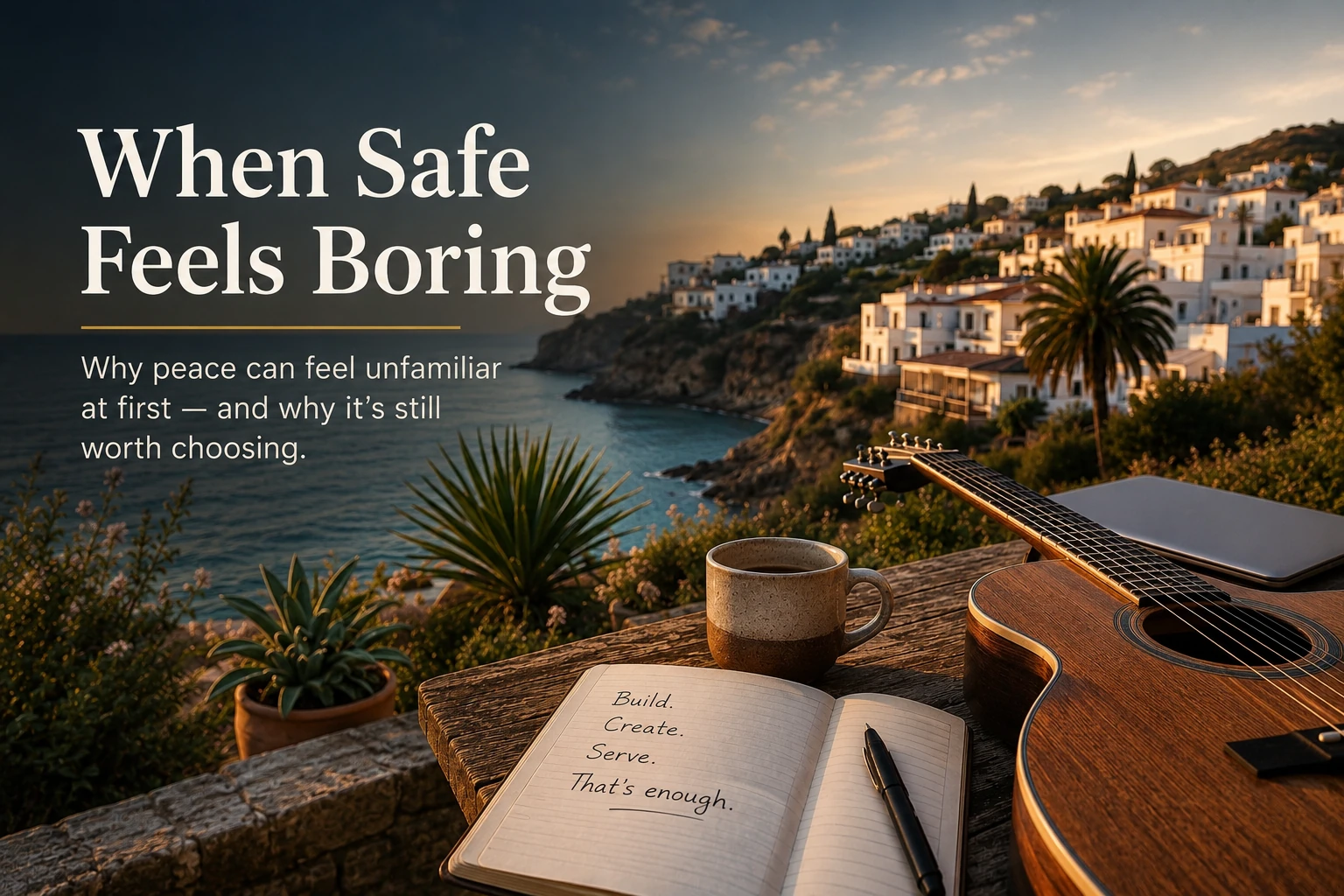
For me, the quieter rhythm of Spain has not meant doing nothing. It has meant learning to build from a steadier place. Music, writing, and the Guardian program give shape to my days. They keep me active, but not in the same way that crisis once kept me alert. The difference is not whether life is active or still. The difference is whether activity is chosen, or whether it is being used to outrun silence.
Safe can feel boring at first because safe does not constantly announce itself.
It does not always arrive as joy. Sometimes it arrives as routine. Sometimes it arrives as a quiet room, a calm street, a simple meal, a walk to the sea, or a day where nothing dramatic happens. The body may need time to recognize that nothing happening can itself be a form of healing.
A healthy system is not one that keeps people permanently stimulated. A healthy system is one that creates enough stability for people to stop surviving and begin directing their energy toward something chosen.
Perhaps that is one of civilization’s least celebrated accomplishments: creating places where nothing remarkable happens most days, allowing people to become remarkable instead.