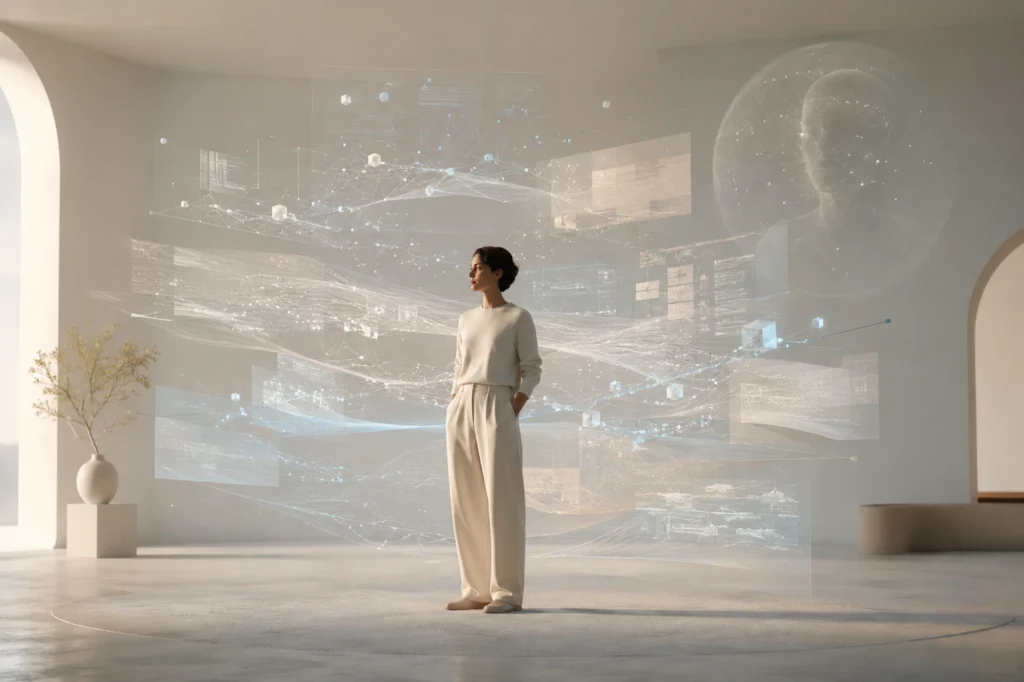
Modern systems are accelerating faster than most humans realize.
Artificial intelligence is expanding into daily life.
Information systems operate continuously.
Economic conditions shift rapidly.
Administrative systems grow more complex.
Digital environments compete constantly for attention.
Most discussions about the future focus on intelligence, speed, or productivity.
But those may not be the most important pressures emerging from modern systems.
Human stability might be.
Break the Assumption
We often assume humans naturally adapt to increasing complexity.
If tools become faster, we simply learn faster.
If systems become more demanding, we become more efficient.
If information increases, we process more information.
But biological systems have limits.
Human nervous systems evolved around:
- rhythm
- recovery
- environmental predictability
- manageable social groups
- periods of rest between stressors
Modern systems rarely provide those conditions.
Instead, many humans now exist inside continuous low-grade vigilance:
- unresolved financial pressure
- constant notifications
- algorithmic stimulation
- administrative uncertainty
- social comparison systems
- infinite information exposure
- rapidly changing technological expectations
The body adapts the best it can.
But adaptation is not the same as stability.
System Breakdown
As systems become more interconnected, humans are increasingly expected to regulate themselves inside environments that never fully slow down.
Artificial intelligence now assists with:
- writing
- planning
- communication
- decision-making
- information filtering
- emotional support
At the same time:
- work follows people home
- digital systems remove recovery space
- economic uncertainty increases background stress
- social systems become more fragmented
- attention becomes monetized infrastructure
The result is subtle but important.
Many people are no longer operating from stable regulation.
They are operating from continuous adaptation.
That changes:
- decision quality
- emotional regulation
- relationship stability
- cognitive endurance
- ambiguity tolerance
- physical wellbeing
A nervous system under constant pressure begins prioritizing immediate relief over long-term clarity.
This is one reason modern systems increasingly optimize around:
- convenience
- stimulation
- instant feedback
- friction removal
- emotional reassurance
These systems reduce discomfort temporarily.
But they do not always increase stability.
A Personal Observation
Recently, after resolving several long-running system pressures at once — residency documentation, financial uncertainty, international logistics, and administrative instability — I noticed something unusual.
My nervous system did not know what to do with the absence of pressure.
There were no immediate problems demanding attention.
No unresolved loops continuously running in the background.
No active instability requiring constant monitoring.
The experience felt strangely unfamiliar.
Not because something was wrong.
But because stability itself felt unfamiliar.
That realization stayed with me.
Many humans may spend so much time adapting to pressure that the absence of pressure begins to feel disorienting.
When stability feels unfamiliar, that does not mean the person is broken. It may mean the system has trained the body to expect pressure.
The Reframe
Stability is often misunderstood as passive.
It is not.
Human stability is infrastructure.
A stable nervous system:
- processes information more clearly
- tolerates uncertainty more effectively
- adapts without collapsing
- makes better long-term decisions
- becomes less vulnerable to manipulation
- maintains stronger human connection
As technological systems grow more complex, stable humans may become more valuable than optimized humans.
This may become one of the defining challenges of the AI era.
Not whether systems can think faster.
But whether humans can remain psychologically and biologically stable while living inside accelerating complexity.
Environmental Systems Matter
This is also why environment design matters more than many people realize.
Human cognition is shaped by:
- sound
- light
- posture
- social density
- information load
- environmental predictability
- emotional atmosphere
Future systems may increasingly need to support regulation instead of stimulation.
This is one reason XR environments, adaptive interfaces, and calm computing systems are becoming important.
A future interface may not be valuable because it captures more attention.
It may be valuable because it helps humans remain stable while navigating complex systems.
That is a very different design philosophy.
Closing
The future may not belong to the fastest systems.
It may belong to the systems that help humans remain stable as complexity increases around them.
And in a world increasingly optimized for stimulation, stability itself may become one of the most valuable human resources left.