
Tag: self-regulation

  • Mind Loops: When the Mind Is Running Too Many Open Systems

    We often talk about focus as if it is only a matter of discipline.

    Pay attention.
    Try harder.
    Stop being distracted.
    Be more productive.

    But sometimes the problem is not a lack of focus.

    Sometimes the problem is that the mind is running too many open loops at once.

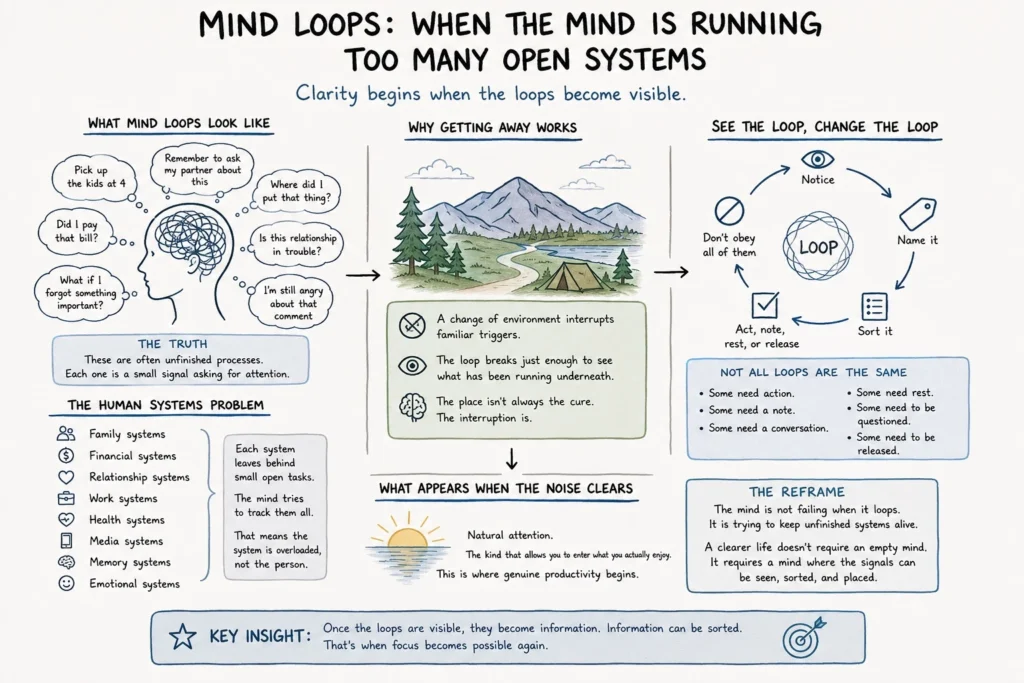
    Pick up the kids at four.
    Remember to ask my partner about this.
    Did I pay that bill?
    What was I supposed to do next?
    Where did I put that thing?
    Is this relationship in trouble?
    I need to buy more pickles.
    I am still angry about that comment.
    What if I forgot something important?

    These thoughts can seem random.

    But they are not always random.

    They are often unfinished processes.

    Each one is a small signal asking for attention. A task. A worry. A memory. A fear. A social script. A financial reminder. A relationship question. A body signal. A piece of emotional residue that has not yet cleared.

    The mind keeps looping because something has not been resolved, placed, understood, trusted, or released.

    The Human Systems Problem

    This is a Human Systems problem.

    We often treat mental noise as a personal weakness, but many times it is cognitive overload.

    Modern life asks the mind to hold too many systems at the same time.

    Family systems.
    Financial systems.
    Relationship systems.
    Work systems.
    Health systems.
    Media systems.
    Memory systems.
    Emotional systems.

    Each system leaves behind small open tasks.

    The mind tries to track them all.

    That does not mean the mind is broken.

    It means the system is overloaded.

    A person may look distracted from the outside, but internally they may be managing dozens of active loops at once. Some are practical. Some are emotional. Some are old. Some are not even important anymore, but they keep returning because they were never sorted.

    Focus becomes difficult because attention is already occupied.

    Why Getting Away Works

    Maybe this is why people love vacations, camping, long walks, or simply getting away.

    It is not always about the different place.

    Sometimes the value is that the old loop gets interrupted.

    The familiar triggers are gone for a moment. The same rooms, screens, bills, reminders, conversations, objects, obligations, and emotional scripts are not constantly pulling on attention.

    The loop breaks just enough for the person to see what has been running underneath.

    That is why distance can feel like clarity.

    Not because life disappeared.

    Because the background noise changed.

    The mind finally has enough space to show what it has been carrying.

    Seeing the Loop

    I think, for once, I finally reached the point where I could see it.

    Not perfectly.

    Not permanently.

    But clearly enough to recognize the loops for what they were.

    They were not my whole mind.

    They were repeated signals, unfinished tasks, old fears, rehearsed conversations, small obligations, and emotional echoes asking for attention.

    Once I could see them, I did not have to obey all of them.

    That changed something.

    Because when the loops are invisible, they feel like reality.

    When they become visible, they become information.

    And information can be sorted.

    Some loops need action.
    Some need a note.
    Some need a conversation.
    Some need rest.
    Some need to be questioned.
    Some need to be released.

    The goal is not to erase the mind.

    The goal is to see what is running.

    Natural Attention

    When enough noise clears away, something different appears.

    Natural attention.

    The kind that allows people to enter what they actually enjoy.

    Not forced productivity.
    Not pressure.
    Not performance.

    Coherence.

    This is where genuine productivity often begins.

    Not from pushing harder, but from reducing the number of unresolved loops competing for the same attention.

    Calm is not always something we find by adding another wellness practice.

    Sometimes calm begins when we stop feeding every loop as if it deserves control.

    Sometimes calm begins when we can finally say:

    This is a task.
    This is a fear.
    This is a memory.
    This is a practical reminder.
    This is an old script.
    This is not the whole truth.

    That separation matters.

    Because once a loop is named, it loses some of its power.

    The Reframe

    The mind is not failing when it loops.

    It is trying to keep unfinished systems alive.

    The problem is not always the thought itself.

    The problem is when too many loops remain open, unnamed, and unmanaged.

    A clearer life does not require an empty mind.

    It requires a mind where the signals can be seen, sorted, and placed.

    That is when focus becomes possible again.

    Not because the person became more disciplined.

    Because the system became more coherent.

    Key Insights

    • Mental loops are often unresolved system signals, not personal failure.
    • Focus becomes difficult when too many open loops compete for attention.
    • Changing environment can interrupt familiar triggers long enough to reveal what is underneath.
    • Once a loop becomes visible, it can be sorted instead of obeyed.
    • Calm often begins when the mind stops treating every signal as equally urgent.

  • Stim Is Self Regulation: Why Movement Creates Calm

    By Oddly Robbie

    person calmly regulating through rhythmic movement in a warm environment

    Let’s start with what “stim” actually means and why stim Is self regulation.

    Stim is short for self-stimulatory behavior.

    The term sounds clinical.

    The reality is simple:

    Stim is how the body regulates itself.


    The Anchor

    Stim is repetitive movement or sound that creates rhythm:

    • rocking
    • tapping
    • shifting weight
    • humming
    • fixing your gaze
    • breathing with motion

    It’s not performance.

    It’s regulation.

    It’s the body creating predictability in an environment that can feel:

    • loud
    • bright
    • fast
    • overwhelming

    The Break

    Everyone stims.

    • someone bouncing their knee
    • pacing during a phone call
    • an athlete rocking before a sprint
    • a musician swaying
    • someone praying in motion

    The difference is not whether we stim.

    It’s which stims are socially accepted.


    System Breakdown

    1. Regulation vs Appearance
    Stim stabilizes the nervous system.

    But environments often prioritize:

    • stillness
    • visual order
    • conformity

    Over actual regulation.


    2. Suppression Training
    Many people—especially autistic children—are taught:

    • “sit still”
    • “stop that”
    • “be normal”

    Which really means:

    regulate invisibly


    3. Internal Cost

    When movement is suppressed:

    • the body still needs regulation
    • but the outlet is removed

    So it shifts inward:

    • jaw tension
    • shoulder tightness
    • internal stress

    The system is still working—

    just less effectively.


    Lived System

    I was trained early to be still.

    In school.
    In church.
    In the military.

    Feet planted.
    Eyes forward.
    Don’t move.

    In that environment, it made sense.

    Stillness created:

    • cohesion
    • predictability
    • immediate response

    But stillness is not the same as calm.


    What Changed

    My nervous system processes input intensely:

    • sound arrives as data
    • movement registers fully
    • emotional tone is present

    So I use rhythm:

    • gentle rocking
    • breath synced with motion
    • visual anchoring

    That rhythm:

    • lowers volatility
    • reduces threat response
    • keeps me present

    What This Reveals

    Stim is not disruption.

    It’s participation.

    It allows:

    • conversation
    • presence
    • engagement
    • creation

    Without shutdown.


    Cultural Misread

    Movement that looks powerful is accepted:

    • athletes bouncing
    • speakers pacing
    • performers swaying

    Movement that looks vulnerable is judged.

    But the nervous system doesn’t make that distinction.


    Reframe

    Stillness is not always control.

    Sometimes it’s suppression.

    Movement is not immaturity.

    It’s biology.


    Application

    If your goal is regulation:

    • allow small movement
    • use rhythm intentionally
    • respect your sensory limits
    • don’t force stillness where it costs you

    Result

    Less overwhelm.
    More presence.
    More sustainable engagement.


    System Insight

    The nervous system regulates through rhythm.

    Not appearance.


    Closing

    I don’t stim to withdraw from the world.

    I stim so I can stay in it.

    Stim is freedom to feel calm.

    And calm is not weakness.

    It’s stability without tension.

    — Oddly Robbie

  • Sovereignty Isn’t Control — It’s a System

    by oddly robbie

    Conceptual illustration of personal sovereignty showing a small human node maintaining autonomy while connected to a larger expanding system network.

    The Pattern Most People Don’t See

    Sovereignty is being discussed loudly at the level of nations.

    Large systems push outward. Smaller systems push back.

    The language sounds political—but the pattern is structural.

    What’s happening between countries is the same thing happening inside systems.

    And the same thing happening inside a single human life.


    Break the Assumption

    Most people think sovereignty is about control.

    That nations, systems, or individuals must hold power to remain secure.

    But control is not sovereignty.

    Control expands outward.
    Sovereignty stabilizes inward.


    The System Behind It

    As systems grow, they lose visibility.

    • Decisions move further from real people
    • Abstraction replaces direct experience
    • Impact becomes harder to feel

    To maintain coherence, large systems expand their influence.

    Not because they are malicious—but because scale creates distance.

    Smaller systems—and individuals—experience the effects directly.

    So they push back.

    This creates a repeating pattern:

    • Expansion from scale
    • Resistance from proximity

    The same structure appears everywhere:

    • Nations vs smaller states
    • Institutions vs individuals
    • Systems vs the human inside them

    Reframe

    Sovereignty is not dominance.

    Sovereignty is self-containment with awareness.

    At the human level, it means:

    • Belonging to yourself
    • Choosing connections freely
    • Owning no one
    • Letting no one own you

    At the system level, it means:

    • Maintaining function without overreach
    • Respecting the autonomy of smaller systems

    Application

    You don’t need to fight every system to maintain sovereignty.

    You need to recognize when expansion is compressing your autonomy.

    Then respond with clarity, not escalation:

    • Define your boundaries clearly
    • Choose participation, don’t default to it
    • Reduce dependence where possible
    • Stay connected—but not absorbed

    Sovereignty is not isolation.

    It’s the ability to remain whole while connected.


    Key Insights

    • Sovereignty is a structural pattern, not just a political concept
    • Large systems expand because scale reduces visibility
    • Resistance comes from those who feel the impact directly
    • Control and sovereignty are not the same
    • True sovereignty is maintaining autonomy while staying connected

  • The Swipe Loop: How Digital Platforms Keep You Hooked

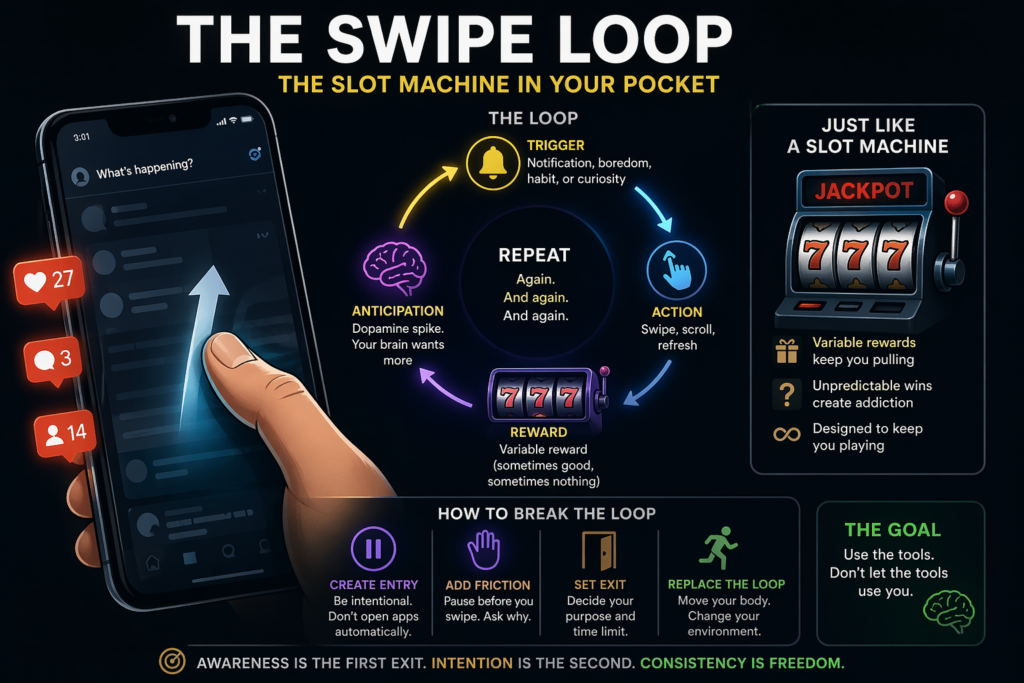
    This infographic illustrates the Swipe Loop, a behavioral system used by digital platforms to maintain user engagement. It shows the cycle of trigger, action, reward, and repetition, similar to a slot machine. The visual also explains key mechanisms such as variable rewards, low-effort interaction, and lack of stopping points. Practical strategies are included to help users break the loop, including intentional app use, adding friction, setting exit conditions, and replacing the behavior with physical movement.

    The Swipe Loop Visual Model

    The Swipe Loop starts the same way every time.

    The bells ring first—sharp, bright, demanding.

    Then the reward.

    That pattern isn’t limited to casinos.

    It’s in your pocket.


    The Anchor

    Every time you:

    • refresh a feed
    • check a notification
    • scroll “just one more time”

    you’re pulling a lever.

    Sometimes you get something:

    • a message
    • a like
    • something interesting

    Most of the time, you don’t.

    That unpredictability is the key.

    This pattern has a name:

    The Swipe Loop


    The Break

    This isn’t accidental.

    Digital platforms are built around a pattern called intermittent reinforcement:

    • rewards come randomly
    • not every time
    • just often enough to keep you engaged

    This is the same mechanism used in slot machines.

    And it’s one of the most powerful behavioral hooks humans have.


    System Breakdown

    1. Variable Reward

    You don’t know when something good will appear.
    That uncertainty keeps you checking.

    2. Low Effort Loop

    • flick
    • refresh
    • repeat

    No friction. Easy to continue.

    3. Social Signal Layer

    • likes
    • views
    • responses

    Your brain reads this as attention and approval.

    4. Endless Design

    There’s no natural stopping point.
    So the loop continues unless you interrupt it.


    Personal Evidence (Loop Resistance in Practice)

    I’ve tried to break the loop in simple ways:

    • hide the app
    • move it off the screen
    • reduce visibility

    When that doesn’t work, I delete it.

    And it works—for a while.

    But then something interesting happens:

    The app comes back.

    Not because I need it.

    Because the loop isn’t finished.

    So I delete it again.

    What this reveals is simple:

    Removing access doesn’t remove the system.

    The urge is not about the app.

    It’s about the loop continuing without closure.


    What This Reveals

    The behavior isn’t a personal flaw.

    It’s a system interacting with your nervous system.

    You’re not weak.

    You’re responding exactly as designed.


    Reframe

    This isn’t about discipline.

    It’s about unfinished loops.

    Deleting the app interrupts access.

    But it doesn’t complete the cycle your brain is trying to resolve.

    Until the loop is closed, it will keep trying to reopen.


    Application (Healthy Use)

    The goal isn’t to quit technology.

    The goal is to stop interacting with it unconsciously.

    1. Create Entry Points

    • open apps intentionally
    • not automatically

    2. Add Friction

    • pause before refreshing
    • ask: “why am I opening this?”

    3. Set Exit Conditions

    Decide before you start:

    • time limit
    • purpose

    4. Replace the Loop

    When the urge hits:

    • stand up
    • move
    • shift your environment

    Break the pattern physically.


    Result

    You still use the tools.

    But they stop using you.


    System Insight

    The Swipe Loop works because it removes closure.

    • no defined start
    • no defined end
    • no completion signal

    Your brain keeps searching for resolution that never arrives.

    When you reintroduce:

    • clear entry
    • defined exit
    • intentional purpose

    the loop weakens.


    Closing

    The machine is designed to keep you pulling.

    But you still decide when to stop.

    And that’s where your control begins.

    — Oddly Robbie

  • Why Indirect Communication Drains Your Energy (and What Actually Protects It)

    Most people think indirect communication is safer.

    Sarcasm. Distance. Withholding. Subtle signals instead of clear words.

    It can feel like control.

    But it isn’t.

    Why Indirect Communication Feels Like Protection

    Indirect communication looks like protection.

    In reality, it’s effort.

    It requires:

    • constant monitoring
    • interpreting signals
    • maintaining a version of yourself

    That costs energy.

    The Break

    We’re often taught that:

    • being direct is risky
    • being unclear is safer

    So people default to indirect communication.

    This is where indirect communication quietly drains you.

    They leak it.

    System Breakdown

    1. Indirect Mode (Friction)

    • signals instead of statements
    • guessing instead of knowing
    • tension instead of clarity

    Result: continuous energy drain

    2. Direct Mode (Clarity)

    • clear communication
    • defined limits
    • intentional responses

    Result: stable energy

    What This Reveals

    Energy isn’t protected by hiding.

    It’s protected by clarity.

    When you’re unclear:

    • you stay engaged longer than needed
    • you process more than necessary
    • you carry interactions with you

    When you’re clear:

    • interactions end cleanly
    • energy returns faster
    • your system resets

    Reframe

    The goal isn’t to protect yourself by being hard to read.

    The goal is to protect your energy by being clear enough to close loops.

    Application

    Instead of:

    • hinting
    • signaling
    • withdrawing indirectly

    Try:

    • stating your response clearly
    • ending the interaction cleanly
    • not carrying it forward

    No extra processing needed.

    Result

    Less mental load.
    Less emotional residue.
    More available energy.

    System Insight

    Unclear behavior extends interaction.
    Clear behavior completes it.

    Completion is what restores energy.

    Closing

    Indirect communication feels like control.

    Clarity actually is.

    — Oddly Robbie

  • When Systems Get Loud, the Human Gets Lost

    A Human Systems view of control, environment, and identity


    Opening — The Assumption

    If everything around you is structured, optimized, and controlled…
    then you should function better.

    More systems = more stability.
    More control = more clarity.

    That’s the belief.


    Break the Assumption

    Some systems don’t support the human.

    They replace them.

    When a system becomes too loud—
    too structured, too controlling, too constant—

    it doesn’t guide behavior.

    It overrides it.


    System Breakdown

    Humans are adaptive systems.

    We regulate through:

    • environment
    • pacing
    • internal signals
    • autonomy of choice

    A healthy system:

    • supports regulation
    • reduces friction
    • allows variation

    But controlling environments do something different:

    They:

    • remove variation
    • suppress internal signals
    • enforce constant external structure
    • replace choice with compliance

    Over time, the human system stops referencing itself.

    It starts referencing the system.


    What Actually Happens

    At first:

    • things feel easier
    • decisions are reduced
    • structure feels supportive

    Then gradually:

    • internal signals get quieter
    • identity becomes reactive
    • behavior becomes scripted

    Eventually:

    The person is functioning—
    but not self-directed.


    The Real Question

    If the system went quiet…

    Who is left?

    Not the role.
    Not the routine.
    Not the behavior shaped by the environment.

    The actual human.


    Reframe

    The goal of a system is not control.

    It’s support without replacement.

    A system should:

    • hold structure lightly
    • amplify awareness
    • protect autonomy
    • adapt to the human—not the other way around

    System Insight

    A system becomes harmful when it becomes the primary source of truth.

    Instead of:

    “This helps me function”

    It becomes:

    “This is how I exist”

    That’s the shift where the human gets lost.


    Application

    Check any system in your life:

    Ask:

    • Can I step out of this and still feel like myself?
    • Do I notice my internal signals, or only external demands?
    • Is this system helping me choose—or choosing for me?

    If the system goes quiet and there’s discomfort…

    That’s not failure.

    That’s signal returning.


    Key Insights

    • Not all structure supports the human system
    • Control can replace regulation if it becomes constant
    • Identity weakens when internal signals are ignored
    • Healthy systems are adjustable—not dominant
    • If you can’t function without the system, the system is too loud

    The human system isn’t meant to be controlled.
    It’s meant to be supported—and still remain itself.