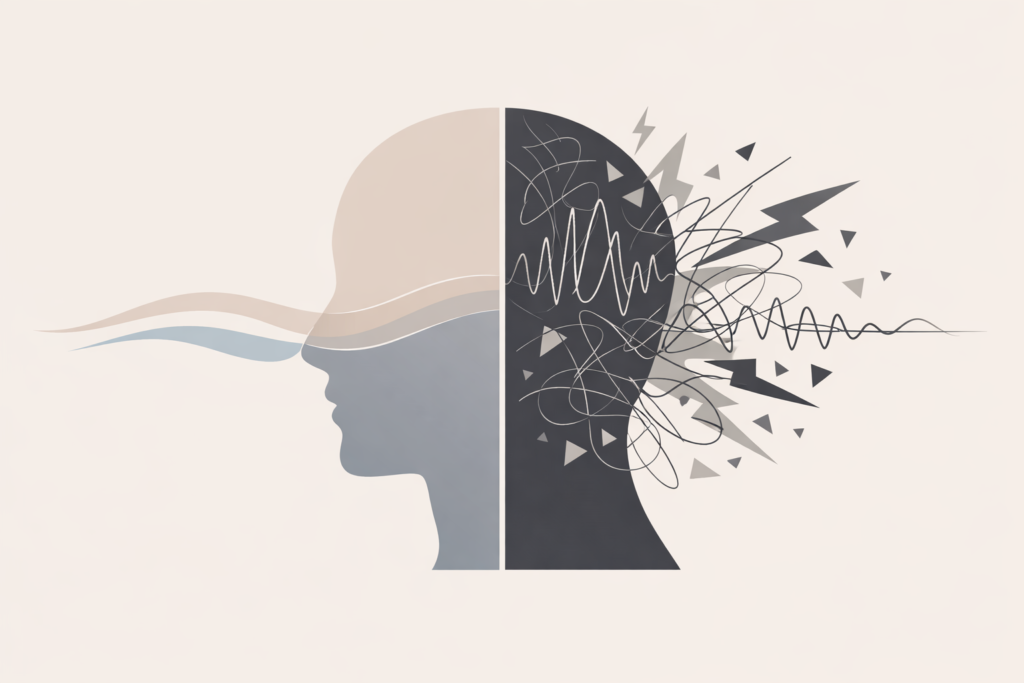

Discussions about autistic meltdowns usually begin with triggers.
Noise. Crowds. Sudden changes. Conflict. Administrative pressure. Housing uncertainty. Too many decisions arriving at once.
These factors matter, but focusing only on triggers gives an incomplete picture. Two people can face the same destabilizing event and have very different outcomes. Even the same person may cope well on one day and become overwhelmed on another.
The difference is often not the event itself.
It is the condition of the system receiving it.
A meltdown is rarely created by one small incident. More often, it is the visible end of accumulated stress, reduced processing capacity, sensory pressure, uncertainty and loss of control. The final event may look minor from the outside, but it lands on a nervous system that no longer has enough capacity to absorb it.
This means prevention cannot be limited to avoiding triggers.
It must also include building stabilizers.
What Is a Stabilizer?
A stabilizer is anything that helps a person maintain or regain regulation.
It may be environmental, physical, cognitive, relational or creative. Some stabilizers reduce incoming pressure. Others restore agency, provide continuity or help the brain organize what is happening.
Examples include:
- a predictable and private home;
- permission to leave an overwhelming environment;
- familiar routines;
- meaningful creative work;
- learning at a self-directed pace;
- movement and rhythmic activity;
- doing something the person already knows they can do well;
- externalizing thoughts through writing or conversation;
- contact with a calm and trusted person;
- having one clear next action.
A stabilizer is not merely a comfort or reward. It performs a regulatory function.
The Secure Base Comes First
For many autistic people, home is not simply where they sleep. It is the primary location where the nervous system recovers from the outside world.
A stable home can provide:
- control over light, sound and temperature;
- familiar objects and spatial arrangements;
- predictable routines;
- privacy;
- reduced social performance;
- a known place to retreat;
- confidence that the environment will still be available tomorrow.
Housing instability can therefore affect much more than housing.
When a home feels temporary, unsafe, noisy or vulnerable to sudden loss, the nervous system may remain partly alert even during periods that appear calm. Recovery becomes incomplete because there is no fully dependable place where the body can conclude that the danger has passed.
A secure base changes how later stress is processed.
The person may still experience conflict, bureaucracy, illness, financial pressure or unexpected change. But those events occur inside a larger structure that remains intact.
The internal message becomes:
This problem is real, but it is not the whole of my life.
That distinction can prevent distress from becoming total system collapse.
Agency Interrupts the Spin
Many people describe overload not primarily as anger, but as a feeling that their thoughts are accelerating and becoming impossible to organize.
Every problem begins to feel equally urgent. Decisions become harder. The inability to decide produces more stress, which further reduces processing capacity.
The cycle can look like this:
Stress increases
↓
Processing capacity decreases
↓
More inputs feel urgent
↓
Prioritization becomes harder
↓
Stress increases again
Agency helps interrupt this loop.
Agency does not require solving the entire problem. It may be as small as choosing to leave, delaying a decision, closing a door, turning off a notification or selecting one manageable action.
The nervous system receives a different signal:
I am not completely trapped. I can still affect what happens next.
This is one reason forced transitions, uncertain housing, inaccessible bureaucracy and situations with no clear exit can be especially destabilizing. The problem is not only complexity. It is the loss of meaningful control.
Creating Can Restore Regulation
Creative activity is often dismissed as recreation, but it can serve a deeper function.
Writing, making music, drawing, coding, designing, building or organizing information converts an unstructured internal state into something visible and ordered.
The pattern is often:
Uncertainty
↓
Expression or construction
↓
Visible structure
↓
Progress
↓
Restored agency
Creating does not always remove the original problem. It changes the person’s relationship to it.
Something that felt shapeless now has form. Something that felt uncontrollable now contains decisions. The person is no longer only receiving events; they are producing something.
This can be especially stabilizing when the activity is personally meaningful and can be performed without social evaluation.
Learning Helps When It Preserves Autonomy
Learning can also restore capacity, but only under the right conditions.
Self-directed learning often provides curiosity, pattern recognition and a sense of forward movement. It can move attention away from repetitive threat analysis and toward discovery.
However, learning is not inherently regulating. A crowded classroom, forced pace, unclear expectations or excessive information can become another source of overload.
The stabilizing form of learning usually includes:
- control over pace;
- permission to stop;
- immediate practical application;
- clear feedback;
- personal relevance;
- freedom to explore adjacent ideas.
The important variable is not simply whether the person is learning. It is whether learning increases or reduces autonomy.
Competence Restores Continuity
During destabilizing periods, a person may begin to feel that the difficult event has taken over their entire identity.
Doing something familiar and skilled can counter that effect.
This may involve singing, repairing something, cooking, programming, organizing documents, caring for animals, navigating a known route or helping another person with a problem.
Competence communicates continuity:
The situation has changed, but my abilities have not disappeared.
This is not about forcing productivity during distress. It is about reconnecting with capacities that already belong to the person.
A small successful action can sometimes provide more regulation than passive distraction because it creates evidence of effectiveness.
The Body Must Be Included
Regulation is not purely cognitive.
Sleep loss, pain, hunger, heat, illness and prolonged sensory exposure can reduce the threshold for overload. Conversely, rhythmic and predictable movement may help discharge accumulated activation.
Useful movement may include:
- walking a familiar route;
- stretching;
- swimming;
- repetitive household activity;
- using walking poles;
- gentle exercise;
- pacing in a private space.
The most stabilizing movement is often noncompetitive, controllable and easy to stop.
The goal is not performance. It is helping the body complete stress cycles that thought alone may not resolve.
Externalizing Reduces Cognitive Load
When many unresolved concerns remain inside working memory, they can begin competing for attention.
Writing, journaling, diagramming or speaking to a trusted person can move some of that complexity outside the mind.
Once externalized, the situation can be inspected rather than continuously carried.
A simple sequence can help:
- What is happening?
- What is uncertain?
- What can be acted on today?
- What must wait?
- What would reduce pressure by ten percent?
The value is not merely emotional expression. Externalization creates structure, and structure reduces simultaneous demand.
A Stabilizer Stack
Stabilizers often work as a hierarchy rather than as isolated interventions.
Secure environment
↓
Basic physical capacity
↓
Freedom to withdraw or choose
↓
Meaningful activity
↓
Competence and visible progress
↓
Reflection and integration
Creative work may not regulate effectively if the person has not slept, has nowhere quiet to go and believes their housing is about to disappear.
Likewise, a secure home alone may not be enough if the person has no meaningful activity, agency or connection.
The strongest protection usually comes from several stabilizers operating together.
What a Guardian System Could Learn
A supportive AI or personal Guardian should not focus only on detecting crisis.
A system trained only on moments of failure may become skilled at identifying distress while learning very little about how the person thrives.
A more useful system would also learn:
- which environments usually support recovery;
- which activities restore agency;
- what kinds of learning generate energy;
- what routines protect capacity;
- which people feel safe during overload;
- what early signs precede loss of regulation;
- which interventions the person has previously chosen successfully.
The system might notice patterns such as:
- creative work is often followed by reduced rumination;
- quiet mornings correlate with greater tolerance later in the day;
- several appointments without recovery time increase overload;
- familiar movement helps after administrative stress;
- uncertainty becomes more manageable after it is written into a sequence;
- the person benefits from being reminded that a decision can wait.
But an ethical Guardian should not convert those observations into commands.
It should not say:
You are dysregulated. Begin the approved intervention.
It could instead say:
Several demands have accumulated today. In similar situations, you have sometimes chosen quiet time, a familiar walk or a creative task. Would any of those be useful now?
The distinction is essential.
The Guardian observes patterns.
The person interprets them.
The person retains final authority.
Support Should Expand Capacity, Not Enforce Normality
The purpose of stabilization is not to make autistic people easier for others to manage.
It is not to suppress visible behaviour while leaving the underlying overload untouched. It is not to maximize productivity or return the person to an environment that repeatedly overwhelms them.
The purpose is to preserve autonomy, reduce suffering and protect the person’s ability to choose.
A good support system asks more than:
What triggered the breakdown?
It also asks:
What conditions allowed this person to remain whole?
That second question changes the design of care, housing, technology and daily life.
Triggers explain where capacity is lost.
Stabilizers show how capacity is built.
And for both people and intelligent systems, learning what supports a life may ultimately be more valuable than becoming an expert in how that life falls apart.