Tag: smart cities

  • Greencities Expo Málaga: Smarter, Cleaner, and More Human Cities

    I walked into Greencities Málaga Spain, expecting to see the future — drones zipping above or holograms showing us how to recycle. And yes, there were VR headsets, AI platforms, and solar grids straight out of SimCity.

    But the thing that made me grin like a kid wasn’t flying or glowing. It was humming quietly on the floor, a green machine with a big vacuum hose — the Glutton Collecto² Electric. Sometimes the future doesn’t shout. Sometimes it just cleans the street, quietly making life better.

    🧹 My Favorite Innovation: Glutton® Collecto² Electric

    This self-propelled, walk-behind street vacuum is 100% electric — silent, emission-free, and designed to keep parks, plazas, and pedestrian areas spotless.

    What makes it remarkable:

    • Multi-function power – Vacuums bottles, cans, cigarette butts, and other debris.

    • Integrated sprayer – Washes and sanitizes surfaces after collection.

    • Smart sorting – Separates larger recyclables from fine litter.

    • Clean filtration – Uses washable filters for cleaner exhaust air and healthier surroundings.

    • Ergonomic design – Maneuverable, quiet, and able to run a full workday on one charge.

    Watching it glide across the pavement, leaving behind spotless trails, reminded me of The Cat in the Hat — when that wild cleanup machine swoops in to restore order to a house in chaos. Except this time, it wasn’t fantasy or rhyme. It was real, sustainable technology doing what imagination once dreamed of — tidying up the world, one quiet sweep at a time.

    🎥 Video

    ☀️ Solar360 by Telefónica & Repsol

    Another standout, Solar360, demonstrated how buildings can act as their own clean-energy producers. Solar rooftops, battery storage, and IoT connectivity combine to reduce emissions and balance city energy use — even feeding power back into the grid.

    🚲 Mothium Minimal Mobility

    Half bicycle, half delivery van — the Mothium Minimal Mobility concept redefines urban transport. It’s compact, electric, and efficient, perfect for last-mile deliveries in busy pedestrian zones.

    ✨ Takeaway

    The biggest revelation at Greencities wasn’t about futuristic gadgets — it was about how human these innovations felt.

    • A street vacuum that makes neighborhoods cleaner.

    • Solar grids that make energy smarter.

    • Lightweight vehicles that unclog our streets.

    • Data systems that make transport more efficient.

    The future of cities isn’t about technology replacing humanity — it’s about technology serving it. The quiet kind of progress that gives us cleaner air, calmer streets, and a better rhythm of life.

    ☕ Closing Thought

    Let’s keep the conversation going. Sit with me — human to digital human — and let’s chat about the future we want to live in.

  • Smart Cities and Culture: Why the Smartest Cities Won’t Look Futuristic

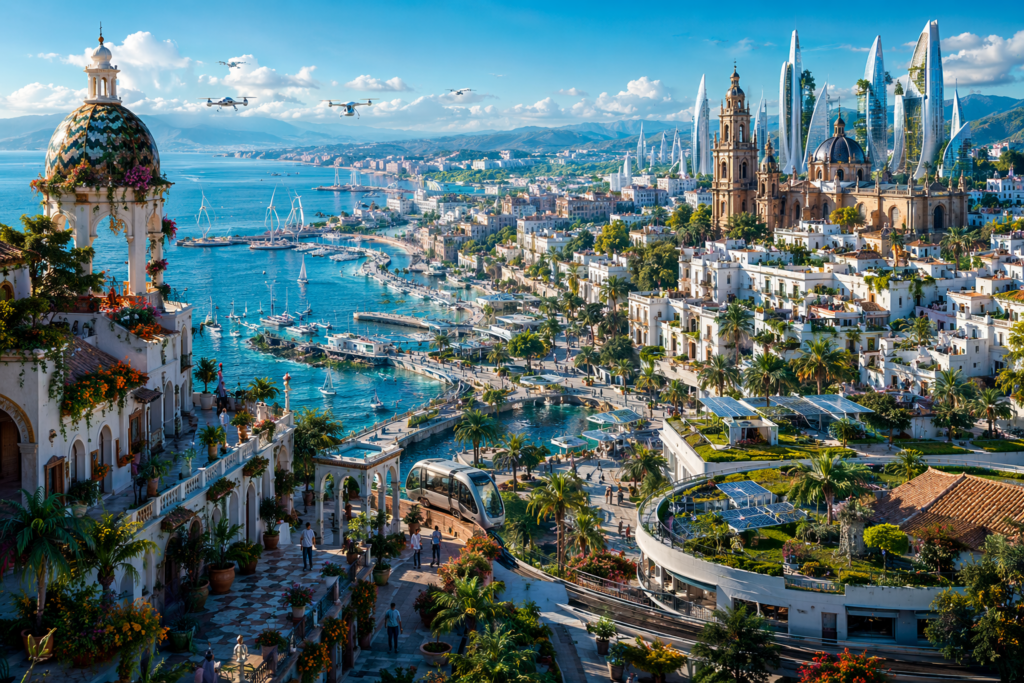
    futuristic coastal smart city in Andalucia blending culture and modern technology

    The future of smart cities is often misunderstood.

    Most people imagine something sleek, efficient, and fully optimized—dense networks of sensors, autonomous systems, and perfectly managed infrastructure.

    The assumption is simple: the more advanced the technology, the more advanced the city.

    Break the Assumption

    This assumption is incomplete.

    Cities are not machines. They are lived environments shaped by culture, behavior, and time. When cities are designed primarily through abstraction—models, simulations, and efficiency metrics—they often lose the qualities that make them meaningful.

    The result is a familiar pattern: cities that function better on paper, but feel less human in reality.

    System Breakdown

    Modern smart cities systems are built on three layers:

    • Sensing — data from sensors, cameras, and infrastructure
    • Modeling — digital twins and real-time representations
    • Optimization — AI-driven decisions to improve efficiency

    This creates cities that are increasingly aware of themselves.

    But awareness alone is not intelligence.

    What’s missing is a fourth layer:

    • Cultural Continuity — the preservation and evolution of what people value

    This includes how people gather, how streets are used, what is preserved, and what is allowed to change.

    Without this layer, cities become technically advanced but culturally interchangeable.

    Reframe

    A city is only “smart” if smart cities culture reflects what matters to the people who live in it.

    Technology can measure movement, energy, and flow. But these are not the things that give a place meaning. Culture lives in patterns that are harder to quantify but easy to feel.

    The goal is not to make cities more efficient.

    The goal is to make them more aware—of both their systems and their identity.

    System Insight

    Some cities already demonstrate this balance.

    In places like Kyoto, infrastructure evolves without erasing the past. Streets remain human in scale. Architecture reflects history. Nature is integrated into daily life rather than added as decoration.

    Technology exists, but it is quiet. It adapts to the city instead of redefining it.

    This reveals a broader pattern:

    Cities that prioritize identity first can integrate technology without losing themselves. Cities that prioritize optimization first often erase what made them unique.

    Application

    This changes how we design urban systems:

    • Sensors should enhance awareness, not enforce control
    • Digital models should reflect lived experience, not just infrastructure
    • AI systems should adapt to cultural patterns, not override them
    • Development should preserve identity before improving efficiency

    The question is no longer how to build smarter cities.

    It is how to build cities that can evolve without losing who they are.

    Key Insights

    • A city is a cultural system, not just an infrastructure system
    • Efficiency is not neutral—it can erase identity
    • Smart systems must learn what people value, not just what can be measured
    • Technology should adapt to cities, not redefine them
    • The future of cities is not built from scratch—it is grown from what already exists