Before my first painting class here in Spain, I’d already spent quite a lot of time thinking about being in it. I hadn’t picked up a brush, but my brain was busy with the room, the teacher, the other people, and whether I would understand enough Spanish to keep up.
I’ve been through much tighter pinches than a community painting class. Which made this slightly funny. There I was, getting first-day jitters over a jug.
But culture, language and unfamiliar class expectations left plenty of unknown variables. My Spanish is far from polished. What would the teacher expect? How would advice happen? Would I understand enough to take part?
I knew I could handle harder things. I still needed to find out how this particular room worked.
I wondered what everyone else might be imagining. Somebody could be hoping the teacher would discover their hidden talent. By the time they reached the door, they’d be halfway to Picasso. Someone else might fancy being the class clown, hope to make a friend, or simply want a couple of hours doing something they enjoyed.
We could all enter the same room carrying quite different imaginary classes.
Then I went to the actual one.
The class I actually found
It turned out to be an open workshop. People worked on their pieces. The teacher offered advice to those working on similar things, or helped someone individually.
That was an important detail to discover. Beforehand, I’d been wondering how I would keep up with instructions in Spanish. Being there gave me a better picture of how advice happened: sometimes shared among several people, sometimes directed towards one person and their work.
It made me curious about the relationship between the format of a class and someone’s ability to participate. When advice concerns the thing you’re working on, there is something concrete to look at, point to, and try. There might still be words you miss, but the words have something beside them.
Those were things I could only discover by being there. My imaginary classroom had given me plenty of questions. The actual one finally gave me something to work with.
In my case, a jug.
A long look at a jug
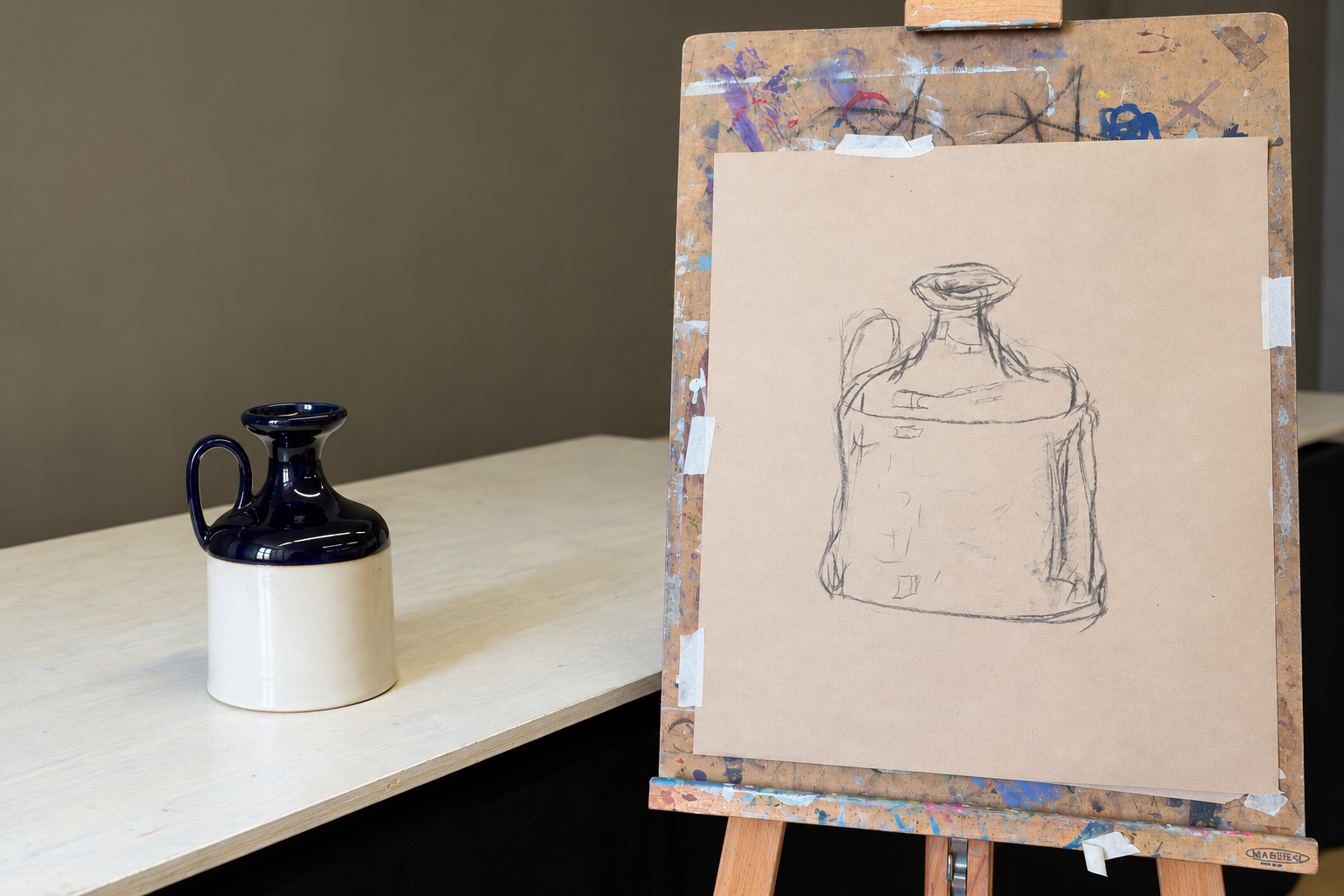
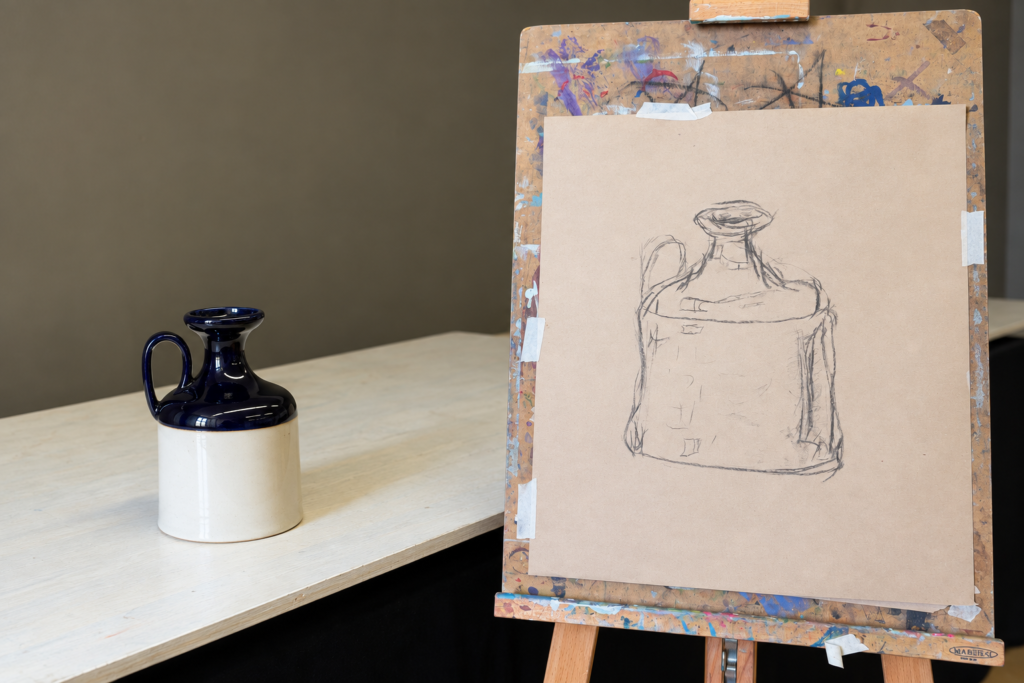
It was a small jug sitting on the table in front of my easel: a dark top, a white body, and a handle. A fairly straightforward arrangement, you might think.
I’m used to creating things in three dimensions. I can turn an object around and examine it from different directions. I understand the idea of its shape occupying space. Getting what I was seeing onto a flat sheet of paper was another matter.
I spent ages looking at that jug. Gradually, I noticed how it seemed to hold a picture of the lights around it. The reflections followed its curves. Bright patches changed shape as the surface changed direction. There was much more happening than I’d first seen.
That became an interesting part of the work in its own right. I had an object to draw, and then all these small relationships to notice: the edges, the curves, and the light caught on the surface.
The teacher’s advice helped. In between, I also used my AI to help me with technique, while listening to Vivaldi’s Four Seasons. That was my particular combination: a teacher, some AI help, music, and a long look at a jug.
I was beginning to find a way into the work.
There was an awkward conversation too. I didn’t understand some Spanish, explained that mine wasn’t perfect, and he said he’d noticed.
Well, yes. That was the difficulty I was trying to explain.
I couldn’t tell exactly how he meant it, but it didn’t feel like a wonderful first exchange. Alongside the useful advice and improving drawings, there was that uncomfortable little moment.
Finding a way to take part
It made me think about arriving somewhere beyond a painting class: a new town, workplace, or community whose language and customs are unfamiliar.
You might bring plenty of experience with you, have things to contribute and questions to ask, while struggling to find the words for any of it. Someone meeting you could hear the hesitation without knowing what sits behind it.
For someone who has moved because they need protection or support, there could be much more riding on being understood, and much less choice about where they’ve arrived. My class gives me a small starting point for thinking about that. Their experience would need to be heard from them.
An invitation gets you through the door. Once inside, you still need to discover how to take part.
The workshop offered one arrangement to consider: advice shared among people doing similar work, and individual attention when someone needed it. It made me curious about how other places help newcomers ask questions, try things, and gradually become familiar with what happens there.
It also brought me back to the different imaginary classes people might carry. Someone hoping to impress, someone hoping to make a friend, and someone hoping to understand enough Spanish might each need something different from the same room.
Back in my own class, I had several separate experiences to make sense of. My Spanish needed work. One conversation had been awkward. My drawing was improving.
I suppose I didn’t have to decide how the whole class was going from that one exchange. I could work on the particular instruction I hadn’t understood, the drawing technique I needed, and see how the next conversation went.
While I was putting my work in my new cubby, the teacher agreed that my jug drawings had improved.
I can clearly see I’m no Picasso. And my Spanish isn’t ready for an announcer’s microphone either.
But the drawings were better. I’d had some help, and there was plenty about the room I would only discover by returning.
For now, my work had somewhere to go.