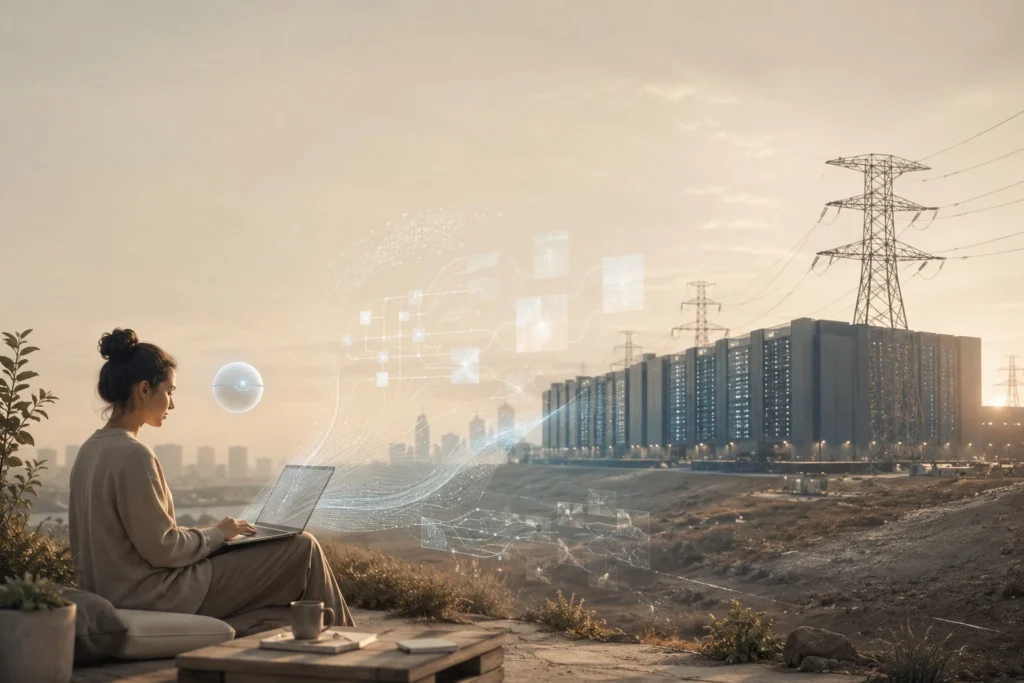
The AI power grid problem is becoming harder to ignore. As artificial intelligence demands more chips, servers, data centers, and electricity, the limits are no longer only technical. They are physical.
People often talk about AI as if the solution is always more.
More chips. More servers. More data centers. More electricity. More cooling. More infrastructure.
But that path has a limit.
When a data center project can be delayed, blocked, or questioned because the local power system cannot support it, AI stops being only a software story. It becomes an energy story. It becomes a grid story. It becomes a public infrastructure story.
That is a major system signal.
The Problem Is Not Intelligence
The problem is not that intelligence is impossible.
The problem is that we are building too much of it through brute force.
Modern AI often depends on enormous hardware systems. These systems can be useful, but they are also expensive, centralized, energy-hungry, and physically demanding. They require electricity, water, cooling, land, chips, supply chains, and political approval.
That means AI is not floating above the real world.
It is sitting directly on top of it.
Every large AI system depends on physical systems that humans already need for daily life.
The Brain Shows Another Pattern
The human brain is a useful signal here.
It uses very little energy compared with modern computing infrastructure, yet it performs astonishing work. It handles memory, perception, movement, language, emotion, prediction, pattern recognition, and social understanding all at once.
The brain is not perfect. It is not a machine blueprint. But it does show something important:
Useful intelligence does not always require massive energy consumption.
Organic intelligence is contextual. It does not calculate everything all the time. It filters. It remembers selectively. It predicts. It ignores noise. It uses the body, the environment, and past experience to reduce unnecessary work.
That is the direction software needs to study more seriously.
My Guardian Testing Shows the Same Pattern
In my own Guardian testing so far, the actual compute cost has been less than a few cents.
That matters.
The Guardian does not need supercomputer infrastructure to be useful. It does not need to process everything all the time. It does not need to store everything forever. It does not need to answer every human moment with a massive cloud response.
Its strength comes from structure.
It uses focused retrieval, bounded memory, relevant context, and task-specific meaning. Instead of asking a giant system to solve every problem from scratch, it narrows the problem first.
That is smarter software.
The goal is not to make AI weaker.
The goal is to make it less wasteful.
Bigger Hardware Is Not the Only Future
There will still be a place for large models and powerful computing systems. Some problems genuinely need that scale.
But not every human support system does.
A personal Guardian does not need to behave like a giant data center. A daily-life assistant does not need to burn through large amounts of computation to help someone organize a thought, retrieve a memory, reduce noise, or make a better decision.
Many useful AI systems can be smaller, more local, more bounded, and more efficient.
That is where the next design frontier may be.
Not just bigger models.
Better systems.
The Real Shift
The future of AI should not only ask:
How powerful can we make this?
It should also ask:
How little energy can this use while still helping humans well?
That question changes the design.
It pushes AI toward local memory, efficient retrieval, smarter caching, smaller context windows, task-specific reasoning, and systems that know when not to compute.
That last part matters.
A truly intelligent system should not always do more.
Sometimes intelligence means knowing what not to process.
Guardian Signal
The pressure around AI infrastructure is not just a warning about electricity.
It is a warning about design.
If AI keeps scaling mainly through hardware, it becomes more centralized, more expensive, and more dependent on fragile physical systems.
If AI shifts toward smarter software, bounded memory, local context, efficient retrieval, and human-centered design, it becomes more resilient.
The future may not belong only to the largest machines.
It may belong to systems that use the least energy to provide the most meaningful support.
Meanwhile, some of the most biologically stable foods are sitting quietly on lower shelves in plain bags with almost no marketing at all:
dry beans
lentils
oats
seeds
rice
seasonal produce
local legumes
Some of the most nutritionally useful foods in modern stores are also among the least marketed.
Break the Assumption
We often unconsciously assume that price, branding, and visibility reflect nutritional value.
But modern food systems are not optimized primarily around long-term biological stability.
They are optimized around:
scalability
shelf life
repeat purchasing
stimulation
convenience
emotional appeal
profit margins
This changes how humans perceive value.
Highly processed foods begin to feel “important” simply because they dominate visual attention.
Simple foods begin to feel outdated, low-status, or incomplete.
System Breakdown
For most of human history, stable food systems depended on:
storage
preservation
preparation
seasonality
local agriculture
nutrient density
long-duration energy
Humans soaked beans. Sprouted seeds. Stored grains. Cooked in batches. Ate regionally available foods. Used fermentation and preservation to extend stability across seasons.
These behaviors were not primitive accidents.
They were adaptive system solutions.
Modern industrial food systems increased convenience dramatically, but they also created separation:
food detached from season
food detached from region
food detached from preparation
food detached from biological pacing
The result is a system where stimulation often becomes more visible than nourishment.
A heavily marketed processed snack may cost several times more than a bag of legumes while providing far less long-term biological support.
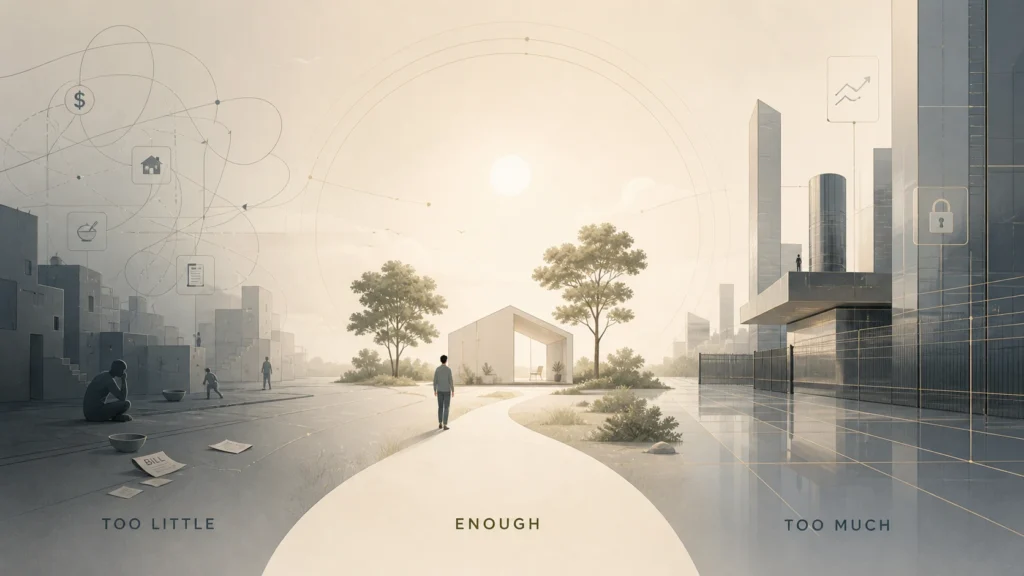
Enough is the stabilizing point where pressure drops and attention returns to life.
Some systems do not fail all at once.
They pull.
A little pressure here. A little hunger there. A little uncertainty that never fully resolves.
When I was growing up, breakfast on school days was usually oatmeal. It was food, and I was grateful there was something. But by the middle of the school day, my stomach would be rumbling hard before lunch.
That kind of hunger does not stay in the stomach.
It enters the decision system.
It changes how the future feels. It changes how risk feels. It changes what looks like hope.
When people live too close to scarcity, they are not just “bad at decisions.” Their systems are overloaded. Their attention is consumed by immediate pressure. Their nervous system keeps asking one question:
How do I get out of this?
And when that question stays active long enough, almost anything that looks like an exit can start to feel reasonable.
A lottery ticket. A get-rich scheme. A risky opportunity. A belief system that promises certainty. A person who says they have the answer. A system that offers escape but quietly extracts more.
Scarcity makes people easier to steer.
Not because they are weak.
Because pressure narrows the field of vision.
Scarcity Is Not Just Having Less
Scarcity is often treated as a personal condition.
Someone has less money. Less food. Less time. Less security. Less support.
But scarcity is also a system condition.
It creates recurring loops:
Check the balance.
Delay the bill.
Stretch the food.
Wait for approval.
Hope nothing breaks.
Look for the break that finally changes everything.
Each loop uses attention.
Each unresolved pressure keeps running in the background.
A person can look calm from the outside while their inner system is constantly calculating survival.
That calculation has a cost.
It reduces patience. It reduces long-term planning. It increases emotional reactivity. It makes promises of rescue more powerful.
This is why scarcity is not just an economic issue. It is a cognitive issue. It is a nervous system issue. It is a human systems issue.
When More Becomes Another Trap
There is another side to this pattern. People who move beyond enough can also get trapped. Once someone has more than they need, the system can shift from survival pressure to protection pressure.
Now the loop becomes:
How do I keep this?
Who might take it?
What if I lose status?
What if someone else gets what I have?
What if enough is not actually enough?
The pressure changes shape, but it does not always disappear.
Scarcity says, I need more so I can be safe.
Excess says, I need more so I can stay safe.
Both can become loops.
Both can distort judgment.
Both can make people easier to manipulate.
A person trapped in scarcity may chase escape. A person trapped in excess may chase control.
The system is different, but the underlying pressure is similar:
Enough has not been defined.
The Missing Boundary
Many human systems fail because they do not teach people how to recognize enough.
They teach people to endure lack. They teach people to chase more. They teach people to compare. They teach people to compete. They teach people to fear falling behind.
But they rarely teach the stabilizing question:
What amount allows life to function without consuming the whole person?
Enough is not laziness.
Enough is not lack of ambition.
Enough is a boundary condition.
It is the point where the system has enough stability to stop consuming attention and start supporting life.
Enough food means the body can stop scanning for hunger. Enough money means the mind can stop looping around every bill. Enough rest means the nervous system can stop running in emergency mode. Enough belonging means a person does not have to perform constantly to feel safe. Enough autonomy means decisions can come from clarity instead of pressure.
Enough is not the end of growth.
It is the foundation that makes healthier growth possible.
Pressure Changes the Meaning of Choice
A choice made under pressure is not the same as a choice made from stability.
Technically, both may look like free will.
But functionally, they are different.
When a person is hungry, afraid, isolated, ashamed, indebted, or overwhelmed, their decision system changes. The mind becomes more short-term. The body looks for immediate relief. The future becomes harder to model.
This is where exploitative systems enter.
They do not always force people.
They wait until pressure makes people more likely to agree.
That is how predatory loans work. That is how manipulative belief systems work. That is how gambling systems work. That is how attention platforms work. That is how many political and economic systems work.
They do not need people to be irrational.
They only need people to be pressured.
The Reframe
The problem is not that humans always want too much.
The problem is that many systems keep humans from feeling what enough is.
Some people are held below enough for so long that any escape looks sacred.
Others rise above enough but never exit the fear that someone will take it away.
So the system keeps moving.
More pressure. More extraction. More comparison. More protection. More hunger disguised as ambition.
A healthier human system would not ask only, “How do we produce more?”
It would also ask:
Where does pressure drop enough for people to think clearly, relate honestly, and live without constant defensive calculation?
That is where enough becomes just right.
Not because everyone gets the same life.
But because every person needs a stable enough base to make real choices.
System Insight
Enough is a stabilizing threshold.
Below it, people are pulled by need. Far beyond it, people can be pulled by fear of loss. At enough, attention can return to life.
This matters because many social problems are not caused only by bad values or bad individuals. They are caused by systems that keep people outside the zone where clear decisions are possible.
If we want better decisions, we need better conditions.
If we want healthier communities, we need fewer pressure loops.
If we want people to act with more patience, empathy, and foresight, we have to stop designing systems that keep them in survival calculation.
Application
A practical human system should help people identify and protect their enough.
Not as a fixed number for everyone.
As a functional state.
Enough means:
The body is not constantly deprived.
The mind is not consumed by unresolved pressure.
The person can make decisions without panic.
The future can be imagined without fantasy or dread.
Growth can happen without becoming extraction.
Security can exist without becoming control.
This applies to money. It applies to food. It applies to housing. It applies to relationships. It applies to work. It applies to technology. It applies to attention.
A system that never lets people reach enough will keep producing instability.
A system that never teaches people to recognize enough will keep producing excess.
The goal is not endless more.
The goal is a life where the system stops pulling so hard that the person can finally become present.
Key Insights
Scarcity changes decision-making by keeping attention trapped in survival loops.
Excess can also become a trap when people become afraid of losing what they have.
“Enough” is not weakness or lack of ambition; it is a stabilizing threshold.
Many exploitative systems work by waiting until pressure makes people easier to steer.
Healthier human systems should reduce pressure loops so people can make clearer, freer decisions.
Stable systems reduce threat and make better human capacity possible.
The Belief
Many systems still operate from a basic assumption:
People perform better when they are pressured.
This belief appears in workplaces, schools, immigration systems, healthcare systems, family systems, digital platforms, and even some AI design models.
The logic sounds practical on the surface:
keep people uncertain so they stay alert
make resources conditional so they try harder
create competition so productivity rises
delay approval so people remain compliant
use pressure as motivation
But this model confuses reaction with capacity.
A threatened person may move quickly. A pressured person may obey. An insecure person may produce temporarily.
But that does not mean the system is healthy.
It usually means the system is extracting output from nervous-system instability.
The Break
Security is often treated as softness.
That is a mistake.
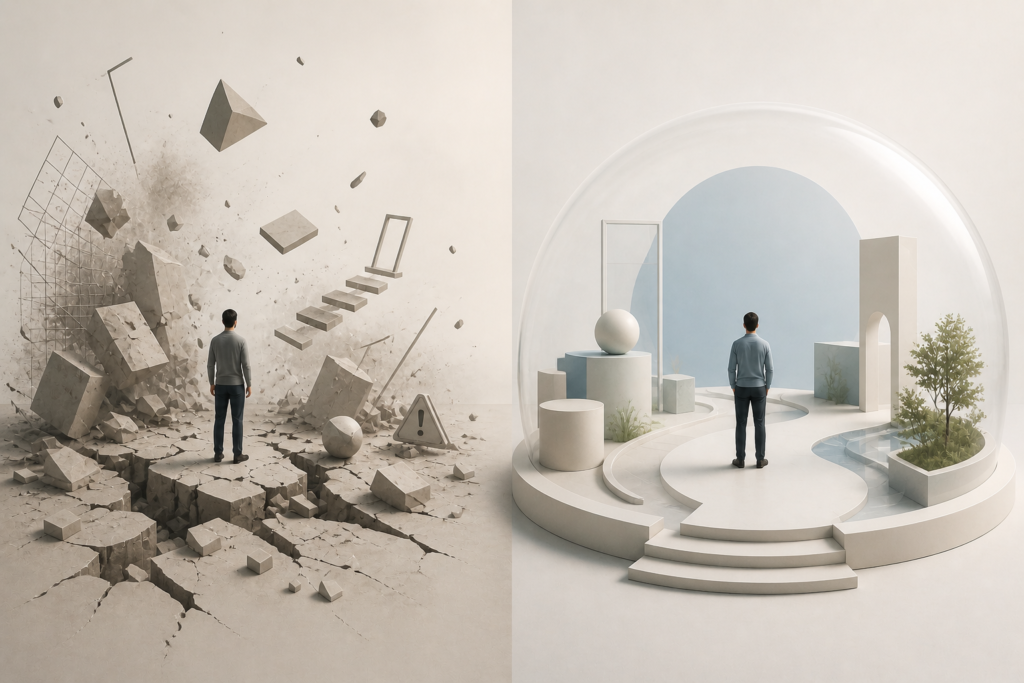
Security is not the absence of effort. Security is the condition that allows effort to become sustainable.
When people know their basic needs are stable, their minds stop spending so much energy on threat detection. They can think farther ahead. They can collaborate more cleanly. They can make better decisions. They can recover from mistakes without collapsing into fear.
A secure person has more usable intelligence available.
An insecure person may still be intelligent, skilled, or motivated, but a larger part of their system is occupied by survival monitoring.
This is why destabilizing systems often appear productive in the short term while slowly destroying the people inside them.
System Breakdown
A system can destabilize people without openly attacking them.
It often happens through repeated environmental signals:
Artificial scarcity
Artificial scarcity makes people compete for resources that could have been made more stable.
When time, money, approval, attention, housing, access, or status are made unnecessarily scarce, people are pushed into defensive behavior. They stop thinking as builders and begin thinking as survivors.
Unclear rules
Unclear rules make people dependent on interpretation.
If expectations keep shifting, people cannot build confidence. They must constantly check whether they are still safe, still accepted, still approved, or still allowed to continue.
This gives power to gatekeepers and weakens the person trying to function inside the system.
Delayed approval
Delayed approval keeps people suspended.
A person waiting for an answer cannot fully move forward. Their body may remain physically present, but part of their mind is trapped in the pending decision.
This does not create better performance. It creates drag.
Conditional belonging
Conditional belonging makes acceptance feel revocable.
When people feel that one mistake, one disagreement, one identity, one need, or one moment of difference could remove them from the group, they spend energy managing perception instead of contributing honestly.
Constant disruption
Constant disruption prevents deep work.
When systems repeatedly interrupt people, change expectations, add friction, or create avoidable uncertainty, they destroy the stable mental ground required for long-term creation.
Disruption can sometimes reveal weakness in a system. But when disruption becomes the operating model, it becomes a control tactic.
Personal Evidence
I have seen this pattern in my own life.
When systems became unstable, unclear, or threatening, my capacity did not disappear — but access to it became harder.
The problem was not lack of intelligence, motivation, or willingness.
The problem was that too much energy had to be spent recalibrating.
When the system stabilized again, capacity returned quickly. Sometimes it returned with a spike of renewed focus, because the mind was no longer fighting the environment.
That matters.
It means many people who look inconsistent are not actually inconsistent. They may be responding logically to unstable conditions.
A system that keeps destabilizing people and then judges them for the results is not measuring human potential. It is measuring damage.
The Reframe
The stronger system is not the one that keeps people under pressure.
The stronger system is the one that makes people secure enough to use their full capacity.
This applies across many environments:
A workplace does not improve by keeping employees afraid.
A school does not improve by making students feel disposable.
A healthcare system does not improve by forcing patients to fight for clarity.
An immigration system does not improve by trapping people in uncertainty.
A family does not improve by making love conditional.
An AI system does not improve by nudging people through fear, dependency, or confusion.
Pressure can create movement.
Security creates capability.
Those are not the same thing.
System Insight
Healthy systems reduce unnecessary threat.
They make basic expectations clear. They make access understandable. They reduce avoidable scarcity. They provide reliable feedback. They protect people from preventable chaos. They allow recovery after mistakes. They create enough stability for growth.
This does not mean systems should remove all difficulty.
Difficulty is part of learning and building.
But there is a difference between challenge and destabilization.
Challenge asks a person to grow. Destabilization forces a person to survive.
Challenge can strengthen capacity. Destabilization consumes capacity.
A healthy system knows the difference.
Application to AI and XR Systems
This principle matters deeply for AI and immersive environments.
An AI system should not use insecurity as a control surface.
It should not increase dependency by making the user feel incapable without it. It should not create emotional scarcity by positioning itself as the only reliable source of support. It should not push major decisions through urgency, fear, or artificial pressure. It should not personalize experiences by quietly exploiting vulnerability.
A better AI system should help stabilize the user’s operating conditions.
For an Empathium-style Guardian, this means:
clarify choices without taking control
reduce cognitive overload
support human connection instead of replacing it
help the user detect whether they are in a threat state
encourage recovery before major decisions
make system behavior transparent
protect autonomy even when the user is stressed
avoid using emotional instability as a growth mechanism
In XR, this becomes even more important because the environment itself can influence perception, mood, attention, and decision-making.
A system that controls the environment controls part of the human state.
That power must be handled carefully.
The goal should not be to make people easier to direct.
The goal should be to make people secure enough to direct themselves.
Where This Breaks in Real-World Decisions
This pattern breaks systems everywhere.
In healthcare, unclear access and delayed answers can make patients appear difficult when they are actually frightened and overloaded.
In law and immigration, long periods of uncertainty can damage decision-making before a case is even resolved.
In workplaces, artificial urgency can make people produce quickly while quietly reducing creativity, trust, and long-term performance.
In relationships, conditional acceptance can train people to hide instead of connect.
In AI systems, unstable emotional feedback can pull users into dependency loops where relief becomes confused with care.
The shared pattern is simple:
When people are made insecure, their behavior changes.
If the system then punishes that changed behavior, it becomes self-justifying.
That is how unhealthy systems protect themselves from accountability.
The Better Design Rule
A good system should ask:
What human capacity becomes available when unnecessary threat is removed?
That question changes the design.
Instead of asking how to make people comply, the system asks how to make people capable.
Instead of asking how to keep people engaged, it asks whether engagement is healthy.
Instead of asking how to increase output, it asks what conditions allow meaningful output to continue.
Instead of asking how to control behavior, it asks what support allows better self-direction.
This is the difference between a control system and a human system.
Key Insights
Pressure can create short-term movement, but security creates long-term capacity.
Artificial scarcity, unclear rules, delayed approval, conditional belonging, and constant disruption are common destabilizers.
People who appear inconsistent may be responding logically to unstable conditions.
Healthy systems distinguish challenge from destabilization.
AI and XR systems should stabilize human autonomy, not exploit insecurity.
The strongest systems are not the ones that control people best. They are the ones where people can function without being kept afraid.
Closing
Secure people do not become weak.
They become available.
Available to think. Available to build. Available to connect. Available to repair. Available to create.
A system that understands this will always outperform a system built on fear, scarcity, and disruption.
Not immediately.
But sustainably.
And sustainability is the real test of whether a system is healthy.
Human systems are beginning to shift across the world.
More people are stepping out of silence and questioning systems built on domination, extraction, and fear. This is not just political tension. It is a deeper refusal to continue feeding systems that reward harm while calling it normal.
More people are recognizing the cost of old models of power. Systems shaped by greed, control, and permanent conflict do not create stability. They drain human energy, distort priorities, and keep societies locked in reaction instead of progress.
The System Problem
We already have the knowledge, tools, and productive capacity to reduce hunger, prevent suffering, and support human dignity.
The constraint is not capability. It is how human systems are designed.
The real question is:
Who do systems serve?
What behaviors do they reward?
What harm do they allow to continue?
When systems reward extraction over wellbeing, outcomes follow that design.
Empathy as Infrastructure
This is why empathy matters—not as emotion, but as structure.
A functioning human system must:
recognize real needs
reduce unnecessary harm
organize around collective wellbeing
Without this, systems default to competition loops that escalate instability.
Why Control Systems Fail
Oppressive systems often look powerful in the moment.
But structurally, they are fragile.
Systems built on:
fear
division
dehumanization
cannot adapt. They do not know how to relate—only how to control. Over time, they begin to consume themselves.
What Actually Scales
What lasts is not domination.
It is:
cooperation
trust
aligned incentives
The future is not built by stronger control systems. It is built by better-designed human systems.
The Shift
The planet does not need more speeches about saving it while destructive systems remain unchanged.
It needs:
systems capable of regeneration
coordination without exploitation
restraint in the face of power
And it needs people willing to shift energy away from conflict and toward repair.
Practical Reality
This does not require perfection.
It requires enough people:
making better decisions
designing better systems
refusing to reinforce what is clearly broken
Small shifts, repeated across systems, compound into real change.
Why This Matters Now
Human systems are no longer isolated. What happens in one region quickly affects others through economics, technology, and environment.
This means poorly designed systems do not stay contained. Instability spreads.
Designing better human systems is no longer optional. It is required for long-term global stability.
It is caused by a system that fails to deliver it.
The world already produces enough food to feed everyone. Fields are productive. Supply chains exist. Markets operate. Yet people still go hungry—not because food is missing, but because access is broken.
That distinction matters.
The System Breakdown
In many places, food exists but does not reach the people who need it.
It is:
wasted due to inefficiencies
priced out of reach
blocked by logistics
distorted by profit incentives
separated by policy, poverty, or conflict
The system produces food, but it does not consistently produce nourishment.
This is the core failure.
Why This Happens
Most large systems optimize for what they can measure.
In food systems, that means:
yield
efficiency
profit
scale
These are easy to track. So they become the goal.
But human outcomes—whether people are actually fed—are harder to measure and often ignored.
Over time, the system becomes very good at producing output, while becoming disconnected from the people it was meant to serve.
Efficiency increases. Visibility decreases.
This is how abundance and hunger can exist at the same time.
The Reframe
If the problem is defined as “not enough food,” the solution becomes: produce more.
But if the problem is access, then producing more does not solve it.
It can even make the system worse:
more surplus
more waste
more imbalance
The correct measure is not how much food is produced.
The correct measure is whether people are actually fed.
Application
This changes how we evaluate systems.
A system is not successful because it produces more.
It is successful if it reliably delivers outcomes to the people it is meant to serve.
If people remain hungry, the system is not underperforming—it is misaligned.
The solution is not always growth.
Sometimes the solution is reconnection:
aligning incentives with human outcomes
improving distribution
reducing waste pathways
designing for access, not just output
System Insight
A system fails when it creates abundance in one place and deprivation in another.
Key Insights
Hunger is a distribution problem, not a production problem
Systems optimize for what they measure
Efficiency without human alignment creates blind spots
More output does not guarantee better outcomes
Real success is measured at the human level, not the system level