There was a period where every part of life was active at once.
Debt. Calls. Children to feed. School. Time collapsing.
Nothing was optional. Everything looped.
The problem was not one difficult task.
The problem was that every task stayed open.
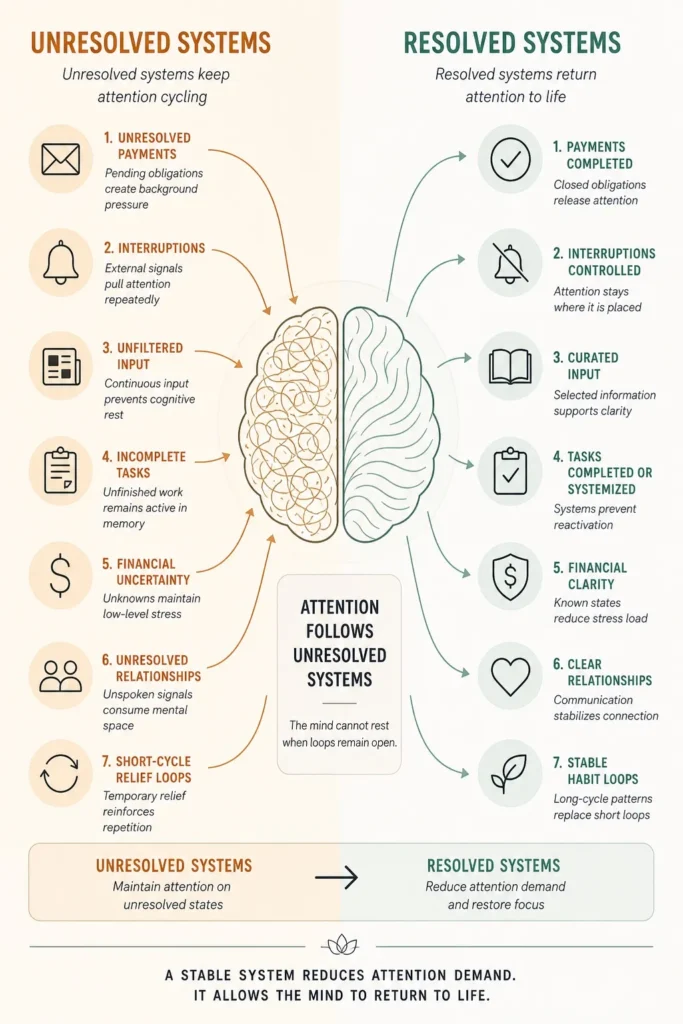
Each unresolved piece kept pulling attention back into the system.
Debt collectors called. Children still needed food. University work still had deadlines. Basic support came with conditions that required more time and more compliance. Even help created another loop.
The system had no space left.
The decisions made inside that pressure were not always ideal.
They were available.
That distinction matters.
This was not a failure of character.
It was a failure of available space inside the system.
Break the Assumption
We often treat looping thoughts as a personal weakness.
“You are overthinking.”
“You need to calm down.”
“You should stop worrying.”
“You lack discipline.”
But that misses the structure.
The mind usually loops when something remains unresolved, uncertain, rewarding, threatening, or incomplete.
A cognitive loop is not just a thought repeating itself.
It is attention returning to an open signal.
The brain keeps checking because the system has not closed.
System Breakdown: What Cognitive Loops Are
A cognitive loop is a recurring attention cycle around an unresolved signal.
It pulls the mind back again and again:
- Did the bill get paid?
- Did the charge clear?
- Did the debt balance drop?
- Did the form get accepted?
- Did the message arrive?
- Did the person respond?
- Is there new news?
- Is there another episode?
- Is there another update?
- Is the threat still active?
- Is the reward available again?
The content changes, but the structure is the same.
The mind is not only thinking.
It is scanning.
And when too many systems remain open at once, scanning becomes a background operating state.
That is where stress grows.
Modern Systems Are Built Around Loops
Many modern systems are not designed to close attention.
They are designed to keep attention returning.
News loops.
Social feeds loop.
Payment cycles loop.
Debt cycles loop.
Streaming episodes loop.
Notifications loop.
Relationship messages loop.
Paperwork loops.
Status pages loop.
Addictions loop.
Unfinished tasks loop.
Some loops are natural.
Meals repeat. Sleep repeats. Relationships need repeated care. Creative work moves through cycles.
The problem is not repetition.
The problem is unresolved, unstable, attention-draining repetition.
A healthy loop gives rhythm.
An unhealthy loop steals attention.
Loop Density Creates Stress
Stress is not only about the size of one problem.
It is often about loop density.
One bill may be manageable.
One deadline may be manageable.
One message may be manageable.
One form may be manageable.
But when debt, children, school, work, food, paperwork, relationships, and uncertainty all stay open at once, the mind enters survival scanning.
That state is not irrational.
It is what happens when too many systems demand attention without giving closure.
A person in that state may look calm from the outside while internally managing dozens of active loops.
Nothing needs to explode for the system to be overloaded.
The overload is in the repetition.
Closure Changes the System
When something resolves, the loop changes.
A card is paid off.
A form is accepted.
A deadline passes.
A payment clears.
A message is answered.
A decision is made.
A debt balance drops.
A status becomes clear.
The brain registers closure.
There can be a small dopamine spike:
That one is done.
Then, if the closure is real, the loop begins to fade.
Not because the person became stronger overnight.
Because the system became more stable.
This is why completing one open task can create a noticeable sense of relief. The mind is not only celebrating progress. It is releasing a monitoring process.
When Loops Stabilize, Life Returns
When enough loops close or become predictable, attention stops being consumed by monitoring.
That freed attention does not disappear.
It can return to life.
Productive work becomes easier.
Art becomes possible again.
Music has space.
Hobbies return.
Relationships feel less like another demand.
The body has more room to rest.
The mind has more room to build.
This is why stable systems matter.
They do not only reduce stress.
They create the conditions for human capacity to reappear.
A person who is no longer trapped in constant checking can become creative again.
Not because creativity was missing.
Because the system finally stopped taking all the available space.
The Reframe
Calm is not the goal.
Calm is the signal.
Calm appears when the surrounding systems stop forcing constant rechecking.
A stable person is often a person inside a more stable loop environment.
A productive person is often someone whose attention is not being constantly pulled back into unresolved cycles.
A regulated nervous system is easier to maintain when the systems around it are clear, predictable, and closable.
This does not remove personal responsibility.
It puts responsibility in the right place.
Humans still make decisions.
But systems shape the conditions under which those decisions are made.
When a system removes time, certainty, food security, sleep, money, and support, decision quality drops.
That is not moral failure.
That is system pressure.
Human Systems Insight
Stabilizing human systems reduce unnecessary loops.
They make status visible.
They make next steps clear.
They confirm completion.
They reduce artificial uncertainty.
They avoid endless refresh behavior.
They do not turn basic survival into repeated attention traps.
Destabilizing systems multiply loops.
They hide status.
They delay feedback.
They require constant checking.
They create artificial scarcity.
They reward compulsive return.
They keep the human nervous system engaged without resolution.
That is not efficient.
It is extractive.
A system that depends on people constantly checking, worrying, refreshing, chasing, or guessing is not a stable system.
It is using human attention as fuel.
Guardian Application
For an adaptive Guardian, cognitive loops matter because they reveal system load.
A user may not say, “I am overwhelmed.”
They may say:
“I need to check this again.”
“What if it didn’t go through?”
“Let me look one more time.”
“I can’t stop thinking about it.”
“I know it’s probably fine, but I need to check.”
“I just need this one thing finished.”
The Guardian should not immediately label that as anxiety, weakness, obsession, or poor discipline.
It should first ask:
What loop is still open?
Is the user waiting for confirmation?
Is there a missing next step?
Is there a real risk?
Is the system unclear?
Is the reward cycle pulling them back?
Is the loop useful, harmful, or unresolved?
The first job is not to interrupt the person.
The first job is to understand the loop.
A good Guardian helps identify which loops can be closed, which can be scheduled, which can be ignored, and which require real action.
The goal is not to force calm.
The goal is to reduce unnecessary loop pressure so calm can emerge naturally.
Application: Designing Better Systems
Any human system should be evaluated by the loops it creates.
Ask:
- What does this system force people to check repeatedly?
- Where does it create uncertainty without purpose?
- Where does it delay closure?
- Where does it hide status?
- Where does it reward compulsive return?
- Where does it punish people for not monitoring constantly?
- Where can confirmation be clearer?
- Where can the next step be made visible?
- Where can the loop be closed?
This applies to healthcare, immigration, debt, education, software, social platforms, workplaces, relationships, and AI systems.
A humane system does not make people guess their way through survival.
It gives enough clarity for the nervous system to stand down.
Key Insights
- Cognitive loops are recurring attention cycles around unresolved signals.
- News, feeds, bills, debt, episodes, messages, paperwork, relationships, and addictions can all function as loops.
- Stress often comes from loop density, not one isolated problem.
- Closure reduces loop pressure and frees attention.
- Calm is not the target state; it is evidence that the system is no longer demanding constant rechecking.
- Good human systems make status visible, next steps clear, and completion recognizable.
- A Guardian should interpret repeated checking as possible system load before treating it as personal failure.
Closing
A stable system does not demand constant attention.
It lets the mind return to life.
That is why calm matters.
Not because calm proves a person is better.
Because calm shows the system has stopped pulling them apart.
And when the system stops pulling, attention returns.
To work.
To art.
To relationships.
To health.
To ordinary life.