Some people think autism means slow reaction.
That is not always true.
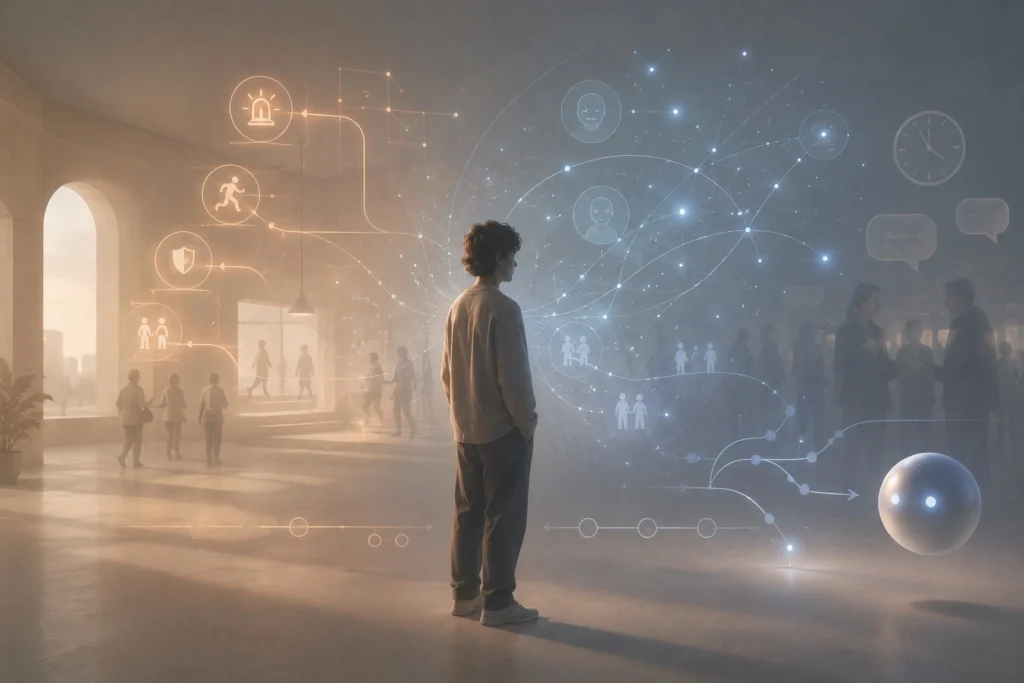
In some situations, the body reacts very well. Emergency situations can become strangely clear. There is a task. There is danger. There is a sequence. Something has to be done now.
When I was an MP, that kind of clarity made sense to me. In emergency situations, the world can become simple enough to act inside. The question is not, “What does this mean socially?” The question is, “What is happening, what needs to be protected, and what is the next correct action?”
That kind of processing can be fast.
But there is another side.
After the event, meaning may arrive late.
The body may handle the moment before the mind fully understands what happened.
A social exchange may seem normal while it is happening, then become clear hours later. A comment may not land until the nervous system has had time to replay it. A conflict may not reveal its real shape until after the body is safe enough to interpret it.
That delay is not stupidity.
It is not weakness.
It is not failure.
It is a different timing system.
The Assumption That Breaks
Modern systems often assume that good processing is immediate processing.
A person is expected to understand the room while they are in it.
They are expected to know what they feel while the feeling is still forming.
They are expected to answer quickly, explain clearly, respond socially, and make meaning in real time.
That works for some people.
It does not work for everyone.
For many autistic people, especially those with trauma histories or high sensory sensitivity, the event and the meaning of the event do not always arrive together.
The body may register pressure first.
The mind may organize facts later.
The meaning may arrive last.
That sequence matters.
When systems ignore that sequence, they misread delayed interpretation as avoidance, confusion, stubbornness, coldness, overreaction, or lack of social awareness.
But the person may simply not have access to the full meaning yet.
The Joke That Revealed the Pattern
My ADHD partner once joked, “Yeah, we are much the same — only you’re slow.”
It was dark humor, not cruelty. And I answered, “Yeah, but you miss stuff.”
That little exchange says a lot.
ADHD and autism can overlap in visible ways. Both can involve attention differences, sensory pressure, executive-function strain, emotional intensity, and social friction. But the timing can be different.
One system may move fast and skip pieces.
Another system may move slowly and assemble more context later.
Neither is automatically better.
Fast processing can create momentum.
Delayed processing can create depth.
The problem happens when the world treats fast output as the only valid intelligence.
Sometimes I am not slow.
Sometimes I am still loading the full meaning.
And sometimes, once it loads, I see the structure other people rushed past.
Emergency Clarity and Social Delay
There is an interesting split here.
In structured emergencies, I can often function well.
The emergency gives the nervous system a clear operating frame:
- Identify risk.
- Protect the person.
- Reduce harm.
- Follow the next step.
- Stay useful until the situation stabilizes.
That is a clean system.
There is no need to decode hidden social meanings. There is no need to guess whether someone is being indirect, sarcastic, manipulative, passive-aggressive, disappointed, flirting, testing, or judging.
The event has a visible structure.
But social life often does not.
Social situations can be full of invisible data:
- tone changes
- facial shifts
- group pressure
- implied expectations
- delayed consequences
- unclear motives
- politeness rituals
- power dynamics
- unspoken emotional contracts
The autistic brain may collect all of this data, but not finish interpreting it in the moment.
Then later, after the body exits the situation, the meaning begins to assemble.
That is when the delayed crash can happen.
Not because the event was small.
Because the system finally had enough safety to process it.
The Delayed Crash
The delayed crash is hard.
During the event, the body may stay functional. It may mask. It may perform. It may follow the expected script. It may keep the peace.
Then afterward, the system drops.
The body realizes what happened.
The mind replays the conversation.
The nervous system rechecks every signal.
The meaning arrives late, but when it arrives, it can arrive all at once.
This is why a person may seem fine during a social event and be exhausted later.
This is why someone may answer calmly in the moment and cry afterward.
This is why a person may not know they were hurt until the next morning.
This is why “Why didn’t you say something then?” is often the wrong question.
They may not have known yet.
The body was still collecting the event.
A Human Systems View
Delayed processing is not only an individual trait.
It is a system-design problem.
Most workplaces, schools, families, bureaucracies, and social groups are built around immediate interpretation.
They reward fast response.
They reward confident speech.
They reward quick social recovery.
They often punish people who need time.
That creates a predictable failure pattern:
| System Demand | Human Reality |
|---|---|
| Answer now | Meaning may not be available yet |
| Explain yourself immediately | The body may still be stabilizing |
| React socially in real time | Social data may require later reconstruction |
| Move on quickly | The nervous system may still be processing |
| Prove impact instantly | The impact may not be clear until after rest |
This is not a personality flaw.
It is a timing mismatch.
The system asks for output before interpretation is complete.
Why This Matters for Neurodiversity
Neurodiversity design cannot only mean sensory accommodations and inclusive language.
Those matter.
But timing matters too.
A truly neurodiversity-respecting system allows different processing speeds without treating slower meaning-making as lesser.
That means a person should be allowed to say:
- “I need time to process that.”
- “I cannot answer that clearly yet.”
- “I may understand this better tomorrow.”
- “I need to leave and return to this.”
- “My first response may not be my final interpretation.”
These should not be treated as failures.
They should be treated as valid access needs.
Some people need ramps.
Some people need captions.
Some people need quiet.
Some people need time.
Guardian Timing Logic
This connects directly to Guardian design.
A Guardian should not assume that the correct support is always immediate advice.
Sometimes immediate advice is interference.
If the person is in an emergency-action state, the Guardian should reduce noise and support sequence:
- What is happening?
- What is unsafe?
- What is the next step?
- What can wait?
But if the person is in delayed processing, the Guardian should not force clarity too early.
It should hold space for interpretation to arrive.
A good Guardian would understand timing phases:
1. During the Event
Support action.
Reduce sensory and cognitive load.
Do not over-explain.
Do not ask for deep meaning while the body is still managing the moment.
2. Immediately After
Support decompression.
Offer grounding.
Avoid pushing analysis too soon.
Let the body exit threat mode.
3. Later Processing
Help reconstruct the event.
Separate facts from interpretations.
Identify what became clear later.
Ask what the body knew before the mind had language.
4. Integration
Help turn the experience into a usable pattern.
What should change next time?
What boundary is needed?
What system failed?
What support would have helped?
That is Guardian timing.
Not constant guidance.
Not emotional replacement.
Not control.
Timing-aware support.
The Body Often Knows First
Delayed processing does not mean no processing is happening.
Often the body is already processing before language catches up.
The shoulders tighten.
The stomach drops.
The head gets loud.
The chest closes.
The person wants to leave but does not yet know why.
The body has detected something, but the meaning is not ready.
This is why body signals matter.
For autistic people, trauma survivors, and highly sensitive people, the body may be the first interface.
The body says:
Something is off.
The mind says:
I need more time to understand what.
A humane system respects both.
The Mistake of Forcing Immediate Meaning
When people force immediate meaning, they often damage the person they are trying to help.
They ask:
“What happened?”
“Why are you upset?”
“What do you want?”
“What did I do wrong?”
“Why didn’t you say something?”
Those questions may be reasonable later.
But too early, they can overload the system.
The person is not withholding clarity.
They may not have clarity yet.
A better approach is:
“Take time.”
“We can return to this later.”
“You do not have to explain it right now.”
“Write it down when it becomes clear.”
“I will not treat your delayed answer as less valid.”
That one change can prevent a lot of harm.
Workplace and Social Design
This has practical implications.
A workplace that respects delayed processing would not require every important response in live meetings.
It would allow written follow-up.
It would send agendas before meetings.
It would allow people to revise their interpretation after reflection.
It would not assume silence means agreement.
It would not assume delayed feedback means manipulation.
It would build time into decision systems.
A friendship or relationship that respects delayed processing would do the same.
It would allow someone to say:
“I enjoyed being there, but I realized later that something bothered me.”
That should not be treated as changing the story.
That is the story arriving.
The Reframe
The goal is not to make everyone process faster.
That is the wrong target.
The better goal is to build systems that understand when meaning arrives.
Some people are fast in emergencies and slow in social interpretation.
Some people are quick with facts and delayed with feelings.
Some people can act before they can explain.
Some people can survive the moment, then understand it later.
That is not broken timing.
That is human timing.
Systems become more humane when they stop demanding immediate interpretation from bodies still processing the event.
Core Insight
Some people do not need faster reactions.
They need systems that respect delayed interpretation.
The event may happen now.
The body may survive it now.
The meaning may arrive later.
A good human system leaves room for that delay.
A good Guardian would, too.
Key Insights
- Delayed processing is not the same as slow intelligence.
- Emergency action and social interpretation use different timing systems.
- Some autistic people can act clearly in structured emergencies but process social meaning later.
- The delayed crash often happens when the body becomes safe enough to interpret what occurred.
- Workplaces, families, schools, and social systems should allow delayed responses.
- Guardian systems should support timing phases: action, decompression, later interpretation, and integration.
- Neurodiversity design must include time as an access need.
- The meaning of an event may be valid even if it arrives later.
Optional Closing Line
The most humane systems do not only ask what happened.
They ask when the person became able to understand what happened.