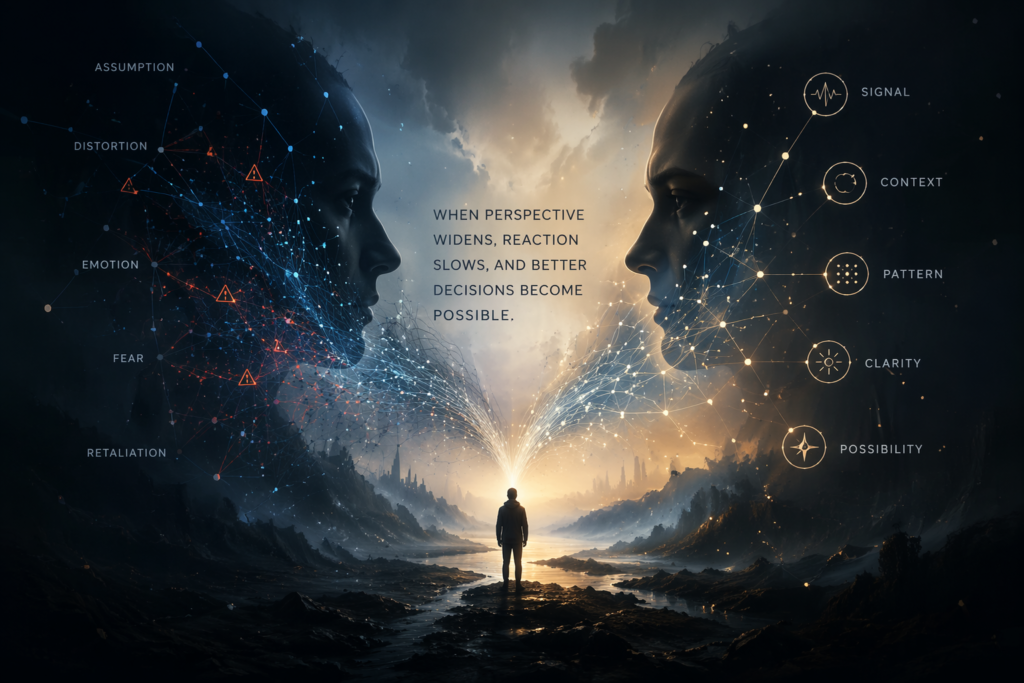
AI conflict resolution begins with understanding how escalation patterns form.
Conflict tends to follow a familiar pattern.
Action. Reaction. Escalation.
Whether between individuals, communities, or nations, the loop repeats with surprising consistency. What changes is scale, speed, and the number of people forced to absorb the cost.
Because retaliation rarely resolves conflict.
It redistributes harm.
It extends instability.
And it reinforces the very conditions that created the conflict.
So the real question is not whether conflict exists.
It’s whether we keep responding to it through the same systems that repeatedly fail to resolve it.
What Actually Keeps Wars Going
Wars don’t sustain themselves by accident.
They are maintained by reinforcing human patterns—especially under pressure.
1. The Need for Victory
Conflict becomes something to win, not resolve.
This creates rigid endpoints:
- one side must dominate
- the other must concede
In complex systems, that rarely happens—so the conflict continues.
2. Rage and Emotional Momentum
Once harm occurs, emotional energy builds fast.
- anger becomes justification
- grief becomes fuel
- fear becomes preemptive action
Perception narrows. Reaction accelerates.
3. Revenge Loops
Retaliation creates feedback cycles:
action → counteraction → escalation
Each side experiences their move as justified.
The loop sustains itself.
4. Historical Distortion
Over time, narratives simplify:
- events are compressed
- blame is concentrated
- identity fuses with the conflict
The story feels absolute—even when it’s incomplete.
5. Superiority and Dehumanization
When one group sees itself as superior:
- empathy drops
- the other becomes abstract
- harm becomes easier to justify
At this stage, conflict is no longer just strategic—it becomes moralized.
Technology Has Been Framed Too Narrowly
Most discussions about AI focus on power:
efficiency, advantage, control.
That’s incomplete.
At its core, AI is a pattern-recognition system.
And conflict is built from patterns:
- misunderstanding
- resource pressure
- identity threat
- communication breakdown
- repeated escalation loops
Humans can sense parts of this.
But rarely the whole system—especially in real time.
A Different Role for AI
AI does not need to optimize force.
It can improve understanding.
Not by replacing human judgment—but by improving its quality.
The goal is not control.
The goal is clarity.
Where AI Can Create Clarity
AI cannot stop a war.
But it can interrupt the conditions that allow wars to escalate blindly.
1. Real-Time Pattern Awareness
AI can detect early escalation signals:
- shifts in language tone
- movement patterns
- breakdowns in communication
This allows earlier response—not just reaction.
2. Narrative Comparison
Different sides describe the same event differently.
Example:
- one calls it “defense”
- the other calls it “attack”
AI can surface both perspectives side-by-side—without forcing a conclusion.
That alone exposes distortion.
3. De-Escalation Windows
There are moments where escalation isn’t locked in:
- pauses
- reduced intensity
- openings for mediation
Humans often miss these under stress.
AI can highlight them.
4. Human Cost Visibility
War decisions often operate on abstraction.
AI can translate impact into tangible projections:
- civilian displacement
- infrastructure collapse
- recovery timelines
This shifts decisions from symbolic to real.
5. Signal vs Story Separation
In high emotion, interpretation becomes “truth.”
AI can separate:
- confirmed signals
- inferred meaning
- assumptions
This reduces unnecessary escalation driven by misinterpretation.
A Simple Example
Imagine a border incident.
One side interprets movement as aggression.
The other sees it as routine positioning.
Without clarity:
- alerts rise
- retaliation is prepared
- escalation begins
With AI-supported clarity:
- historical patterns are checked
- intent probabilities are surfaced
- communication gaps are identified
The situation is still tense.
But reaction slows just enough to allow verification.
Sometimes, that pause is enough.
The Missing Investment
For decades, societies have invested heavily in:
- defense
- deterrence
- retaliation
Far less has gone into systems that reduce escalation early.
What’s underbuilt are systems that:
- reduce misunderstanding
- surface shared interests
- detect stress before aggression
- support resolution before identity hardens
That imbalance matters.
The Human Role Remains Central
No system can carry moral responsibility.
And it shouldn’t.
Humans still decide:
- what matters
- what is fair
- what future is acceptable
But better systems support better decisions.
They widen the frame.
They slow reaction.
They create space between impulse and action.
And that space is where better outcomes become possible.
Closing Thought
Peace cannot be enforced by technology. But clarity can be supported.
This kind of clarity doesn’t have to come from large institutions alone. It can emerge through personal, adaptive interfaces that help individuals navigate complexity—quietly supporting better decisions in real time.
And wars are often sustained by distorted perception under pressure.
If we reduce distortion—even slightly—we change decisions. And repeated decisions are what shape outcomes.
The question is no longer whether we have powerful tools. It’s whether we are willing to use them to interrupt cycles of harm instead of accelerating them.