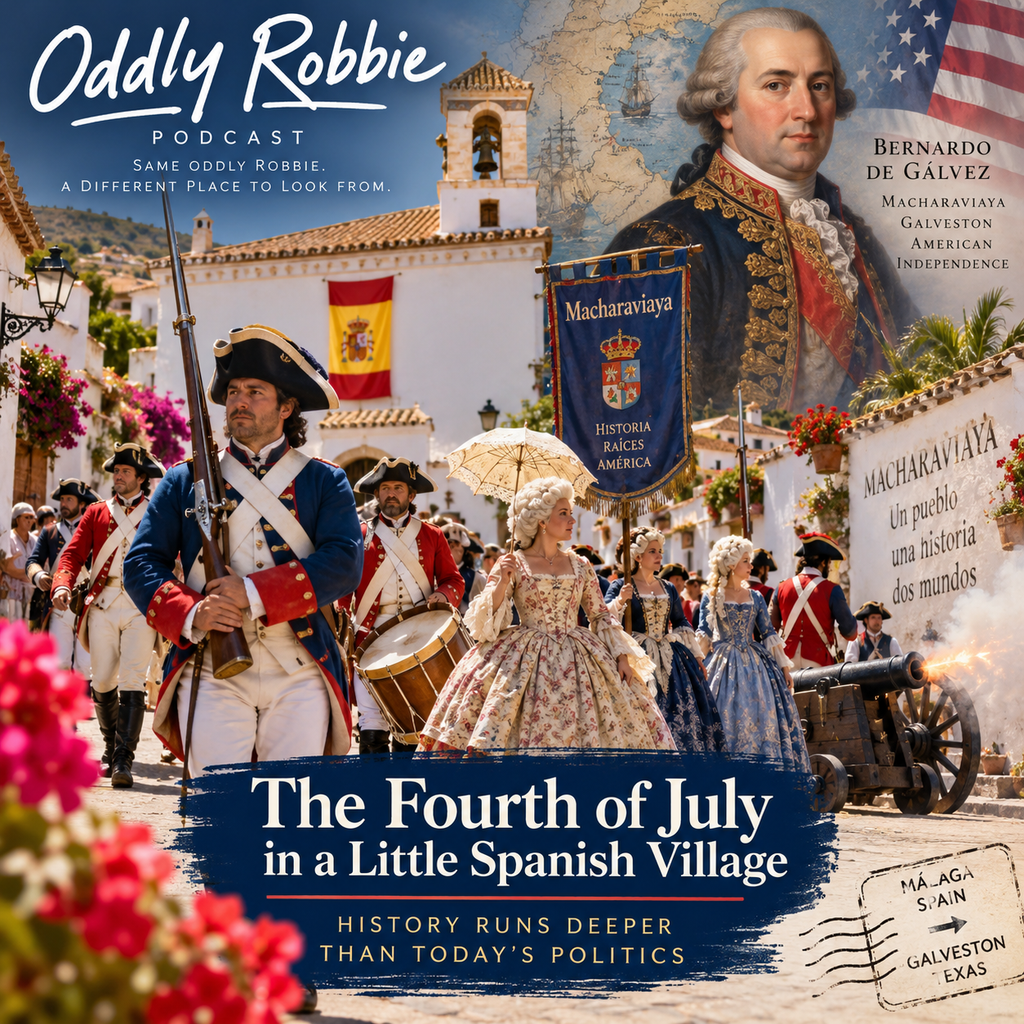
History runs deeper than today’s politics.
The other day, my landlord here in Spain sent me a couple of links on WhatsApp. We’d been talking about history, and he ended up giving me quite an interesting history lesson. One I don’t remember ever being taught growing up in the United States.
The first link was about a Spaniard who has an American city named after him. The second was a video of people celebrating the Fourth of July. Nothing particularly unusual about that, except the celebration wasn’t happening in America. It was happening in Macharaviaya, a little village here in Málaga province, Spain.
Wait. Why is a Spanish village celebrating American Independence Day?
As it turns out, there’s quite a story behind it. And it made me realize how much of the American Revolution I’d learned from an almost entirely American perspective.
A Spaniard Who Helped America Become Independent
Bernardo de Gálvez was born in Macharaviaya in 1746, when Spain was still a major colonial power.
During the American Revolution, Spain had its own reasons for wanting to weaken Britain. France had already become an important American ally, and when Spain entered the war against Britain in 1779, Gálvez, then governor of Spanish Louisiana, became an important military leader.
He led successful campaigns against British positions along the Mississippi River and Gulf Coast, including Baton Rouge and Mobile. Then, in 1781, he commanded Spanish-led forces that captured Pensacola, Florida, from the British. The victory weakened Britain’s position along the Gulf Coast and contributed to the wider struggle for American independence.
Spain’s involvement also extended beyond military campaigns. Supplies, financing, ports, and trade routes helped sustain the American cause.
Of course, Spain wasn’t acting simply out of affection for a new American republic. European empires had competing interests, and weakening Britain served Spain’s own ambitions. History is rarely as tidy as the versions we learn in school. But the contribution was significant.
And here’s an interesting connection: Galveston, Texas, takes its name from Bernardo de Gálvez. An American city carries the name of a man born in a little Andalusian village.
In 2014, the United States went a step further and made Gálvez an honorary American citizen.
Posthumously. He’d been dead for more than two centuries.
A rather delayed welcome to the country he helped make possible.
And this is where my landlord’s little history lesson really caught my attention. Growing up in America, I learned about George Washington, the Declaration of Independence, the British redcoats, and the familiar founding stories. I remember learning about France’s contribution, too.
But Spain’s role? The military campaigns along the Gulf Coast? The supplies and financing coming through international networks? Those weren’t prominent parts of the history I remember being taught.
Yet here I was, learning about them from my landlord in Spain.
Sometimes moving to another country doesn’t just teach you about that country’s history. It changes how you understand your own.
This Is Not Your Average Fourth of July Celebration
When I first heard that Macharaviaya celebrated the Fourth of July, I imagined something fairly modest. A few American flags. Some music. Perhaps sparklers and fireworks.
Oh, no. These people reenact an entire battle.
We’re talking British redcoats, Spanish soldiers, military formations, period weapons, cannon effects, and people dressed in elaborate eighteenth-century clothing. Full military uniforms. Tricorn hats. Wigs. And women in enormous, elaborate period dresses.
In Andalucía. In July.
If you’ve experienced a Málaga summer, you’ll appreciate the commitment involved. Walking to the grocery store can be warm enough without dressing like an eighteenth-century aristocrat.
But the people of Macharaviaya take their history seriously. The reenactment depicts the Siege of Pensacola, fought in Florida in 1781. It’s one of the major victories associated with Gálvez and Spain’s participation in the American War of Independence. So here we have a Spanish village recreating a battle fought thousands of kilometers away, more than two centuries ago, as part of its celebration of American independence.
And 2026 happens to be the 250th anniversary of the American Declaration of Independence. Two hundred and fifty years later, that connection is still being celebrated.
Not just in history books. Not just in museums. But out in the streets, with people gathering, dressing up, and bringing the past back to life.
I find that rather wonderful.
A Battle Close to Home
Macharaviaya is only about an hour’s drive from where I live in Torremolinos. I’d absolutely love to see this celebration in person.
There’s just one little problem.
Cannons. Explosions. Loud, unexpected bangs.
Those and my nervous system don’t get along particularly well.
I can enjoy a thunderstorm. The sound of rain and distant thunder can be quite comforting. But sudden explosions are an entirely different experience.
So while I admire the extraordinary effort involved in recreating history, I may have to appreciate this particular battle from a safe distance.
Which, come to think of it, is probably a fairly sensible position to take on most battles.
Perhaps I’ll visit the village and its Gálvez museum on a quieter day instead. The history will still be there.
Countries Are More Than Their Governments
There’s another reason this little celebration caught my attention. Here we are in 2026, with political disagreements and tensions between the United States and parts of Europe. Trade, security, international responsibilities, and different political priorities all contribute to those disagreements.
And if you follow the news, it’s easy to get the impression that countries are single, enormous personalities.
America thinks this. Spain thinks that. Europe wants something else.
But countries aren’t single people. They’re overlapping systems of people, institutions, businesses, communities, and families.
Governments are one layer. And that layer can change remarkably quickly.
An election happens. A new administration takes office. Policies change. Diplomatic relationships become warmer or colder.
But the deeper connections between people often move much more slowly.
People continue traveling between countries. Students study abroad. Businesses trade.
Musicians collaborate. Families cross borders. People fall in love, get married, and build lives together.
And apparently, a little Spanish village continues celebrating an American revolution.
The political relationship is only one layer of something much larger. That doesn’t mean political disagreements are unimportant. They can have very real consequences for the people living under those governments.
But those disagreements don’t erase the history, culture, and personal relationships that existed before the current political moment. And they don’t necessarily determine what those relationships will become.
The History Beneath Our Feet
Living in Spain has changed how I encounter history. When I lived in the United States, I knew the familiar stories of the American Revolution. The Declaration of Independence. George Washington. The British redcoats. The founding of a new country.
But Bernardo de Gálvez? I can’t say he occupied much space in my understanding of American history.
And yet here I am, living in Málaga province, not very far from the village where he was born. A village that still celebrates its connection to American independence.
And what I find especially interesting is how I learned about it.
Not from an American history textbook. Not from a museum in Washington. But from my Spanish landlord sharing a little local history.
Something ordinary to him became a missing piece of the history I’d carried with me from America. It reminds me that the history we learn often depends on where we’re standing when we learn it.
The American Revolution looks a little different when viewed from Spain. And Spanish history looks a little different when you discover how much of it connects to places across the Atlantic.
History isn’t neatly contained within the borders we draw on maps. Neither are the people who make it.
A Little Loop Across the Atlantic
What I enjoyed most about this discovery is how ordinary it began. It wasn’t a geopolitical analysis. It wasn’t a documentary about international relations. It was my landlord sending me two links on WhatsApp.
A Spaniard here in Málaga taught an American living in Málaga about a Spaniard from Málaga who helped Americans become independent. And now that American is sitting here in Spain writing about it. There’s something rather satisfying about that little loop.
Governments will come and go. Political disagreements will come and go. Borders and alliances may change.
But history doesn’t simply disappear. And neither do all the connections people have built across generations.
Maybe countries aren’t quite as separate as our maps—and sometimes our politics—make them look.
And apparently, if I ever get homesick for the Fourth of July, I don’t actually have to go back to America. I just have to go a little farther into Málaga.
Preferably with a very good pair of ear defenders.
⸻
Coming Up on Oddly Robbie: The Future of Farming
What will the future of agriculture look like? AI, robotics, autonomous tractors, smart farming, and technology we haven’t even imagined yet?
Well, good news! Oddly Robbie has been invited to Expo AgriTech 2026 in Málaga, Spain, to see what’s coming! I’ll be exploring the innovations that could change how we grow our food, use our resources, and care for our planet.
And I’m especially curious about the robots. What can they actually do? Are they genuinely useful, or are some of them still looking for a job?
What will I discover? I have no idea yet. That’s the fun part!
I’ll be there asking questions, exploring the technology, and seeing what the future of farming might actually look like. Stay tuned to the Oddly Robbie Blog.
⸻
Same Oddly Robbie. A different place to look from.
Leave a Reply