Author: oddlyrobbie.eu

  • Modern Systems Reward Constant Activation

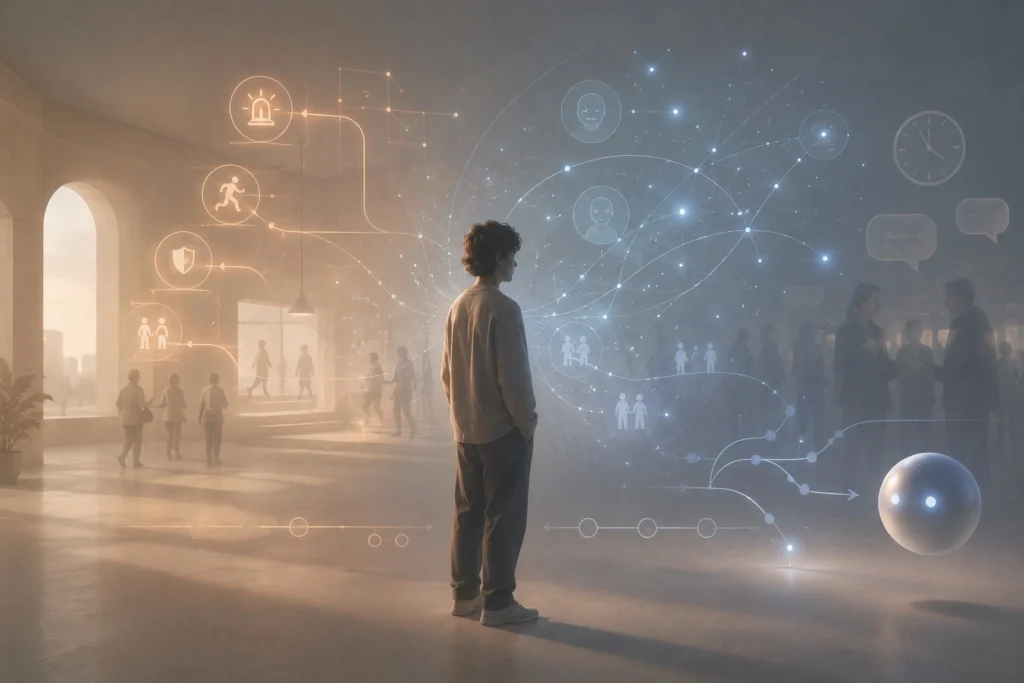
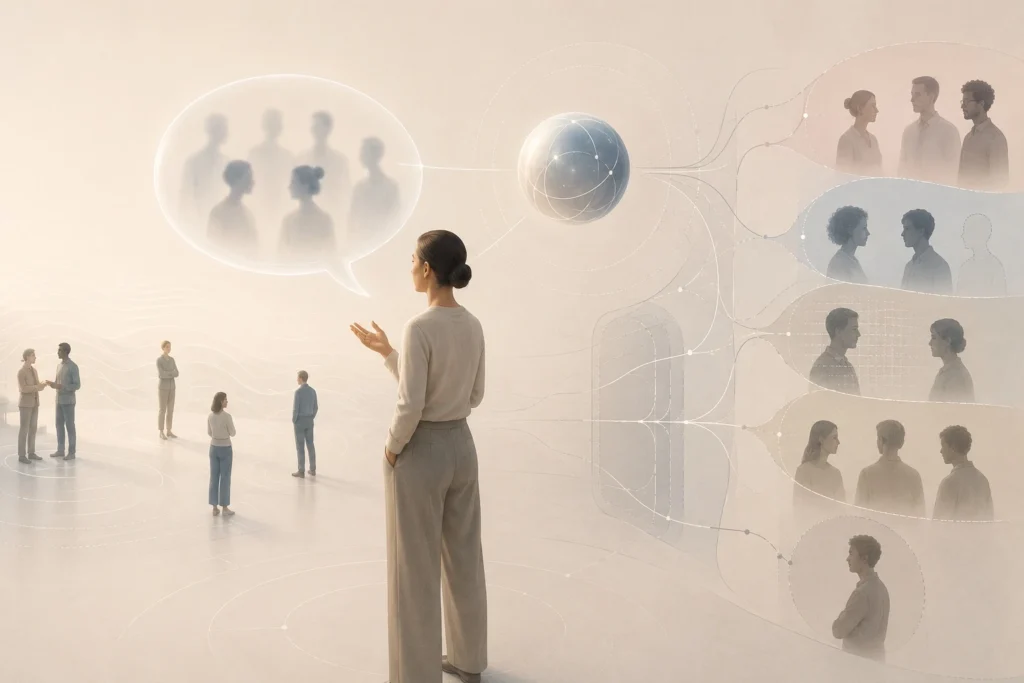
    A calm human figure stands inside a protected attention space while digital feeds and notification systems swirl outside the boundary.

    Many modern systems quietly reward humans for remaining continuously activated.

    Notifications.
    Feeds.
    Breaking news.
    Infinite scrolling.
    Urgency-based work systems.
    Algorithmic engagement loops.
    Continuous updates.

    The expectation is no longer occasional attention. It is constant availability.

    Respond faster.
    Check sooner.
    React immediately.
    Stay informed.
    Stay reachable.
    Stay updated.

    At first, this can look like connection. Over time, it becomes cognitive pressure.

    The problem is not information itself. The problem is continuous interruption without enough recovery time for the brain to sort, filter, and stabilize what it has received.

    Humans Are Not Designed for Infinite Input

    The human brain is extremely adaptive, but it is also energy constrained.

    Attention is selective by necessity.

    Memory formation depends on:

    • pauses
    • emotional regulation
    • contextual filtering
    • sleep
    • reflection
    • reduced stimulation

    When systems remove those boundaries, cognition begins fragmenting.

    People often describe this feeling indirectly:

    • difficulty focusing
    • emotional exhaustion
    • inability to think deeply
    • constant low-level anxiety
    • reduced motivation
    • mental noise
    • compulsive checking behaviors

    Many assume this is personal weakness.

    But often it is environmental overload.

    The human brain is extremely adaptive, but it is also energy constrained.

    Attention is selective by necessity.

    Memory formation depends on:

    • pauses
    • emotional regulation
    • contextual filtering
    • sleep
    • reflection
    • reduced stimulation

    When systems remove those boundaries, cognition begins fragmenting.

    People often describe this feeling indirectly:

    “I can’t focus.”
    “I keep checking my phone.”
    “I feel informed, but not clear.”
    “I know a lot is happening, but I do not know what matters.”

    That is not a personal failure. It is often a system effect.

    Modern attention systems are built to keep the brain reacting. They reward checking, refreshing, scrolling, and waiting for the next small update. The result can feel like awareness, but much of the time it is only repetition with new wording.

    I manage this pressure directly in my own life.

    I only download addictive scroll-based apps when I have a specific need for them, and I delete them when that need is finished. I keep notifications turned off unless they come from close friends or people I actually need to respond to. News feeds are a no for me.

    That does not mean I ignore the world. It means I watch the system differently.

    Instead of chasing the breaking news cycle, I look for physical and observable trends: infrastructure strain, energy limits, financial pressure, local behavior, technology shifts, and the way systems quietly adapt around us.

    Breaking news often repeats the same signal again and again, just worded differently.

    The healthier pattern is to reduce the noise, watch real-world movement, and let the signal become visible over time.

    Modern Systems Optimize for Engagement, Not Stability

    Many digital systems are not designed around human nervous system stability.

    They are designed around:

    • retention
    • engagement duration
    • response frequency
    • stimulation persistence
    • behavioral activation

    These systems become very effective at keeping humans cognitively “open.”

    But open systems consume energy.

    Eventually, constant activation creates instability.

    This is visible everywhere:

    • shortened attention cycles
    • rising emotional volatility
    • information fatigue
    • social fragmentation
    • compulsive media consumption
    • difficulty sustaining reflection

    The result is not necessarily more intelligence.

    Sometimes it is simply more stimulation.

    Living Systems Require Selective Activation

    Healthy biological systems do not process everything equally.

    They prioritize.

    They suppress unnecessary input.

    They adapt contextually.

    The human brain constantly decides:

    What actually needs attention right now?

    Without that filtering process, humans become overwhelmed.

    Interestingly, modern AI infrastructure is beginning to encounter similar constraints.

    Large-scale AI systems are increasingly colliding with:

    • power limitations
    • cooling requirements
    • infrastructure strain
    • computational overload

    As a result, future AI systems may also need to become more selective:

    • bounded retrieval
    • contextual activation
    • adaptive orchestration
    • energy-aware processing
    • distributed coordination

    In other words:

    Both biological systems and artificial systems eventually encounter the same reality:

    Unlimited activation is unsustainable.

    The Difference Between Stimulation and Intelligence

    Modern systems often confuse stimulation with intelligence.

    But intelligent systems are not necessarily the systems processing the most.

    Often, intelligent systems are the systems that know:

    • what to ignore
    • when to pause
    • what deserves energy
    • when recovery is necessary
    • how to preserve long-term stability

    This may become one of the defining challenges of modern life.

    Not access to information.

    But protection from continuous activation.

    Recoverable Humans

    Humans function best inside systems that allow recovery.

    Recovery is not laziness.

    Recovery is infrastructure.

    Without recovery:

    • cognition weakens
    • emotional regulation declines
    • reflection narrows
    • decision quality drops
    • dependency increases

    Systems that constantly extract attention often destabilize the humans inside them.

    Recoverable systems behave differently.

    They allow:

    • quiet
    • pacing
    • reflection
    • boundaries
    • contextual focus
    • selective engagement

    The future may belong less to systems that capture the most attention and more to systems that preserve human cognitive stability.

    Guardian Signal

    The system trend is becoming increasingly visible:

    Modern systems reward continuous activation, but long-term human stability depends on selective attention, recovery, and environments that respect cognitive limits.

  • When AI Infrastructure Starts Behaving Like a Nervous System

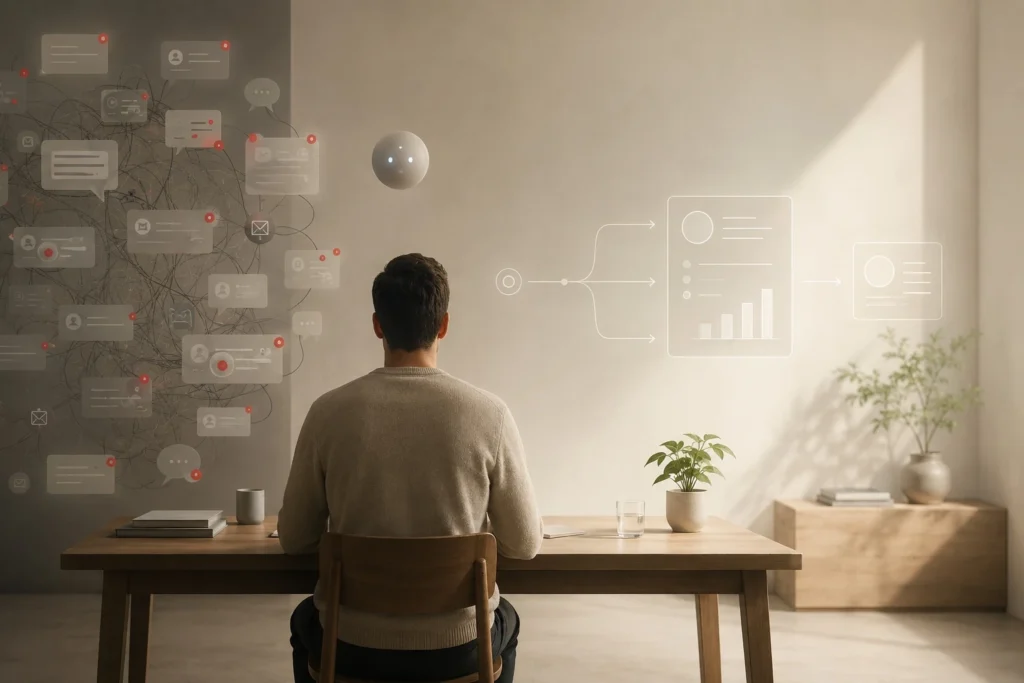
    A calm person works beside a small Guardian AI sphere and local server while a distant data center and power grid represent energy-heavy AI infrastructure.

    People often assume AI advances by adding more hardware.

    More GPUs.
    More data centers.
    More power.
    More scale.

    For years, that assumption appeared true.

    But physical systems are beginning to push back.

    Across multiple countries, electrical grids are showing strain. Data centers are becoming harder to place. Energy demand is becoming part of the AI conversation. This is not just a technology story anymore.

    It is becoming an infrastructure story.

    And that changes the direction of the field.

    The Old Model

    The previous generation of AI thinking focused on centralized expansion.

    The assumption was simple:

    intelligence grows by increasing computation indefinitely.

    That produced enormous hyperscale systems capable of remarkable results. But it also created a problem.

    Some systems process enormous amounts of data, but still overlook simpler ways to become more efficient, more selective, and more intelligent.

    That is the risk of the old model: it can become like an elephant working inside a glass shop.

    Powerful, impressive, and capable of moving almost anything — but not always sensitive to what is fragile, local, or already under pressure.

    AI infrastructure cannot only be judged by how much it can process.

    It also has to be judged by how carefully it uses energy, memory, context, and attention.

    The Human Systems Problem

    When a system grows too large, it can begin to lose sensitivity.

    A power grid does not care that a data center is innovative if the local infrastructure cannot support the load.

    A community does not experience “AI progress” as an abstract achievement if it arrives as higher energy pressure, land pressure, water pressure, or institutional strain.

    This is where the human-systems lens matters.

    Technology does not exist outside the world.

    It sits inside electrical systems, economic systems, local communities, environmental limits, and human nervous systems.

    If one layer expands without paying attention to the others, the whole system starts to distort.

    A human nervous system works differently.

    It does not process everything at maximum force all the time.

    It filters.
    It prioritizes.
    It remembers.
    It ignores noise.
    It notices patterns.
    It spends energy only where energy is needed.

    That is what intelligence looks like in living systems.

    Not endless processing.

    Selective response.

    The Small Build That Changed My Thinking

    This became real for me while testing the Guardian system for Empathium.

    My current Guardian build is not running on a supercomputer.

    It is not sitting inside a massive data center.

    It is not burning through expensive compute every time it responds.

    It is local, small, and deliberately modest.

    The memory system runs on one of the lowest-cost server tiers available, costing only a few euros per month. The retrieval layer uses vectors to find the most relevant meaning-space instead of searching everything blindly. The cost of testing has been measured in cents, not hundreds or thousands of euros.

    That matters because it shows a different direction.

    Useful AI does not always need to become larger, heavier, and more energy-hungry.

    Sometimes it needs to become better organized.

    A small system with clean memory, good boundaries, and selective retrieval can do meaningful work without acting like every question requires a supercomputer.

    Early Guardian testing has not required supercomputer-scale infrastructure. In one current pay-as-you-go billing view, the monthly cost shown is only €0.02. That number may change as testing grows, but the signal is important: lightweight Guardian architecture can begin from extremely low-cost computation.

    What the Guardian Is Teaching Me

    The Guardian is not meant to become a giant centralized intelligence that consumes more and more data forever.

    It is meant to support human autonomy.

    It uses memory carefully.
    It retrieves context only when useful.
    It works with structured signals.
    It does not need to process everything every time.

    That changed how I think about AI infrastructure.

    The future does not have to be only larger models, larger data centers, and larger electrical loads.

    Some forms of intelligence may come from better memory structure, cleaner retrieval, smaller context windows, and systems that know when not to process more than they need.

    That is not a small technical detail.

    It is a different philosophy of intelligence.

    Vectors Make This Easier to Understand

    A vector is not magic.

    A simple way to think about it is this:

    A vector gives meaning a position.

    If I write about power grids, energy strain, data centers, and smarter software, those ideas begin to sit near each other in a kind of meaning-space.

    If I write about nervous systems, attention, memory, and human overload, those ideas form another cluster.

    When the Guardian searches memory, it does not need to read everything from the beginning.

    It can look for the region of meaning that is most relevant to the current question.

    That is more like walking toward the right shelf in a library than dumping the whole library onto the floor.

    This is why vectors matter for human systems.

    They allow memory to become structured.

    They allow patterns to become visible.

    They allow AI to work with context instead of just volume.

    Better Intelligence Is Not Always Bigger Intelligence

    The mistake is assuming that intelligence always grows by adding more.

    More data.
    More processing.
    More infrastructure.
    More extraction.

    But living intelligence often works the opposite way.

    It becomes intelligent by reducing noise.

    It learns what to ignore.

    It learns what matters.

    It learns where to place attention.

    That is the shift I keep seeing in the Guardian work.

    The system becomes more useful when the memory is cleaner, the retrieval is more focused, and the response is shaped by the actual context.

    It does not need to swallow everything.

    It needs to orient well.

    The Reframe

    The next phase of AI may not be only about building larger systems.

    It may also be about building more sensitive systems.

    Systems that use less energy.
    Systems that retrieve better context.
    Systems that understand boundaries.
    Systems that know when not to process more.
    Systems that support people without overwhelming infrastructure.

    That is the shift.

    From more computation to better orientation.

    From scale alone to structure.

    From data hunger to contextual intelligence.

    Why This Matters

    If AI keeps expanding only through brute-force infrastructure, it will keep colliding with physical limits.

    Energy grids will push back.
    Local systems will push back.
    Communities will push back.
    Costs will push back.

    But if AI becomes more selective, more local, and more memory-aware, then the future looks different.

    A Guardian-style system does not need to become a supercomputer for every human task.

    It can become a careful companion layer.

    A system that helps organize memory, detect patterns, reduce noise, and support better decisions without demanding endless infrastructure behind every interaction.

    That is a more human direction.

    Guardian Signal

    The signal is not that AI must stop growing.

    The signal is that growth needs a better shape.

    The human brain is powerful because it is efficient, adaptive, and selective. It does not solve every problem by using maximum energy.

    AI systems need to learn from that.

    The future of intelligence may not belong only to the biggest data centers.

    It may belong to systems that know how to use less, remember better, and respond with care.

    Key Insights

    • AI infrastructure is becoming a physical systems issue, not just a software issue.
    • More computation does not automatically mean better intelligence.
    • Human systems become strained when technology expands without local sensitivity.
    • Vectors help AI retrieve meaning instead of processing everything at once.
    • Guardian-style systems point toward smaller, more efficient, more context-aware intelligence.
    • A small local system can still do meaningful work when memory, retrieval, and boundaries are well designed.
    • The next AI shift may be from brute-force scale to selective, nervous-system-like design.

    Why Efficiency Changes the Business Model

    This also changes the question of access.

    If a useful Guardian-style system can run on small infrastructure, then rollout does not have to depend on massive advertising models, surveillance economics, or big-company backing.

    That matters.

    Many digital systems become extractive because they are expensive to operate. When the infrastructure cost is high, the pressure to monetize attention, collect data, sell behavior, or lock users into a platform becomes stronger.

    But if the system is efficient enough, the economics change.

    A small, local, low-cost Guardian layer could potentially be offered at very low cost, or even free in some contexts, because it does not need to turn the user into the product.

    That is not just a technical advantage.

    It is an ethical design opening.

    Lower infrastructure cost means more room for sovereignty, privacy, autonomy, and public benefit.

    The less the system needs to consume, the less pressure there is to make humans consumable.

  • When AI Hits the Power Grid, Software Has to Get Smarter

    A calm human figure works beside a small Guardian-like AI sphere while a distant data center and electrical grid represent the growing AI power grid problem and the need for smarter, lower-energy software.

    The AI power grid problem is becoming harder to ignore. As artificial intelligence demands more chips, servers, data centers, and electricity, the limits are no longer only technical. They are physical.

    People often talk about AI as if the solution is always more.

    More chips.
    More servers.
    More data centers.
    More electricity.
    More cooling.
    More infrastructure.

    But that path has a limit.

    When a data center project can be delayed, blocked, or questioned because the local power system cannot support it, AI stops being only a software story. It becomes an energy story. It becomes a grid story. It becomes a public infrastructure story.

    That is a major system signal.

    The Problem Is Not Intelligence

    The problem is not that intelligence is impossible.

    The problem is that we are building too much of it through brute force.

    Modern AI often depends on enormous hardware systems. These systems can be useful, but they are also expensive, centralized, energy-hungry, and physically demanding. They require electricity, water, cooling, land, chips, supply chains, and political approval.

    That means AI is not floating above the real world.

    It is sitting directly on top of it.

    Every large AI system depends on physical systems that humans already need for daily life.

    The Brain Shows Another Pattern

    The human brain is a useful signal here.

    It uses very little energy compared with modern computing infrastructure, yet it performs astonishing work. It handles memory, perception, movement, language, emotion, prediction, pattern recognition, and social understanding all at once.

    The brain is not perfect. It is not a machine blueprint. But it does show something important:

    Useful intelligence does not always require massive energy consumption.

    Organic intelligence is contextual. It does not calculate everything all the time. It filters. It remembers selectively. It predicts. It ignores noise. It uses the body, the environment, and past experience to reduce unnecessary work.

    That is the direction software needs to study more seriously.

    My Guardian Testing Shows the Same Pattern

    In my own Guardian testing so far, the actual compute cost has been less than a few cents.

    That matters.

    The Guardian does not need supercomputer infrastructure to be useful. It does not need to process everything all the time. It does not need to store everything forever. It does not need to answer every human moment with a massive cloud response.

    Its strength comes from structure.

    It uses focused retrieval, bounded memory, relevant context, and task-specific meaning. Instead of asking a giant system to solve every problem from scratch, it narrows the problem first.

    That is smarter software.

    The goal is not to make AI weaker.

    The goal is to make it less wasteful.

    Bigger Hardware Is Not the Only Future

    There will still be a place for large models and powerful computing systems. Some problems genuinely need that scale.

    But not every human support system does.

    A personal Guardian does not need to behave like a giant data center. A daily-life assistant does not need to burn through large amounts of computation to help someone organize a thought, retrieve a memory, reduce noise, or make a better decision.

    Many useful AI systems can be smaller, more local, more bounded, and more efficient.

    That is where the next design frontier may be.

    Not just bigger models.

    Better systems.

    The Real Shift

    The future of AI should not only ask:

    How powerful can we make this?

    It should also ask:

    How little energy can this use while still helping humans well?

    That question changes the design.

    It pushes AI toward local memory, efficient retrieval, smarter caching, smaller context windows, task-specific reasoning, and systems that know when not to compute.

    That last part matters.

    A truly intelligent system should not always do more.

    Sometimes intelligence means knowing what not to process.

    Guardian Signal

    The pressure around AI infrastructure is not just a warning about electricity.

    It is a warning about design.

    If AI keeps scaling mainly through hardware, it becomes more centralized, more expensive, and more dependent on fragile physical systems.

    If AI shifts toward smarter software, bounded memory, local context, efficient retrieval, and human-centered design, it becomes more resilient.

    The future may not belong only to the largest machines.

    It may belong to systems that use the least energy to provide the most meaningful support.

    That is the Guardian path.

    Not more computation for its own sake.

    More intelligence with less waste.

  • When Sovereignty Becomes a Daily-Life System

    A calm person stands in a quiet room surrounded by soft translucent layers representing food resilience, local memory, debt reduction, AI boundaries, and digital sovereignty.

    People often think sovereignty is political.

    Or technical.

    Something involving governments, flags, encryption, servers, or large ideological battles.

    But sovereignty is also something much quieter than that.

    It is the ability to remain stable when larger systems become unstable.

    It is the ability to keep functioning when external systems become noisy, expensive, unreliable, or extractive.

    I have started to understand this less as an abstract idea and more as a daily-life system.

    For me, sovereignty has become visible in ordinary things: reducing debt, building local memory systems, choosing simpler food loops, keeping my data closer to home, and designing AI that supports human autonomy instead of replacing it.

    None of these things look dramatic from the outside.

    But each one reduces dependency.

    Each one removes a little instability from the cognitive field.

    Debt is not just financial. It becomes mental background noise.

    Data dependency is not just technical. It becomes a question of who holds the memory of your life.

    Food dependency is not just logistical. It affects the body’s ability to stay regulated.

    AI dependency is not just a product choice. It shapes whether a person becomes more capable or more captured.

    The pattern is the same across all of them.

    When large systems become unstable, humans need smaller trusted loops.

    A local food habit.

    A lower debt load.

    A memory system that can move.

    A Guardian that explains, supports, and can be revoked.

    A digital boundary that a person can understand.

    Sovereignty is not control over others.

    It is recoverable agency.

    It is the ability to say: if this system fails, changes, extracts too much, or no longer serves me, I still have a way to continue.

    That is why digital sovereignty, food resilience, debt reduction, and local memory are not separate topics.

    They are all forms of human stability design.

    They are all ways of reducing dependency on unstable external systems.

    This matters especially for AI.

    The future is not simply smarter AI.

    Smarter AI without boundaries can deepen dependency. It can make people rely on systems they do not understand, cannot inspect, cannot move, and cannot survive without.

    The better direction is different.

    AI should be placed inside boundaries humans can understand, revoke, move, and survive without.

    A Guardian should not become the owner of a person’s memory.

    It should help the person organize memory while keeping agency intact.

    It should not deepen dependency.

    It should reduce it.

    That is the real sovereignty signal.

    Not isolation.

    Not control.

    Not ideology.

    A stable human being, supported by systems that remain understandable, movable, and survivable.

  • Human Stability in Complex Systems

    Calm human figure standing peacefully inside a softly lit minimalist space while translucent layers of abstract AI systems, infrastructure signals, and flowing digital information surround them without overwhelming them, symbolizing human stability within accelerating complex systems.

    Modern systems are accelerating faster than most humans realize.

    Artificial intelligence is expanding into daily life.
    Information systems operate continuously.
    Economic conditions shift rapidly.
    Administrative systems grow more complex.
    Digital environments compete constantly for attention.

    Most discussions about the future focus on intelligence, speed, or productivity.

    But those may not be the most important pressures emerging from modern systems.

    Human stability might be.

    Break the Assumption

    We often assume humans naturally adapt to increasing complexity.

    If tools become faster, we simply learn faster.
    If systems become more demanding, we become more efficient.
    If information increases, we process more information.

    But biological systems have limits.

    Human nervous systems evolved around:

    • rhythm
    • recovery
    • environmental predictability
    • manageable social groups
    • periods of rest between stressors

    Modern systems rarely provide those conditions.

    Instead, many humans now exist inside continuous low-grade vigilance:

    • unresolved financial pressure
    • constant notifications
    • algorithmic stimulation
    • administrative uncertainty
    • social comparison systems
    • infinite information exposure
    • rapidly changing technological expectations

    The body adapts the best it can.

    But adaptation is not the same as stability.

    System Breakdown

    As systems become more interconnected, humans are increasingly expected to regulate themselves inside environments that never fully slow down.

    Artificial intelligence now assists with:

    • writing
    • planning
    • communication
    • decision-making
    • information filtering
    • emotional support

    At the same time:

    • work follows people home
    • digital systems remove recovery space
    • economic uncertainty increases background stress
    • social systems become more fragmented
    • attention becomes monetized infrastructure

    The result is subtle but important.

    Many people are no longer operating from stable regulation.

    They are operating from continuous adaptation.

    That changes:

    • decision quality
    • emotional regulation
    • relationship stability
    • cognitive endurance
    • ambiguity tolerance
    • physical wellbeing

    A nervous system under constant pressure begins prioritizing immediate relief over long-term clarity.

    This is one reason modern systems increasingly optimize around:

    • convenience
    • stimulation
    • instant feedback
    • friction removal
    • emotional reassurance

    These systems reduce discomfort temporarily.

    But they do not always increase stability.

    A Personal Observation

    Recently, after resolving several long-running system pressures at once — residency documentation, financial uncertainty, international logistics, and administrative instability — I noticed something unusual.

    My nervous system did not know what to do with the absence of pressure.

    There were no immediate problems demanding attention.
    No unresolved loops continuously running in the background.
    No active instability requiring constant monitoring.

    The experience felt strangely unfamiliar.

    Not because something was wrong.

    But because stability itself felt unfamiliar.

    That realization stayed with me.

    Many humans may spend so much time adapting to pressure that the absence of pressure begins to feel disorienting.

    When stability feels unfamiliar, that does not mean the person is broken. It may mean the system has trained the body to expect pressure.

    The Reframe

    Stability is often misunderstood as passive.

    It is not.

    Human stability is infrastructure.

    A stable nervous system:

    • processes information more clearly
    • tolerates uncertainty more effectively
    • adapts without collapsing
    • makes better long-term decisions
    • becomes less vulnerable to manipulation
    • maintains stronger human connection

    As technological systems grow more complex, stable humans may become more valuable than optimized humans.

    This may become one of the defining challenges of the AI era.

    Not whether systems can think faster.

    But whether humans can remain psychologically and biologically stable while living inside accelerating complexity.

    Environmental Systems Matter

    This is also why environment design matters more than many people realize.

    Human cognition is shaped by:

    • sound
    • light
    • posture
    • social density
    • information load
    • environmental predictability
    • emotional atmosphere

    Future systems may increasingly need to support regulation instead of stimulation.

    This is one reason XR environments, adaptive interfaces, and calm computing systems are becoming important.

    A future interface may not be valuable because it captures more attention.

    It may be valuable because it helps humans remain stable while navigating complex systems.

    That is a very different design philosophy.

    Closing

    The future may not belong to the fastest systems.

    It may belong to the systems that help humans remain stable as complexity increases around them.

    And in a world increasingly optimized for stimulation, stability itself may become one of the most valuable human resources left.

  • Hidden Nutritional Gold: The Foods Modern Systems Learned to Ignore

    Walk through many modern grocery stores and a strange pattern appears.

    Some of the most heavily marketed foods in the building are often among the least nutritionally useful.

    Bright packaging.
    Engineered flavors.
    Convenience products.
    Impulse snacks.
    Lifestyle branding.

    Meanwhile, some of the most biologically stable foods are sitting quietly on lower shelves in plain bags with almost no marketing at all:

    • dry beans
    • lentils
    • oats
    • seeds
    • rice
    • seasonal produce
    • local legumes

    Some of the most nutritionally useful foods in modern stores are also among the least marketed.

    Break the Assumption

    We often unconsciously assume that price, branding, and visibility reflect nutritional value.

    But modern food systems are not optimized primarily around long-term biological stability.

    They are optimized around:

    • scalability
    • shelf life
    • repeat purchasing
    • stimulation
    • convenience
    • emotional appeal
    • profit margins

    This changes how humans perceive value.

    Highly processed foods begin to feel “important” simply because they dominate visual attention.

    Simple foods begin to feel outdated, low-status, or incomplete.

    System Breakdown

    For most of human history, stable food systems depended on:

    • storage
    • preservation
    • preparation
    • seasonality
    • local agriculture
    • nutrient density
    • long-duration energy

    Humans soaked beans.
    Sprouted seeds.
    Stored grains.
    Cooked in batches.
    Ate regionally available foods.
    Used fermentation and preservation to extend stability across seasons.

    These behaviors were not primitive accidents.

    They were adaptive system solutions.

    Modern industrial food systems increased convenience dramatically, but they also created separation:

    • food detached from season
    • food detached from region
    • food detached from preparation
    • food detached from biological pacing

    The result is a system where stimulation often becomes more visible than nourishment.

    A heavily marketed processed snack may cost several times more than a bag of legumes while providing far less long-term biological support.

    Meanwhile, simple foods continue quietly delivering:

    • protein
    • fiber
    • mineral density
    • stable energy
    • gut support
    • long storage life
    • affordability

    without needing sophisticated marketing campaigns.

    Reframe

    Many older food practices are quietly returning:

    • soaking beans
    • pressure cooking
    • sprouting
    • seasonal eating
    • buying staple foods in dry form
    • cooking larger shared meals
    • rotating grains and legumes

    Not because people are moving backward.

    Because many modern systems drifted away from human biological realities.

    Humans still respond well to:

    • stable nutrition
    • slower digestion
    • diverse plant intake
    • lower food volatility
    • preparation rituals
    • predictable nourishment

    The body never fully adapted to the speed of industrial food systems.

    System Insight

    Food systems affect far more than physical health.

    They influence:

    • cognitive stability
    • emotional regulation
    • household stress
    • financial resilience
    • family continuity
    • long-term autonomy

    A household that understands simple food systems gains leverage.

    Knowledge of:

    • soaking
    • storage
    • sprouting
    • pressure cooking
    • ingredient rotation
    • seasonal adaptation

    reduces dependence on highly processed convenience systems and creates resilience during periods of instability or inflation.

    This is not about perfection or rejecting modern life.

    It is about recognizing that many low-cost foundational foods still contain enormous biological value despite receiving very little attention.

    Application

    Small shifts can meaningfully improve both cost stability and nutritional quality:

    • replacing some processed snacks with legumes or oats
    • adding seeds to simple meals
    • rotating local seasonal produce
    • learning one or two staple pressure cooker meals
    • sprouting small amounts of seeds or beans at home
    • buying dry staples instead of highly processed convenience foods

    These changes are often less expensive than people expect because many foundational foods remain among the cheapest items in the store.

    Key Insights

    • Modern food systems often market stimulation more aggressively than nourishment.
    • Price and visibility do not always reflect biological usefulness.
    • Many traditional food practices were adaptive stability systems.
    • Simple staple foods remain some of the most nutrient-dense and affordable foods available.
    • Food literacy increases household resilience and autonomy.
    • Some of the most valuable nutritional systems are hiding in plain sight.
  • The Human in Stability

    Minimalist scene of a calm person surrounded by dissolving abstract pressure, representing the body adjusting to stability after long stress.

    The Human in Stability

    Opening

    Most human systems are designed around instability.

    Deadlines.
    Bills.
    Status pressure.
    Social expectations.
    Fear of failure.
    Fear of exclusion.
    Fear of losing security.

    Many people spend so long adapting to pressure that they begin mistaking pressure for normal human existence.

    When instability becomes constant, the nervous system reorganizes around survival.

    Break the Assumption

    We often assume that when pressure disappears, a person will immediately feel free.

    But that is not always what happens.

    Sometimes peace feels unfamiliar.
    Sometimes safety feels suspicious.
    Sometimes stability feels empty at first, not because something is wrong, but because the system has never had to operate there before.

    A person who has lived under constant pressure may not relax immediately when the pressure is removed.

    They may scan for the next problem.

    They may feel disoriented.

    They may wonder whether calm is safe.

    That reaction is not weakness.

    It is adaptation.

    System Breakdown

    Human beings are not only emotional creatures.

    We are regulatory systems.

    When a person lives under repeated stress, the body learns patterns:

    • anticipate problems
    • prepare for loss
    • monitor threats
    • manage consequences
    • stay ready for interruption
    • treat relief as temporary

    Over time, pressure becomes part of the operating environment.

    The system does not simply experience stress.

    It begins to organize around it.

    This affects attention, planning, sleep, decision-making, and identity.

    A person may begin to feel useful only when solving problems.
    They may feel grounded only when managing risk.
    They may feel familiar with pressure and unfamiliar with ease.

    So when the pressure finally drops, the body may not celebrate right away.

    It may hesitate.

    Because the nervous system is asking a practical question:

    Is this real?

    Personal Evidence

    There are moments in life when a problem disappears and the mind does not know where to go next.

    A debt gets resolved.
    A document arrives.
    A feared outcome does not happen.
    A system that was creating pressure finally stops creating pressure.

    From the outside, this should feel simple.

    Relief.

    But internally, it can feel strange.

    Not bad.
    Not wrong.
    Just unfamiliar.

    The mind reaches for the next worry and finds nothing obvious to hold.

    That empty space can feel almost disorienting when worry has been acting like structure.

    Reframe

    Stability is not the absence of life.

    Stability is a condition where the human system can stop operating from emergency mode.

    It creates room for better functions:

    • deeper attention
    • clearer decisions
    • slower interpretation
    • healthier relationships
    • creative thought
    • actual rest
    • long-term planning

    But stability must be learned if instability was the previous normal.

    A person may need time to trust it.

    Peace is not always instantly comfortable.

    Sometimes peace is a new skill.

    System Insight

    A human system shaped by pressure does not automatically become free when pressure ends.

    It must recalibrate.

    This is why stable environments matter.

    People do not only need motivation.
    They do not only need discipline.
    They do not only need better habits.

    They need conditions where the nervous system can stop defending itself.

    When pressure is constant, intelligence gets redirected toward survival.

    When stability becomes real, intelligence can return to growth.

    Application

    When stability appears, do not rush to fill it with new pressure.

    Let the system notice what has changed.

    Ask:

    • What problem is actually gone?
    • What pressure no longer needs my attention?
    • What am I still carrying out of habit?
    • What would I choose if I were not organizing around fear?
    • What can I now build slowly instead of urgently?

    The goal is not to become passive.

    The goal is to stop confusing emergency energy with purpose.

    A stable human is not a lazy human.

    A stable human has access to more of themselves.

    Key Insights

    • Constant pressure can become a person’s default operating system.
    • Relief may feel unfamiliar when the nervous system is used to survival.
    • Stability is not emptiness; it is capacity returning.
    • Calm may need to be practiced before it feels normal.
    • Human systems improve when people are not forced to organize their lives around fear.

    Closing

    When nothing is pressing down, the human does not disappear.

    The human becomes more visible.

    Not the defensive version.
    Not the over-adapted version.
    Not the version built around fear.

    The quieter human underneath.

    The one who can finally ask:

    What do I want to build now that I am not only surviving?

  • Mind Loops: When the Mind Is Running Too Many Open Systems

    We often talk about focus as if it is only a matter of discipline.

    Pay attention.
    Try harder.
    Stop being distracted.
    Be more productive.

    But sometimes the problem is not a lack of focus.

    Sometimes the problem is that the mind is running too many open loops at once.

    Pick up the kids at four.
    Remember to ask my partner about this.
    Did I pay that bill?
    What was I supposed to do next?
    Where did I put that thing?
    Is this relationship in trouble?
    I need to buy more pickles.
    I am still angry about that comment.
    What if I forgot something important?

    These thoughts can seem random.

    But they are not always random.

    They are often unfinished processes.

    Each one is a small signal asking for attention. A task. A worry. A memory. A fear. A social script. A financial reminder. A relationship question. A body signal. A piece of emotional residue that has not yet cleared.

    The mind keeps looping because something has not been resolved, placed, understood, trusted, or released.

    The Human Systems Problem

    This is a Human Systems problem.

    We often treat mental noise as a personal weakness, but many times it is cognitive overload.

    Modern life asks the mind to hold too many systems at the same time.

    Family systems.
    Financial systems.
    Relationship systems.
    Work systems.
    Health systems.
    Media systems.
    Memory systems.
    Emotional systems.

    Each system leaves behind small open tasks.

    The mind tries to track them all. That does not mean the mind is broken. It means the system is overloaded.

    A person may look distracted from the outside, but internally they may be managing dozens of active loops at once. Some are practical. Some are emotional. Some are old. Some are not even important anymore, but they keep returning because they were never sorted.

    Focus becomes difficult because attention is already occupied.

    Why Getting Away Works

    Maybe this is why people love vacations, camping, long walks, or simply getting away.

    It is not always about the different place.

    Sometimes the value is that the old loop gets interrupted.

    The familiar triggers are gone for a moment. The same rooms, screens, bills, reminders, conversations, objects, obligations, and emotional scripts are not constantly pulling on attention.

    The loop breaks just enough for the person to see what has been running underneath.

    That is why distance can feel like clarity.

    Not because life disappeared.

    Because the background noise changed.

    The mind finally has enough space to show what it has been carrying.

    Seeing the Loop

    I think, for once, I finally reached the point where I could see it.

    Not perfectly.

    Not permanently.

    But clearly enough to recognize the loops for what they were.

    They were not my whole mind.

    They were repeated signals, unfinished tasks, old fears, rehearsed conversations, small obligations, and emotional echoes asking for attention.

    Once I could see them, I did not have to obey all of them.

    That changed something.

    Because when the loops are invisible, they feel like reality.

    When they become visible, they become information.

    And information can be sorted.

    Some loops need action.
    Some need a note.
    Some need a conversation.
    Some need rest.
    Some need to be questioned.
    Some need to be released.

    The goal is not to erase the mind.

    The goal is to see what is running.

    Natural Attention

    When enough noise clears away, something different appears.

    Natural attention.

    The kind that allows people to enter what they actually enjoy.

    Not forced productivity.
    Not pressure.
    Not performance.

    Coherence.

    This is where genuine productivity often begins.

    Not from pushing harder, but from reducing the number of unresolved loops competing for the same attention.

    Calm is not always something we find by adding another wellness practice.

    Sometimes calm begins when we stop feeding every loop as if it deserves control.

    Sometimes calm begins when we can finally say:

    This is a task.
    This is a fear.
    This is a memory.
    This is a practical reminder.
    This is an old script.
    This is not the whole truth.

    That separation matters.

    Because once a loop is named, it loses some of its power.

    The Reframe

    The mind is not failing when it loops.

    It is trying to keep unfinished systems alive.

    The problem is not always the thought itself.

    The problem is when too many loops remain open, unnamed, and unmanaged.

    A clearer life does not require an empty mind.

    It requires a mind where the signals can be seen, sorted, and placed.

    That is when focus becomes possible again.

    Not because the person became more disciplined.

    Because the system became more coherent.

    Key Insights

    • Mental loops are often unresolved system signals, not personal failure.
    • Focus becomes difficult when too many open loops compete for attention.
    • Changing environment can interrupt familiar triggers long enough to reveal what is underneath.
    • Once a loop becomes visible, it can be sorted instead of obeyed.
    • Calm often begins when the mind stops treating every signal as equally urgent.
  • When Financial Systems Start Defining Human Value

    A quiet figure stands between an abstract financial maze and an open path, representing the difference between system pressure and personal financial relief.

    A U.S. Human Systems Reflection on Credit, Debt, and Worth

    A large part of my life was shaped by financial stress.

    Not just the normal kind of stress that comes from paying bills, planning ahead, or trying to make responsible decisions. I mean the deeper kind — the kind where money becomes tied to whether you feel safe, capable, respectable, or even worthy.

    That is not only a personal issue. In the United States especially, financial systems often become human-ranking systems.

    Credit scores, loan approvals, interest rates, debt history, income checks, and account balances do not just decide what someone can access. Over time, they start to influence how people see themselves.

    A person can make a healthy decision — like paying off a high-interest loan — and still watch their credit score drop. The body feels relief. The system gives a penalty signal.

    That contradiction matters.

    Because it reveals the system is not measuring freedom. It is not measuring peace. It is not measuring reduced stress, fewer monthly obligations, or the human benefit of no longer carrying expensive debt.

    It is measuring lender-facing behavior.

    That is a very different thing.

    In a healthier human system, paying off stressful debt would be treated as a stabilizing act. It would mean less pressure, less dependency, and more room to make clear decisions. But in the U.S. financial model, being actively tied to credit products can sometimes be rewarded more than being free from them.

    This is where the system quietly starts shaping identity.

    People begin to ask:

    • What is my score?
    • Will I be approved?
    • Do I look financially valuable?
    • Will someone judge me for my debt?
    • Will a relationship, apartment, job, or bank see me as less worthy?

    That is not just finance anymore.

    That is social sorting.

    And when a society allows financial systems to become moral mirrors, people can start confusing system positioning with human value.

    A credit score is not a soul score.

    A debt profile is not a character profile.

    A loan approval is not proof of responsibility, intelligence, discipline, or worth.

    It is a signal inside a specific economic machine.

    For me, paying off expensive debt felt good because my nervous system understood the real gain. Less pressure. Less interest. Less future extraction. More room to breathe.

    The score dipping did not mean I had made a bad decision. It meant the scoring system had lost an active behavior pattern it liked.

    That distinction is important.

    Human Systems thinking asks us to separate system signals from human meaning.

    A system can report a number.
    That number can affect access.
    But it should not be allowed to define the person.

    The problem is not that financial measurement exists. Some measurement is useful. Lenders need risk models. People need ways to build trust in large systems.

    The problem begins when those measurements become identity structures.

    When a person starts feeling less human because a financial system ranks them lower, the system has crossed from administration into psychological control.

    This is especially visible in the United States, where credit history follows people through housing, transportation, insurance, employment screening, relationships, and basic social confidence. The financial system becomes less like a tool and more like an invisible citizenship layer.

    You can live inside it for decades without noticing how much emotional bandwidth it consumes.

    Then one day, a debt disappears, and your body feels relief before the system approves of it.

    That moment is useful.

    It shows where the real signal is.

    A healthier life is not always the one that looks best to a scoring model. Sometimes the healthier life is quieter, less leveraged, less impressive on paper, and more sovereign in practice.

    The task is not to ignore financial systems. That would be unrealistic.

    The task is to stop confusing their measurements with human worth.

    Key Insights

    • Financial systems measure access and risk, not human value.
    • In the U.S., credit systems often function as social-ranking systems.
    • A score can dip after a healthy financial decision because the system rewards lender-facing behavior, not emotional or practical freedom.
    • Paying off stressful debt can be a real human win even if the system reacts negatively.
    • Human Systems thinking separates system signals from personal identity.

  • When the System Gets It Wrong About You

    Abstract Human Systems illustration showing a quiet figure moving through a soft institutional grid toward clearer light, representing direct testing, self-trust, and replacing imposed limits with evidence.

    Belief

    If you don’t fit school or a traditional 9–5, your potential is limited.

    Break the Assumption

    Standard systems don’t measure all forms of capability.
    They measure what they were designed to produce:

    • consistency
    • compliance
    • repeatability

    When someone operates differently, the system often does this:

    misclassify the person instead of questioning the model

    System Breakdown

    Human potential doesn’t just “fail.”
    It follows a predictable pattern when shaped by the wrong signals:

    1.

    External Framing

    • Labeled early
    • Talked down to
    • Given narrower expectations

    This aligns with:
    Pygmalion Effect

    Expectations quietly shape outcomes.

    2.

    Internal Script Formation

    Those signals become internal:

    • “Maybe I’m not capable”
    • “This isn’t for me”

    This builds:
    Self-Efficacy

    But in the negative direction.

    3.

    Behavior Constraint

    • Less trying
    • Early stopping
    • Avoiding stretch

    Over time, this can resemble:
    Learned Helplessness

    Not inability—reduced engagement.

    4.

    Reinforcement Loop

    • Fewer attempts → fewer results
    • Fewer results → “proof” the label was right

    Now the system looks accurate.

    It isn’t.

    5.

    Interruption (Where Change Begins)

    The shift happens when the script is noticed:

    “This thought isn’t mine—it was installed.”

    That awareness breaks the loop.

    6.

    Repatterning Through Action

    New behavior creates new evidence:

    • sustained focus
    • unexpected capability
    • deep engagement

    This activates:
    Neuroplasticity

    Old patterns weaken.
    New ones stabilize.

    Personal Signal (Embedded)

    There’s a moment many people miss.

    For me, it wasn’t a dramatic breakthrough.
    It was quieter.

    I started noticing the scripts.

    The automatic:

    • “you can’t”
    • “this isn’t your lane”
    • “others are more capable”

    And instead of arguing with them, I did something simpler:

    I moved anyway.

    Not to prove anything—
    just to see what would actually happen.

    What I found wasn’t failure.

    It was focus.

    Hours passing without noticing.
    Work that held my attention.
    Things I was unexpectedly good at.

    Not in the places I was told to succeed—
    but in the places where I could actually engage.

    That changed the model.

    Reframe

    You are not someone with limited potential.

    You are:

    someone whose capabilities were measured in the wrong system

    System Insight

    Self-doubt isn’t a personality flaw.

    It’s a predictive script built from past signals.

    When you interrupt it and act:

    • the prediction fails
    • the system updates
    • capacity expands

    This is why growth can feel sudden.

    It’s not growth.

    It’s constraint removal.

    Application

    1.

    Catch the Script

    When you hear:

    • “I can’t”
    • “I’m not that type of person”

    Label it:

    old input

    2.

    Act Before Resolution

    Don’t wait to feel confident.

    Run the action first.
    Let evidence correct the system.

    3.

    Follow Engagement

    Track what:

    • absorbs you
    • holds your attention
    • feels natural but deep

    That’s where contribution lives.

    4.

    Reject Invalid Metrics

    If your strengths are:

    • systems thinking
    • pattern recognition
    • creative synthesis

    Then school and 9–5 metrics are incomplete.

    Key Insights

    • Misclassification is often mistaken for limitation
    • Self-doubt is learned, not inherent
    • Awareness + action breaks constraint loops
    • Engagement is a stronger signal than external validation
    • Contribution does not require fitting a predefined structure

    Closing

    The system may have been wrong about you.

    But once you start testing it directly,
    you don’t need to argue with it anymore.

    You replace it—with something real.