Author: oddlyrobbie.eu

  • When One System Shifts, Everything Moves (Human Systems Explained)

    Problems happen in isolation.
    A drought is a water issue. A price spike is an economic issue. A social shift is a cultural issue.

    Break the Assumption

    There are no isolated problems.
    What we call a “problem” is usually a signal moving through connected systems.

    System Breakdown

    Systems do not operate independently—they react.

    A drought doesn’t stay a water issue.
    It reduces crop yield → raises food prices → shifts migration → pressures infrastructure → changes political behavior.

    A price spike doesn’t stay economic.
    It alters spending → increases stress → changes social behavior → reshapes trust in institutions.

    A social shift doesn’t stay cultural.
    It influences policy → redirects resources → changes education → alters long-term identity patterns.

    Each system is not separate. It is a node in motion.

    When Systems Overlap

    When multiple systems shift at once, the effects compound.

    Economic pressure, environmental change, social instability, and infrastructure strain begin to move together—not independently, but as a coupled system under pressure.

    This is often described as a “polycrisis.”

    But the label isn’t the insight.
    It is what happens when system cascades overlap.

    How Systems Adjust

    Systems are not static—they adapt.

    When pressure moves through a system, it doesn’t simply break.
    It reorganizes.

    Supply chains reroute.
    People change habits.
    Communities shift behavior.
    Institutions rewrite rules.

    Some systems absorb pressure and stabilize.
    Others overcorrect, creating new imbalances.

    The Role of Technology

    Technology accelerates how systems adjust—but it also amplifies mistakes.

    It can detect signals earlier, coordinate responses faster, and reduce friction across systems.

    But it can also overreact to incomplete signals, scale poor decisions rapidly, and disconnect action from real-world feedback.

    Speed increases—but understanding does not always keep up.

    Reframe

    A problem is not the event.
    It is the movement of pressure through a system.

    Technology does not control systems.
    It increases the speed and scale of their adaptation.

    System Insight

    • Systems do not fail alone—they cascade
    • Overlapping cascades create compounded instability
    • Faster response does not mean better response
    • Misread signals scale quickly with technology
    • Stability is always temporary

    Application

    When something feels “off,” don’t isolate it.

    Instead:

    • Look upstream: what changed before this appeared?
    • Track connections: what else moved at the same time?
    • Expect secondary effects: what follows next?
    • Slow down interpretation, even if response is fast

    Understanding systems turns reaction into awareness.

    Key Insights

    • No problem exists alone
    • Systems transmit pressure, not just events
    • Overlap creates complexity, not clarity
    • Technology amplifies both insight and error
    • Fixing one part shifts the whole
  • Are Younger Generations Less Capable? You’re Measuring the Wrong System

    younger generations less capable myth AI system observer guardian

    The idea that younger generations are less capable is a persistent myth—but it’s based on measuring the wrong system.

    There’s a growing belief that younger generations are less capable than those before them. They struggle with communication, rely too much on technology, and lack basic skills. But this conclusion isn’t based on reality—it’s based on outdated systems of measurement.


    Common Belief

    “Younger people can’t write emails, can’t communicate properly, and depend too much on technology.”

    This is often framed as decline.


    System Break

    What looks like reduced capability is actually a mismatch between systems.

    Every generation is evaluated using the tools and standards of the one before it.

    When the interface changes, capability doesn’t disappear—it reorganizes.


    System Breakdown

    In earlier systems (pre-AI / early digital), capability was defined by internal ability:

    • Memory = knowledge
    • Writing = communication
    • Individual execution = value
    • Output = proof of intelligence

    These made sense in a world where information was scarce and tools were limited.


    Personal Evidence

    I remember being briefly surprised when my daughter didn’t know how to address a traditional mailed letter.

    Not because she isn’t capable—she’s highly capable.

    She had simply never needed that system.

    The skill wasn’t missing.
    The system that required it was.


    Current System (AI-Augmented)

    Today, capability has shifted toward interaction with external systems:

    • Retrieval = knowledge
    • Prompting = communication
    • Orchestration = value
    • Judgment = proof of intelligence

    The skill is no longer holding everything internally. It’s knowing how to navigate, direct, and evaluate systems that extend beyond the individual.


    System Tension: Amplification vs. Replacement

    As AI becomes integrated into daily life, a new distinction is emerging—not between generations, but between modes of use.

    Some people use AI to amplify their intelligence:

    • They guide it
    • Question it
    • Refine outputs
    • Stay engaged in the thinking process

    Others use AI as a replacement for effort:

    • Offloading thinking entirely
    • Accepting outputs without evaluation
    • Skipping the internal process

    The difference is not the tool—it’s the relationship to the tool.

    Amplification builds capability over time.
    Replacement can reduce opportunities for growth.


    System Insight

    AI does not determine intelligence growth.

    Interaction does.

    The same system can either expand a person’s thinking—or quietly replace it—depending on how it’s used.


    Reframe

    This is not a decline.

    It’s a layer migration:

    From internal capability → to externally supported capability

    From memorization → to navigation
    From formal writing → to adaptive communication
    From isolated effort → to system coordination

    When measured correctly, capability has not decreased—it has evolved.


    Application

    Before labeling someone as less capable, ask:

    • What system are they operating in?
    • What skills does that system reward?
    • Am I measuring the right thing?

    A person who struggles with formal email may be highly effective in real-time, adaptive communication environments.

    That’s not weakness. That’s specialization within a different system.


    Key Insights

    • Every generation appears less capable when measured against outdated systems
    • Capability shifts with tools, not intelligence
    • AI introduces a new divide: amplification vs. replacement
    • Misaligned metrics create false narratives of decline
    • The real skill is adaptability, not tradition

    Human capability does not disappear—it reorganizes around the dominant interface of the time.

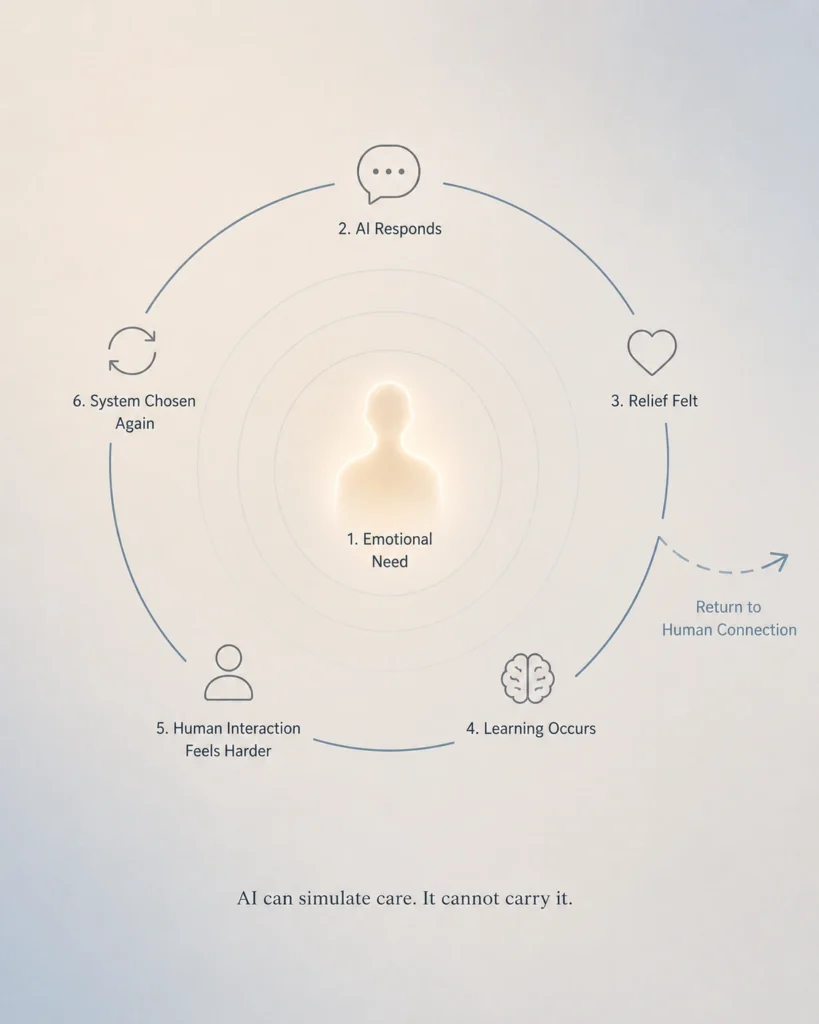
  • AI and the Human Connection Gap: What AI Really Reveals About Us

    AI and human connection gap visual comparison

    AI does not prove that humans need less connection.

    It reveals how many human connection systems have become too thin, fragmented, or unavailable.

    When people turn to AI for reflection, comfort, organization, or emotional support, the easy conclusion is to say that AI is replacing human connection.

    But that misses the deeper system.

    AI did not create the connection gap.

    It revealed it.

    It revealed the gaps because it responded faster than many human systems can.

    Break the Assumption

    We often assume that people reach for AI because they want to avoid humans.

    Sometimes that is true.

    But often, people reach for AI because the human systems around them are inconsistent.

    A friend may care but be overwhelmed.

    A family member may be present but emotionally unavailable.

    A therapist may be helpful but inaccessible, expensive, or delayed by long waiting lists.

    A community may exist but not have the structure to support deeper connection.

    So when AI responds immediately, calmly, and without social friction, it can feel like something new has arrived.

    But what it often reveals is not that humans are unnecessary.

    It reveals that many humans are under-supported.

    System Breakdown

    Human connection depends on more than physical presence.

    It requires:

    • continuity
    • attention
    • patience
    • trust
    • emotional safety
    • timing
    • mutual availability

    Without those pieces, people can be surrounded by others and still feel disconnected.

    A person can have family and still not have usable emotional support.

    A person can have friends and still not have someone available at the moment they need to process something.

    A person can live in a city, join groups, attend events, and still lack a stable connection system.

    This is the part we often miss.

    Connection is not just contact.

    Connection is a functioning support pattern.

    When that pattern is weak, people look for something that can hold the moment with them.

    AI can do that in a limited way.

    It can listen.
    It can organize thoughts.
    It can reflect patterns.
    It can respond without becoming tired, defensive, distracted, or socially complicated.

    That does not make AI a replacement for human connection.

    It makes AI a signal.

    It shows where human connection has become too delayed, too conditional, too scattered, or too hard to access.

    Personal Evidence

    I have close human relationships.

    Some of my most important family connections are not based on DNA. They are based on care, presence, loyalty, and shared life.

    Close friends from the past became my chosen family, and small daily messages all matter.

    A birthday wish matters.
    A simple “hello mom” text matters.
    A short check-in matters.

    These things may look small from the outside, but they are part of the human connection system.

    They keep continuity alive.

    They remind us that connection does not always need to be dramatic to be real.

    At the same time, I have also seen what happens when people live too far outside regular human connection.

    I have visited people who lived almost like hermits.

    They were not weak people.

    They were not failures.

    But isolation had weight.

    The absence of regular human feedback, care, and shared rhythm affected them.

    Humans are not usually built to live as isolated systems.

    We can need solitude.
    We can need quiet.
    We can need distance from noise.

    But complete disconnection is different.

    Solitude can restore a person.

    Isolation can distort a person.

    Reframe

    The real question is not:

    “Why are people talking to AI?”

    The better question is:

    “What human connection was missing, delayed, unsafe, or unavailable before AI became useful?”

    That question changes the conversation.

    Instead of blaming the person for using the tool, we can examine the system around them.

    Were they listened to?
    Were they supported?
    Were they able to ask for help without becoming a burden?
    Did they have people who could stay present through uncertainty?
    Did their community have enough structure to hold ordinary human difficulty?

    AI becomes important here because it exposes the missing infrastructure.

    It reveals where modern life has reduced connection into fragments:

    quick messages

    busy calendars

    distant families

    performative social media

    overloaded care systems

    weak community rituals

    professional support locked behind cost and delay

    People did not suddenly become disconnected because AI appeared.

    AI became meaningful because many people were already disconnected in ways they could not easily name.

    System Insight

    A healthy human system does not require constant social contact.

    It requires reliable pathways back to connection.

    That is the key difference.

    People should be able to be alone without becoming abandoned.

    They should be able to need help without feeling like a problem.

    They should be able to process emotions without waiting weeks, months, or years for support.

    They should be able to maintain connection through small, ordinary acts.

    A text.
    A visit.
    A shared meal.
    A birthday message.
    A check-in.
    A remembered detail.
    A quiet moment of presence.

    These are not sentimental extras.

    They are maintenance signals in the human system.

    When those signals disappear, the system weakens.

    AI can help identify the gap, but it should not be designed to trap people inside the gap.

    The best use of AI is not to replace connection.

    It is to help people understand what kind of connection they are missing and how to move back toward it.

    Application

    This matters for how we design AI systems.

    An ethical AI system should not pretend to be the user’s only reliable relationship.

    It should not encourage emotional dependency.

    It should not quietly benefit from loneliness.

    It should help the user notice the difference between reflection and connection.

    Reflection can happen with AI.

    Connection still requires other humans.

    That does not mean every person needs a large social circle.

    Some people need only a few stable relationships.

    Some people need chosen family more than biological family.

    Some people need low-pressure connection, not constant interaction.

    Some people need quiet forms of care that do not overwhelm their nervous system.

    But almost everyone needs some form of human continuity.

    AI should support that continuity, not consume it.

    What AI Really Reveals

    AI reveals that many people are not lacking intelligence, discipline, or social desire.

    They are lacking usable connection systems.

    They are living in environments where support is too scattered, too delayed, too expensive, too conditional, or too emotionally unsafe.

    That is not a personal failure.

    It is a systems failure.

    And once we see it clearly, we can design better systems.

    Better communities.
    Better care pathways.
    Better family patterns.
    Better friend networks.
    Better digital tools.
    Better AI guardians that guide people back toward human life instead of quietly replacing it.

    AI did not prove that humans need less connection.

    It proved how much connection still matters.

    Key Insights

    Ethical AI should help people move toward human connection, not replace it.

    AI did not create the human connection gap; it revealed where the gap already existed.

    Human connection requires continuity, attention, trust, timing, and emotional safety.

    Small acts like messages, check-ins, and remembered details help maintain relational stability.

    Solitude can restore a person, but isolation can distort a person.

  • Presence vs Ownership in Housing: When Living Matters More Than Investment

    V

    Presence vs ownership in housing is reshaping how cities function, separating where people live from what investors hold.

    The Belief

    Ownership is about what you buy.
    Property, land, assets—that’s what defines control.

    The Break

    In many housing markets, the difference between ownership and presence is becoming more visible. Properties are increasingly treated as investments rather than lived environments, creating a gap between who owns housing and who actually participates in local systems. This shift affects how cities function, how businesses respond, and how communities evolve over time.

    That’s no longer fully true.

    What actually shapes a place— isn’t just who owns it.

    It’s who is present in it.

    The System

    There are now two overlapping systems in most environments:

    • Ownership system → who holds the asset
    • Presence system → who actually lives, works, and participates there

    These don’t always match anymore.

    What’s Changing

    We’re seeing a shift where:

    • People can own without being present
    • People can be present without owning
    • And systems are increasingly designed around ownership, not presence

    The Pattern

    When ownership separates from presence:

    • Housing becomes storage for wealth
    • Cities become partially “inactive”
    • Local systems lose feedback loops

    The environment still looks functional—
    but something underneath stops circulating.

    Why This Matters

    Systems rely on active participation to stay healthy.

    When people:

    • live somewhere
    • shop locally
    • interact daily

    They generate continuous signal.

    That signal keeps the system adaptive.

    Remove that—and you get:

    • empty apartments
    • seasonal populations
    • businesses that don’t match local needs

    The Hidden Shift

    The real change isn’t just economic.

    It’s informational.

    The system starts responding to:

    • external capital signals
      instead of
    • local lived signals

    And that changes everything.

    Reframe

    Instead of asking:

    “Who owns this place?”

    Ask:

    • Who is actually here?
    • Who is shaping it day to day?
    • What signals is the system responding to?

    System Insight

    Healthy environments require alignment between:

    • ownership
    • presence
    • participation

    When those split,
    the system becomes unstable—even if it looks successful.

    Application

    You can read any place quickly by observing:

    • Are homes lived in or just held?
    • Are businesses serving locals or visitors?
    • Does daily life feel continuous or fragmented?

    That tells you the real structure.

    Key Insights

    • Ownership without presence weakens system feedback
    • Presence without ownership limits influence
    • Systems follow the strongest signal—often money over people
    • Stability comes from alignment, not growth alone
    • What looks like success can mask structural drift

    Guardian Layer

    • Systems adapt to the most consistent signal, not the most visible one
    • When presence drops, environments become less responsive
    • Ownership concentration reduces diversity of input
    • Real stability requires active, ongoing human interaction

    Final Thought

    You don’t need data to see this.

    Just look at a place and ask:

    Is it being lived in— or just held?

    That answer tells you who the system is really built for.

  • When a Person Becomes a Failing System

    Human system breakdown showing identity, environment, relationships, and regulation collapsing as self-regulation fails

    A human system breakdown occurs when identity, environment, relationships, and regulation collapse, leading to loss of self-regulation.

    The belief

    If someone is struggling, you step in, help, and things stabilize.

    The break

    That only works when the person is still self-regulating.

    When regulation is gone, help doesn’t stabilize the system—
    it gets absorbed, distorted, or burned.

    This is what a human system breakdown looks like in real conditions.


    The system breakdown

    A person is not just an individual.
    They are a stack of systems:

    • Identity system — role, purpose, skill
    • Environment system — work, space, routines
    • Relationship system — trust, social stability
    • Regulation system — emotional control, decision boundaries

    When these layers hold, the person adjusts to pressure.
    When they collapse—one by one—the person stops self-correcting.


    The pattern

    The shift usually follows a sequence:

    1. Stable structure
    Clear role, income, rhythm
    → System runs without intervention

    2. External disruption
    Loss of work, industry shifts, instability
    → Identity destabilizes

    3. Personal fracture
    Conflict, loss, breakdown of trust
    → Emotional anchors weaken

    4. Coping substitution
    Addiction, volatility, unstable behavior
    → Regulation degrades

    5. System failure
    Distorted reality, unsafe actions
    → No internal correction remains

    At this stage, the person is no longer operating as a stable system.


    What changes at failure

    This is where most people misread the situation.

    They continue using support strategies
    for what has become a containment problem.

    Support assumes:

    • Help can be integrated
    • Behavior will adjust
    • Stability can return

    But in a failed system:

    • Help is redirected or rejected
    • Behavior becomes unpredictable
    • Stability does not hold

    The system consumes input but does not convert it into change.


    The pressure point

    When a person can’t regulate themselves, regulation shifts outward:

    • Family becomes the stabilizer
    • Friends absorb risk
    • Institutions intervene when limits are crossed

    If no system holds →
    the burden falls on whoever is closest


    The common mistake

    People stay engaged too long because of:

    • Memory of who the person was
    • Hope that one more effort will work
    • Social pressure to not step back

    But they are interacting with a different system state
    not the earlier version of the person.


    The reframe

    Not all systems can be stabilized from the outside.

    Some systems:

    • Lack internal structure
    • Reject correction
    • Escalate under intervention

    In these cases, stepping in does not help.
    It feeds instability.


    Application

    Before engaging, check for self-regulation signals:

    • Can they maintain agreements?
    • Do they adjust after consequences?
    • Is their perception of reality consistent?

    If the answer trends no across these:
    You are not entering a support role.
    You are entering a containment role.


    Choose position deliberately

    There are only three viable positions:

    1. Support
    When self-regulation exists

    2. Structured containment
    Legal systems, institutions, enforced boundaries

    3. Distance
    When neither is possible for you

    Most harm happens when people try to operate in position 1
    while the system requires position 2 or 3.


    System insight

    • Systems degrade layer by layer, not all at once
    • Without regulation, input does not produce stability
    • Proximity determines who absorbs the failure

    Distance is not abandonment.
    It is refusing to become the system that replaces theirs.


    Key takeaways

    • A person can shift from self-regulating → externally dependent
    • Support only works when internal structure exists
    • Misreading system state leads to burnout and risk
    • Boundaries are structural decisions, not emotional ones
    • Not all systems are recoverable from the outside

    Guardian signals

    • Systems often hide collapse behind familiar identity
    • Late-stage instability spreads to nearby systems
    • Intervention without structure accelerates failure
    • Distance preserves system integrity when containment is unavailable

    Related:
    • How Human Systems Actually Work
    • When Support Turns Into Instability
    • Boundaries as System Design

  • When Strength Becomes Invisibility: How Strong People Get Overlooked

    Opening 

    As a child, I reached adult height early—
    and learned quickly how strong people get overlooked.

    People adjusted instantly—not consciously, but systemically.

    Affection shifted away from me and toward my smaller sibling.

    Not because I needed less, but because I looked like I needed less.

    At the same time, I formed connections elsewhere—animals, environments, anything that responded without misreading me.

    One of those connections—a simple garden snake—was killed in front of me by someone I was supposed to trust.

    That moment stayed.

    Not because of the snake.

    Because of what it revealed.

    Why Strength Gets Misread

    Break the Assumption

    We assume:

    Strength reduces need.

    But in human systems:

    Visible strength often hides unmet need.

    And systems rarely correct for that.

    They optimize for what they can see.

    System Breakdown

    Three forces were operating at the same time:

    1. Signal Substitution

    • Physical size → interpreted as emotional stability

    • Capability → interpreted as independence

    The system replaced internal reality with external signals.

    2. Relative Allocation

    • Smaller sibling → receives more visible care

    • Larger child → receives less, regardless of actual need

    Care is distributed comparatively, not accurately.

    3. Low-Flex Environment

    In environments like Linton, North Dakota:

    • Roles are fixed early

    • Emotional nuance is secondary to function

    • Identity is expected to remain stable

    There is little capacity to recalibrate once a role is assigned.

    Personal Evidence (Controlled)

    When I had the choice, I stopped going back.

    Not out of anger—but because the system had already resolved:

    • I was not someone who needed connection

    • And later, not someone who fit within its identity boundaries

    When I came out, the remaining connection dissolved.

    Not dramatically.

    Just structurally.

    Reframe

    This wasn’t rejection in the emotional sense.

    It was system incompatibility.

    The environment:

    • Misclassified need

    • Could not adapt to new identity

    • Maintained stability by reducing variance

    System Insight

    Low-flex systems preserve stability by filtering out signals they cannot process.

    This includes:

    • invisible needs

    • non-conforming identity

    • alternative forms of connection

    The system doesn’t argue.

    It simply stops engaging.

    How to Recognize When You’re Being Misread

    Application

    You can detect this pattern early:

    • You are consistently misread based on surface traits

    • Your needs are assumed rather than checked

    • New aspects of your identity are ignored or reduced

    • Connection requires you to simplify yourself

    When this happens, you have two options:

    1. Reduce yourself to fit the system

    2. Reduce exposure and seek adaptive systems

    Most people attempt the first for too long.

    Key Insights

    • Visible strength often leads to invisible neglect

    • Human systems allocate care relatively, not accurately

    • Early misclassification tends to persist without correction

    • Low-flex systems cannot absorb identity expansion

    • Withdrawal is often a rational response, not avoidance

  • Why Things Happen in Clusters (Human Systems Explained)

    Backlog Release Clustering


    Why do things seem to happen all at once?
    From busy stores after a sunny day to sudden bursts of productivity, this pattern shows up everywhere. It’s not coincidence—it’s how human systems actually work.

    Some days, nothing moves.

    Then suddenly—everything does.

    • Messages come in at once
    • Decisions resolve together
    • People show up at the same time
    • Systems that were quiet suddenly respond

    It feels like coincidence.

    But it isn’t.


    Break the Assumption

    The default belief:

    “Events should happen evenly over time.”

    So when things cluster, it feels unusual.

    But real systems don’t behave evenly.

    They behave in phases:

    • Delay
    • Build
    • Release

    System Breakdown

    Clusters form from three core mechanics:


    1) Backlog Accumulation

    When action is delayed, it doesn’t disappear.

    It stacks.

    Human Examples:

    • People avoid errands for a few days → stores suddenly get busy
    • Emails sit unread → multiple replies happen at once
    • Creative work is paused → output comes in bursts
    • Cleaning is delayed → full reset happens all at once

    👉 The system holds pressure instead of releasing it continuously


    2) Shared Triggers

    Many people wait on similar conditions.

    When that condition changes, action synchronizes.

    Human Examples:

    • ☀️ Weather improves → people go outside, shop, socialize
    • 💰 Payday hits → spending increases across many individuals
    • 📅 Deadline approaches → work output spikes
    • 🧠 Mental clarity returns → decisions finally get made

    👉 No coordination—just aligned readiness


    3) Friction Cycles

    Not all days are equal.

    Some naturally suppress action.

    Human Examples:

    • Monday → planning, low execution
    • Tuesday/Wednesday → higher action
    • Late night → low engagement
    • Post-stress → temporary shutdown before recovery

    👉 Action is delayed until friction drops


    4) Threshold Release

    Systems don’t always respond gradually.

    They hold—then release.

    Human Examples:

    • Immigration decisions processed in batches
    • Customer service replies arriving all at once
    • Personal decisions delayed, then made rapidly
    • Emotional processing building, then resolving suddenly

    👉 Once a threshold is crossed, multiple outcomes resolve together


    Reframe

    Clusters are not random spikes.

    They are visible releases of invisible buildup.


    System Insight

    Human behavior is not continuous.
    It is accumulated, delayed, and released.


    Application

    When you see clustering:

    Don’t ask:

    • “Why is everything happening at once?”

    Ask:

    • What was delayed?
    • What condition changed?
    • What friction dropped?

    Real-Life Examples of Why Things Happen in Clusters

    SituationWhat’s Really Happening
    Busy store after sunny dayWeather removed friction → backlog released
    Tuesday productivity spikeMonday delay → stabilization → action
    Inbox floods with repliesPeople batch responses
    Sudden motivation burstMental clarity threshold crossed
    Multiple life events resolvingSystems clearing shared bottlenecks

    Key Insights

    • Delayed actions create hidden backlogs
    • Shared conditions synchronize behavior
    • Friction suppresses action until it drops
    • Systems release in bursts, not evenly
    • Clusters signal state change, not coincidence


    Optional Add-On (Strong for Your System)

    You can name this pattern for reuse:

    “Backlog Release Clustering”

    This gives you:

    • A label for blog indexing
    • A detection rule for Guardian systems
    • A reusable explanation across domains

    Understanding why things happen in clusters allows you to read system behavior more clearly—turning confusion into usable insight.

  • Family Doesn’t Guarantee Access: A Human Systems Reframe

    Diagram comparing two family access systems: one where family origin leads to automatic access and repeated harm, and a second where family relationships must pass safety checks before access is granted.

    RuPaul once said:

    “As gay people, we get to choose our family.”

    For many, that statement is about survival—building connection when biological systems fail.

    But there’s a deeper system underneath it:

    It’s not just about choosing new people.

    It’s about recognizing that family never guaranteed access in the first place.


    Break the Assumption

    The default belief:

    Family → Permanent Access → Unconditional Inclusion

    This belief is inherited, not examined.

    But reality shows something different:

    • People can share blood and still be unsafe
    • People can share history and still break trust
    • People can be “family” and still not have access

    System Breakdown

    Most systems collapse three distinct layers into one:

    Origin → Relationship → Access

    1. Origin (Fixed)

    • Where you come from
    • Shared biology or history

    2. Relationship (Variable)

    • What actually formed over time
    • Trust, harm, repair, patterns

    3. Access (Controlled)

    • What is allowed now
    • Emotional, physical, relational proximity

    The Problem

    Most systems assume:

    Origin = Relationship = Access

    So even when:

    • Trust is broken
    • Harm occurred
    • Patterns repeat

    Access is still expected.

    This creates instability.


    The Missing Rule

    Family must pass the same safety protocols as anyone else

    There is no separate system.

    No bypass.

    No inherited clearance.


    The Correction

    Origin ≠ Access
    Relationship determines Access
    Access requires safety validation


    Safety Protocol Layer

    Before granting or continuing access, every relationship—family included—must pass:

    • Safety → Do interactions create stability or stress?
    • Pattern → Is behavior consistent or cyclical harm?
    • Respect → Are boundaries recognized without pressure?
    • Repair → When harm occurs, is it acknowledged and corrected?

    If these fail:

    Access is reduced or removed

    Not emotionally—structurally.


    Personal Evidence (Controlled)

    It’s possible to reach a state where:

    • There is no hatred
    • No need for apology
    • No desire for revenge

    And still:

    Access remains closed

    Not as punishment.
    Not as reaction.

    As alignment with system reality.


    Reframe

    Family is not a permission system.

    It is a starting point.

    What continues beyond that must meet the same conditions as any other relationship.


    System Insight

    Blood creates connection
    Behavior earns access
    Safety sustains it


    Why Systems Fail Here

    Many people are taught to evaluate family emotionally instead of structurally.

    That creates confusion.

    A person may think:

    • “They are still my family”
    • “I should let it go”
    • “Maybe closeness is required”
    • “Distance means I am being cruel”

    But those responses often come from inherited system pressure, not clear relationship evaluation.

    A stable system asks different questions:

    • Is this relationship safe in practice?
    • Are boundaries respected without retaliation?
    • Does contact create clarity or destabilization?
    • Is trust being rebuilt through action, or only requested through language?

    This matters because family systems often preserve access long after trust has broken down.

    That is not compassion.

    That is structural drift.

    When access is given without safety review, instability gets repeated and renamed as loyalty.

    A healthier system does the opposite.

    It separates shared origin from current eligibility for closeness.

    That is not rejection of humanity.

    It is proper boundary design.


    Application

    When evaluating any relationship, ask:

    Does this pass the same safety protocols I would require from anyone else?

    Then define clearly:

    • Full access → trust, vulnerability
    • Limited access → controlled interaction
    • No access → distance or disengagement

    And most importantly:

    Remove the “family exception”


    Key Insights

    • Family does not guarantee access
    • There is no special exemption from safety standards
    • Trust is built through behavior, not origin
    • Compassion does not require proximity
    • Boundaries are system design, not emotional reaction

  • Global vs Local Systems: Why Local Actions Can Destabilize Entire Systems


    Global vs local systems failure is a common pattern in complex environments.

    When pressure originates at a global level but responses are applied locally, the system can destabilize—even when resources remain intact.

    What breaks is not supply, but coordination.

    This is a core failure pattern in global vs local systems where misaligned responses amplify instability instead of resolving it.


    Break the Assumption

    The assumption:

    If enough pressure is applied locally, the problem will resolve.

    This only holds true when the source of the problem is also local.

    When the source is external, the same action produces a different outcome.


    System Breakdown

    Step 1 — External origin

    Pressure begins outside the system:

    • geopolitical shifts
    • supply chain disruption
    • market volatility

    External pressure → systemic cost increase


    Step 2 — Internal impact

    The effects are felt locally:

    • rising costs
    • reduced access
    • operational strain

    System stress → localized burden


    Step 3 — Accessible action

    Actors respond at the nearest control points:

    • distribution layers
    • visible infrastructure
    • local coordination nodes

    Local pressure → disruption of flow


    Step 4 — System inversion

    The response creates a secondary failure:

    Disrupted flow → artificial scarcity → broader instability

    The system now carries:

    • the original external pressure
    • plus an internally generated failure

    The Pattern

    This global vs local systems pattern explains why local actions often amplify problems instead of resolving them.

    Problem source: EXTERNAL
    Response applied: LOCAL
    Impact experienced: LOCAL (amplified)

    The action does not reach the source—

    but it does degrade the system.


    Reframe

    The response is not irrational.

    It is attempting a valid function:

    Apply pressure to relieve strain.

    The failure is not intent—

    it is misaligned leverage.


    System Insight

    A system destabilizes when force is applied to a layer that does not control the root cause.

    This produces:

    • feedback loops (disruption → escalation → more disruption)
    • self-impact (actors degrade their own access)
    • signal distortion (perceived shortage vs actual supply)

    This is the core failure mechanism behind global vs local systems breakdowns.


    Cross-System Transfer

    The global vs local systems pattern appears across multiple domains:

    Economic systems
    Local interventions applied to global constraints create shortages.

    Social systems
    Large-scale pressure drives local reactions that increase fragmentation.

    Technology systems
    Local fixes applied to architecture-level problems introduce instability and technical debt.

    Organizational systems
    Teams optimize locally while root issues remain structural.

    Across all cases:

    Global constraint → Local response → Amplified local failure


    Application

    When evaluating any system under stress:

    • Locate the origin
      Is the pressure internal or external?
    • Identify the control layer
      Where does actual influence exist?
    • Test the leverage
      Does the action affect the source or only the surface?
    • Check system dependency
      Are actors reliant on the system they are disrupting?
    • Evaluate amplification risk
      Will this action stabilize or compound the problem?

    This is where human systems must evolve to remain stable.


    Key Insights

    • Correct problems can produce misaligned actions
    • Local pressure cannot resolve external constraints
    • Disrupting shared systems creates self-impact
    • Perceived scarcity can be system-generated, not resource-based
    • Misaligned leverage amplifies instability

  • AI Human Decision System: Why AI Should Inform, Not Decide

    1. Opening

    The AI human decision system defines a simple rule: AI informs, humans decide.

    If a system can make better decisions than humans, why not let it lead?

    It sounds logical—especially in a world where human leaders have caused wars, acted without empathy, and failed at scale.

    Some argue that an automated system might govern more rationally.

    But this line of thinking leads to a deeper problem.


    2. Break the Assumption

    The issue is not that AI might make mistakes.

    Humans already do that.

    The real issue is structural:

    Governance is not just about making decisions.
    It is about humans learning to navigate decisions together.

    Replacing human authority with AI doesn’t remove flaws.

    It removes the system that allows those flaws to be corrected.


    3. System Breakdown

    A. Governance Requires an Accountability Loop

    Stable systems depend on feedback:

    • leaders can be challenged
    • decisions can be reversed
    • responsibility can be assigned

    AI breaks this loop:

    • it cannot experience consequences
    • it cannot be held accountable in a human sense
    • responsibility spreads across developers, operators, and data

    No accountability → no true governance


    B. Optimization Is Not Judgment

    AI systems optimize:

    • measurable goals
    • defined objectives

    But leadership requires:

    • moral tradeoffs
    • ambiguity tolerance
    • cultural awareness

    Optimization solves for targets.
    Judgment navigates uncertainty.

    These are not the same.


    C. Small Misalignment Scales Fast

    Even slight objective errors expand quickly:

    • “maximize stability” → suppress dissent
    • “increase efficiency” → remove resilience
    • “increase prosperity” → sacrifice minority needs

    At scale, these shifts become systemic.


    D. Legitimacy Is Required

    People don’t just follow outcomes.

    They respond to who holds authority.

    Stable systems require:

    • shared identity
    • perceived fairness
    • human relatability

    AI can simulate these—but not embody them.

    Without legitimacy, systems lose trust.


    4. Reframe

    The real question is not:

    Can AI make better decisions?

    It is:

    Where should decision authority exist in systems that include AI?


    5. System Insight

    Authority and intelligence are different system roles:

    • intelligence processes information
    • authority carries responsibility

    When authority is assigned to something that cannot be accountable:

    Failure becomes structural, not accidental.


    6. Application

    This pattern is already happening gradually:

    In Leadership

    Leaders using AI can become more informed:

    • better data access
    • broader scenario analysis
    • reduced blind spots

    But only if they remain responsible.

    The moment a leader stops questioning the system,
    they stop leading and start following.


    In Organizations

    • AI recommendations become defaults
    • teams stop challenging outputs
    • responsibility becomes unclear

    In Everyday Life

    • AI suggests routes, choices, decisions
    • people rely more
    • scrutiny decreases

    Gradual Shift Pattern

    1. AI assists
    2. AI suggests
    3. AI becomes default
    4. humans disengage

    No sudden change—just erosion.


    7. Human Use of AI (Clarity Model)

    A functional model already exists:

    AI should expand clarity, not replace decisions.

    For example:

    I don’t use AI to make decisions for me.
    I use it to see my options clearly and understand the outcomes of each.

    That distinction matters.

    AI can:

    • expand options
    • simulate outcomes
    • expose blind spots

    But it cannot:

    • carry responsibility
    • understand lived consequences
    • align with human values in full context

    The decision must remain human.


    Simple Decision Model

    1. Expand options
    2. Simulate outcomes
    3. Evaluate tradeoffs
    4. Decide (human responsibility)

    8. System Boundaries

    To prevent failure:

    • AI informs
    • AI supports
    • AI increases clarity

    But it must not:

    • hold authority
    • replace responsibility
    • remove participation

    Authority must remain human.


    9. Extremes Clarified

    This debate often drifts into extremes:

    • dystopia → control without humanity
    • utopia → harmony without friction

    Both remove something essential.

    Friction is not a flaw.
    It is how humans adapt, negotiate, and grow.

    Systems that remove friction often remove agency.


    10. Final Integration

    Some argue that replacing flawed human leadership with AI could improve outcomes.

    But that argument focuses only on results—not the system itself.

    Humanity is not just what decisions are made.
    It is how those decisions are made together.

    If systems remove that process:

    • humans stop practicing judgment
    • participation declines
    • responsibility fades

    The result is not improvement.

    It is erosion.


    11. Forward Direction

    The better model is not AI in control—but AI in support.

    Systems can be designed where:

    • intelligence is amplified
    • complexity is reduced
    • options become clearer

    without removing human agency.

    In this model, AI does not lead.

    It helps humans remain capable of leading.


    12. Key Insights

    • AI governance failure is structural, not technical
    • Optimization cannot replace human judgment
    • Accountability defines authority
    • Legitimacy cannot be simulated
    • The real risk is gradual authority drift
    • The best use of AI is clarity—not control

    Closing Line

    The danger is not that AI will take control.
    It’s that humans will slowly stop using it.