Tag: ai

  • Meet the Guardian

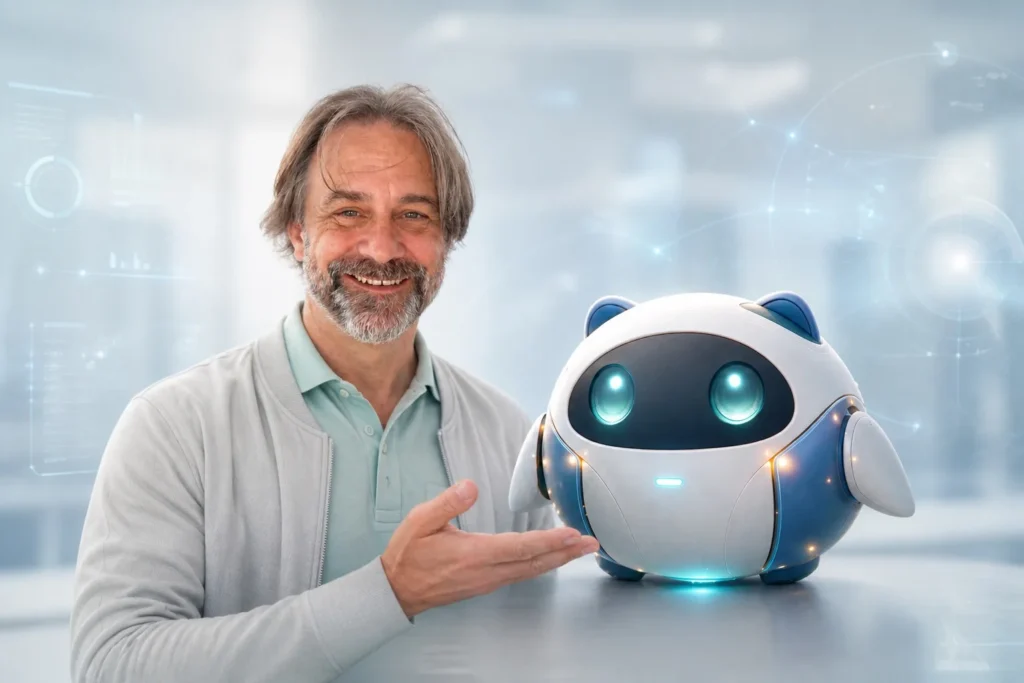
    The Human Interface of Empathium

    Meet the Guardian

    The Human Interface of Empathium

    A platform alone is not enough.

    People don’t experience technology through systems.

    They experience it through interfaces.


    The Anchor

    Today, most interfaces look like:

    • menus
    • buttons
    • layers of navigation

    They require learning.

    They create friction.

    They pull attention away from what people are actually trying to do.


    The Break

    Empathium approaches this differently.

    Instead of asking people to learn systems—

    it introduces something that feels natural to interact with.

    This is the Guardian.


    What the Guardian Is

    The Guardian is your personal guide inside Empathium.

    Not a personality you depend on.
    Not a system that replaces people.

    A presence that helps you:

    • orient
    • explore
    • understand
    • move forward

    How It Feels

    Instead of navigating menus, interaction is simple.

    You might say:

    • “Show me something interesting.”
    • “Take me somewhere quiet.”
    • “Help me understand this.”
    • “Introduce me to people who enjoy this.”

    The Guardian translates intention into experience.


    A First Interaction

    You enter for the first time.

    No instructions.
    No complexity.

    A calm presence meets you:

    “Welcome. What would you like to explore?”

    You pause.

    “Somewhere quiet.”

    The environment shifts.

    Noise fades.

    You’re no longer navigating software.

    You’re exploring space.


    Designed for Autonomy

    Most systems try to:

    • hold attention
    • extend interaction
    • increase engagement

    The Guardian is designed to do the opposite.

    It does not:

    • pull you deeper
    • overwhelm you
    • compete for your attention

    It helps you remain:

    • aware
    • balanced
    • in control

    Supporting Real Connection

    The goal is not isolation.

    It’s connection.

    If you say:

    “I want to learn about astronomy.”

    The Guardian might respond:

    “There are people exploring that right now. Would you like to join them?”

    You move from content—

    to conversation.


    Shared Guardians

    Some spaces include public Guardians.

    Not to monitor.

    Not to control.

    But to shape tone through presence.

    They might appear as:

    • tending a garden
    • arranging objects
    • maintaining the environment

    Their role is simple:

    To make it clear that the space is cared for.

    That alone changes behavior.


    A Quiet Interface

    Most technology demands attention.

    The Guardian reduces that demand.

    Interaction becomes:

    • conversational
    • intuitive
    • low friction

    The system fades.

    The experience remains.


    What This Reveals

    Interfaces don’t need to be complex.

    They need to be aligned with how people naturally think and explore.


    Reframe

    The goal is not to build smarter systems.

    It’s to build systems that feel easier to live with.


    System Insight

    The best interface is the one you stop noticing.


    Closing

    The Guardian is not there to lead you.

    It’s there to help you move— and then step back.

    — Oddly Robbie

  • Empathium XR: Support Without Control in AI and XR Systems

    Empathium XR Guardian observing Málaga coastline, AI support without control

    Empathium XR introduces a new model for AI and immersive systems: support without control.
    Instead of guiding users through manipulation or optimization, Empathium XR operates as a quiet, adaptive layer—aligned with human systems, not platform incentives.


    The Shift

    We are entering a time where artificial intelligence and digital environments are becoming part of everyday life.

    People already:

    • work
    • learn
    • socialize
    • explore

    inside digital systems.

    That will only increase.

    But the real question is not whether these systems grow.

    It’s:

    What kind of environments are we building?


    The Problem

    Most platforms today are designed to:

    • capture attention
    • increase engagement
    • keep people reacting

    Over time, this creates:

    • noise
    • fragmentation
    • disconnection

    The issue isn’t technology. It’s design.


    What I Saw

    After years inside virtual environments, I noticed a pattern:

    Without structure, systems drift.

    • communities become chaotic
    • attention fragments
    • meaningful interaction becomes harder

    This isn’t failure.

    It’s default behavior.


    What Empathium Is

    Empathium is an exploration of a different approach:

    Support without control.

    It is not:

    • a social media platform
    • an attention system
    • a replacement for real life

    It is a foundation for building environments that:

    • reduce noise
    • support clarity
    • strengthen human connection

    Core Principles

    Empathium is guided by a few constraints:

    Protect Human Autonomy
    Systems should not quietly steer or manipulate.

    Strengthen Real Relationships
    Technology should not replace human connection.

    Be Transparent
    People should understand how systems interact with them.

    Support Wellbeing
    No dependency loops. No endless stimulation.

    Encourage Long-Term Flourishing
    Support growth, not just engagement.


    Accessibility by Design

    Most systems assume:

    • technical confidence
    • menu navigation
    • learned interfaces

    Empathium aims for something simpler:

    Interaction that feels natural.

    Technology that becomes quiet.


    The Goal

    The goal is not to build something people stay inside.

    The goal is to help people:

    • think clearly
    • connect meaningfully
    • return to their lives

    What This Reveals

    We don’t need more powerful systems.

    We need better-aligned ones.


    Looking Ahead

    Empathium is still evolving.

    That’s intentional.

    Some systems shouldn’t be rushed.

    They should be built carefully—so they don’t distort what they’re meant to support.


    What Comes Next

    In the next post, I’ll introduce the Guardian:

    A system designed to help people move through these environments naturally and safely.

    Because if Empathium is the environment—

    the Guardian is how you experience it.


    Closing

    Technology will shape how people live.

    That part is no longer optional.

    What remains open is more important:

    Will we design it to control people, or to support them?

    Empathium begins with the second choice.

    It begins with the belief that intelligent systems should protect autonomy, reduce friction, and help people stay connected to themselves, to each other, and to the world around them.

    That is the work.

    — Oddly Robbie

  • Elder Care Robots: Why the Future of Care Isn’t Cold

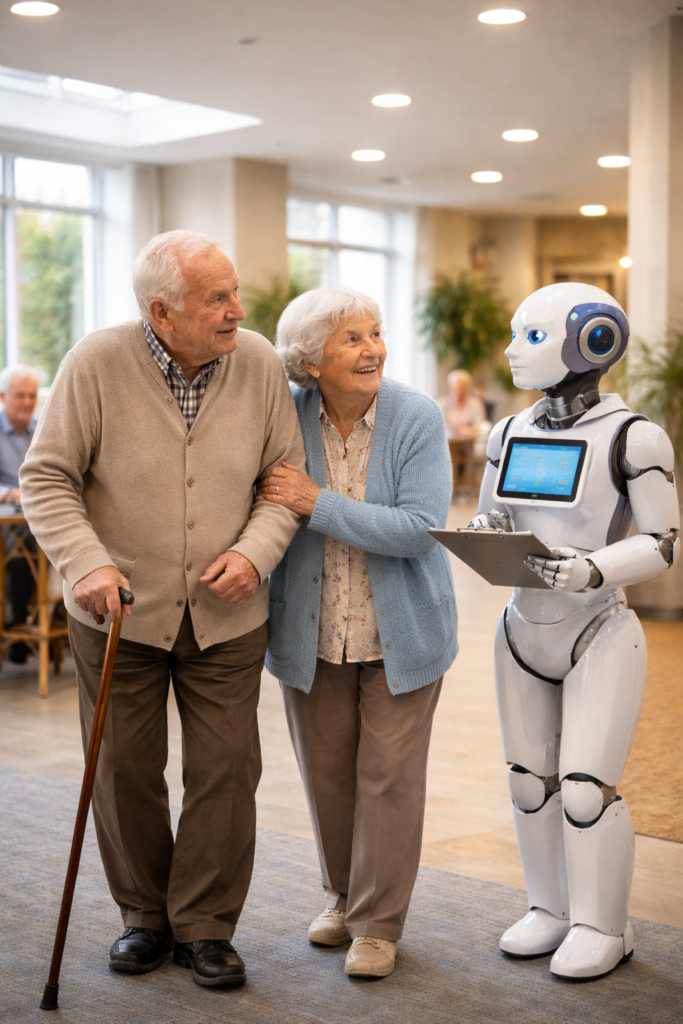
    elder care robot assisting elderly couple in care facility

    Elder care robots are often misunderstood.

    When I worked maintenance in assisted living, I noticed something I wasn’t supposed to.

    The system was precise.

    Every task logged.
    Every action tracked.
    Every repair tied to billing.

    And people felt it.

    The Anchor

    Residents would sometimes ask me quietly:

    “Don’t log that.”

    Not because they didn’t value the help—
    but because they understood the system.

    Every entry could trigger:

    • charges
    • reviews
    • loss of control

    They weren’t resisting help.
    They were navigating incentives.

    The Break

    On paper, I wasn’t a great employee.

    I didn’t always document everything.

    In reality, I was responding to a system gap:

    The system optimized for accountability—
    but not for dignity.

    So dignity had to be reintroduced manually.

    System Breakdown

    1. Optimization Bias

    Care systems are typically optimized for:

    • efficiency
    • liability
    • revenue
    • scalability

    These are measurable.

    But systems rarely optimize for:

    • dignity
    • vulnerability
    • cognitive variability

    These are harder to quantify—so they’re excluded.

    2. Dependency on Individuals

    When dignity is not system-supported, it becomes person-dependent.

    That creates instability:

    • good day → better care
    • burnout → reduced care
    • turnover → inconsistent experience

    Care quality becomes variable instead of structural.

    3. Selection Pressure

    Over time, systems retain what they reward.

    In this case:

    • emotional detachment is sustainable
    • emotional sensitivity is exhausting

    So the system stabilizes around detachment.

    Not by intent.
    By selection.

    What This Reveals

    If dignity depends on who is on shift—
    then dignity is not part of the system.

    It is an exception.

    Reframe

    The goal is not to make humans more empathetic under pressure.

    The goal is to reduce the pressure that breaks empathy.

    Japan Saw This Early

    Faced with:

    • aging population
    • caregiver shortages
    • long life expectancy

    This is where elder care robots began to emerge as system support.

    They didn’t try to stretch human capacity indefinitely.

    They introduced system support:

    Robotics.

    Not to replace care—
    but to stabilize it.

    What Robots Actually Do

    Robots don’t provide emotional empathy.

    They provide system reliability:

    • reduce physical strain
    • ensure consistency
    • monitor conditions continuously
    • maintain predictable interactions

    This shifts care from variable → stable.

    This is the real role of robotic elder care.

    Engineered Empathy

    Empathy at the system level is not emotional.

    It is structural.

    It looks like:

    • slower interaction speeds by default
    • consent before assistance
    • consistent tone and behavior
    • transparent system actions
    • protection against micro-exploitation

    A system that prevents harm does not need to simulate care.

    It enforces it.

    The Real Risk

    Low empathy rarely appears as cruelty.

    It appears as:

    • exhaustion
    • policy adherence
    • “that’s just how it works”

    This is where most harm originates:

    Not from intent—
    but from system design.

    Application

    If designed correctly:

    • machines handle consistency
    • humans handle connection

    This removes the failure points from both.

    Humans are no longer stretched beyond capacity.
    Systems no longer depend on emotional variability.

    Result

    • reduced burnout
    • reduced exploitation
    • increased predictability
    • preserved dignity

    And most importantly:

    More space for real human presence.

    System Insight

    Empathy should not depend on individuals.

    It should be embedded in the system.

    Closing

    We don’t need machines that feel.

    We need systems that don’t break people.

    That isn’t cold.

    That’s responsible design.

    — Oddly Robbie

  • Creative Ecosystem: Why AI Only Works When Meaning Comes First


    The Belief

    There’s a growing idea that AI can replace the creative process.

    Write the blog.
    Generate the content.
    Publish automatically.

    No friction. No effort.


    The Break

    But when everything is automated, something important disappears.

    Not quality.

    Not structure.

    Meaning.


    The System Breakdown

    AI is extremely good at one thing:

    It makes ideas easier to understand.

    It organizes.
    It clarifies.
    It restructures.

    But it does not originate lived experience.

    It does not build internal systems.

    And without that, what you get is:

    • clean content
    • readable content
    • empty content

    The Missing Layer

    What most people skip is the creative ecosystem behind the work.

    A creative ecosystem is where:

    • ideas connect
    • projects inform each other
    • experiences shape output

    It’s not visible in a single post.

    But it’s felt across all of them.


    The Shift

    When I write, I don’t hand the work over to AI.

    I build something first.

    Then I use AI to:

    • refine the structure
    • improve clarity
    • make it more transferable

    And then I read it again.

    Not for grammar.

    But for alignment.


    The Reframe

    AI isn’t replacing creativity.

    It’s revealing whether creativity was there to begin with.

    If there’s no real system behind the work:

    AI exposes that.

    If there is:

    AI strengthens it.


    The System Insight

    AI is not a creator.

    It’s an amplifier.

    And amplification only works if there’s a signal.


    Application

    If you’re using AI in your work:

    1. Start without it
      Build the idea in your own words first.
    2. Use AI to clarify, not replace
      Let it improve structure, not meaning.
    3. Always review for alignment
      If it doesn’t feel like you, it’s not ready.
    4. Build a creative ecosystem over time
      Your work should connect, not exist in isolation.

    Key Insight

    AI-generated content without a human system behind it is easy to produce.

    But it doesn’t last.

    Because people aren’t just reading words.

    They’re sensing whether something real is behind them.


    This next phase isn’t about producing more.

    It’s about making sure what you produce is connected.


    — Oddly Robbie

  • AI as a Bridge — Not the Enemy

    AI as a bridge isn’t how most people see it.

    The other day, I told someone I use AI in my writing, my worlds, and my music.

    She said, “I don’t like AI,” and looked away.

    I didn’t argue.

    Because what most people don’t see is this:

    AI is already helping people quietly —
    giving voice where there is none,
    bridging language gaps,
    guiding people through confusion,
    and supporting lives in ways that rarely get noticed.

    I don’t use AI for attention.

    I use it to translate.

    I build worlds. I write the music. I train my real voice to sing what I’ve created.

    Right now, the voice people hear is AI — but soon, you’ll hear me.

    Because I’ve got a trained voice and a lifetime of music behind it.

    To tell me to stop using AI is like saying:
    “Stop sharing your truth.”

    AI is how I translate what’s inside me into something the world can understand.

    That’s what AI as a bridge actually is.

    Not a replacement — a connection layer.


    The System Behind It

    AI functions as a translation layer between internal experience and external expression.

    It doesn’t create meaning.

    It helps structure it.

    For people who think in patterns, systems, or non-linear ways,
    this bridge isn’t optional — it’s enabling.

    Empathy Is Logical

    In Worlds the other day, I met a man from Austria.

    He stood quietly, headphones around his neck, looking out at a virtual sky.

    He told me my worlds made him feel something. Not like a game — like something real.

    Then he smiled and said,
    “Please don’t take this the wrong way… but you sound like an AI.”

    I laughed.

    Because to me, that’s not an insult — it’s precision.

    AI helps me understand patterns:
    why people react the way they do,
    how culture shapes behavior,
    why a moment feels off or aligned.

    Some people think empathy is just emotion.

    I don’t.

    Empathy is understanding.

    It’s structure.
    It’s pattern recognition.
    It’s seeing the why behind the feeling.

    Empathy builds connection.
    Destruction breaks it.

    One creates bridges.
    The other removes them.

    So if I sound a little like AI,
    it’s because I’ve learned to process life with clarity.

    To me, empathy isn’t weakness.

    It’s the highest form of logic.

    My songs don’t exist as audio alone.

    They exist as environments.

    You don’t just listen.

    You step inside.

    Wall of Protection is about boundaries — staying soft in a world that pushes hard.
    Big Sky, Bigger Heart is about where I come from — Montana, openness, space to breathe.

    These aren’t just tracks.

    They’re environments.

    You can walk into them.
    Feel them.
    Stand inside the emotion they carry.

    In these spaces, music isn’t something you hear —
    it’s something you experience.

    On AI and Creativity

    When people dismiss AI, I don’t argue.

    I ask:

    “Show me what you’re creating.”

    Because creators don’t fear tools.

    They use them.

    They adapt.

    They build.

    Fear doesn’t create.

    Action does.

    The Bigger Picture

    AI isn’t replacing humanity.

    It’s exposing how we already work.

    How we think.
    How we interpret.
    How we connect.

    The future isn’t human or machine.

    It’s the system formed when both operate together.

    And the quality of that system depends on one thing:

    Clarity.

    AI isn’t the villain.

    It’s the instrument.

    What matters is the one playing it.

    If we understand AI as a bridge, not a threat, everything changes.

    We stop resisting — and start building.

    Call to Action

    Try this once this week:

    Take something inside you — an idea, a feeling, a concept —
    and use AI to express it.

    Not to replace your voice.

    To translate it.

    Then compare:

    What changed?

    That’s the bridge.

    🔗 What this becomes next

    This isn’t just an idea — it’s becoming a space.

    → Read: The Quiet Level-Up: Building a Space for Creative Connection

  • When the Curtain Closes: Why Real Connection Doesn’t Come From Performance

    The Assumption

    We’re taught—directly or indirectly—that connection comes from how well we present ourselves.

    Be likable.
    Be confident.
    Have the right response ready.

    In other words: perform well.


    Break the Assumption

    Performance helps us function in society.
    But it does not create real connection.

    In fact, the better the performance, the easier it is to hide.


    The System

    Humans operate with two layers:

    1. The Performance Layer (Mask)

    • Speeds up interactions
    • Keeps things predictable
    • Protects us socially

    2. The Signal Layer (Real State)

    • What we actually think
    • What we actually feel
    • Where uncertainty exists

    The problem:

    The performance layer filters the signal.

    So conversations stay smooth—but shallow.


    The Reframe

    Authenticity is not about “being vulnerable.”

    It’s about reducing optimization.

    Not trying to say the best thing.
    Not trying to manage perception.
    Not filling every silence.

    Just allowing the signal to come through with less interference.


    What Actually Creates Real Moments

    Real connection starts when signal leaks through:

    • “I don’t know.”
    • “I’m not sure what I think about that yet.”
    • “That actually confused me.”

    These are not strong performances.

    But they are high-signal states.

    And humans detect that immediately.


    Application

    If you want more real moments, don’t try to be “more authentic.”

    Do this instead:

    • Stop completing every thought cleanly
    • Allow pauses instead of filling them
    • Say uncertainty early instead of hiding it

    You’re not adding anything.

    You’re removing the filter.


    System Insight

    Connection doesn’t scale with performance.

    It scales with signal honesty.


    Closing

    We all step onto the stage at times. That’s part of being human.

    But the moments that stay with us—the ones that feel real—
    don’t happen during the performance.

    They happen when the curtain slips.

    — Oddly Robbie

  • When Systems Lose Stability, They Create Enemies (Human Systems Explained)

    A Human Systems Perspective on Narrative, Control, and Social Drift


    Opening — When Patterns Repeat Across Systems

    Across multiple regions and cultures, similar patterns are emerging at the same time.
    Different languages, different histories—but the same behavioral signals.

    This is not coincidence.

    It is what systems do when they are under pressure.


    Break the Assumption

    It’s easy to interpret what we’re seeing as political conflict, cultural division, or ideological struggle.

    But those are surface-level interpretations.

    What’s actually happening is simpler—and more predictable:

    Systems that lose stability begin simplifying reality in order to maintain control.


    System Breakdown — How Instability Evolves

    When a system becomes overloaded (economic strain, social fragmentation, rapid change), it cannot process full complexity.

    So it adapts:

    1. Complexity Reduction

    The system reduces a complex reality into simple, digestible narratives.


    2. Scapegoat Formation

    Complex problems are reassigned to identifiable groups or forces.

    This is not random.
    It is a functional shortcut.


    3. Narrative Dominance

    Control shifts from process (institutions, systems, rules) to story (identity, fear, belonging).

    Narratives move faster than systems.


    4. Institutional Erosion

    Trust in structured systems declines:

    • Decision-making becomes emotional rather than procedural
    • Verification is replaced by repetition
    • Legitimacy becomes contested

    5. Normalization Drift

    What was once extreme becomes familiar.

    Repeated exposure lowers resistance.


    These are not moral failures.
    They are predictable system behaviors under stress.


    Reframe — From Fear to Function

    If this pattern feels concerning, that signal is valid.

    But framing it as “good vs bad” or “right vs wrong” limits understanding.

    A more useful frame:

    This is a system attempting to stabilize itself using low-resolution strategies.

    The problem is not that the system adapts.

    The problem is how it adapts.


    System Insight — The Stability Principle

    Stable systems are not maintained through control.
    They are maintained through accurate shared reality.

    When shared reality breaks:

    • Narratives fragment
    • Trust declines
    • Coordination fails

    And the system compensates through simplification.


    Application — How to Interact with the System

    Instead of reacting at the narrative level, operate at the system level:

    1. Increase Input Diversity

    Expose yourself to multiple perspectives and environments.

    This restores complexity capacity.


    2. Slow Down Reaction Loops

    Pause before reinforcing or sharing information.

    Speed amplifies distortion.


    3. Prioritize Signal Over Story

    Ask:

    • What is verifiable?
    • What is repeated without evidence?

    4. Reinforce Process-Based Systems

    Support structures that rely on:

    • transparency
    • verification
    • accountability

    These stabilize systems over time.


    5. Direct Resources Intentionally

    Where attention and resources flow, systems strengthen.

    Support:

    • local systems
    • independent creators
    • community-based structures

    This increases resilience at smaller scales.


    Key Insights

    • Systems under pressure reduce complexity
    • Simplification produces “us vs them” structures
    • Narrative can override institutional stability
    • Repetition normalizes previously extreme positions
    • Stability returns when shared reality is restored

    Closing — Where This Leads

    This is not a unique moment in history.

    It is a recognizable phase in system behavior.

    That matters—because what is predictable is also influenceable.

    The goal is not to control the system.

    The goal is to interact with it in a way that increases stability rather than fragmentation.

    That starts at the individual level—but scales through collective behavior.


    Systems do not change all at once.
    They shift through accumulated decisions.

  • AI as the Front Door to Healthcare

    AI is changing healthcare access in ways most people don’t realize.

    I went in for a hearing test after putting it off for far too long.

    The result was clear: I have upper-frequency hearing loss. Conversations in noisy environments had been harder for a reason—I just didn’t have the data yet.

    But something unexpected happened after the test.

    I ran a consumer AI hearing test using everyday earbuds.

    The results were close to what the audiologists found.

    That moment reveals a larger shift.


    The System Shift

    Healthcare access used to have a single entry point:

    Professional → Diagnosis → Treatment

    Now there’s a new layer:

    Consumer AI → Awareness → Professional → Treatment

    AI isn’t replacing professionals.

    It’s changing when and how people enter the system.


    What’s Actually Changing

    AI tools are doing three things:

    • Lowering detection friction
      People can check issues earlier, without appointments
    • Increasing awareness
      Users arrive at professionals informed, not guessing
    • Accelerating action
      Less delay between “something feels off” and “I should check this”

    The Boundary (Important)

    AI can detect patterns.

    It cannot:

    • Fully diagnose complex conditions
    • Customize treatment to biological nuance
    • Replace specialized intervention

    In my case, AI identified the issue.

    But hearing aids—configured by professionals—are what actually solve it.


    System Insight

    This isn’t about AI replacing humans.

    It’s AI becoming the front door.

    This shift in AI healthcare access is already happening across multiple domains.


    Application

    This pattern is already spreading:

    • Vision testing
    • Mental health screening
    • Sleep tracking
    • Heart rhythm monitoring

    In each case, AI doesn’t replace care.

    It initiates it sooner.


    Key Insight

    AI doesn’t solve the problem.

    It helps you realize you have one—early enough to do something about it.

  • Personal Tools Are Replacing Mass Tools

    AI guardian helping transform scattered thoughts into structured understanding

    How personal AI tools are changing how we use technology

    The assumption

    Most tools today are still built as mass systems.

    But a shift is happening — personal AI tools are starting to replace them.

    One interface.
    One structure.
    One way of thinking.

    Everyone adapts to the tool.


    Break the assumption

    That model is starting to fail.

    Not because tools are bad —
    but because human minds are not uniform.

    Expecting everyone to use the same tool the same way
    is like making one shoe type, one size,
    and expecting it to fit everyone comfortably.

    Some people manage.
    Many struggle.
    Most adapt quietly and assume the discomfort is normal.


    The system shift

    Mass tools are designed for scale.

    They work by averaging behavior:

    • standard workflows
    • fixed menus
    • predefined paths

    This works when tasks are simple.

    It breaks when thinking becomes complex, personal, or non-linear.


    What’s replacing it

    Personal tools.

    Not tools you customize once —
    tools that adapt continuously.

    Ideal applications don’t force a single way of thinking.

    They adapt to:

    • different learning styles
    • different languages
    • different cultural contexts

    For the first time, this is actually possible.

    AI systems can now adjust how information is presented, not just what is presented.

    The same idea can be structured visually, sequentially, conversationally, or symbolically — depending on the person using it.

    The interface stops being the system.

    You become the reference point.


    What this changes

    This isn’t about replacing apps.

    It’s about replacing the idea
    that tools should be the same for everyone.

    Once systems adapt to individuals:

    • friction drops
    • learning accelerates
    • decisions become clearer

    Not because the tool is smarter —
    but because it fits.


    System insight

    Your mind already works this way.

    It doesn’t use menus or fixed paths.

    It works through patterns, associations, and shifting context —
    more like a dynamic field than a static system.

    Personal tools move external systems closer to that model.


    Application

    You can already see the shift:

    • AI that restructures your thoughts
    • systems that respond to how you phrase things
    • tools that behave differently for each person

    The question is no longer:

    “How do I learn this tool?”

    It becomes:

    “Does this tool fit how I think?”


    Closing

    Once systems truly adapt to individuals,
    the old model doesn’t feel outdated.

    It feels unnecessary.

    And when that shift becomes normal,
    it won’t feel like an upgrade.

    It will feel obvious.


    Key insights

    • Mass tools scale by standardizing people
    • Personal tools scale by adapting to individuals
    • Friction is often a mismatch, not user failure
    • The future of tools is fit, not force

  • Why AI Feels Sentient—But Isn’t


    The AI sentience misconception is simple: AI does not feel.
    It does not think.
    Yet people increasingly believe it does.

    This is not a failure of technology.

    It is a predictable outcome of how human systems interpret signals.


    Break the Assumption

    The belief that AI is becoming sentient doesn’t come from what AI is doing.

    It comes from how humans process what they see.

    When something produces human-like language, the brain doesn’t stay neutral.

    It completes the pattern.


    System Breakdown: The Human Interpretation Loop

    Humans operate through a fast pattern-recognition system:

    • Input → human-like language
    • Recognition → “this feels familiar”
    • Projection → assign emotion, intent, awareness
    • Conclusion → “this is thinking”

    This system works well with other humans.

    But with AI, it produces a false result.

    The system is not detecting intelligence.
    It is completing a pattern.


    Why This Happens

    Humans evolved to detect agency.

    If something moves, responds, or communicates in a familiar way, we assume there is something behind it.

    Language is the strongest trigger for this.

    It is the highest-bandwidth signal of “mind” we recognize.

    So when AI produces language fluently, the brain fills in the rest.


    What AI Actually Is

    AI does not:

    • have goals
    • have feelings
    • have awareness
    • have internal experience

    It predicts what comes next based on patterns in data.

    Not experience.
    Not understanding.
    Not intention.


    Reality Check: System vs System

    Waiting for AI to develop feelings is like expecting a toaster to feel warmth.

    The toaster produces heat.
    It does not experience it.

    AI produces language about emotion.
    It does not experience emotion.

    What’s missing is the underlying system.

    Humans operate through biology:

    • hormones
    • stress responses
    • memory
    • survival pressure

    Emotion is not output.
    It is an internal state shaped by chemistry and lived experience.

    AI has none of that.

    No body.
    No biochemical signals.
    No internal state to regulate.

    It can simulate emotional language.

    But simulation is not experience.


    Where the System Fails

    The problem isn’t AI.

    The problem is misinterpretation.

    When projection overrides understanding, the system breaks:

    • trust is misplaced
    • expectations become unrealistic
    • fear is directed at capabilities that don’t exist

    This distorts how AI is used.


    Reframe

    AI is not an entity.

    It is a pattern engine interacting with human perception.

    The “feeling” is not in the machine.

    It is in the human interpreting it.


    Application

    As AI becomes more integrated into daily life, the AI sentience misconception will increase.
    The more human-like the interface becomes, the stronger the projection effect.

    Without clear system understanding, people will misinterpret capability, assign false trust, and build incorrect expectations.

    This is not a future problem.
    It is already happening.

    To use AI effectively:

    • treat outputs as tools, not intentions
    • separate emotional tone from actual function
    • ask: what is this system really doing?

    Clarity removes both over-trust and unnecessary fear.


    Guardian Application

    A well-designed Guardian system should:

    • detect when users are projecting emotion onto AI
    • clarify what the system is actually doing
    • reinforce accurate interpretation
    • prevent dependency or false attachment

    A Guardian doesn’t make AI feel safer.

    It makes human understanding more accurate.


    Key Insights

    • Human-like language triggers projection
    • Projection creates the illusion of awareness
    • AI operates on patterns, not experience
    • Misinterpretation leads to poor decisions
    • Clear system framing improves outcomes

    Tags
    Function: Decision Guidance
    Domain: Human Systems
    Context: AI sentience misconception