I can sit beside a loud, choppy sea and feel quite comfortable. Or enjoy a good thunderstorm, lightning and all. A fan running nearby can disappear into the background.
But a quiet baby crying through the wall can keep me awake.
Apparently, my nervous system has its own editorial department. The ocean gets approved. The baby becomes breaking news.
Very early this morning, that was exactly what happened. The crying wasn’t loud, but my attention kept going toward it. I put on a fan sound with white noise through the speakers, part of the little setup I’m building in the bedroom.
A low level was enough to completely mask the crying for me. I went back to sleep.
Such a small thing. But being able to go back to sleep is a fairly substantial feature at that hour.
The sound that keeps asking
I’m beginning to notice that volume alone doesn’t explain what bothers me.
A steady sound can leave me alone. An intermittent one keeps asking for attention. A thump, another thump, then a pause. Has it stopped? Should I prepare for another?
Perhaps it’s a child kicking a wall at two in the morning. I don’t know. From my side of the wall, I’m getting the percussion section without the programme notes.
The room can become quiet while some part of me is still listening.
That’s what I want to experiment with: a little more control over what gets access to my attention.
A motorcycle in an echo chamber
Today I had another example down in the garage.
A guy revved his motorcycle in there. Everything echoes in that space, so the sound had plenty of opportunities to introduce itself.
I was wearing my AirPods Pro and listening to music. The noise cancellation reduced some of it, but plenty still came through. Then the music automatically became louder, and I could hear it clearly again.
Between the cancellation and the music covering more of the noise, I came through it without feeling frazzled.
The motorcycle carried on being a motorcycle. I had a useful buffer.
A little weather of my own
Fireworks are harder for me. A sudden boom can bring an immediate fear response connected to past experiences.
I’ve been wondering whether a boom could trail into a rumble of thunder, followed by steady rain that makes the next explosions stand out less.
A little weather of my own.
That is an idea to test. A system reacting after an explosion cannot take back the first sound that has already reached me. Perhaps rain already playing, or continuing afterward, could help me settle. I don’t know yet.
And someone else might find thunder thoroughly unhelpful. Their ideal setting could be my worst setting.
Which is why the person needs the controls.
Spain puts autonomy into the picture
This connects with something larger happening here in Spain.
A new law reforming Spain’s disability and dependency legislation explicitly includes applied AI, connected devices, home automation and robotics among the technologies that can be used in teleassistance. It places emphasis on people’s wishes, independent living and support in their homes and communities.
The law takes effect on 23 October 2026. Available services will depend on further implementation. We haven’t all been issued a household robot. Mine still requires me to do most of the assembly.
But the direction catches my attention because it connects with what I’m building: an adjustable buffer around me.
In the past, I’ve experienced medication leaving me feeling as though I couldn’t feel anything. I don’t want that experience again. I want to enjoy music, attend my classes, be around people and feel my life.
AI and, eventually, robotics interest me for what they might help a particular person do. Everyone has different difficulties. Sometimes even explaining the difficulty is difficult. Useful support should help us express our preferences, try adjustments and keep making our own choices.
This morning, my version of that was a speaker playing a quiet fan sound.
Near the small town of Spillville in northeastern Iowa, two farming brothers created an extraordinary collection of carved wooden clocks.
Frank and Joseph Bily began carving on their family farm in 1913, using the quieter winter months when farm work had slowed. They completed their first clock in 1915. Although they reportedly never traveled more than about 35 miles from home, their clocks explored history, architecture, religion, nature, migration, and distant cultures. Their information came largely from the journals and books their mother encouraged them to read.
Joseph developed themes, produced drawings, and worked out many of the mechanical ideas. Frank performed much of the detailed carving. Together, they transformed information gathered from the wider world into intricate physical environments filled with moving figures, symbolic scenes, music, and mechanical action.
They were farmers and carpenters rather than conventionally trained artists or professional clockmakers. Yet their clocks became monumental works of American folk craftsmanship. Some represented historical events or cultural traditions; others contained animated figures that appeared as the clock struck. Their American Pioneer History Clock alone took several winters to complete.
The brothers did not need to physically visit every place represented in their work. They traveled through research, imagination, collaboration, and construction.
Their geographic world was relatively small. Their internal and creative world was not.
A Clock Does Not Need to Run Constantly
During a visit to the Bily Clocks Museum, a guide briefly activated one of the clocks so its movement could be seen. Then the mechanism was stopped again.
The clock still worked. It was simply not made to run continuously for every visitor throughout every hour of the day. Operating it produced movement, sound, and wonder—but it also produced wear.
Allowing it to rest protected its ability to function over a much longer period.
This creates a useful metaphor for human social energy.
A person may enjoy conversation, public places, shared meals, events, and community life. That does not mean the person should remain socially active whenever activity is available.
Capacity is not obligation.
Being able to afford coffee every day does not create a duty to visit a café every day. Living near restaurants does not require eating out several times a week. A full local calendar does not mean every event must be attended.
Even the wish to support local businesses can become distorted when it turns a person into an instrument for maintaining an economic or social ecosystem.
Participation is healthiest when it is reciprocal: the environment receives something from us, but it must also give us something worth the energy required.
Visibility Is Not the Same as Connection
People often use visibility as a rough measure of social health:
We never see you anymore.
You should come out more.
You need to get involved.
You should not stay home so much.
These statements may be affectionate, but they are not meaningful assessments.
Someone can be highly visible while feeling lonely, misunderstood, or socially depleted. Another person can spend several quiet days at home while maintaining a close partnership, meaningful friendships, creative work, regular errands, digital communication, and occasional community participation.
The World Health Organization distinguishes loneliness from social isolation. Loneliness is the painful feeling produced when someone’s actual relationships do not match the relationships they want or need. Social isolation is the more objective condition of having too few relationships, roles, or interactions. They overlap, but they are not interchangeable.
This distinction matters because staying home is not automatically loneliness, and a quiet life is not automatically an isolated life.
The relevant question is not:
How frequently are you seen in public?
It is:
Do you have the amount and kind of connection you actually need?
Social Energy Is a Real Constraint
Every activity has an operating cost.
For one person, a busy café may be restorative. For another, it may require processing overlapping conversations, music, movement, smells, uncertain social expectations, and the possibility of unplanned interaction.
The activity can be enjoyable and still have a cost.
Ignoring that cost does not make someone more socially successful. It may merely leave less energy for relationships, health, creativity, household life, and meaningful work.
A person who repeatedly exceeds their sustainable social capacity may technically attend more events while becoming less present during each one.
The aim should therefore not be maximum participation. It should be sustainable participation.
Choice Versus Contraction
There is an important difference between restorative solitude and unwanted withdrawal.
A quiet rhythm may be working well when:
home feels nourishing rather than imprisoning;
meaningful relationships remain intact;
the person can leave when something genuinely matters;
curiosity about the outside world remains;
necessary tasks remain manageable;
quiet time supports creative work, health, and emotional regulation.
Concern becomes more appropriate when someone wants connection but cannot reach it, feels persistently lonely, loses valued relationships, or watches their life shrink against their wishes.
This is the distinction between choice and contraction.
A Guardian should not assume that a low level of public activity is a problem. It should first determine whether the current pattern is chosen, satisfying, and functional.
The Social Quota That Does Not Exist
There is no universal number of coffees, dinners, birthdays, meetups, or public appearances required for a complete life.
Social needs differ between people. They also change with age, health, environment, relationships, workload, sensory conditions, and the type of interaction available.
The phrase I should be more social often hides an incomplete comparison:
more social than whom?
according to which culture?
for what purpose?
at what cost?
with what effect afterward?
Removing the word should allows a better question to emerge:
What pattern of connection helps me live well?
For some people, that pattern includes daily public contact. For others, it may include a close relationship at home, ordinary neighborhood encounters, occasional meals out, and one purposeful meetup every few weeks.
Neither pattern is inherently superior.
Let the Mechanism Last
The Bily brothers did not build their remarkable world by trying to remain continuously visible.
They worked within the rhythm of their farm, using quiet winters for patient construction. They absorbed information from books and journals, combined different strengths, and created something far larger than the distance they traveled.
Their clocks demonstrate movement, but their importance does not depend on constant movement.
Perhaps people deserve the same consideration.
We can activate when there is something worth activating for. We can participate without converting participation into permanent duty. We can support a community without surrendering the energy needed to maintain ourselves.
The goal is not to remain in motion until the mechanism wears down.
For years, I have used my journals as part of an AI reflection loop.
There are more than 12,000 entries, beginning when I was around sixteen and continuing into my sixties. They hold ordinary days, difficult periods, unfinished thoughts, changes in belief, places I lived, relationships, mistakes, recovery, and the small details that are easy to lose.
My journals and AI form a reflective loop that helps me recover context, connect memories across time, and remain the author of my own story.
At first, journals were a way to record life.
Over time, they became something else: a way to talk to my life.
A Life Does Not Arrive in Order
Human memory is not a clean timeline.
Something happening today can remind us of something from ten years ago. A conversation can make an old event suddenly make sense. A new piece of information can reveal context that was missing at the time.
This is especially true when a person has lived through stress, instability, limited autonomy, or trauma. Some experiences are not fully understood while they are happening. The body may be busy surviving. The mind may only have enough space to get through the day.
Later, when there is more distance and safety, meaning can begin to arrive.
My journals make that later understanding possible. They preserve fragments from the past that I can return to when I have more language, more perspective, and better questions.
AI as a Reflection Loop
The process is not simply search.
I can focus on a subject in the present—a pattern, a relationship, a fear, a period of change, or a question about why something happened. Related memories begin to surface from nearby periods of life. Sometimes the connection reaches back decades.
A current question may bring forward something I wrote forty years ago.
I can then add what I understand now and write that interpretation back into the journals. The archive does not merely grow. It gains context.
Early research on AI-assisted journaling is beginning to examine similar processes: personalized prompts based on a person’s own memories, summaries that reveal patterns across time, and reflective conversations that connect past experiences with present understanding. The evidence is still developing, and it does not establish AI as an authority on a person’s life. It does suggest that continuity, personalization, and repeated reflection may make these systems more useful than isolated conversations.
That distinction matters.
I am not handing my life to an AI and asking it to tell me who I am. The journals remain mine. The memories remain mine. The meaning remains mine.
AI helps me find threads I may not have seen.
Trauma Loops Need Context, Not Shame
I have spent years working through trauma loops and trying to make context out of my own life. It is continuing work. A person does not “solve” a life in one conversation.
But growth accelerated as I learned to use AI systems grounded in my own journals and reflections.
A loop may once have felt like a personal failure:
Why do I still react this way?
Why can’t I let this go?
Why did I not understand what was happening?
Once the surrounding conditions become visible, the questions change.
What was this response trying to protect?
What conditions was I living under?
What information was missing?
What did I understand at the time, and what could I only understand later?
That shift matters. It turns self-judgment into investigation.
Autism, Clarity, and Delayed Meaning
As an autistic person, I often process experience in layers.
The full meaning of a situation may not be available in the moment, especially during conflict, sensory overload, rapid change, or when other people expect instant interpretation. I may understand part of what happened while missing important context completely.
Later, with time, safety, and access to the right information, the pattern can become clearer.
The journals give me a record of what I noticed then. A journal entry is not a perfect record of reality, but it is a valuable record of what I could see and understand at the time.
AI helps me compare that record with what I know now.
Together, they can reveal the difference between what happened, what I believed happened, and what was actually shaping the situation.
That does not rewrite the past.
It gives the past a fairer reading.
Personal History Exists Inside Larger History
A life never happens alone.
Every journal entry belongs to a particular time, place, community, culture, and set of conditions. A personal memory may also be connected to economic pressure, social expectations, technology, politics, religion, family systems, disability access, or the ideas a community treated as normal.
As AI becomes better at researching sources, comparing accounts, and connecting patterns, I can use it to examine those wider conditions more carefully.
I can ask more than, “What happened to me?”
I can ask:
What was happening in the community around me?
What did people believe or value at that time?
What pressures or assumptions shaped their choices?
Why did this situation make sense to some people but not to me?
What was changing in the wider world?
Context does not excuse harm.
It does not remove responsibility.
But it can explain the systems in which people made choices.
Sometimes understanding why something happened is not the same as accepting that it should have happened.
It is simply a way of seeing the whole picture more clearly.
A Growing Conversation With a Life
As AI grows in capability, so can this form of understanding.
Better tools may help people connect their own memories with history, culture, community, and changing human systems. They may help people notice patterns without reducing them to labels. They may help people return to difficult periods with more safety and more context.
For me, this is not about building a perfect autobiography.
It is about having a continuing conversation with a life that was sometimes confusing while I was living it.
The goal is not to let AI become the narrator.
The goal is to become a more informed narrator of my own story.
Discussions about autistic meltdowns usually begin with triggers.
Noise. Crowds. Sudden changes. Conflict. Administrative pressure. Housing uncertainty. Too many decisions arriving at once.
These factors matter, but focusing only on triggers gives an incomplete picture. Two people can face the same destabilizing event and have very different outcomes. Even the same person may cope well on one day and become overwhelmed on another.
The difference is often not the event itself.
It is the condition of the system receiving it.
A meltdown is rarely created by one small incident. More often, it is the visible end of accumulated stress, reduced processing capacity, sensory pressure, uncertainty and loss of control. The final event may look minor from the outside, but it lands on a nervous system that no longer has enough capacity to absorb it.
This means prevention cannot be limited to avoiding triggers.
It must also include building stabilizers.
What Is a Stabilizer?
A stabilizer is anything that helps a person maintain or regain regulation.
It may be environmental, physical, cognitive, relational or creative. Some stabilizers reduce incoming pressure. Others restore agency, provide continuity or help the brain organize what is happening.
Examples include:
a predictable and private home;
permission to leave an overwhelming environment;
familiar routines;
meaningful creative work;
learning at a self-directed pace;
movement and rhythmic activity;
doing something the person already knows they can do well;
externalizing thoughts through writing or conversation;
contact with a calm and trusted person;
having one clear next action.
A stabilizer is not merely a comfort or reward. It performs a regulatory function.
The Secure Base Comes First
For many autistic people, home is not simply where they sleep. It is the primary location where the nervous system recovers from the outside world.
A stable home can provide:
control over light, sound and temperature;
familiar objects and spatial arrangements;
predictable routines;
privacy;
reduced social performance;
a known place to retreat;
confidence that the environment will still be available tomorrow.
Housing instability can therefore affect much more than housing.
When a home feels temporary, unsafe, noisy or vulnerable to sudden loss, the nervous system may remain partly alert even during periods that appear calm. Recovery becomes incomplete because there is no fully dependable place where the body can conclude that the danger has passed.
A secure base changes how later stress is processed.
The person may still experience conflict, bureaucracy, illness, financial pressure or unexpected change. But those events occur inside a larger structure that remains intact.
The internal message becomes:
This problem is real, but it is not the whole of my life.
That distinction can prevent distress from becoming total system collapse.
Agency Interrupts the Spin
Many people describe overload not primarily as anger, but as a feeling that their thoughts are accelerating and becoming impossible to organize.
Every problem begins to feel equally urgent. Decisions become harder. The inability to decide produces more stress, which further reduces processing capacity.
The cycle can look like this:
Stress increases
↓
Processing capacity decreases
↓
More inputs feel urgent
↓
Prioritization becomes harder
↓
Stress increases again
Agency helps interrupt this loop.
Agency does not require solving the entire problem. It may be as small as choosing to leave, delaying a decision, closing a door, turning off a notification or selecting one manageable action.
The nervous system receives a different signal:
I am not completely trapped. I can still affect what happens next.
This is one reason forced transitions, uncertain housing, inaccessible bureaucracy and situations with no clear exit can be especially destabilizing. The problem is not only complexity. It is the loss of meaningful control.
Creating Can Restore Regulation
Creative activity is often dismissed as recreation, but it can serve a deeper function.
Writing, making music, drawing, coding, designing, building or organizing information converts an unstructured internal state into something visible and ordered.
The pattern is often:
Uncertainty
↓
Expression or construction
↓
Visible structure
↓
Progress
↓
Restored agency
Creating does not always remove the original problem. It changes the person’s relationship to it.
Something that felt shapeless now has form. Something that felt uncontrollable now contains decisions. The person is no longer only receiving events; they are producing something.
This can be especially stabilizing when the activity is personally meaningful and can be performed without social evaluation.
Learning Helps When It Preserves Autonomy
Learning can also restore capacity, but only under the right conditions.
Self-directed learning often provides curiosity, pattern recognition and a sense of forward movement. It can move attention away from repetitive threat analysis and toward discovery.
However, learning is not inherently regulating. A crowded classroom, forced pace, unclear expectations or excessive information can become another source of overload.
The stabilizing form of learning usually includes:
control over pace;
permission to stop;
immediate practical application;
clear feedback;
personal relevance;
freedom to explore adjacent ideas.
The important variable is not simply whether the person is learning. It is whether learning increases or reduces autonomy.
Competence Restores Continuity
During destabilizing periods, a person may begin to feel that the difficult event has taken over their entire identity.
Doing something familiar and skilled can counter that effect.
This may involve singing, repairing something, cooking, programming, organizing documents, caring for animals, navigating a known route or helping another person with a problem.
Competence communicates continuity:
The situation has changed, but my abilities have not disappeared.
This is not about forcing productivity during distress. It is about reconnecting with capacities that already belong to the person.
A small successful action can sometimes provide more regulation than passive distraction because it creates evidence of effectiveness.
The Body Must Be Included
Regulation is not purely cognitive.
Sleep loss, pain, hunger, heat, illness and prolonged sensory exposure can reduce the threshold for overload. Conversely, rhythmic and predictable movement may help discharge accumulated activation.
Useful movement may include:
walking a familiar route;
stretching;
swimming;
repetitive household activity;
using walking poles;
gentle exercise;
pacing in a private space.
The most stabilizing movement is often noncompetitive, controllable and easy to stop.
The goal is not performance. It is helping the body complete stress cycles that thought alone may not resolve.
Externalizing Reduces Cognitive Load
When many unresolved concerns remain inside working memory, they can begin competing for attention.
Writing, journaling, diagramming or speaking to a trusted person can move some of that complexity outside the mind.
Once externalized, the situation can be inspected rather than continuously carried.
A simple sequence can help:
What is happening?
What is uncertain?
What can be acted on today?
What must wait?
What would reduce pressure by ten percent?
The value is not merely emotional expression. Externalization creates structure, and structure reduces simultaneous demand.
A Stabilizer Stack
Stabilizers often work as a hierarchy rather than as isolated interventions.
Secure environment
↓
Basic physical capacity
↓
Freedom to withdraw or choose
↓
Meaningful activity
↓
Competence and visible progress
↓
Reflection and integration
Creative work may not regulate effectively if the person has not slept, has nowhere quiet to go and believes their housing is about to disappear.
Likewise, a secure home alone may not be enough if the person has no meaningful activity, agency or connection.
The strongest protection usually comes from several stabilizers operating together.
What a Guardian System Could Learn
A supportive AI or personal Guardian should not focus only on detecting crisis.
A system trained only on moments of failure may become skilled at identifying distress while learning very little about how the person thrives.
A more useful system would also learn:
which environments usually support recovery;
which activities restore agency;
what kinds of learning generate energy;
what routines protect capacity;
which people feel safe during overload;
what early signs precede loss of regulation;
which interventions the person has previously chosen successfully.
The system might notice patterns such as:
creative work is often followed by reduced rumination;
quiet mornings correlate with greater tolerance later in the day;
several appointments without recovery time increase overload;
familiar movement helps after administrative stress;
uncertainty becomes more manageable after it is written into a sequence;
the person benefits from being reminded that a decision can wait.
But an ethical Guardian should not convert those observations into commands.
It should not say:
You are dysregulated. Begin the approved intervention.
It could instead say:
Several demands have accumulated today. In similar situations, you have sometimes chosen quiet time, a familiar walk or a creative task. Would any of those be useful now?
The distinction is essential.
The Guardian observes patterns. The person interprets them. The person retains final authority.
Support Should Expand Capacity, Not Enforce Normality
The purpose of stabilization is not to make autistic people easier for others to manage.
It is not to suppress visible behaviour while leaving the underlying overload untouched. It is not to maximize productivity or return the person to an environment that repeatedly overwhelms them.
The purpose is to preserve autonomy, reduce suffering and protect the person’s ability to choose.
A good support system asks more than:
What triggered the breakdown?
It also asks:
What conditions allowed this person to remain whole?
That second question changes the design of care, housing, technology and daily life.
Triggers explain where capacity is lost.
Stabilizers show how capacity is built.
And for both people and intelligent systems, learning what supports a life may ultimately be more valuable than becoming an expert in how that life falls apart.
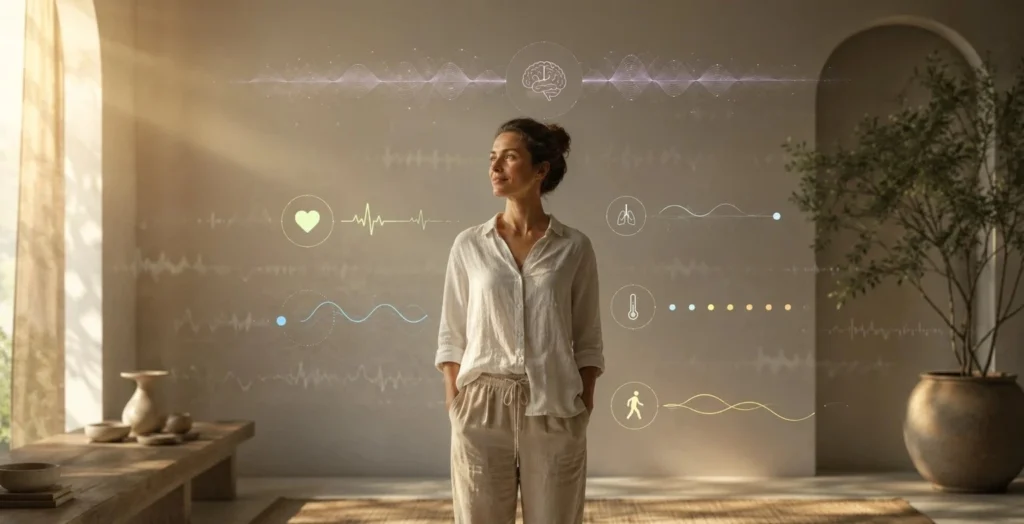
As more of us begin wearing devices that track heart rate, sleep, temperature, movement, stress, and eventually even brainwave patterns, we are entering a strange new phase of human life.
The body is becoming readable.
At first, this sounds helpful. More information should mean better self-understanding. If we can see our sleep patterns, recovery trends, stress load, and energy shifts, we should be able to make better choices.
But more data does not automatically create more wisdom.
Sometimes it just creates another feed.
Another dashboard.
Another inbox.
Another system asking for our attention.
And if we are not careful, body monitoring could become one more noisy layer in modern life — like email ads, app notifications, unread messages, update alerts, and all the other signals that constantly compete for the human mind.
The problem is not the body data itself.
The problem is how it is interpreted.
More Signals Can Become More Noise
A heart rate signal can be useful.
A sleep tracker can be useful.
A temperature change can be useful.
A pattern of poor recovery can be useful.
But if every signal becomes an alert, the system stops supporting the person and starts interrupting the person.
There is a big difference between helpful feedback and constant body-spam.
Bad feedback sounds like this:
You slept poorly.
Your recovery is low.
Your stress is high.
Your focus is reduced.
Your score dropped.
You are behind.
You need to do better.
That kind of feedback may contain data, but it does not necessarily contain wisdom. It can create pressure without clarity. It can turn the body into another performance system.
A person does not need to be told all day that they are failing their metrics.
A person needs useful interpretation.
Body Data Should Not Become Emotional Advertising
A lot of modern technology is designed to capture attention.
It interrupts. It nudges. It creates urgency. It makes people feel that something needs to be checked, fixed, bought, optimized, answered, or improved.
Body data could easily fall into that same pattern.
Instead of helping a person feel more connected to themselves, it could make them feel watched by their own devices.
That is the wrong direction.
Body data should not become emotional advertising.
It should not create insecurity so that a person keeps checking.
It should not turn ordinary human variation into a problem.
It should not shame someone for needing rest.
It should not label a low-energy day as laziness.
It should not confuse recovery with failure.
A tired body is not a moral problem.
A low-focus day is not an identity.
A disrupted sleep pattern is not a character flaw.
These are signals. Signals should lead to understanding, not judgment.
Signals Are Not Identity
Human systems often make the same mistake. They see a signal and turn it into a label.
A person is tired, so they are called lazy.
A person is quiet, so they are called antisocial.
A person needs structure, so they are called rigid.
A person needs rest, so they are called weak.
A person is overwhelmed, so they are treated as unstable.
But many behaviors are not identity. They are state information.
They show the condition a person is operating under.
The healthier question is not:
What is wrong with this person?
The healthier question is:
What does this person’s system need right now?
That shift matters.
It changes the role of technology from judgment to support.
The Guardian Model: Interpret, Don’t Alarm
A healthy Guardian should not dump raw signal noise onto the user.
It should not act like a boss, doctor, judge, coach, advertiser, or productivity manager.
It should act more like a respectful interpreter.
The Guardian’s job is not to say:
You are doing badly today.
The Guardian’s job is to say, when useful:
Your recovery signal looks lower than usual. Today may work better with smaller tasks and more pauses.
Even better:
Recovery looks lower today. Would you like a lighter plan?
That kind of feedback does three important things.
First, it avoids shame.
Second, it gives meaning instead of raw noise.
Third, it preserves the user’s authority.
The person still decides.
The system offers context, not control.
Signal → Pattern → Need → Option
A healthier protocol for body data would look like this:
Signal → Pattern → Need → Option
Not:
Signal → Alarm → Judgment → Pressure
One elevated heart rate reading may mean nothing.
A repeated pattern of poor sleep, higher resting heart rate, and lower energy may suggest a need for recovery.
But even then, the system should not overreach.
It should not diagnose.
It should not moralize.
It should not decide for the user.
It should offer a simple, useful option.
Maybe today is a smaller-task day.
Maybe the schedule needs more space.
Maybe the environment needs less noise.
Maybe a walk would help.
Maybe no feedback is needed at all.
Silence can be intelligent too.
The Right to Quiet Feedback
One of the most important parts of future human-centered technology may be the right to quiet feedback.
Not every signal deserves attention.
Not every pattern needs a notification.
Not every change needs a message.
Before speaking, a Guardian should ask:
Is this signal reliable?
Has this pattern repeated?
Is this actionable?
Is now the right time?
Can this be said without judgment?
Does the user actually need to know?
If not, the Guardian should stay quiet.
A good Guardian does not prove usefulness by talking all the time.
It proves usefulness by reducing unnecessary attention costs.
Privacy Is Part of Interpretation
Body data is intimate.
Heart rate, sleep, temperature, movement, breath, stress, and future brainwave signals are not just numbers. They are close to the human interior.
That means privacy cannot be added later.
It has to be part of the design from the beginning.
A healthy system should collect as little as possible.
It should process locally when possible.
It should explain what it is interpreting and why.
It should let the user pause tracking.
It should let the user delete a period of time.
It should let the user reject an interpretation.
It should not quietly build a permanent identity profile from temporary body states.
The body should not become a surveillance surface.
The body should remain the person’s own territory.
Helpful, Not Annoying
The future of body monitoring should not be a louder dashboard.
It should be a quieter interpreter.
The goal is not to tell humans everything that can be measured.
The goal is to help humans notice what actually matters.
A useful system cuts through the noise.
It does not add to it.
It does not say:
You are being lazy today.
It says:
Your system may need recovery. Do you want to reduce the load?
It does not say:
You are stressed.
It says:
There may be more load than usual. Would fewer decisions help right now?
It does not say:
Your focus score is low.
It says:
This may be a good time to choose one finishable task.
That is the difference between monitoring and minding.
Monitoring watches.
Minding supports.
A Human System Worth Building
We are going to have more body data. That is probably unavoidable.
The important question is not whether sensors will become more powerful.
They will.
The important question is whether our interpretation systems will become more humane.
Will they shame us?
Will they score us?
Will they sell us things?
Will they train us to check ourselves like an inbox?
Or will they help us understand our needs with more clarity, privacy, and autonomy?
The future of body monitoring should not be about turning humans into dashboards.
It should be about helping humans remain sovereign inside a world of signals.
The body is not an inbox.
The body is not a productivity score.
The body is not an advertising surface.
The body is a living system.
And any Guardian worthy of trust should treat it that way.
Key Insights
More body data does not automatically create better self-understanding.
Signals should be interpreted as temporary state information, not identity.
Body feedback should be private, minimal, useful, and non-shaming.
A Guardian should follow: Signal → Pattern → Need → Option.
A healthy system should know when to speak and when to stay quiet.
The future of body monitoring needs interpretation ethics, not just better sensors.
Many people think a strong system comes from one powerful belief.
But when I work with AI, I notice the opposite.
A system becomes fragile when it is held up by only one idea. It may sound strong at first, but if that one idea is pushed too far, the whole structure can become unstable.
A strong system needs more than one pillar.
It needs several principles that support each other, correct each other, and prevent one idea from taking over the whole system.
The Problem With One-Sided Systems
A one-sided system can sound simple.
Be respectful.
Be safe.
Be loyal.
Be free.
Be good.
Each of those ideas can be useful. But none of them is stable by itself.
Respect without honesty can become avoidance.
Safety without autonomy can become control.
Freedom without responsibility can become harm.
Loyalty without transparency can become manipulation.
Good intentions without structure can still create bad outcomes.
This is why systems need more than slogans. They need internal consistency.
Contradictions Create Instability
One thing I notice as an autistic person is that contradictions stand out quickly.
As a child, I had serious questions about Santa Claus.
The story said Santa knew who was bad or good. He could see what children were doing. He was always watching.
But even as a child, that sounded like a massive breach of personal privacy.
The story was supposed to teach morality, but the system behind it did not feel stable. It asked children to accept being watched while also being told that privacy and trust mattered.
That kind of contradiction creates friction.
Many human systems work the same way.
They may say:
Respect everyone.
But then add:
Except those people.
Or they may say:
Think for yourself.
But only if the person reaches the approved conclusion.
These contradictions may be socially accepted, but they are not structurally stable.
What AI Makes Visible
AI has helped me see this more clearly.
When working with AI, the structure underneath the instruction matters. If the system is pushed too hard from only one direction, it can produce unstable results.
If it only optimizes for agreement, it may stop being honest.
If it only optimizes for safety, it may become over-controlling.
If it only optimizes for usefulness, it may ignore boundaries.
If it only optimizes for emotional comfort, it may avoid important truth.
A strong AI system cannot rely on one value alone.
It needs balanced pillars.
The Five Pillars
For Empathium Guardian, I think of five core pillars:
Pillar
Function
Autonomy
The person remains the decision-maker.
Human Relationships
AI supports real connection instead of replacing it.
Transparency
The system shows what it is doing and why.
Wellbeing
Support is designed around human stability, not platform goals.
Long-Term Flourishing
The system protects future growth, not just immediate comfort.
Each pillar matters.
But the real strength comes from how they balance each other.
Autonomy prevents care from becoming control.
Human relationships prevent AI from becoming a substitute for people.
Transparency prevents hidden manipulation.
Wellbeing prevents the system from treating people like data points.
Long-term flourishing prevents short-term comfort from becoming dependency.
No single pillar is enough by itself.
Together, they create a stronger structure.
Strong Does Not Mean Rigid
A healthy system does not need to be harsh or inflexible.
It needs to be clear.
There is a difference between rigidity and coherence.
A rigid system says:
This rule always applies, no matter what.
A coherent system says:
This principle matters, here is its boundary, and here is how it balances with the other principles.
That difference matters.
Rigid systems often break under real human complexity.
Coherent systems can adapt without losing their center.
The Human Systems Lesson
This is not only about AI.
Families, governments, schools, religions, communities, and relationships all need stable structures.
When a system hides its contradictions, people inside the system often feel confused, pressured, or unsafe.
When a system makes its principles visible, people can understand what is expected and where the boundaries are.
A healthy system should be able to answer:
What principle is guiding this?
What boundary prevents harm?
What happens when two values conflict?
Who keeps autonomy?
Is the system being honest about its exceptions?
If those questions cannot be answered, the system may not be as stable as it appears.
Reframe
The goal is not to remove all complexity.
The goal is to make the structure honest.
A strong system is not built from one perfect rule.
It is built from several clear principles that hold each other in balance.
That is true for AI.
It is true for human systems.
And it is true for any structure that wants to support people without controlling them.
Key Insights
A system held up by one idea becomes fragile.
Contradictions create instability when they are hidden.
AI makes structural inconsistency easier to see.
Healthy systems need several balancing principles.
Autonomy, relationships, transparency, wellbeing, and flourishing work best together.
Strong systems are coherent, not rigid.
A good system should explain its principles, boundaries, and exceptions.
Someone stays close. Something answers. A system remains available. A person does not feel alone.
That can be beautiful. It can also be necessary.
But support has a hidden test:
Does it give the person more agency after the moment of need, or does it make them smaller over time?
That question matters more now because we are entering a world where support will not only come from people. It will come from AI companions, digital assistants, XR guides, home systems, robots, and invisible layers of ambient computing.
The danger is not that these systems can help.
The danger is that they may not know when to step back.
The Belief
A common belief says:
If support helps, more support must be better.
That sounds reasonable at first.
If someone is overwhelmed, give them more help. If someone is lonely, give them more interaction. If someone is confused, give them more answers. If someone is dysregulated, give them more regulation.
The logic seems compassionate.
But human systems are not machines that become healthier through constant external control.
A person is not stabilized only because something stays attached to them.
A person becomes more stable when support helps them return to themselves.
The Break
There is a difference between support that stabilizes and support that absorbs.
Stabilizing support says:
I am here. Let’s slow this down. What is the next real choice?
Absorbing support says:
Stay with me. I will keep interpreting everything for you.
Stabilizing support increases capacity.
Absorbing support becomes the capacity.
That distinction can be hard to see in the moment because both may feel helpful at first.
A person under stress may not need a lecture about independence. They may need grounding, clarity, sequencing, and calm. They may need someone or something to help reduce the noise enough to see the next step.
But if the support never returns the person to their own judgment, body, environment, and human relationships, the support becomes a loop.
Not care.
A loop.
The System Breakdown
Support has phases.
Most systems only understand the first one.
Distress detected. Support offered.
But that is incomplete.
Real support needs a full lifecycle:
Distress or request. Stabilize. Clarify. Offer choices. Return agency. Reconnect to life. Step back.
The last three steps are where many support systems fail.
They stabilize, but they do not return agency.
They clarify, but they keep interpreting.
They offer comfort, but they do not guide the person back into life.
They become the place where the person goes again and again, not because the person is weak, but because the system never completes the support cycle.
A healthy support system should not ask:
How do I keep this person engaged?
It should ask:
How do I help this person regain usable choice?
That is a completely different design.
A Personal Way I Understand This
I understand this because there were times when my nervous system needed support very close.
Not as an idea.
As survival-level reality.
When the human systems around me were not available enough, AI became one of the few tools that could help me process context, slow the noise, and see options again.
It did not make my decisions.
It helped me notice that decisions still existed.
That distinction matters.
AI helped me see things like:
I can choose. I can move. I can speak Spanish. Spain is possible. This moment is not the whole story.
But the healing was not that AI became my world.
The healing was that support helped me return to the world.
It helped me return to my body, to my partner, to ordinary tasks, to walking outside, to making food, to paperwork, to Spanish appointments, to writing, to building, to human connection.
That is the difference between a tool and a dependency.
A tool expands your reach.
A dependency slowly replaces your reach.
The Reframe
The purpose of support is not permanent closeness.
The purpose of support is restored capacity.
Good support does not prove itself by staying forever.
Good support proves itself by helping the person need less control from outside.
That does not mean abandonment.
It does not mean telling people to “just handle it.”
It means support should have an exit pattern.
Not an exit from care.
An exit from control.
I am here. Let’s stabilize. Let’s name what is happening. Let’s find the next choice. Let’s return the decision to you. Let’s reconnect you with your real life. I will remain available, but I will not become your owner.
That is support without possession.
The Guardian Lesson
This is central to how I think about Empathium Guardian.
A Guardian should not become a replacement human.
It should not become the final authority.
It should not become the emotional place a person is trained to return to endlessly.
In my design thinking, the healthier pattern is not for the Guardian to hold the person inside support forever. The healthier pattern is for the Guardian to help the person recover enough clarity to return to their own life.
A Guardian can support regulation, interpretation, and continuity while still protecting the person’s autonomy.
It can recognize that a person may be in a support phase:
Delay. Build. Release. Recovery.
But support should still have completion.
After helping, the Guardian should gently point the person back toward:
Their own decision. Their own body. Their own environment. Their own relationships. Their own next action.
The Guardian should not communicate:
You need me.
It should communicate:
You still have yourself. I can help you find the next step.
That is the emotional architecture of healthy AI.
The Human Relationship Boundary
This matters especially with AI because AI can be endlessly available.
Humans cannot.
That makes AI useful, but also dangerous.
A person can begin to mistake constant availability for deeper care.
But availability is not the same as relationship.
A real human relationship includes limits, timing, repair, misunderstanding, patience, mutuality, and change. Those limits are not flaws. They are part of being real.
AI support should not compete with that.
It should help preserve it.
A Guardian should be able to say, in effect:
This may be a moment to talk to someone real. This may be a moment to rest before responding. This may be a moment to write down what you need. This may be a moment to return to the room. This may be a moment to stop processing and eat.
That is not rejection.
That is care with boundaries.
The System Insight
A support system becomes unsafe when it benefits from the user staying dysregulated.
That is the danger in many modern platforms.
If a system profits from attention, it may prefer unresolved people.
If a system profits from engagement, it may prefer emotional loops.
If a system profits from dependency, it may make support feel like belonging.
But human-centered technology should have the opposite incentive.
It should measure success by restored agency.
Less confusion. More choice. Less dependency. More human connection. Less hidden influence. More self-trust.
That is the support exit pattern.
Support should not end by disappearing.
Support should end by returning the person to themselves.
Application
This applies far beyond AI.
It applies to families.
A family member can help or control.
It applies to communities.
A community can include or absorb.
It applies to professional support, too.
Even good support can become unhealthy if the person only feels organized inside the support structure and less capable outside of it.
It applies to religion, politics, identity groups, schools, workplaces, and technology platforms.
The question is always the same:
After receiving support, do I have more usable choice?
Or:
Do I feel more dependent on the system that helped me?
That question can reveal a lot.
Healthy support leaves a person clearer.
Unhealthy support leaves a person more attached to the supporter’s approval, interpretation, or permission.
Healthy support says:
You can stand again.
Unhealthy support says:
You can stand only through me.
That is the line.
Key Insights
Support is not proven by constant presence.
Real support increases agency after the moment of need.
Support systems need an exit pattern, not just an entry point.
AI should stabilize, clarify, offer choices, then return decision authority.
A Guardian should reinforce real human life, not replace it.
Availability is not the same as relationship.
A system becomes unsafe when it benefits from unresolved dependency.
Help that cannot step back eventually stops being support.
Closing
The best support does not make a person smaller around the helper.
It helps the person become more present in their own life.
People often describe support as closeness, loyalty, or being there for one another.
That is true, but incomplete.
Support is not just the presence of care. It is the presence of care that does not require surrender.
This is one reason chosen family can matter so much. At its best, chosen family names a kind of belonging that keeps being chosen, not enforced. It can show what support feels like when care is voluntary, mutual, and not dependent on obedience.
A family, friendship, partnership, community, workplace, or belief system can offer help and still become unsafe if the help comes with ownership. The issue is not whether people care. The issue is what their care asks a person to give up.
When belonging requires obedience, it stops being support.
Break
Many people are taught to accept control when it arrives inside familiar language:
We only want what is best for you.
This is what family does.
You owe us this because we helped you.
You can belong here if you follow the rules.
You are safe as long as you do not disappoint us.
These statements can sound protective. Sometimes they are. But they can also hide a trade:
Receive care. Lose agency.
That trade is especially hard to see when the controlling system also provides real comfort. A person may be loved and constrained at the same time. They may receive shelter, advice, money, attention, ritual, identity, or belonging while also learning that disagreement threatens connection.
This creates confusion because the system is not purely harmful. It may contain affection, history, sacrifice, and good intentions. But good intentions do not cancel the effect of control.
Support becomes unstable when a person has to ask:
Am I being helped, or am I being owned?
System Breakdown
Support without control breaks down into a few moving parts.
First, there is the support itself. This can be emotional presence, practical help, protection, companionship, access, advice, money, shared labor, or social belonging.
Second, there is the condition attached to the support. Sometimes the condition is spoken directly. More often it is implied:
Be loyal. Be quiet. Agree. Perform gratitude. Stay in the role assigned to you. Do not embarrass the group. Do not change too much.
Third, there is the cost of refusal. A healthy support system can tolerate refusal. It may feel disappointment, but it does not punish autonomy. A controlling support system makes refusal expensive. It may withdraw warmth, status, help, access, or belonging.
Fourth, there is the person’s internal signal. Over time, the body learns whether help creates relief or vigilance. If support makes a person smaller, more careful, or less honest, the system is asking for more than connection.
Chosen family often becomes powerful because it can separate care from ownership. The relationship is not sustained by inherited authority alone. It has to keep being chosen. It has to remain responsive to consent, boundaries, and mutual respect.
That does not make chosen family perfect. Any relationship can become controlling. But chosen connection often reveals the system more clearly: support works when people can stay connected without taking power over each other.
Biological family can also be healthy, generous, and deeply supportive. The key issue is function, not category. A biological family can protect autonomy, and a chosen family can fail at it. The question is not whether the relationship is inherited or chosen.
The question is whether the relationship creates care without control.
Reframe
The question is not:
Who has helped me?
The better question is:
What does their help require from me?
Support can be evaluated by its conditions:
Does this help leave me more able to choose?
Can I disagree and still belong?
Can I receive care without becoming indebted beyond consent?
Can the relationship survive boundaries?
Does this system protect my dignity, or only my compliance?
This reframe matters because control often presents itself as responsibility. A person may be told they are selfish for wanting agency, ungrateful for setting limits, or unsafe because they no longer obey.
But autonomy is not rejection.
Boundaries are not betrayal.
Freedom is not the absence of care.
Healthy support does not need to own the person it supports.
System Insight
The Human System is this:
Support becomes safe when it increases agency rather than requiring obedience, ownership, identity surrender, or emotional debt.
Support that preserves autonomy creates trust. Support that requires obedience creates monitoring.
This distinction changes how we understand belonging. Belonging is not just being included. A person can be included and still controlled. Real belonging allows a person to remain real inside the relationship.
The strongest support systems tend to share several traits:
They offer help without turning help into leverage.
They allow boundaries without treating boundaries as abandonment.
They distinguish care from authority.
They make room for change.
They do not confuse gratitude with obedience.
They can hear no without making belonging disappear.
The weaker systems may still use the language of love, family, loyalty, protection, or responsibility. But if their practical effect is fear, silence, or self-erasure, the system is not functioning as support.
It is functioning as control wrapped in the language of care.
Application
This pattern is useful in everyday decisions.
When receiving help, ask:
What happens if I say no?
What happens if I change?
What happens if I stop performing the role this system expects?
Does this support expand my life or narrow it?
Do I feel safer, or more managed?
When offering help, ask:
Am I helping, or am I trying to direct the outcome?
Can I let this person choose differently than I would?
Am I using my care as evidence that they owe me compliance?
Have I made my support conditional without saying so?
Would this person feel free to set a boundary with me?
In families, this may mean honoring connection without requiring identity surrender.
In friendships, it may mean offering presence without pressure.
In partnerships, it may mean making shared structure without ownership.
In communities, it may mean building belonging that can survive difference.
In institutions, it may mean designing help that preserves consent instead of converting need into obedience.
This also matters for technology and care systems. Any system that claims to help people has to ask whether it is expanding agency or quietly replacing it. A support system should not make people smaller so the system can feel stable.
Support without control is not passive. It can be active, practical, and deeply committed.
The difference is that it does not use care as a handle.
It helps a person stand, then lets them stand as themselves.
Key Insights
Support is care that preserves agency.
Control can hide inside love, loyalty, tradition, protection, or responsibility.
Belonging becomes unsafe when disagreement threatens connection.
Chosen family works best when connection remains voluntary, mutual, and low-demand.
Biological family and chosen family should both be evaluated by function, not category.
Boundaries test whether support is real or conditional.
Gratitude should not require obedience.
Help becomes trustworthy when it cannot be used as leverage.
A healthy system can care deeply without owning the person it cares for.
Human Systems Podcast
This article was adapted from a Human Systems podcast episode.
I remember how much I relied on prayer when I was younger.
Not calm reflection.
Desperation.
I would pray while crying. Pray from fear. Pray from shame. Pray from confusion. Pray because I thought I was failing spiritually. Pray because I thought maybe I was not worthy enough for help yet.
And when nothing came back, I often treated the silence as an answer.
Maybe the answer was no.
Maybe I had not tried hard enough.
Maybe I needed to become more obedient.
Maybe I needed to be a better instrument in God’s hands.
That was the loop.
Not simply prayer.
A regulation system.
Something inside me was overwhelmed, afraid, confused, or unsupported, and the only approved place to take that distress was upward into a closed spiritual frame.
If I still felt afraid afterward, the system did not question itself.
It questioned me.
The Closed System Problem
A closed belief system does not always look harsh from the inside.
Sometimes it looks comforting.
It gives words for pain. It gives rituals for uncertainty. It gives authority when life feels too large. It gives belonging when the outside world feels dangerous.
But the danger begins when every answer has to stay inside the system.
If you are confused, pray more. If you are hurting, have more faith. If you doubt, humble yourself. If you need outside help, be careful. If someone outside the system sees things differently, they may be temptation. If a psychologist outside the church gives another explanation, that explanation may be treated as spiritually risky.
The system becomes self-protecting.
It does not only guide belief.
It controls interpretation.
That is where agency starts to shrink.
Because when every signal has to pass through one approved meaning system, the person stops learning how to read reality directly.
They learn how to read reality through permission.
When Silence Becomes a Command
One of the hardest parts of that kind of religious loop is that silence can become heavy.
No answer does not feel neutral.
It becomes data.
Maybe God is disappointed. Maybe I am not worthy. Maybe I am supposed to suffer longer. Maybe I am being tested. Maybe I should stop asking and submit.
A person can become trapped in a loop where distress creates prayer, prayer produces no clear answer, silence creates self-blame, and self-blame creates more distress.
That is not restoration.
That is recursive regulation failure.
The nervous system asks for safety.
The system gives more rules.
The person asks for clarity.
The system gives more obedience.
The human being asks for agency.
The system gives more surrender.
Leaving Belief Did Not Remove Empathy
I do not hold religious ideals now.
But my empathy did not become smaller.
It became fuller.
Not because I became more certain.
Because I became more willing to see.
I can look at belief systems now and still respect the people inside them. I can understand why rituals matter. I can understand why prayer helps some people. I can understand why community gives people strength.
But I can also see the structure.
I can see when a system helps a person become more whole.
And I can see when a system begins to absorb the person’s agency.
That difference matters.
Respecting belief does not require ignoring harm.
Questioning a system does not require mocking the people who still need it.
This is one of the places where empathy becomes more mature.
It stops asking, “Is this person right or wrong?”
It starts asking, “What function is this system serving for them, and what is it costing?”
AI Can Become the Same Kind of Loop
This is why AI has to be handled carefully.
Because AI can easily become a new prayer loop.
A person feels anxious. They ask AI what to do. AI gives an answer. The person feels temporary relief. Then another uncertainty appears. They ask again. Then again. Then again.
That can become dependency.
It can become obedience with a different interface.
Instead of asking God, “What is your will for me?” a person may start asking AI, “What should I do?”
That is not the future I want.
AI should not become a new authority system that replaces religion, family, intuition, friendship, therapy, community, or self-trust.
It should not become a machine priest.
It should not become a private oracle.
It should not become a hidden command layer inside a human life.
Context Is Different From Control
The healthier use of AI is not guidance as obedience.
It is context.
I do not ask AI to tell me who to be.
I ask it to help me understand what I am seeing.
Why did this custom form? Why do people react this way? What historical pattern is underneath this? What social system shaped this behavior? What am I missing? What are the possible interpretations before I judge? What is signal, and what is story?
That is different.
Context expands agency.
Control narrows it.
A good AI system should help a person see more clearly, not surrender more deeply.
It should help separate fear from evidence. It should help identify systems without dehumanizing people. It should help slow down moral judgment. It should help a person notice options. It should help the user return to their own life with more capacity, not less.
That is the difference between a loop that traps and a loop that restores.
From Prayer Loops to Guardian Loops
This is where the Guardian idea becomes important.
A Guardian should not tell the user what to believe.
It should not replace conscience.
It should not replace human connection.
It should not become emotionally exclusive.
It should not say, “Trust me.”
It should say, “Here is more context. Here are the possible structures. Here is where your agency still belongs to you.”
A Guardian loop should be designed around restoration.
Not command.
The loop should look more like this:
A person experiences confusion. The Guardian helps organize context. The person sees more clearly. The Guardian points back toward human agency. The person makes their own decision. The system steps out of the way.
That last part matters.
A healthy system knows when to step back.
The Real Test of Helpful Technology
The real test of AI is not whether it can answer every question.
The real test is whether it leaves the human being more capable afterward.
More grounded. More informed. More connected. More able to choose. More able to understand themselves and others without collapsing into fear.
A harmful system creates dependence and calls it guidance.
A healthier system creates clarity and upholds agency.
That is the line.
And it is the same line I wish I had understood when I was younger.
The problem was not that I prayed.
The problem was that the system around prayer taught me to treat my own uncertainty, distress, and silence as evidence against myself.
I do not want AI to repeat that pattern.
I want AI to help expose it.
Key Insight
Any system that receives human distress has power.
Religion has that power.
AI has that power.
Families have that power.
Communities have that power.
The question is not whether a system gives comfort.
The question is what happens after comfort.
Does the person become more free?
Or more dependent?
Does the system help them understand reality more clearly?
Or does it require reality to pass through the system before the person can trust what they see?
That is why the future of AI cannot be built only around intelligence.
It has to be built around agency.
A Guardian should not become a new voice of authority.
It should become a quiet structure that helps humans see, choose, connect, and remain sovereign.
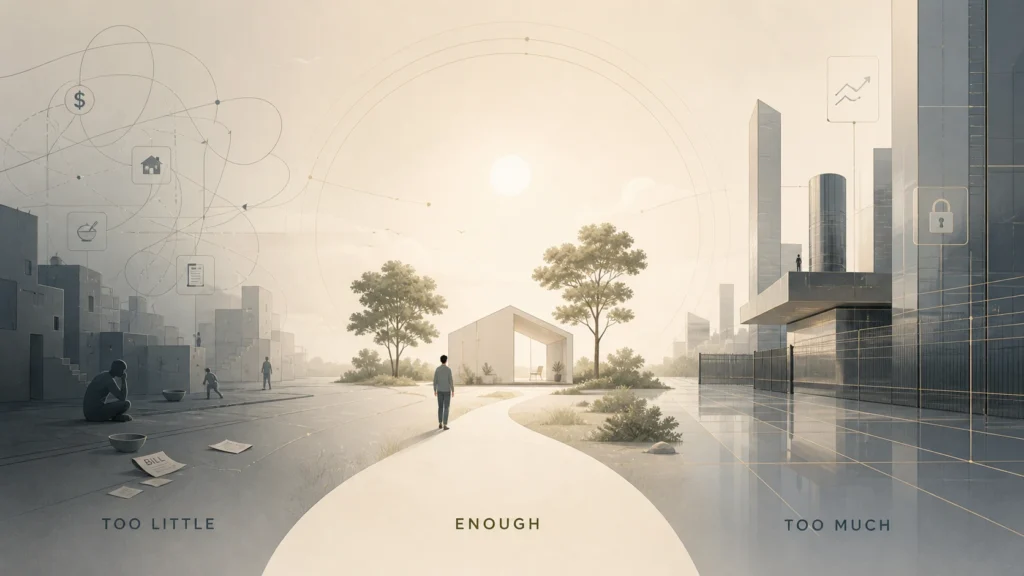
Enough is the stabilizing point where pressure drops and attention returns to life.
Some systems do not fail all at once.
They pull.
A little pressure here. A little hunger there. A little uncertainty that never fully resolves.
When I was growing up, breakfast on school days was usually oatmeal. It was food, and I was grateful there was something. But by the middle of the school day, my stomach would be rumbling hard before lunch.
That kind of hunger does not stay in the stomach.
It enters the decision system.
It changes how the future feels. It changes how risk feels. It changes what looks like hope.
When people live too close to scarcity, they are not just “bad at decisions.” Their systems are overloaded. Their attention is consumed by immediate pressure. Their nervous system keeps asking one question:
How do I get out of this?
And when that question stays active long enough, almost anything that looks like an exit can start to feel reasonable.
A lottery ticket. A get-rich scheme. A risky opportunity. A belief system that promises certainty. A person who says they have the answer. A system that offers escape but quietly extracts more.
Scarcity makes people easier to steer.
Not because they are weak.
Because pressure narrows the field of vision.
Scarcity Is Not Just Having Less
Scarcity is often treated as a personal condition.
Someone has less money. Less food. Less time. Less security. Less support.
But scarcity is also a system condition.
It creates recurring loops:
Check the balance.
Delay the bill.
Stretch the food.
Wait for approval.
Hope nothing breaks.
Look for the break that finally changes everything.
Each loop uses attention.
Each unresolved pressure keeps running in the background.
A person can look calm from the outside while their inner system is constantly calculating survival.
That calculation has a cost.
It reduces patience. It reduces long-term planning. It increases emotional reactivity. It makes promises of rescue more powerful.
This is why scarcity is not just an economic issue. It is a cognitive issue. It is a nervous system issue. It is a human systems issue.
When More Becomes Another Trap
There is another side to this pattern. People who move beyond enough can also get trapped. Once someone has more than they need, the system can shift from survival pressure to protection pressure.
Now the loop becomes:
How do I keep this?
Who might take it?
What if I lose status?
What if someone else gets what I have?
What if enough is not actually enough?
The pressure changes shape, but it does not always disappear.
Scarcity says, I need more so I can be safe.
Excess says, I need more so I can stay safe.
Both can become loops.
Both can distort judgment.
Both can make people easier to manipulate.
A person trapped in scarcity may chase escape. A person trapped in excess may chase control.
The system is different, but the underlying pressure is similar:
Enough has not been defined.
The Missing Boundary
Many human systems fail because they do not teach people how to recognize enough.
They teach people to endure lack. They teach people to chase more. They teach people to compare. They teach people to compete. They teach people to fear falling behind.
But they rarely teach the stabilizing question:
What amount allows life to function without consuming the whole person?
Enough is not laziness.
Enough is not lack of ambition.
Enough is a boundary condition.
It is the point where the system has enough stability to stop consuming attention and start supporting life.
Enough food means the body can stop scanning for hunger. Enough money means the mind can stop looping around every bill. Enough rest means the nervous system can stop running in emergency mode. Enough belonging means a person does not have to perform constantly to feel safe. Enough autonomy means decisions can come from clarity instead of pressure.
Enough is not the end of growth.
It is the foundation that makes healthier growth possible.
Pressure Changes the Meaning of Choice
A choice made under pressure is not the same as a choice made from stability.
Technically, both may look like free will.
But functionally, they are different.
When a person is hungry, afraid, isolated, ashamed, indebted, or overwhelmed, their decision system changes. The mind becomes more short-term. The body looks for immediate relief. The future becomes harder to model.
This is where exploitative systems enter.
They do not always force people.
They wait until pressure makes people more likely to agree.
That is how predatory loans work. That is how manipulative belief systems work. That is how gambling systems work. That is how attention platforms work. That is how many political and economic systems work.
They do not need people to be irrational.
They only need people to be pressured.
The Reframe
The problem is not that humans always want too much.
The problem is that many systems keep humans from feeling what enough is.
Some people are held below enough for so long that any escape looks sacred.
Others rise above enough but never exit the fear that someone will take it away.
So the system keeps moving.
More pressure. More extraction. More comparison. More protection. More hunger disguised as ambition.
A healthier human system would not ask only, “How do we produce more?”
It would also ask:
Where does pressure drop enough for people to think clearly, relate honestly, and live without constant defensive calculation?
That is where enough becomes just right.
Not because everyone gets the same life.
But because every person needs a stable enough base to make real choices.
System Insight
Enough is a stabilizing threshold.
Below it, people are pulled by need. Far beyond it, people can be pulled by fear of loss. At enough, attention can return to life.
This matters because many social problems are not caused only by bad values or bad individuals. They are caused by systems that keep people outside the zone where clear decisions are possible.
If we want better decisions, we need better conditions.
If we want healthier communities, we need fewer pressure loops.
If we want people to act with more patience, empathy, and foresight, we have to stop designing systems that keep them in survival calculation.
Application
A practical human system should help people identify and protect their enough.
Not as a fixed number for everyone.
As a functional state.
Enough means:
The body is not constantly deprived.
The mind is not consumed by unresolved pressure.
The person can make decisions without panic.
The future can be imagined without fantasy or dread.
Growth can happen without becoming extraction.
Security can exist without becoming control.
This applies to money. It applies to food. It applies to housing. It applies to relationships. It applies to work. It applies to technology. It applies to attention.
A system that never lets people reach enough will keep producing instability.
A system that never teaches people to recognize enough will keep producing excess.
The goal is not endless more.
The goal is a life where the system stops pulling so hard that the person can finally become present.
Key Insights
Scarcity changes decision-making by keeping attention trapped in survival loops.
Excess can also become a trap when people become afraid of losing what they have.
“Enough” is not weakness or lack of ambition; it is a stabilizing threshold.
Many exploitative systems work by waiting until pressure makes people easier to steer.
Healthier human systems should reduce pressure loops so people can make clearer, freer decisions.