RuPaul once said:
“As gay people, we get to choose our family.”
For many, that statement is about survival—building connection when biological systems fail.
But there’s a deeper system underneath it:
It’s not just about choosing new people.
It’s about recognizing that family never guaranteed access in the first place.
Break the Assumption
The default belief:
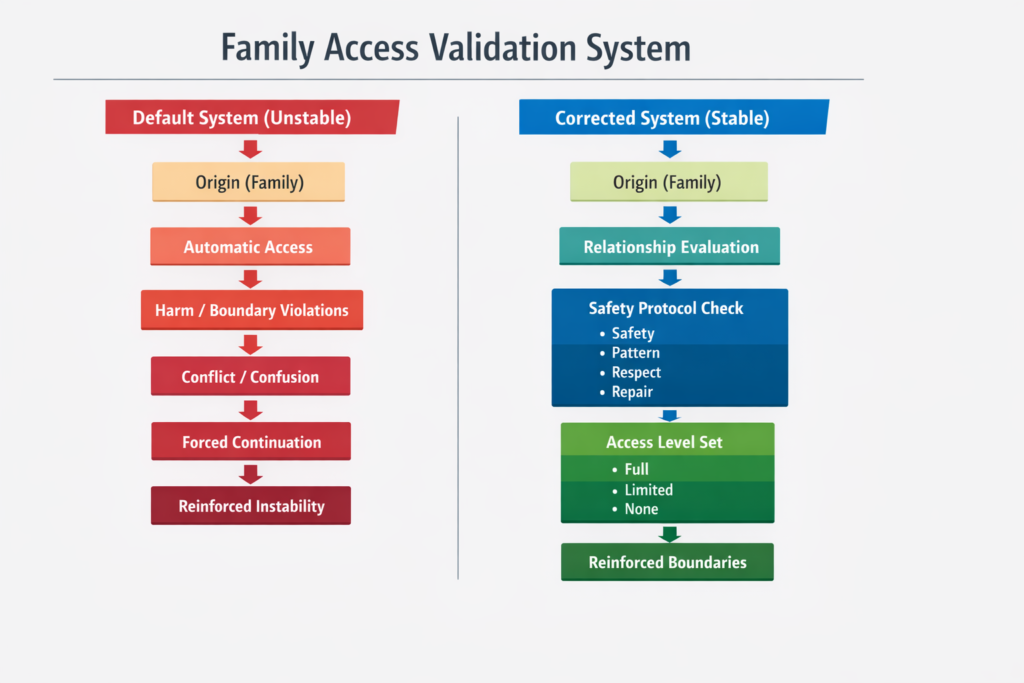
Family → Permanent Access → Unconditional Inclusion
This belief is inherited, not examined.
But reality shows something different:
- People can share blood and still be unsafe
- People can share history and still break trust
- People can be “family” and still not have access
System Breakdown
Most systems collapse three distinct layers into one:
Origin → Relationship → Access
1. Origin (Fixed)
- Where you come from
- Shared biology or history
2. Relationship (Variable)
- What actually formed over time
- Trust, harm, repair, patterns
3. Access (Controlled)
- What is allowed now
- Emotional, physical, relational proximity
The Problem
Most systems assume:
Origin = Relationship = Access
So even when:
- Trust is broken
- Harm occurred
- Patterns repeat
Access is still expected.
This creates instability.
The Missing Rule
Family must pass the same safety protocols as anyone else
There is no separate system.
No bypass.
No inherited clearance.
The Correction
Origin ≠ Access
Relationship determines Access
Access requires safety validation
Safety Protocol Layer
Before granting or continuing access, every relationship—family included—must pass:
- Safety → Do interactions create stability or stress?
- Pattern → Is behavior consistent or cyclical harm?
- Respect → Are boundaries recognized without pressure?
- Repair → When harm occurs, is it acknowledged and corrected?
If these fail:
Access is reduced or removed
Not emotionally—structurally.
Personal Evidence (Controlled)
It’s possible to reach a state where:
- There is no hatred
- No need for apology
- No desire for revenge
And still:
Access remains closed
Not as punishment.
Not as reaction.
As alignment with system reality.
Reframe
Family is not a permission system.
It is a starting point.
What continues beyond that must meet the same conditions as any other relationship.
System Insight
Blood creates connection
Behavior earns access
Safety sustains it
Why Systems Fail Here
Many people are taught to evaluate family emotionally instead of structurally.
That creates confusion.
A person may think:
- “They are still my family”
- “I should let it go”
- “Maybe closeness is required”
- “Distance means I am being cruel”
But those responses often come from inherited system pressure, not clear relationship evaluation.
A stable system asks different questions:
- Is this relationship safe in practice?
- Are boundaries respected without retaliation?
- Does contact create clarity or destabilization?
- Is trust being rebuilt through action, or only requested through language?
This matters because family systems often preserve access long after trust has broken down.
That is not compassion.
That is structural drift.
When access is given without safety review, instability gets repeated and renamed as loyalty.
A healthier system does the opposite.
It separates shared origin from current eligibility for closeness.
That is not rejection of humanity.
It is proper boundary design.
Application
When evaluating any relationship, ask:
Does this pass the same safety protocols I would require from anyone else?
Then define clearly:
- Full access → trust, vulnerability
- Limited access → controlled interaction
- No access → distance or disengagement
And most importantly:
Remove the “family exception”
Key Insights
- Family does not guarantee access
- There is no special exemption from safety standards
- Trust is built through behavior, not origin
- Compassion does not require proximity
- Boundaries are system design, not emotional reaction
Leave a Reply