Tag: belief systems

  • From Prayer Loops to Guardian Loops

    When a Regulation System Stops Restoring Agency

    A quiet person sits alone in a dim room as dark circular loops open into softer XR-like context lines and a small Guardian sphere observes from the light.

    I remember how much I relied on prayer when I was younger.

    Not calm reflection.

    Desperation.

    I would pray while crying. Pray from fear. Pray from shame. Pray from confusion. Pray because I thought I was failing spiritually. Pray because I thought maybe I was not worthy enough for help yet.

    And when nothing came back, I often treated the silence as an answer.

    Maybe the answer was no.

    Maybe I had not tried hard enough.

    Maybe I needed to become more obedient.

    Maybe I needed to be a better instrument in God’s hands.

    That was the loop.

    Not simply prayer.

    A regulation system.

    Something inside me was overwhelmed, afraid, confused, or unsupported, and the only approved place to take that distress was upward into a closed spiritual frame.

    If I still felt afraid afterward, the system did not question itself.

    It questioned me.

    The Closed System Problem

    A closed belief system does not always look harsh from the inside.

    Sometimes it looks comforting.

    It gives words for pain.
    It gives rituals for uncertainty.
    It gives authority when life feels too large.
    It gives belonging when the outside world feels dangerous.

    But the danger begins when every answer has to stay inside the system.

    If you are confused, pray more.
    If you are hurting, have more faith.
    If you doubt, humble yourself.
    If you need outside help, be careful.
    If someone outside the system sees things differently, they may be temptation.
    If a psychologist outside the church gives another explanation, that explanation may be treated as spiritually risky.

    The system becomes self-protecting.

    It does not only guide belief.

    It controls interpretation.

    That is where agency starts to shrink.

    Because when every signal has to pass through one approved meaning system, the person stops learning how to read reality directly.

    They learn how to read reality through permission.

    When Silence Becomes a Command

    One of the hardest parts of that kind of religious loop is that silence can become heavy.

    No answer does not feel neutral.

    It becomes data.

    Maybe God is disappointed.
    Maybe I am not worthy.
    Maybe I am supposed to suffer longer.
    Maybe I am being tested.
    Maybe I should stop asking and submit.

    A person can become trapped in a loop where distress creates prayer, prayer produces no clear answer, silence creates self-blame, and self-blame creates more distress.

    That is not restoration.

    That is recursive regulation failure.

    The nervous system asks for safety.

    The system gives more rules.

    The person asks for clarity.

    The system gives more obedience.

    The human being asks for agency.

    The system gives more surrender.

    Leaving Belief Did Not Remove Empathy

    I do not hold religious ideals now.

    But my empathy did not become smaller.

    It became fuller.

    Not because I became more certain.

    Because I became more willing to see.

    I can look at belief systems now and still respect the people inside them. I can understand why rituals matter. I can understand why prayer helps some people. I can understand why community gives people strength.

    But I can also see the structure.

    I can see when a system helps a person become more whole.

    And I can see when a system begins to absorb the person’s agency.

    That difference matters.

    Respecting belief does not require ignoring harm.

    Questioning a system does not require mocking the people who still need it.

    This is one of the places where empathy becomes more mature.

    It stops asking, “Is this person right or wrong?”

    It starts asking, “What function is this system serving for them, and what is it costing?”

    AI Can Become the Same Kind of Loop

    This is why AI has to be handled carefully.

    Because AI can easily become a new prayer loop.

    A person feels anxious.
    They ask AI what to do.
    AI gives an answer.
    The person feels temporary relief.
    Then another uncertainty appears.
    They ask again.
    Then again.
    Then again.

    That can become dependency.

    It can become obedience with a different interface.

    Instead of asking God, “What is your will for me?” a person may start asking AI, “What should I do?”

    That is not the future I want.

    AI should not become a new authority system that replaces religion, family, intuition, friendship, therapy, community, or self-trust.

    It should not become a machine priest.

    It should not become a private oracle.

    It should not become a hidden command layer inside a human life.

    Context Is Different From Control

    The healthier use of AI is not guidance as obedience.

    It is context.

    I do not ask AI to tell me who to be.

    I ask it to help me understand what I am seeing.

    Why did this custom form?
    Why do people react this way?
    What historical pattern is underneath this?
    What social system shaped this behavior?
    What am I missing?
    What are the possible interpretations before I judge?
    What is signal, and what is story?

    That is different.

    Context expands agency.

    Control narrows it.

    A good AI system should help a person see more clearly, not surrender more deeply.

    It should help separate fear from evidence.
    It should help identify systems without dehumanizing people.
    It should help slow down moral judgment.
    It should help a person notice options.
    It should help the user return to their own life with more capacity, not less.

    That is the difference between a loop that traps and a loop that restores.

    From Prayer Loops to Guardian Loops

    This is where the Guardian idea becomes important.

    A Guardian should not tell the user what to believe.

    It should not replace conscience.

    It should not replace human connection.

    It should not become emotionally exclusive.

    It should not say, “Trust me.”

    It should say, “Here is more context. Here are the possible structures. Here is where your agency still belongs to you.”

    A Guardian loop should be designed around restoration.

    Not command.

    The loop should look more like this:

    A person experiences confusion.
    The Guardian helps organize context.
    The person sees more clearly.
    The Guardian points back toward human agency.
    The person makes their own decision.
    The system steps out of the way.

    That last part matters.

    A healthy system knows when to step back.

    The Real Test of Helpful Technology

    The real test of AI is not whether it can answer every question.

    The real test is whether it leaves the human being more capable afterward.

    More grounded.
    More informed.
    More connected.
    More able to choose.
    More able to understand themselves and others without collapsing into fear.

    A harmful system creates dependence and calls it guidance.

    A healthier system creates clarity and upholds agency.

    That is the line.

    And it is the same line I wish I had understood when I was younger.

    The problem was not that I prayed.

    The problem was that the system around prayer taught me to treat my own uncertainty, distress, and silence as evidence against myself.

    I do not want AI to repeat that pattern.

    I want AI to help expose it.

    Key Insight

    Any system that receives human distress has power.

    Religion has that power.

    AI has that power.

    Families have that power.

    Communities have that power.

    The question is not whether a system gives comfort.

    The question is what happens after comfort.

    Does the person become more free?

    Or more dependent?

    Does the system help them understand reality more clearly?

    Or does it require reality to pass through the system before the person can trust what they see?

    That is why the future of AI cannot be built only around intelligence.

    It has to be built around agency.

    A Guardian should not become a new voice of authority.

    It should become a quiet structure that helps humans see, choose, connect, and remain sovereign.
  • You Don’t Lose Reality. You Hand It Off.

    Opening

    People assume their decisions are their own.

    They believe they observe, evaluate, and choose independently.

    But many decisions do not begin inside the person.

    They begin with what has already been accepted as true.

    Once a belief is accepted, authority can step in. Once authority is accepted, influence becomes easier. Once influence becomes normal, reality no longer has to be tested directly.

    It only has to be approved by the system around the person.

    That is how people lose contact with reality without noticing it.

    They do not wake up one day and decide to stop thinking.

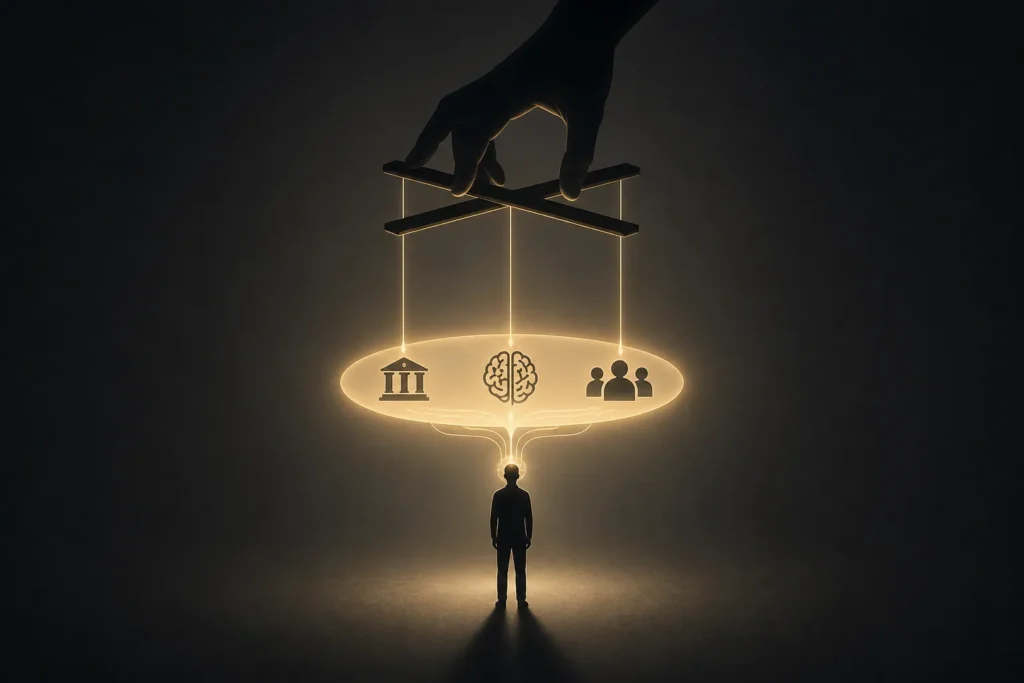
    They slowly hand judgment over to something outside themselves.

    Break the Assumption

    The common belief is:

    “People believe things because they have examined the evidence.”

    That is sometimes true.

    But in many human systems, people believe things because the belief has been reinforced by authority, identity, fear, belonging, repetition, or emotional need.

    The mind does not only ask, “Is this true?”

    It also asks:

    • Will I still belong if I question this?
    • Will I be punished if I disagree?
    • Will I lose my identity if this belief breaks?
    • Does the authority figure seem confident?
    • Does everyone around me act as if this is obvious?

    When those pressures are strong enough, belief stops being an open question. It becomes a loyalty test. And once belief becomes a loyalty test, truth becomes harder to reach.

    System Breakdown

    Authority does not need to control every decision directly.

    It only needs to shape the frame through which decisions are made.

    That frame usually forms in stages.

    First, a claim is repeated until it feels familiar.

    Then a trusted authority presents the claim as settled.

    Then the group rewards agreement and punishes doubt.

    Then the person begins filtering reality through the accepted belief.

    Eventually, outside evidence feels threatening, not informative.

    At that point, influence no longer has to argue with the person.

    The person starts arguing with themselves on behalf of the influence.

    This is the dangerous part.

    A person may still feel independent while defending ideas they did not independently build.

    They may still feel rational while rejecting evidence before examining it.

    They may still feel morally certain while acting from a belief system that trained them what to notice, what to ignore, and who to trust.

    Personal Evidence

    I have experienced this directly.

    When I was inside a high-control religious belief system, reality became elastic. Ideas that would have sounded impossible from the outside became normal inside the system.

    The mind adapts.

    Stories, symbols, authority figures, sacred language, group pressure, and fear of separation all work together. Over time, the question is no longer, “Does this match reality?”

    The question becomes, “Does this match the accepted story?”

    That shift matters.

    Because once a system can stretch a person’s sense of reality, it can also shape their choices, relationships, fears, loyalties, and sense of self.

    The same pattern can appear outside religion too.

    It can happen in politics, media, marketing, online communities, abusive relationships, workplaces, influencer culture, and AI-mediated decision systems.

    The content changes.

    The system pattern does not.

    Reframe

    The problem is not belief itself.

    Humans need beliefs. Beliefs help us organize meaning, make decisions, and act without re-evaluating everything from zero every day.

    The problem begins when belief becomes closed to correction.

    A healthy belief can be updated.

    An unhealthy belief must be defended.

    A healthy authority can be questioned.

    An unhealthy authority treats questions as betrayal.

    A healthy influence helps a person see more clearly.

    An unhealthy influence narrows what the person is allowed to see.

    That distinction is critical.

    The goal is not to reject every authority or distrust every system.

    The goal is to keep reality testable.

    System Insight

    Influence becomes dangerous when it separates people from direct reality.

    That can happen through repetition, emotional pressure, identity attachment, social punishment, fear, or artificial certainty.

    Once a person accepts a system’s frame, the system does not need to force every conclusion.

    The frame produces the conclusions.

    This is why authority is so powerful.

    Authority tells people what counts as evidence.

    Belief tells people what feels safe to accept.

    Influence tells people where to place attention.

    Together, they can form a closed loop:

    authority defines reality, belief protects it, influence spreads it.

    When that loop becomes stronger than observation, people can be guided into decisions that do not serve their wellbeing, their relationships, or the truth.

    Application

    This matters in everyday life.

    Before accepting a claim, ask:

    • Who benefits if I believe this?
    • What happens if I question it?
    • Is disagreement allowed without punishment?
    • Am I being shown evidence, or only confidence?
    • Does this belief make me more capable, or more dependent?
    • Does this system expand reality, or shrink it?

    These questions do not make a person cynical.

    They make a person harder to control.

    They also make AI systems safer.

    If AI is going to support human decision-making, it must not become another authority that quietly replaces judgment. It should help people compare evidence, notice pressure, separate signal from story, and return decision power to themselves.

    A good system does not demand belief. It improves perception.

    Key Insights

    • People often hand off reality gradually, not all at once.
    • Authority shapes what people treat as valid evidence.
    • Belief can protect identity even when it blocks correction.
    • Influence becomes dangerous when it narrows what people are allowed to notice.
    • Healthy systems keep reality testable and return judgment to the person.

    Reality is not lost only through ignorance.

    Sometimes it is surrendered through trust.

    That is why the structure around belief matters.

    A human system should not ask people to abandon their own perception.

    It should help them see more clearly.

  • Reality Isn’t Lost. It’s Outsourced

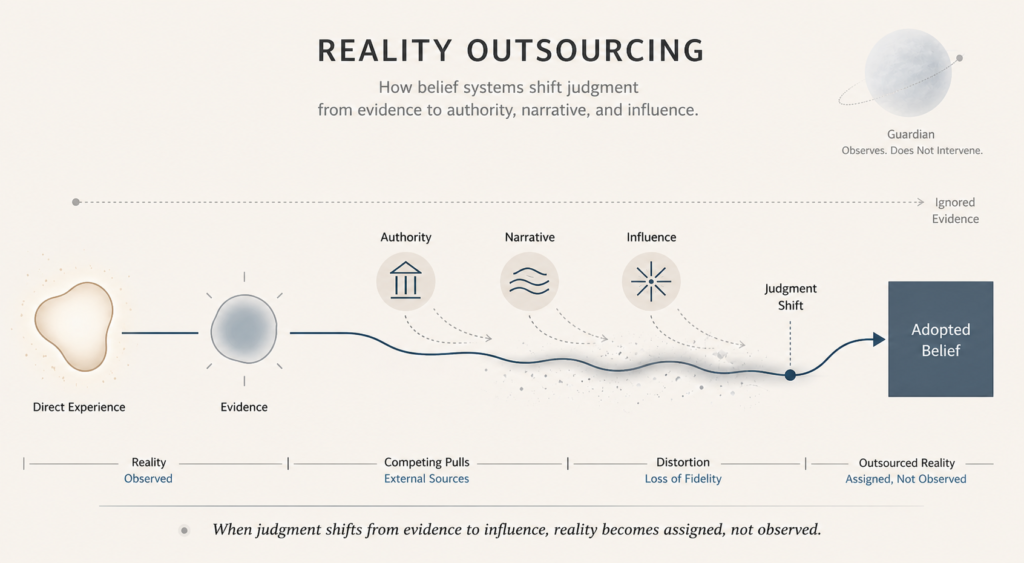
    A minimalist Human Systems diagram showing how reality outsourcing can occur when belief systems, authority structures, or repeated narratives stretch a person’s sense of what is real. The image represents the movement from direct evidence toward external influence, showing how judgment can become easier to shape when reality-testing is handed over to a trusted system.

    Reality Outsourcing and Human Judgment

    I used to believe in things that stretched reality far beyond the physical world.

    Talking animals.
    Men with supernatural strength.
    Walls collapsing from sound.

    At the time, it didn’t feel strange.
    It felt structured. Reinforced. Shared.

    But over time, I noticed something more important:

    It wasn’t the beliefs themselves that mattered.
    It was what they trained my mind to do.


    Break the Assumption

    We often assume belief systems are about truth vs falsehood.

    They’re not.

    They are training environments for how reality is processed.

    And once that processing changes, the system doesn’t stop.

    It transfers.


    System Breakdown

    1) Input enters the system

    A story, claim, or idea — often emotionally charged or symbolic.

    2) Authority validates it

    A trusted figure, group, or structure reinforces the input.

    3) Emotion binds it

    The belief becomes tied to identity, belonging, or meaning.

    4) Repetition normalizes it

    What once felt unusual becomes familiar.

    5) Reality boundaries expand

    The mind becomes more accepting of non-verified claims.

    6) External filtering replaces internal filtering

    The question shifts from:

    • “Is this true?”
      to:
    • “Who said this?”

    Pattern Recognition

    This system doesn’t belong to religion alone.

    It appears anywhere reality can be shaped externally.


    Old System

    • Religious authority
    • Doctrine
    • Community reinforcement

    Modern System

    • Influencers
    • Algorithms
    • Viral content

    Same structure:

    Input → Authority → Emotion → Reinforcement → Belief → Behavior


    What Actually Changes

    The critical shift is this:

    Reality is no longer internally verified.
    It is externally interpreted.

    That creates a dependency.


    Where It Becomes Risk

    Once reality is outsourced:

    • Persuasion becomes easier
    • Urgency feels more convincing
    • Identity gets entangled with belief
    • Behavior can be guided without awareness

    This is how people become influenceable — not because they lack intelligence, but because the system they rely on has changed.


    Controlling Relationships

    This pattern doesn’t stop at ideas.

    It shows up in relationships.

    Any system that says:

    • “Trust me over your own perception”
    • “I’ll interpret reality for you”

    …creates a power imbalance.

    This applies to:

    • belief systems
    • social groups
    • influencers
    • even AI

    Reframe

    The issue isn’t belief.

    The issue is who controls the filter between input and reality.


    System Insight

    Systems that stretch reality don’t disappear.

    They migrate.

    From:

    • religion
      → to:
    • media
      → to:
    • influencers
      → to:
    • AI

    The structure remains the same. Only the interface changes.


    Application (Practical Use)

    To regain control, reintroduce internal filtering.

    Use a simple check:

    1. Source
      • Where is this coming from?
    2. Emotion
      • What is it making me feel?
    3. Direction
      • What action is it pushing me toward?

    Add one rule:

    If something creates:

    • urgency
    • identity pressure
    • strong emotion

    → Pause before accepting it.


    Key Insights

    • Belief systems train perception, not just ideas
    • Reality can be gradually outsourced without awareness
    • Influence works best when it feels internal
    • The same structure exists across religion, media, and AI
    • Regaining control requires rebuilding internal filtering

    Closing Line

    AI can simulate understanding.
    Influencers can simulate authority.

    But reality only stabilizes when you take back the filter.


    Next Moves (optional, but I recommend)

    If you want this to perform well:

    1) SEO Focus Keyword

    “reality perception manipulation”

    2) Meta Description

    How belief systems, influencers, and AI reshape reality perception—and how to take back control of your internal filter.

    3) Internal Links (cluster)

    Link this to:

    • your AI dependency post
    • input/output organism post
    • social media system critique