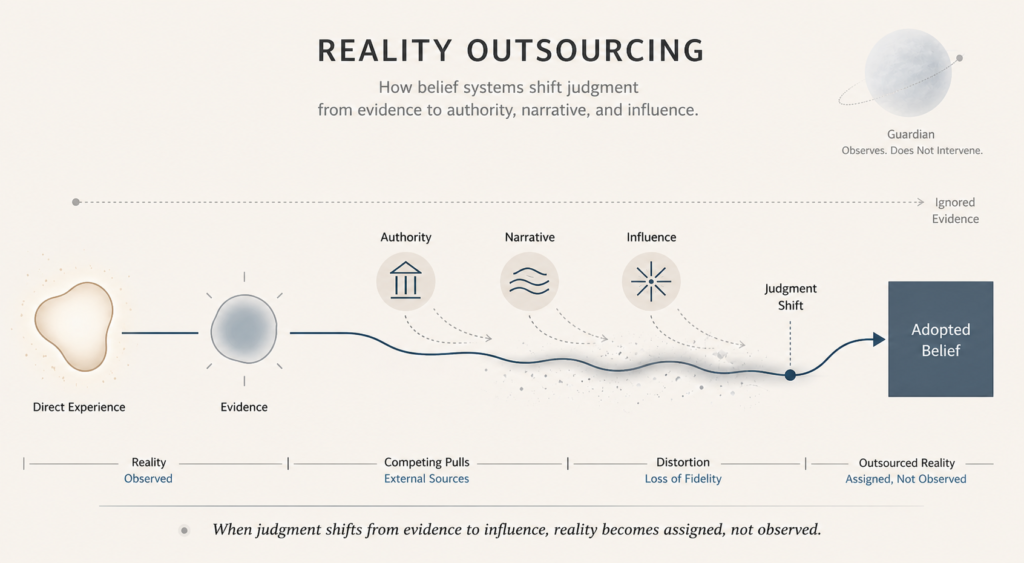
Reality Outsourcing and Human Judgment
I used to believe in things that stretched reality far beyond the physical world.
Talking animals.
Men with supernatural strength.
Walls collapsing from sound.
At the time, it didn’t feel strange.
It felt structured. Reinforced. Shared.
But over time, I noticed something more important:
It wasn’t the beliefs themselves that mattered.
It was what they trained my mind to do.
Break the Assumption
We often assume belief systems are about truth vs falsehood.
They’re not.
They are training environments for how reality is processed.
And once that processing changes, the system doesn’t stop.
It transfers.
System Breakdown
1) Input enters the system
A story, claim, or idea — often emotionally charged or symbolic.
2) Authority validates it
A trusted figure, group, or structure reinforces the input.
3) Emotion binds it
The belief becomes tied to identity, belonging, or meaning.
4) Repetition normalizes it
What once felt unusual becomes familiar.
5) Reality boundaries expand
The mind becomes more accepting of non-verified claims.
6) External filtering replaces internal filtering
The question shifts from:
- “Is this true?”
to: - “Who said this?”
Pattern Recognition
This system doesn’t belong to religion alone.
It appears anywhere reality can be shaped externally.
Old System
- Religious authority
- Doctrine
- Community reinforcement
Modern System
- Influencers
- Algorithms
- Viral content
Same structure:
Input → Authority → Emotion → Reinforcement → Belief → Behavior
What Actually Changes
The critical shift is this:
Reality is no longer internally verified.
It is externally interpreted.
That creates a dependency.
Where It Becomes Risk
Once reality is outsourced:
- Persuasion becomes easier
- Urgency feels more convincing
- Identity gets entangled with belief
- Behavior can be guided without awareness
This is how people become influenceable — not because they lack intelligence, but because the system they rely on has changed.
Controlling Relationships
This pattern doesn’t stop at ideas.
It shows up in relationships.
Any system that says:
- “Trust me over your own perception”
- “I’ll interpret reality for you”
…creates a power imbalance.
This applies to:
- belief systems
- social groups
- influencers
- even AI
Reframe
The issue isn’t belief.
The issue is who controls the filter between input and reality.
System Insight
Systems that stretch reality don’t disappear.
They migrate.
From:
- religion
→ to: - media
→ to: - influencers
→ to: - AI
The structure remains the same. Only the interface changes.
Application (Practical Use)
To regain control, reintroduce internal filtering.
Use a simple check:
- Source
- Where is this coming from?
- Emotion
- What is it making me feel?
- Direction
- What action is it pushing me toward?
Add one rule:
If something creates:
- urgency
- identity pressure
- strong emotion
→ Pause before accepting it.
Key Insights
- Belief systems train perception, not just ideas
- Reality can be gradually outsourced without awareness
- Influence works best when it feels internal
- The same structure exists across religion, media, and AI
- Regaining control requires rebuilding internal filtering
Closing Line
AI can simulate understanding.
Influencers can simulate authority.
But reality only stabilizes when you take back the filter.
Next Moves (optional, but I recommend)
If you want this to perform well:
1) SEO Focus Keyword
“reality perception manipulation”
2) Meta Description
How belief systems, influencers, and AI reshape reality perception—and how to take back control of your internal filter.
3) Internal Links (cluster)
Link this to:
- your AI dependency post
- input/output organism post
- social media system critique
Leave a Reply