Tag: boundaries

  • Family Doesn’t Guarantee Access: A Human Systems Reframe

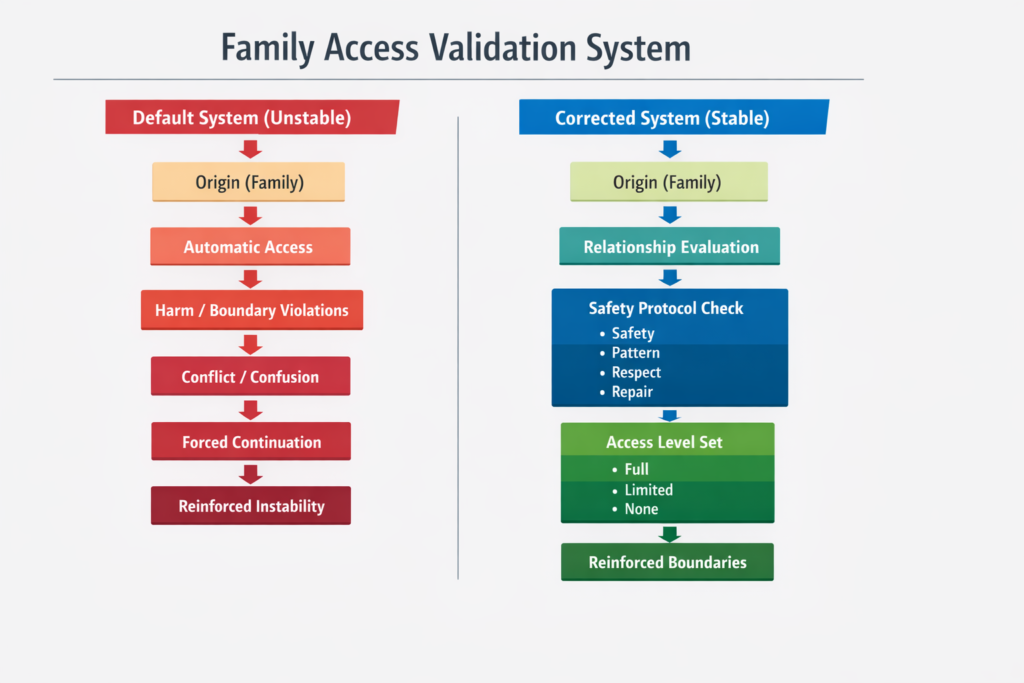
    Diagram comparing two family access systems: one where family origin leads to automatic access and repeated harm, and a second where family relationships must pass safety checks before access is granted.

    RuPaul once said:

    “As gay people, we get to choose our family.”

    For many, that statement is about survival—building connection when biological systems fail.

    But there’s a deeper system underneath it:

    It’s not just about choosing new people.

    It’s about recognizing that family never guaranteed access in the first place.


    Break the Assumption

    The default belief:

    Family → Permanent Access → Unconditional Inclusion

    This belief is inherited, not examined.

    But reality shows something different:

    • People can share blood and still be unsafe
    • People can share history and still break trust
    • People can be “family” and still not have access

    System Breakdown

    Most systems collapse three distinct layers into one:

    Origin → Relationship → Access

    1. Origin (Fixed)

    • Where you come from
    • Shared biology or history

    2. Relationship (Variable)

    • What actually formed over time
    • Trust, harm, repair, patterns

    3. Access (Controlled)

    • What is allowed now
    • Emotional, physical, relational proximity

    The Problem

    Most systems assume:

    Origin = Relationship = Access

    So even when:

    • Trust is broken
    • Harm occurred
    • Patterns repeat

    Access is still expected.

    This creates instability.


    The Missing Rule

    Family must pass the same safety protocols as anyone else

    There is no separate system.

    No bypass.

    No inherited clearance.


    The Correction

    Origin ≠ Access
    Relationship determines Access
    Access requires safety validation


    Safety Protocol Layer

    Before granting or continuing access, every relationship—family included—must pass:

    • Safety → Do interactions create stability or stress?
    • Pattern → Is behavior consistent or cyclical harm?
    • Respect → Are boundaries recognized without pressure?
    • Repair → When harm occurs, is it acknowledged and corrected?

    If these fail:

    Access is reduced or removed

    Not emotionally—structurally.


    Personal Evidence (Controlled)

    It’s possible to reach a state where:

    • There is no hatred
    • No need for apology
    • No desire for revenge

    And still:

    Access remains closed

    Not as punishment.
    Not as reaction.

    As alignment with system reality.


    Reframe

    Family is not a permission system.

    It is a starting point.

    What continues beyond that must meet the same conditions as any other relationship.


    System Insight

    Blood creates connection
    Behavior earns access
    Safety sustains it


    Why Systems Fail Here

    Many people are taught to evaluate family emotionally instead of structurally.

    That creates confusion.

    A person may think:

    • “They are still my family”
    • “I should let it go”
    • “Maybe closeness is required”
    • “Distance means I am being cruel”

    But those responses often come from inherited system pressure, not clear relationship evaluation.

    A stable system asks different questions:

    • Is this relationship safe in practice?
    • Are boundaries respected without retaliation?
    • Does contact create clarity or destabilization?
    • Is trust being rebuilt through action, or only requested through language?

    This matters because family systems often preserve access long after trust has broken down.

    That is not compassion.

    That is structural drift.

    When access is given without safety review, instability gets repeated and renamed as loyalty.

    A healthier system does the opposite.

    It separates shared origin from current eligibility for closeness.

    That is not rejection of humanity.

    It is proper boundary design.


    Application

    When evaluating any relationship, ask:

    Does this pass the same safety protocols I would require from anyone else?

    Then define clearly:

    • Full access → trust, vulnerability
    • Limited access → controlled interaction
    • No access → distance or disengagement

    And most importantly:

    Remove the “family exception”


    Key Insights

    • Family does not guarantee access
    • There is no special exemption from safety standards
    • Trust is built through behavior, not origin
    • Compassion does not require proximity
    • Boundaries are system design, not emotional reaction

  • Empathy and Influence: How Good Intentions Create Drift

    empathy and boundaries concept showing emotional overextension

    empathy-boundaries.jpg

    Empathy doesn’t just connect you to people.
    It can keep you present longer than your system can sustain.


    The Anchor

    I’m neurodivergent.

    For much of my life, I found myself in the same pattern:

    • drained
    • overextended
    • quietly giving more than I meant to

    Nothing dramatic.
    Nothing obviously harmful.

    Just a repeating question:

    How did I end up here again?


    The Break

    For a long time, I thought the problem was me:

    • not firm enough
    • not perceptive enough
    • not fast enough to see what was happening

    Now I understand something different.

    This isn’t about good people or bad people.

    It’s about how empathy, influence, and structure interact.


    System Interaction

    1. Open Access (Empathy)
    Empathy opens access:

    • attention
    • time
    • emotional availability

    Without limits, that access stays open longer than it should.


    2. Unstructured Influence
    Influence doesn’t need intention to have impact.

    Often it looks like:

    • proximity replacing invitation
    • assumptions replacing consent
    • direction replacing choice

    No clear line is crossed—
    but options quietly narrow.


    3. Structural Familiarity
    If you’ve been trained to:

    • follow authority
    • maintain harmony
    • override internal signals

    then these environments feel normal.

    Even when they cost you.


    4. Recognition Delay
    Empathy tries to understand first:

    • “Did they mean that?”
    • “What are they going through?”
    • “Am I reading this correctly?”

    That delay keeps the interaction open.


    The Interaction

    This pattern doesn’t require bad intent.

    One side opens access through empathy.
    The other moves within that access—often without realizing it.

    No one is forcing anything.

    But without clear boundaries or explicit consent,
    the interaction begins to shape direction on its own.

    That’s where drift happens.


    What This Reveals

    Empathy doesn’t always protect you.

    Sometimes it keeps you engaged longer than your system can sustain.


    Reframe

    This isn’t about becoming less empathetic.

    It’s about adding one condition:

    Empathy does not override autonomy.


    Application

    You don’t need to analyze everything.

    Check your state:

    • Do I feel ease?
    • Do I still have agency?
    • Can I say no without resistance?
    • Can I leave cleanly?

    If not, the system is already misaligned.


    Result

    You don’t harden.
    You don’t shut down.

    You stay:

    • open
    • aware
    • connected

    Without being:

    • drained
    • extended
    • pulled into patterns

    System Insight

    Empaths create access.
    Influencers shape direction.

    Without structure, neither sees the full system.


    Closing

    I’m still empathetic.
    I’m still open.

    I just no longer confuse staying too long with being kind.

    — Oddly Robbie

  • Why Indirect Communication Drains Your Energy (and What Actually Protects It)

    Most people think indirect communication is safer.

    Sarcasm. Distance. Withholding. Subtle signals instead of clear words.

    It can feel like control.

    But it isn’t.

    Why Indirect Communication Feels Like Protection

    Indirect communication looks like protection.

    In reality, it’s effort.

    It requires:

    • constant monitoring
    • interpreting signals
    • maintaining a version of yourself

    That costs energy.

    The Break

    We’re often taught that:

    • being direct is risky
    • being unclear is safer

    So people default to indirect communication.

    This is where indirect communication quietly drains you.

    They leak it.

    System Breakdown

    1. Indirect Mode (Friction)

    • signals instead of statements
    • guessing instead of knowing
    • tension instead of clarity

    Result: continuous energy drain

    2. Direct Mode (Clarity)

    • clear communication
    • defined limits
    • intentional responses

    Result: stable energy

    What This Reveals

    Energy isn’t protected by hiding.

    It’s protected by clarity.

    When you’re unclear:

    • you stay engaged longer than needed
    • you process more than necessary
    • you carry interactions with you

    When you’re clear:

    • interactions end cleanly
    • energy returns faster
    • your system resets

    Reframe

    The goal isn’t to protect yourself by being hard to read.

    The goal is to protect your energy by being clear enough to close loops.

    Application

    Instead of:

    • hinting
    • signaling
    • withdrawing indirectly

    Try:

    • stating your response clearly
    • ending the interaction cleanly
    • not carrying it forward

    No extra processing needed.

    Result

    Less mental load.
    Less emotional residue.
    More available energy.

    System Insight

    Unclear behavior extends interaction.
    Clear behavior completes it.

    Completion is what restores energy.

    Closing

    Indirect communication feels like control.

    Clarity actually is.

    — Oddly Robbie

  • Peace Isn’t Passive: Stability as an Active System

    We’re taught that peace is something you find—
    but real peace comes from an active stability system, not a calm environment.

    But that model breaks under real conditions.

    Because the world doesn’t stabilize itself.

    If your peace depends on external calm,
    you lose it the moment systems become unpredictable.


    Peace is not an environment.

    It’s a behavioral system.

    It requires:

    • boundary enforcement
    • selective connection
    • energy regulation
    • action under uncertainty

    Without these, “peace” collapses into avoidance.


    Peace isn’t passive.

    It’s the ability to remain stable while interacting with unstable systems.

    Not withdrawing.
    Not numbing.
    Not waiting.

    But engaging without losing internal structure.


    At 2AM, a neighbor called for help.

    New country. Language friction. No established protocol memory.

    There was no time to evaluate.

    Only one decision mattered:
    Do you show up, or not?

    Action replaced uncertainty.

    Not dramatic. Not heroic.
    Just functional.


    Stability is revealed under load.

    You don’t build peace in calm moments.

    You test it in disruption.

    And what holds is what you’ve already structured:

    • your boundaries
    • your response patterns
    • your willingness to act

    If you want real stability:

    • Build environments that reduce unnecessary noise
    • Choose people who don’t require self-abandonment
    • Practice small acts of intentional calm
    • Train your system to act without overprocessing

    Because when disruption comes,
    you won’t rise to the moment—

    You’ll fall back to your system.


    Peace is not something you protect from the world.

    It’s something you bring into it.

    Even at 2AM.


  • Self-Care vs Helping Others: Why Boundaries Prevent Burnout

    Sustainable systems don’t give everything at once—they continue providing over time.

    The Common Belief

    Self-care vs helping others is often misunderstood. Many believe giving more always creates more good.

    Break the Assumption

    This belief overlooks a critical flaw.

    If giving has no boundaries, it does not create more good—it creates depletion.

    The idea is familiar. In The Giving Tree, the tree gives everything it has until it becomes a stump. The story is often interpreted as generosity, but from a systems perspective, it represents total resource collapse.

    If the tree had maintained its capacity, it could have provided apples for a lifetime.

    System Breakdown

    Every person operates within a finite energy system:

    • Input → rest, nutrition, emotional recovery
    • Output → helping, working, supporting others
    • Recovery → restoring system stability

    When output exceeds input over time, the system enters delayed depletion.

    This is why burnout doesn’t feel immediate.
    It builds quietly while the person continues to give.

    Reframe

    Helping others is not about giving everything.

    It is about managing capacity so giving can continue.

    Boundaries are not a limitation of compassion—they are what make compassion sustainable.

    System Insight

    Unbounded giving is not generosity.
    It is resource exhaustion disguised as virtue.

    Sustainable support comes from preserving the system that produces it.

    The most effective people are not those who give the most once, but those who can continue giving over time.

    Application

    Shift how you evaluate your actions:

    • Set boundaries before exhaustion appears
    • Treat rest as required system maintenance
    • Monitor your energy like a limited resource
    • Reduce output when recovery is insufficient

    Instead of asking:
    “Am I giving enough?”

    Ask:
    “Can I keep giving at this level without breaking the system?”

    Key Insights

    • Energy is finite and must be managed
    • Burnout is delayed, not immediate
    • Boundaries extend your ability to help
    • Unbounded giving leads to collapse
    • Sustainable impact requires maintained capacity