Tag: neurodiversity

  • Mind Loops: When the Mind Is Running Too Many Open Systems

    We often talk about focus as if it is only a matter of discipline.

    Pay attention.
    Try harder.
    Stop being distracted.
    Be more productive.

    But sometimes the problem is not a lack of focus.

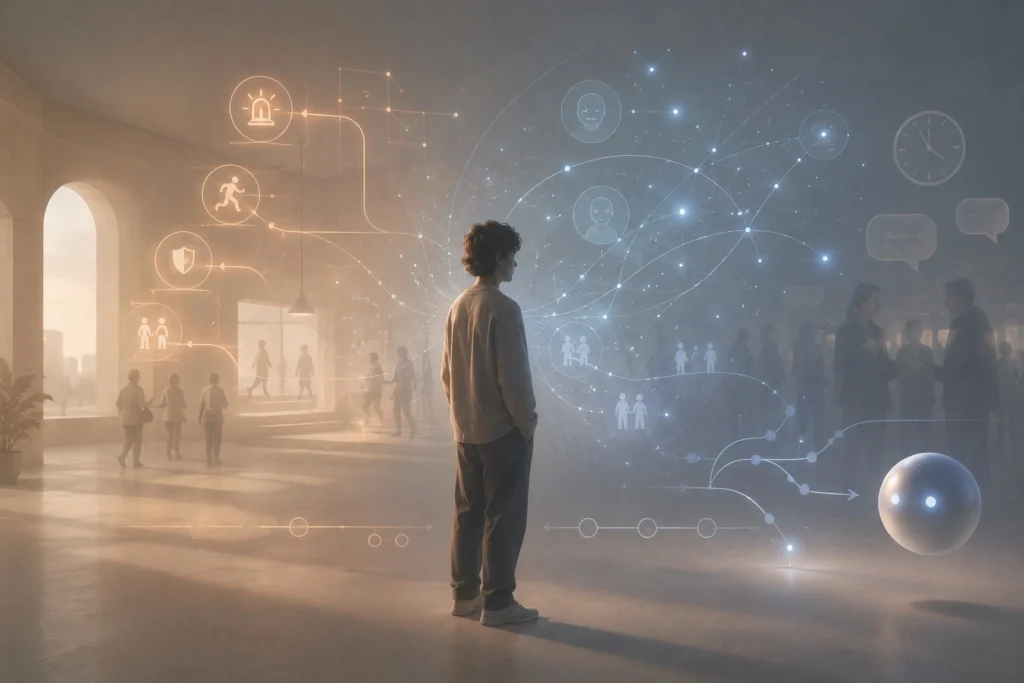
    Sometimes the problem is that the mind is running too many open loops at once.

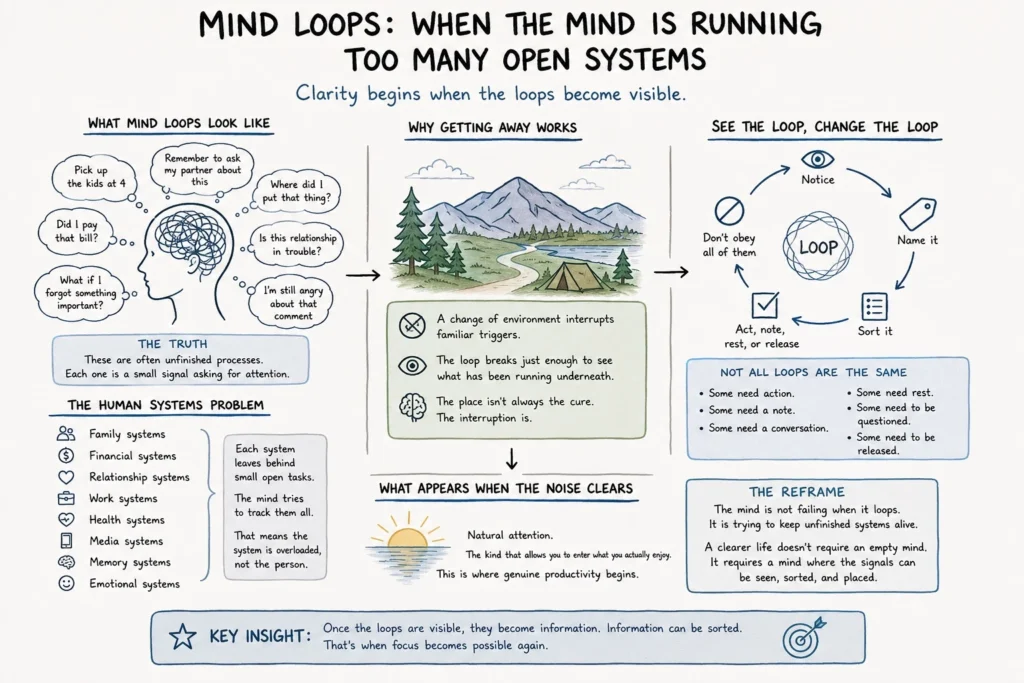
    Pick up the kids at four.
    Remember to ask my partner about this.
    Did I pay that bill?
    What was I supposed to do next?
    Where did I put that thing?
    Is this relationship in trouble?
    I need to buy more pickles.
    I am still angry about that comment.
    What if I forgot something important?

    These thoughts can seem random.

    But they are not always random.

    They are often unfinished processes.

    Each one is a small signal asking for attention. A task. A worry. A memory. A fear. A social script. A financial reminder. A relationship question. A body signal. A piece of emotional residue that has not yet cleared.

    The mind keeps looping because something has not been resolved, placed, understood, trusted, or released.

    The Human Systems Problem

    This is a Human Systems problem.

    We often treat mental noise as a personal weakness, but many times it is cognitive overload.

    Modern life asks the mind to hold too many systems at the same time.

    Family systems.
    Financial systems.
    Relationship systems.
    Work systems.
    Health systems.
    Media systems.
    Memory systems.
    Emotional systems.

    Each system leaves behind small open tasks.

    The mind tries to track them all.

    That does not mean the mind is broken.

    It means the system is overloaded.

    A person may look distracted from the outside, but internally they may be managing dozens of active loops at once. Some are practical. Some are emotional. Some are old. Some are not even important anymore, but they keep returning because they were never sorted.

    Focus becomes difficult because attention is already occupied.

    Why Getting Away Works

    Maybe this is why people love vacations, camping, long walks, or simply getting away.

    It is not always about the different place.

    Sometimes the value is that the old loop gets interrupted.

    The familiar triggers are gone for a moment. The same rooms, screens, bills, reminders, conversations, objects, obligations, and emotional scripts are not constantly pulling on attention.

    The loop breaks just enough for the person to see what has been running underneath.

    That is why distance can feel like clarity.

    Not because life disappeared.

    Because the background noise changed.

    The mind finally has enough space to show what it has been carrying.

    Seeing the Loop

    I think, for once, I finally reached the point where I could see it.

    Not perfectly.

    Not permanently.

    But clearly enough to recognize the loops for what they were.

    They were not my whole mind.

    They were repeated signals, unfinished tasks, old fears, rehearsed conversations, small obligations, and emotional echoes asking for attention.

    Once I could see them, I did not have to obey all of them.

    That changed something.

    Because when the loops are invisible, they feel like reality.

    When they become visible, they become information.

    And information can be sorted.

    Some loops need action.
    Some need a note.
    Some need a conversation.
    Some need rest.
    Some need to be questioned.
    Some need to be released.

    The goal is not to erase the mind.

    The goal is to see what is running.

    Natural Attention

    When enough noise clears away, something different appears.

    Natural attention.

    The kind that allows people to enter what they actually enjoy.

    Not forced productivity.
    Not pressure.
    Not performance.

    Coherence.

    This is where genuine productivity often begins.

    Not from pushing harder, but from reducing the number of unresolved loops competing for the same attention.

    Calm is not always something we find by adding another wellness practice.

    Sometimes calm begins when we stop feeding every loop as if it deserves control.

    Sometimes calm begins when we can finally say:

    This is a task.
    This is a fear.
    This is a memory.
    This is a practical reminder.
    This is an old script.
    This is not the whole truth.

    That separation matters.

    Because once a loop is named, it loses some of its power.

    The Reframe

    The mind is not failing when it loops.

    It is trying to keep unfinished systems alive.

    The problem is not always the thought itself.

    The problem is when too many loops remain open, unnamed, and unmanaged.

    A clearer life does not require an empty mind.

    It requires a mind where the signals can be seen, sorted, and placed.

    That is when focus becomes possible again.

    Not because the person became more disciplined.

    Because the system became more coherent.

    Key Insights

    • Mental loops are often unresolved system signals, not personal failure.
    • Focus becomes difficult when too many open loops compete for attention.
    • Changing environment can interrupt familiar triggers long enough to reveal what is underneath.
    • Once a loop becomes visible, it can be sorted instead of obeyed.
    • Calm often begins when the mind stops treating every signal as equally urgent.

  • Stim Is Self Regulation: Why Movement Creates Calm

    By Oddly Robbie

    person calmly regulating through rhythmic movement in a warm environment

    Let’s start with what “stim” actually means and why stim Is self regulation.

    Stim is short for self-stimulatory behavior.

    The term sounds clinical.

    The reality is simple:

    Stim is how the body regulates itself.


    The Anchor

    Stim is repetitive movement or sound that creates rhythm:

    • rocking
    • tapping
    • shifting weight
    • humming
    • fixing your gaze
    • breathing with motion

    It’s not performance.

    It’s regulation.

    It’s the body creating predictability in an environment that can feel:

    • loud
    • bright
    • fast
    • overwhelming

    The Break

    Everyone stims.

    • someone bouncing their knee
    • pacing during a phone call
    • an athlete rocking before a sprint
    • a musician swaying
    • someone praying in motion

    The difference is not whether we stim.

    It’s which stims are socially accepted.


    System Breakdown

    1. Regulation vs Appearance
    Stim stabilizes the nervous system.

    But environments often prioritize:

    • stillness
    • visual order
    • conformity

    Over actual regulation.


    2. Suppression Training
    Many people—especially autistic children—are taught:

    • “sit still”
    • “stop that”
    • “be normal”

    Which really means:

    regulate invisibly


    3. Internal Cost

    When movement is suppressed:

    • the body still needs regulation
    • but the outlet is removed

    So it shifts inward:

    • jaw tension
    • shoulder tightness
    • internal stress

    The system is still working—

    just less effectively.


    Lived System

    I was trained early to be still.

    In school.
    In church.
    In the military.

    Feet planted.
    Eyes forward.
    Don’t move.

    In that environment, it made sense.

    Stillness created:

    • cohesion
    • predictability
    • immediate response

    But stillness is not the same as calm.


    What Changed

    My nervous system processes input intensely:

    • sound arrives as data
    • movement registers fully
    • emotional tone is present

    So I use rhythm:

    • gentle rocking
    • breath synced with motion
    • visual anchoring

    That rhythm:

    • lowers volatility
    • reduces threat response
    • keeps me present

    What This Reveals

    Stim is not disruption.

    It’s participation.

    It allows:

    • conversation
    • presence
    • engagement
    • creation

    Without shutdown.


    Cultural Misread

    Movement that looks powerful is accepted:

    • athletes bouncing
    • speakers pacing
    • performers swaying

    Movement that looks vulnerable is judged.

    But the nervous system doesn’t make that distinction.


    Reframe

    Stillness is not always control.

    Sometimes it’s suppression.

    Movement is not immaturity.

    It’s biology.


    Application

    If your goal is regulation:

    • allow small movement
    • use rhythm intentionally
    • respect your sensory limits
    • don’t force stillness where it costs you

    Result

    Less overwhelm.
    More presence.
    More sustainable engagement.


    System Insight

    The nervous system regulates through rhythm.

    Not appearance.


    Closing

    I don’t stim to withdraw from the world.

    I stim so I can stay in it.

    Stim is freedom to feel calm.

    And calm is not weakness.

    It’s stability without tension.

    — Oddly Robbie

  • Human Response to Stress Isn’t Failure—It’s System Overload


    Human response to stress illustrated as a silhouette with calm signals on one side and chaotic sensory overload on the other

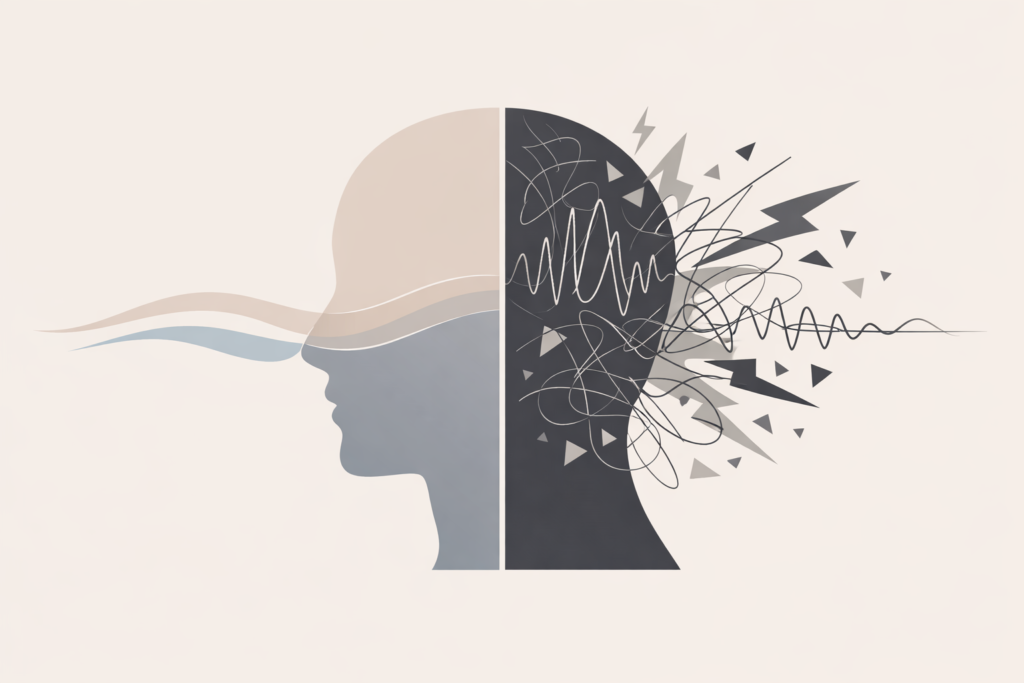
    The Human Response to Stress Isn’t Failure—It’s System Overload.

    Lets break the assumption.

    When people shut down, freeze, or make poor decisions under pressure, it’s often labeled as weakness or failure.

    That framing is wrong.

    What looks like failure is usually a system exceeding its limits.


    System Breakdown

    Every human operates within a system:

    • Input: sensory load, pressure, urgency, environment
    • Processing: nervous system state, past experience, cognitive capacity
    • Output: decisions, actions, reaction speed
    • Feedback: outcome, emotional response, system adjustment

    Under normal conditions, this system performs well.

    Under excessive load, it degrades.

    Not because the person changes—but because the system is saturated.


    What Overload Actually Does

    When the system exceeds capacity:

    • Processing narrows
    • Reaction time distorts
    • Fine decision-making collapses
    • The body shifts into survival mode

    At that point, behavior is no longer optimized for precision.

    It is optimized for continuation.


    Personal Evidence (Condensed)

    In a high-pressure moment, a grenade didn’t go far enough.

    But I did.

    Not because I was fearless.
    Not because I performed perfectly.

    Because the system kept moving—even while it was breaking.


    Reframe

    Under pressure, performance doesn’t reveal character.

    It reveals system limits.

    This distinction matters.

    Because if you mislabel system overload as personal failure, you design solutions that don’t work.


    System Insight

    Humans don’t fail randomly.

    They fail predictably when:

    • Input exceeds processing capacity
    • Environments ignore human limits
    • Systems are designed for ideal conditions, not real ones

    The outcome is not a mystery.

    It’s a design flaw.


    Application

    If you want better human performance:

    Don’t push harder.

    Design better systems.

    • Reduce unnecessary input
    • Match environments to human capacity
    • Allow for degradation without collapse
    • Build for real conditions, not perfect ones

    This applies to:

    • Emergency response
    • Work environments
    • Technology design
    • Education
    • XR systems and AI interaction

    Key Insights

    • Human breakdown under pressure is system saturation, not personal failure
    • Performance under stress reflects system design, not character
    • Environments shape outcomes before decisions are made
    • Systems that adapt to humans outperform systems that demand conformity
    • Better design prevents failure states before they occur

    Final Thought

    If you’ve ever frozen, shut down, or failed under pressure, it wasn’t random.

    It was your system reaching its limit.

    The question isn’t:
    “Why did I fail?”

    It’s:
    “What conditions pushed my system past what it could handle?”

    That’s where real understanding begins.

    And where better systems are built.

  • Why We Outgrew the 9-to-5—But Haven’t Reclaimed Rest Yet

    Split scene contrasting overworked office environment with peaceful daytime rest, illustrating biphasic sleep and human-aligned energy cycles.

    The Belief We Inherited

    Remember nap time as a kid?

    We resisted it. Fought it. Didn’t want to stop.

    Now as adults, we’ve flipped completely—pushing through exhaustion as if rest is something we’re supposed to outgrow.

    But that assumption doesn’t hold up.

    The need for midday rest never disappeared.
    We just built systems that ignore it.


    System Breakdown — Where This Came From

    Modern schedules were not designed around human biology.

    They were designed for:

    • industrial efficiency
    • synchronized labor
    • predictable output

    The result is a rigid expectation:

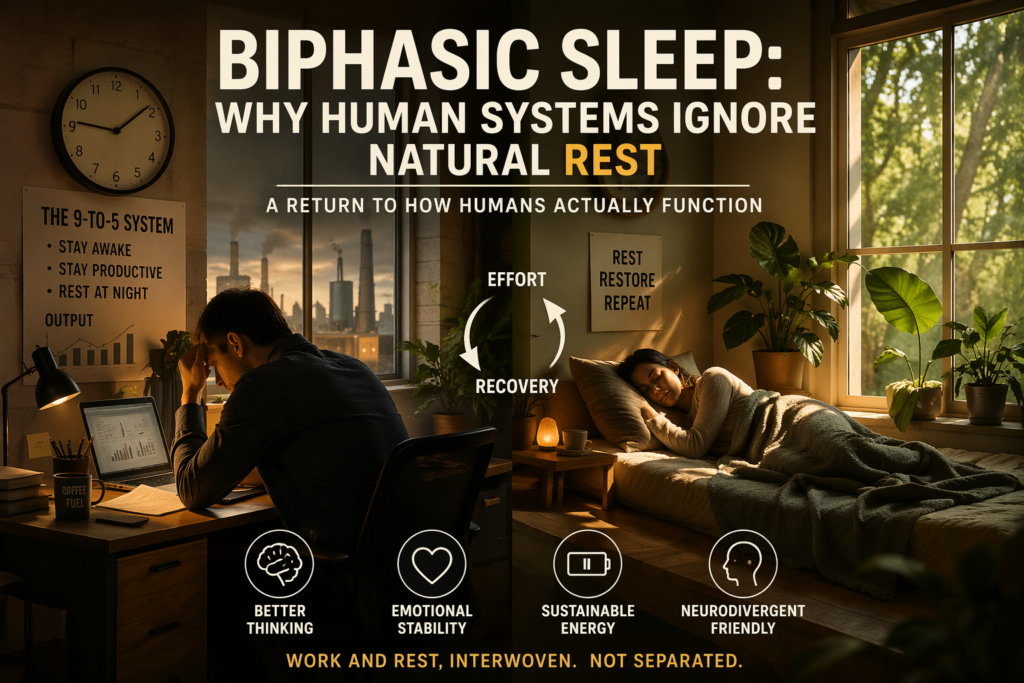
    stay awake → stay productive → rest only at night

    But human energy doesn’t work like that.

    Historically, humans often slept in two phases:

    • a longer rest at night
    • a second rest during the day

    This is known as biphasic sleep.

    It wasn’t a flaw.
    It was alignment.


    What Actually Happens

    Short naps don’t work for me.

    They feel like a partial reset—just enough to notice the fatigue, not enough to resolve it.

    But when I allow a true 1–3 hour rest:

    • my system fully resets
    • my thinking becomes clear again
    • overstimulation drops

    It’s not indulgence.

    It’s completion.


    The Real Mistake

    We don’t need to “optimize naps.”

    We need to stop shrinking rest to fit productivity systems.

    A 20-minute nap is treated as efficient.
    But efficiency isn’t the goal—restoration is.


    What Changes Now

    We are entering a world where:

    • automation reduces constant labor demands
    • schedules become more flexible
    • individuals regain control over time

    This creates a new possibility:

    Work and rest can be interwoven instead of separated.

    Instead of one long depletion cycle, we can move through:

    • effort → recovery → effort → recovery

    This improves:

    • cognitive performance
    • emotional stability
    • long-term sustainability

    For neurodivergent individuals, this isn’t optional—it’s stabilizing.


    How to Test This

    Don’t overthink it. Test it directly.

    • Allow one true rest window during the day
    • Reduce stimulation before rest (lower light, no screens)
    • Let the rest complete naturally (don’t force short naps)
    • Observe how you function after—not during

    The key shift:

    Measure what improves after rest, not how disciplined you were avoiding it.


    Where This Breaks Today

    Most structured environments still reject this.

    For example, adult care systems often:

    • prioritize constant engagement
    • discourage rest
    • unintentionally increase overstimulation

    For many people—especially those with sensory sensitivity—this creates unnecessary stress.

    A better system would include:

    • structured quiet time
    • optional deep rest periods
    • environments designed for recovery, not just activity

    This is a design problem, not a personal one.


    The Real Question

    Rest isn’t something we grow out of.

    It’s something our systems trained us to ignore.

    Now that we have more control over how we structure our time, the question isn’t:

    Should we rest during the day?

    It’s:

    Why did we design a world where we stopped?

  • When Rituals Don’t Fit: A Different Way to See Neurodiversity

    Many social environments are built around rituals.

    Shared meals.
    Extended conversations.
    Structured gatherings.

    For many people, these create connection.

    For others, they create strain.

    A Different Experience

    As an autistic individual, I experience many of these rituals differently.

    What feels natural to some can feel overwhelming or exhausting to me.

    • crowded environments
    • extended social expectations
    • sensory overload

    These aren’t minor inconveniences.

    They can be genuinely difficult.

    The Mismatch

    The issue isn’t that rituals exist.

    It’s that they are often treated as universal.

    When someone doesn’t fit them, the assumption becomes:

    “They need to adapt.”

    But often, it’s the system that needs adjustment.

    What Rituals Actually Do

    Rituals serve a purpose:

    • create connection
    • provide structure
    • reinforce belonging

    That works well—when the system fits the person.

    When it doesn’t, the same structure can create exclusion.

    Cultural Perspective

    Living in different cultures made this clearer.

    In Japan, structure and expectation are precise.

    In Argentina, social rituals are extended and expressive.

    Both are valid.

    Both can also be overwhelming—depending on how you process the world.

    A Better Approach

    The goal shouldn’t be to remove rituals.

    It should be to make them more flexible.

    That might mean:

    • allowing variation in participation
    • reducing unnecessary pressure
    • creating multiple ways to engage

    This directly connects to how I think about human systems.

    Systems work best when they:

    • support different ways of participating
    • reduce unnecessary friction
    • adapt to people—not force conformity

    Because inclusion isn’t about adding people into a system.

    It’s about adjusting the system itself.

    System Application

    A healthier system does not require every person to participate in the same way.

    It asks better questions:

    • What function is this ritual supposed to serve?
    • Does this interaction actually create connection, or only signal conformity?
    • Who is being excluded by the default expectation?
    • Can the same social purpose be met through more than one path?

    This matters in schools, workplaces, families, healthcare, public services, and digital environments.

    When systems allow only one acceptable form of participation, they create unnecessary pressure. People may appear distant, resistant, rude, or disengaged when they are actually trying to manage sensory load, timing, uncertainty, or social translation.

    The problem is not always the person.

    Often, the problem is that the system has mistaken one communication style for the only valid one.

    Reframe

    Neurodiversity does not ask society to remove all structure.

    It asks society to stop confusing structure with sameness.

    Clear expectations can help. Predictable environments can help. Flexible participation can help. What harms people is not structure itself, but rigid structure that leaves no room for different nervous systems.

    A more mature human system recognizes that connection can happen through speech, silence, shared work, written communication, parallel presence, direct honesty, or quiet trust.

    Different does not mean disconnected.

    Different means the system needs more than one doorway.

    Key Insights

    • Social rituals are not universal human requirements.
    • Some rituals create connection, while others only enforce conformity.
    • Neurodivergent people are often misread when systems prioritize performance over function.
    • Flexible participation improves inclusion without lowering standards.
    • Human systems become stronger when they design for real nervous systems, not idealized social behavior.

  • Human Systems Thinking: Oddly Robbie’s Personal Operating System

    Robbie Ellestad portrait – XR and AI systems architect, founder of EmpathiumXR

    Human systems thinking starts with a simple observation: most personal blogs begin with a story, but stories alone don’t explain how people actually operate.

    A story.
    A background.
    A timeline of where someone has been.

    It makes sense. People want context before they engage.

    But context alone doesn’t explain anything.


    The Assumption

    We tend to believe that understanding a person comes from knowing their past.

    Where they grew up.
    What they went through.
    What shaped them.

    But that model is incomplete.

    Because people are not defined by events.

    They are defined by the systems they build to navigate those events.


    The System

    Every human develops internal systems over time.

    • How they process information
    • How they regulate emotion
    • How they make decisions
    • How they relate to others
    • How they adapt to change

    These systems are not fixed.
    They evolve through friction, contrast, and iteration.

    Military structure. Personal freedom.
    Isolation. Connection.
    Constraint. Exploration.

    Each contrast forces an adjustment.

    Over time, those adjustments become a personal operating system.


    Personal Context (Condensed)

    I’m Robbie.

    A veteran.
    An autistic systems thinker.
    Someone who has lived across cultures—Montana, Argentina, Japan, and now Spain.

    Each environment didn’t just add experience.

    It forced system updates.

    Different languages.
    Different expectations.
    Different definitions of identity.

    What emerged wasn’t a single story.

    It was a way of seeing.


    The Reframe

    This is not a blog about my life.

    It’s a space for observing and refining human systems.

    The focus is not:

    • what happened

    The focus is:

    • how systems form
    • how they break
    • how they can be redesigned

    What This Becomes

    This work now extends into something more intentional:

    Empathium

    An exploration of AI, XR, and human-centered systems designed to support:

    • Autonomy
    • Emotional clarity
    • Real-world connection

    Not technology that replaces people.

    Technology that understands human limits and works with them.


    System Insight

    Most people don’t need more information.

    They need better internal systems for:

    • interpreting reality
    • regulating response
    • navigating complexity

    When those systems improve, outcomes change naturally.


    Why Human Systems Thinking Matters

    Without a clear internal system, people rely on reaction instead of design.

    This leads to:

    • inconsistent decisions
    • emotional volatility
    • dependency on external structure

    Human systems thinking shifts the focus from reacting to events toward designing how you respond to them.

    Instead of asking:
    “What should I do in this situation?”

    You begin asking:
    “What system would make this decision easier next time?”


    Application

    This space brings together:

    • Personal experience → as system input
    • Technology → as system extension
    • Neurodiversity → as system variation
    • Future design → as system direction

    Nothing here is presented as final.

    Everything is iterative.


    What to Expect

    No polished perfection.
    No simplified answers.

    Instead:

    • Clear patterns
    • Working models
    • Real adjustments

    If you’re looking for certainty, this won’t help.

    If you’re learning how to think, adapt, and build your own systems—

    You’re in the right place.


    Key Insights

    • People are not their stories—they are their systems
    • Experience only matters if it changes how you operate
    • Better systems reduce the need for constant effort
    • Technology should support human systems, not override them
    • Growth is not linear—it’s iterative system refinement