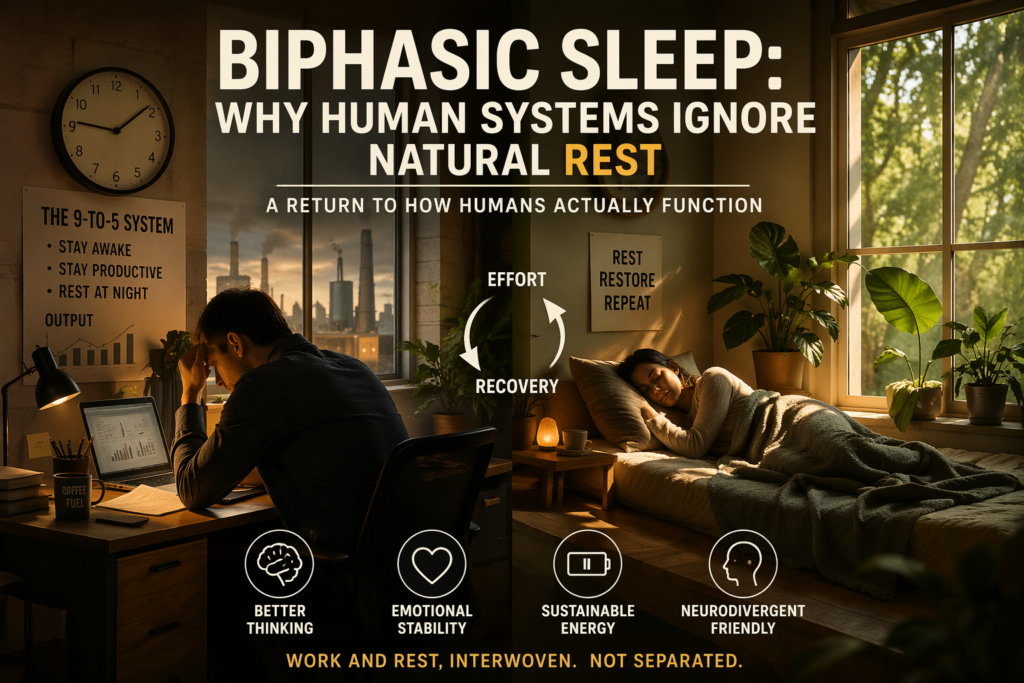
The Belief We Inherited
Remember nap time as a kid?
We resisted it. Fought it. Didn’t want to stop.
Now as adults, we’ve flipped completely—pushing through exhaustion as if rest is something we’re supposed to outgrow.
But that assumption doesn’t hold up.
The need for midday rest never disappeared.
We just built systems that ignore it.
System Breakdown — Where This Came From
Modern schedules were not designed around human biology.
They were designed for:
- industrial efficiency
- synchronized labor
- predictable output
The result is a rigid expectation:
stay awake → stay productive → rest only at night
But human energy doesn’t work like that.
Historically, humans often slept in two phases:
- a longer rest at night
- a second rest during the day
This is known as biphasic sleep.
It wasn’t a flaw.
It was alignment.
What Actually Happens
Short naps don’t work for me.
They feel like a partial reset—just enough to notice the fatigue, not enough to resolve it.
But when I allow a true 1–3 hour rest:
- my system fully resets
- my thinking becomes clear again
- overstimulation drops
It’s not indulgence.
It’s completion.
The Real Mistake
We don’t need to “optimize naps.”
We need to stop shrinking rest to fit productivity systems.
A 20-minute nap is treated as efficient.
But efficiency isn’t the goal—restoration is.
What Changes Now
We are entering a world where:
- automation reduces constant labor demands
- schedules become more flexible
- individuals regain control over time
This creates a new possibility:
Work and rest can be interwoven instead of separated.
Instead of one long depletion cycle, we can move through:
- effort → recovery → effort → recovery
This improves:
- cognitive performance
- emotional stability
- long-term sustainability
For neurodivergent individuals, this isn’t optional—it’s stabilizing.
How to Test This
Don’t overthink it. Test it directly.
- Allow one true rest window during the day
- Reduce stimulation before rest (lower light, no screens)
- Let the rest complete naturally (don’t force short naps)
- Observe how you function after—not during
The key shift:
Measure what improves after rest, not how disciplined you were avoiding it.
Where This Breaks Today
Most structured environments still reject this.
For example, adult care systems often:
- prioritize constant engagement
- discourage rest
- unintentionally increase overstimulation
For many people—especially those with sensory sensitivity—this creates unnecessary stress.
A better system would include:
- structured quiet time
- optional deep rest periods
- environments designed for recovery, not just activity
This is a design problem, not a personal one.
The Real Question
Rest isn’t something we grow out of.
It’s something our systems trained us to ignore.
Now that we have more control over how we structure our time, the question isn’t:
Should we rest during the day?
It’s:
Why did we design a world where we stopped?
Leave a Reply