Tag: relationships

  • Family Doesn’t Guarantee Access: A Human Systems Reframe

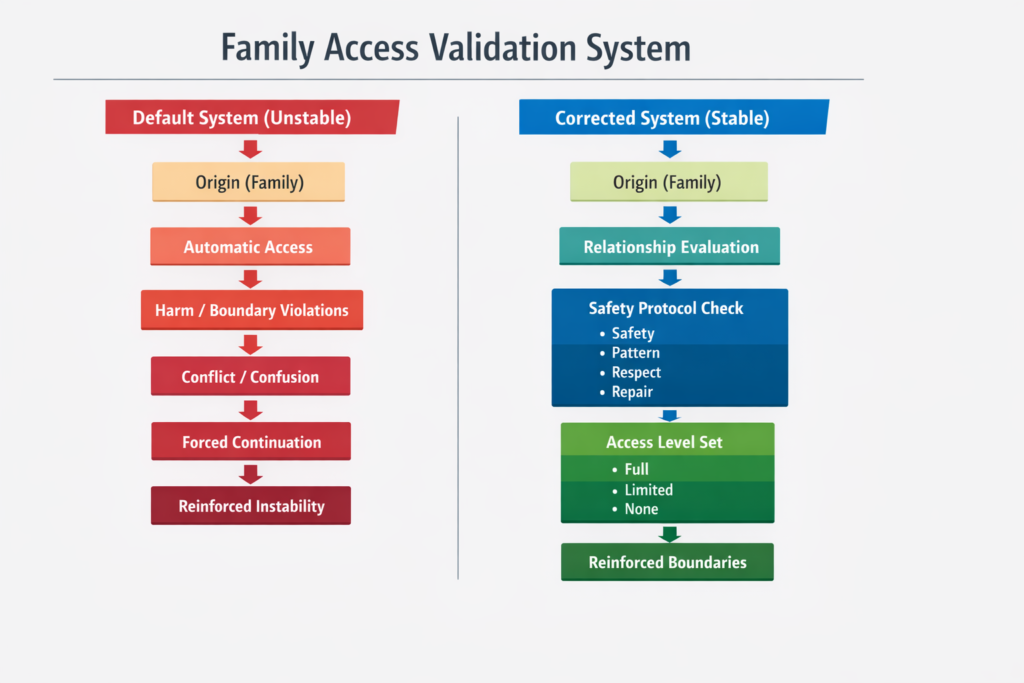
    Diagram comparing two family access systems: one where family origin leads to automatic access and repeated harm, and a second where family relationships must pass safety checks before access is granted.

    RuPaul once said:

    “As gay people, we get to choose our family.”

    For many, that statement is about survival—building connection when biological systems fail.

    But there’s a deeper system underneath it:

    It’s not just about choosing new people.

    It’s about recognizing that family never guaranteed access in the first place.


    Break the Assumption

    The default belief:

    Family → Permanent Access → Unconditional Inclusion

    This belief is inherited, not examined.

    But reality shows something different:

    • People can share blood and still be unsafe
    • People can share history and still break trust
    • People can be “family” and still not have access

    System Breakdown

    Most systems collapse three distinct layers into one:

    Origin → Relationship → Access

    1. Origin (Fixed)

    • Where you come from
    • Shared biology or history

    2. Relationship (Variable)

    • What actually formed over time
    • Trust, harm, repair, patterns

    3. Access (Controlled)

    • What is allowed now
    • Emotional, physical, relational proximity

    The Problem

    Most systems assume:

    Origin = Relationship = Access

    So even when:

    • Trust is broken
    • Harm occurred
    • Patterns repeat

    Access is still expected.

    This creates instability.


    The Missing Rule

    Family must pass the same safety protocols as anyone else

    There is no separate system.

    No bypass.

    No inherited clearance.


    The Correction

    Origin ≠ Access
    Relationship determines Access
    Access requires safety validation


    Safety Protocol Layer

    Before granting or continuing access, every relationship—family included—must pass:

    • Safety → Do interactions create stability or stress?
    • Pattern → Is behavior consistent or cyclical harm?
    • Respect → Are boundaries recognized without pressure?
    • Repair → When harm occurs, is it acknowledged and corrected?

    If these fail:

    Access is reduced or removed

    Not emotionally—structurally.


    Personal Evidence (Controlled)

    It’s possible to reach a state where:

    • There is no hatred
    • No need for apology
    • No desire for revenge

    And still:

    Access remains closed

    Not as punishment.
    Not as reaction.

    As alignment with system reality.


    Reframe

    Family is not a permission system.

    It is a starting point.

    What continues beyond that must meet the same conditions as any other relationship.


    System Insight

    Blood creates connection
    Behavior earns access
    Safety sustains it


    Why Systems Fail Here

    Many people are taught to evaluate family emotionally instead of structurally.

    That creates confusion.

    A person may think:

    • “They are still my family”
    • “I should let it go”
    • “Maybe closeness is required”
    • “Distance means I am being cruel”

    But those responses often come from inherited system pressure, not clear relationship evaluation.

    A stable system asks different questions:

    • Is this relationship safe in practice?
    • Are boundaries respected without retaliation?
    • Does contact create clarity or destabilization?
    • Is trust being rebuilt through action, or only requested through language?

    This matters because family systems often preserve access long after trust has broken down.

    That is not compassion.

    That is structural drift.

    When access is given without safety review, instability gets repeated and renamed as loyalty.

    A healthier system does the opposite.

    It separates shared origin from current eligibility for closeness.

    That is not rejection of humanity.

    It is proper boundary design.


    Application

    When evaluating any relationship, ask:

    Does this pass the same safety protocols I would require from anyone else?

    Then define clearly:

    • Full access → trust, vulnerability
    • Limited access → controlled interaction
    • No access → distance or disengagement

    And most importantly:

    Remove the “family exception”


    Key Insights

    • Family does not guarantee access
    • There is no special exemption from safety standards
    • Trust is built through behavior, not origin
    • Compassion does not require proximity
    • Boundaries are system design, not emotional reaction

  • Not All Distance Is Emotional — Some of It Is Structural

    Conceptual illustration of a human social system where two central figures form a new relationship center while others are repositioned farther away, representing structural distance in relationships.

    Every system reorganizes when a new center forms.

    In human systems, that center is often a relationship.

    When two people become primary to each other,
    the structure around them shifts:

    who is close
    who is peripheral
    who remains visible

    Most people experience this as emotion.

    But it isn’t emotional first.

    It’s structural.

    What looks like distance… is often reorganization.


    Break the Assumption

    We’re taught to interpret distance as meaning:

    something is wrong
    someone pulled away
    something needs to be fixed

    So when relationships shift, we look for emotional explanations.

    But many of these shifts don’t come from conflict.

    They come from structure.


    System Breakdown

    1. Ritual as Structure

    Events like weddings aren’t just emotional moments.

    They function as system resets:

    • defining roles
    • signaling hierarchy
    • setting future proximity

    They don’t just celebrate relationships.

    They reorganize them.


    2. Social Repositioning

    When a new central relationship forms,
    other relationships shift outward in priority.

    Not as rejection— but as reorganization.

    The system reallocates attention, time, and presence.

    No conversation required.


    3. Silent Transition

    These changes rarely get discussed.

    They don’t announce themselves.

    They happen through behavior:

    • where you sit
    • how often you’re contacted
    • how decisions include (or exclude) you

    The signal is subtle—but consistent.


    Personal Evidence

    I experienced this directly.

    I once had a best friend—a military buddy.

    We traveled together. Lived close. Built under pressure.

    He was the best man at my wedding.

    Later, when he married, I wasn’t his.

    That part made sense.

    But something else happened.

    I was asked to move seats.

    From the close row… to the back.

    It was small.

    But it wasn’t about a chair.

    It was a preview.

    Over time, the distance continued.

    Not dramatically.

    Just quietly.

    I saw a similar pattern at another wedding.

    A couple left early.

    Later, I learned they were quietly cut off. No argument.
    No discussion.

    Just a silent downgrade.I had also left early. I chose not to mention it— not out of fear, but because I could see the system they were operating in.


    Reframe

    Most people interpret distance as rejection.

    But in human systems, distance often follows structure—not intention.

    When you mistake structural change for emotional meaning, you create confusion that doesn’t exist.


    System Insight

    Not all distance is conflict.

    Some distance is structural.

    Rituals can amplify connection— but they also reveal how a system is organized.

    And structure doesn’t always match emotion.


    Application

    If you want to understand your relationships more clearly, ask:

    • Has a new “center” formed in this system?
    • Has my position shifted relative to that center?
    • Am I reacting to behavior… or assigning meaning to it?
    • What changes if I stop taking this personally?

    This doesn’t remove feeling.

    It removes misinterpretation.


    Result

    Less pressure.

    Fewer unnecessary conversations.

    More accurate understanding.

    More stable connection.


    Closing

    Once you see this, something changes.

    You stop chasing explanations that aren’t there.

    You stop forcing conversations that don’t need to happen.

    You stop taking structural shifts personally.

    And instead, you start reading the system.

    Because not all distance is conflict.

    Some distance is structural.

    And when you understand that,

    you move with clarity instead of confusion.

    — Oddly Robbie

  • Connection Doesn’t Require Shared Experience

    Opening

    There’s a hill above a small-town football field.

    Second tier.

    That’s where the brown station wagon parked on Friday nights.

    1970s brown. Long. Heavy doors. More room than car.

    Down below, my dad was the head coach.

    At that age, he might as well have been invisible to me—not emotionally, just physically. I didn’t see him. I didn’t interact with him.

    I only knew that being there mattered.


    Break the Assumption

    We tend to believe connection requires interaction.

    Shared activity. Conversation. Engagement.

    If those aren’t present, we assume distance.

    But that assumption doesn’t hold.


    System Breakdown

    There are at least two distinct modes of human connection:

    1. Participatory Connection

    • Direct interaction
    • Shared experience
    • Active engagement

    2. Observational Presence

    • No interaction
    • No shared activity
    • But stable, known presence within the same environment

    Both are valid. Both create connection.


    Personal Evidence (Controlled)

    Inside the station wagon, my mom engineered warmth.

    Heat turned up high. Blankets. Contained comfort.

    Outside, my dad existed in a completely separate layer—focused, unavailable, part of another system entirely.

    I didn’t engage with him.

    But I knew where he was.

    And that mattered.


    Reframe

    Connection is not binary.

    It is not “connected” or “not connected.”

    It operates across different modes.

    Presence alone—when stable and predictable—can create a form of connection that does not require interaction.


    System Insight

    Humans don’t require shared experience to feel connected.

    They require:

    • Consistent presence
    • Predictable placement in a shared structure
    • Awareness that the other exists within their world

    This creates:

    A low-demand connection system that still supports emotional stability.


    Application

    This matters more than it seems.

    In relationships

    Not every connection needs constant interaction.
    Some people connect through proximity, not participation.

    In neurodivergent systems

    Lower-interaction connection models reduce social load while preserving connection.

    In digital and XR environments

    Systems like Guardians don’t need to constantly engage.
    They can exist as stable, peripheral presence—available, but not intrusive.

    In everyday life

    Being there—consistently—often matters more than trying to perform connection.


    Key Insights

    • Connection does not require interaction
    • Presence can be enough when it is consistent
    • Shared space can replace shared activity
    • Predictability creates emotional stability
    • Low-demand connection systems are still real connection

    Closing

    I didn’t need to see him.

    I didn’t need to interact.

    I just needed to know he was there.

    And that was enough.