The future of calendars isn’t about time.
There was a time when calendars came in the mail.
Insurance companies sent them at the end of the year. You’d hang one on the fridge, circle a few dates, maybe write something small in the corner.
It wasn’t perfect.
But it worked.
Then calendars moved into our phones.
They synced across devices.
They became faster, cleaner, more precise.
But something important didn’t improve.
The Break
We digitized the calendar.
We didn’t redesign it.
We kept:
- rigid grids
- fixed time slots
- numbered boxes
We just made them glow.
But the human mind doesn’t work in boxes.
It doesn’t think:
“3:00–4:00 PM”
It thinks:
“This will take effort.”
“This feels heavy.”
“I don’t have the energy for this today.”
The System Behind the Problem
A traditional calendar assumes:
- all time blocks are equal
- all events have the same weight
- visibility equals usefulness
None of that is true.
Time is not flat.
Events are not equal.
And seeing everything does not mean understanding anything.
Reframe
A calendar is not a storage system for time.
It is a navigation system for energy and action.
The Shift: From Boxes to Bubbles
The next evolution is simple:
Time stops looking like a grid.
It starts looking like a field.
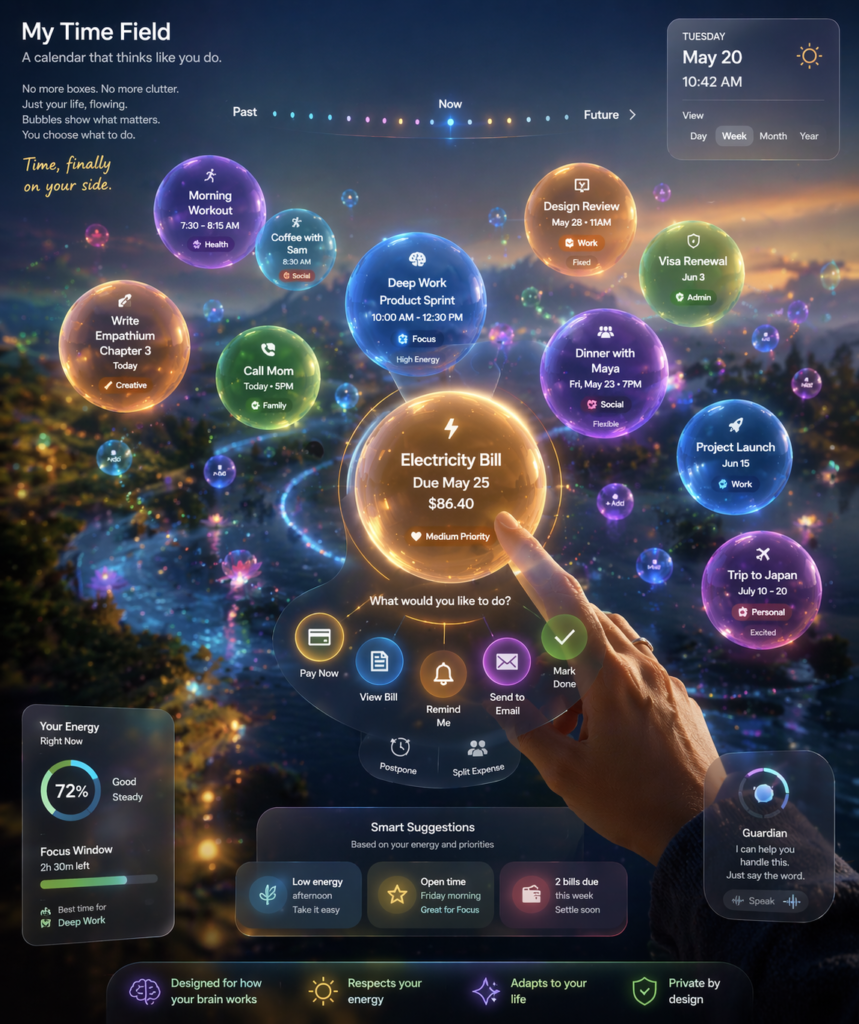
Instead of boxes, you see bubbles.
Each bubble represents something real:
- a task
- a commitment
- a moment that will take energy
Some are large.
Some are small.
Some are fixed.
Some can move.
Empty days are not filled with numbers.
They are simply… open.
This is what energy-based scheduling actually looks like in practice.
The Actionabubble System
Here’s where it changes everything.
A bubble is not just something you look at.
It becomes an Actionabubble — a unit of time that contains its own actions.
Tap it, and it opens.
Not into a menu.
Into contextual choices built into the moment itself:
- Call
- Message
- Pay
- Order a ride
- Postpone
- Cancel
No switching apps.
No hunting for buttons.
The action lives inside the moment.
This is the shift:
Time is no longer something you manage.
It becomes something you act on.
Energy-Aware Time
Not all days are the same.
Some days:
- you’re focused
- you’re social
- you’re drained
A real system adapts.
You wake up low energy.
Instead of pushing everything at you, the system shifts:
- heavy Actionabubbles soften or move
- lighter options come forward
- urgent items stay visible
It doesn’t fight you.
It works with you.
System Insight
When time becomes visual and interactive:
- You don’t manage tasks
- You navigate your life
And when action is embedded inside each bubble:
- You don’t plan what to do
- You act from where you are
Application
A human-centered time system would:
- remove rigid grids
- show only what matters now
- represent events as energy objects
- use Actionabubbles for direct interaction
- adapt based on your state
Not more features.
Less friction.
What This Replaces
This doesn’t improve the calendar.
It replaces it.
Not with more features—but with a different model entirely.
Instead of asking:
“What time is this scheduled?”
The system asks:
“What state are you in—and what can you do from here?”
That’s the difference between managing time and navigating life.
Key Insights
- The calendar was never the problem — the model was
- Time is better understood as energy, not numbers
- Visibility should be earned, not constant
- Action should exist at the point of awareness
- The Actionabubble System replaces planning with execution
- Systems should adapt to humans, not the other way around
Time won’t always be boxes on a screen.
It will feel like something you move through.
Something you shape.
Something that responds back.
And when that happens—
You won’t be managing your schedule anymore.
You’ll just be living it.
This is how human systems evolve—away from rigid structures and toward adaptive, human-centered design.
Leave a Reply