I can sit beside a loud, choppy sea and feel quite comfortable. Or enjoy a good thunderstorm, lightning and all. A fan running nearby can disappear into the background.
But a quiet baby crying through the wall can keep me awake.
Apparently, my nervous system has its own editorial department. The ocean gets approved. The baby becomes breaking news.
Very early this morning, that was exactly what happened. The crying wasn’t loud, but my attention kept going toward it. I put on a fan sound with white noise through the speakers, part of the little setup I’m building in the bedroom.
A low level was enough to completely mask the crying for me. I went back to sleep.
Such a small thing. But being able to go back to sleep is a fairly substantial feature at that hour.
The sound that keeps asking
I’m beginning to notice that volume alone doesn’t explain what bothers me.
A steady sound can leave me alone. An intermittent one keeps asking for attention. A thump, another thump, then a pause. Has it stopped? Should I prepare for another?
Perhaps it’s a child kicking a wall at two in the morning. I don’t know. From my side of the wall, I’m getting the percussion section without the programme notes.
The room can become quiet while some part of me is still listening.
That’s what I want to experiment with: a little more control over what gets access to my attention.
A motorcycle in an echo chamber
Today I had another example down in the garage.
A guy revved his motorcycle in there. Everything echoes in that space, so the sound had plenty of opportunities to introduce itself.
I was wearing my AirPods Pro and listening to music. The noise cancellation reduced some of it, but plenty still came through. Then the music automatically became louder, and I could hear it clearly again.
Between the cancellation and the music covering more of the noise, I came through it without feeling frazzled.
The motorcycle carried on being a motorcycle. I had a useful buffer.
A little weather of my own
Fireworks are harder for me. A sudden boom can bring an immediate fear response connected to past experiences.
I’ve been wondering whether a boom could trail into a rumble of thunder, followed by steady rain that makes the next explosions stand out less.
A little weather of my own.
That is an idea to test. A system reacting after an explosion cannot take back the first sound that has already reached me. Perhaps rain already playing, or continuing afterward, could help me settle. I don’t know yet.
And someone else might find thunder thoroughly unhelpful. Their ideal setting could be my worst setting.
Which is why the person needs the controls.
Spain puts autonomy into the picture
This connects with something larger happening here in Spain.
A new law reforming Spain’s disability and dependency legislation explicitly includes applied AI, connected devices, home automation and robotics among the technologies that can be used in teleassistance. It places emphasis on people’s wishes, independent living and support in their homes and communities.
The law takes effect on 23 October 2026. Available services will depend on further implementation. We haven’t all been issued a household robot. Mine still requires me to do most of the assembly.
But the direction catches my attention because it connects with what I’m building: an adjustable buffer around me.
In the past, I’ve experienced medication leaving me feeling as though I couldn’t feel anything. I don’t want that experience again. I want to enjoy music, attend my classes, be around people and feel my life.
AI and, eventually, robotics interest me for what they might help a particular person do. Everyone has different difficulties. Sometimes even explaining the difficulty is difficult. Useful support should help us express our preferences, try adjustments and keep making our own choices.
This morning, my version of that was a speaker playing a quiet fan sound.
Before my first painting class here in Spain, I’d already spent quite a lot of time thinking about being in it. I hadn’t picked up a brush, but my brain was busy with the room, the teacher, the other people, and whether I would understand enough Spanish to keep up.
I’ve been through much tighter pinches than a community painting class. Which made this slightly funny. There I was, getting first-day jitters over a jug.
But culture, language and unfamiliar class expectations left plenty of unknown variables. My Spanish is far from polished. What would the teacher expect? How would advice happen? Would I understand enough to take part?
I knew I could handle harder things. I still needed to find out how this particular room worked.
I wondered what everyone else might be imagining. Somebody could be hoping the teacher would discover their hidden talent. By the time they reached the door, they’d be halfway to Picasso. Someone else might fancy being the class clown, hope to make a friend, or simply want a couple of hours doing something they enjoyed.
We could all enter the same room carrying quite different imaginary classes.
Then I went to the actual one.
The class I actually found
It turned out to be an open workshop. People worked on their pieces. The teacher offered advice to those working on similar things, or helped someone individually.
That was an important detail to discover. Beforehand, I’d been wondering how I would keep up with instructions in Spanish. Being there gave me a better picture of how advice happened: sometimes shared among several people, sometimes directed towards one person and their work.
It made me curious about the relationship between the format of a class and someone’s ability to participate. When advice concerns the thing you’re working on, there is something concrete to look at, point to, and try. There might still be words you miss, but the words have something beside them.
Those were things I could only discover by being there. My imaginary classroom had given me plenty of questions. The actual one finally gave me something to work with.
In my case, a jug.
A long look at a jug
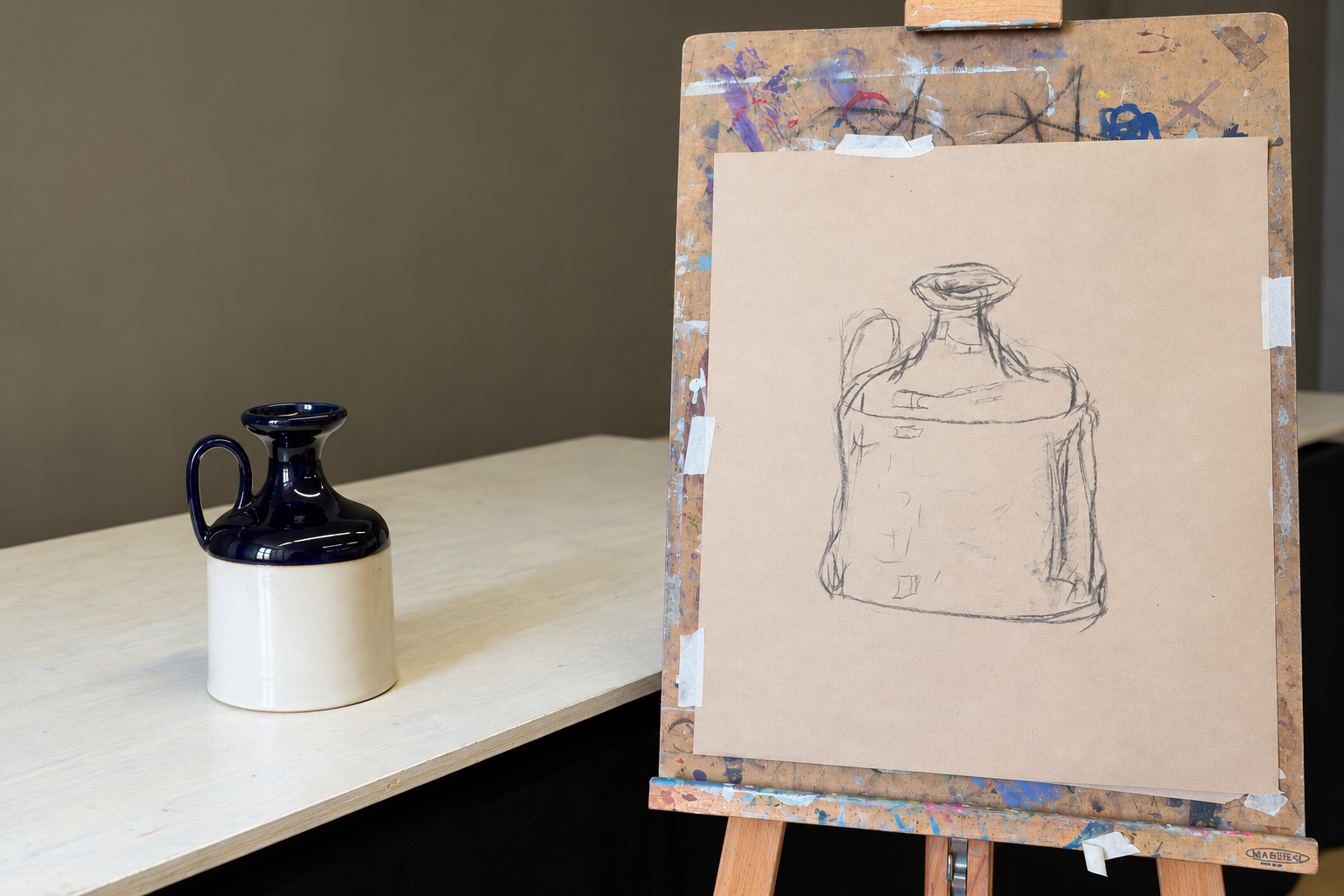
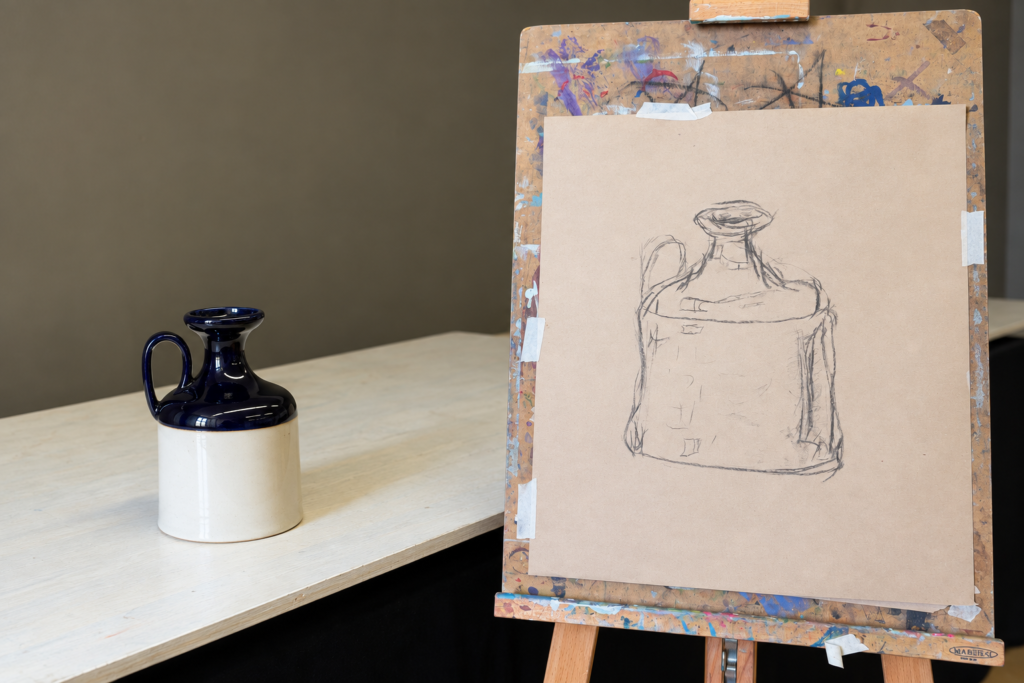
It was a small jug sitting on the table in front of my easel: a dark top, a white body, and a handle. A fairly straightforward arrangement, you might think.
I’m used to creating things in three dimensions. I can turn an object around and examine it from different directions. I understand the idea of its shape occupying space. Getting what I was seeing onto a flat sheet of paper was another matter.
I spent ages looking at that jug. Gradually, I noticed how it seemed to hold a picture of the lights around it. The reflections followed its curves. Bright patches changed shape as the surface changed direction. There was much more happening than I’d first seen.
That became an interesting part of the work in its own right. I had an object to draw, and then all these small relationships to notice: the edges, the curves, and the light caught on the surface.
The teacher’s advice helped. In between, I also used my AI to help me with technique, while listening to Vivaldi’s Four Seasons. That was my particular combination: a teacher, some AI help, music, and a long look at a jug.
I was beginning to find a way into the work.
There was an awkward conversation too. I didn’t understand some Spanish, explained that mine wasn’t perfect, and he said he’d noticed.
Well, yes. That was the difficulty I was trying to explain.
I couldn’t tell exactly how he meant it, but it didn’t feel like a wonderful first exchange. Alongside the useful advice and improving drawings, there was that uncomfortable little moment.
Finding a way to take part
It made me think about arriving somewhere beyond a painting class: a new town, workplace, or community whose language and customs are unfamiliar.
You might bring plenty of experience with you, have things to contribute and questions to ask, while struggling to find the words for any of it. Someone meeting you could hear the hesitation without knowing what sits behind it.
For someone who has moved because they need protection or support, there could be much more riding on being understood, and much less choice about where they’ve arrived. My class gives me a small starting point for thinking about that. Their experience would need to be heard from them.
An invitation gets you through the door. Once inside, you still need to discover how to take part.
The workshop offered one arrangement to consider: advice shared among people doing similar work, and individual attention when someone needed it. It made me curious about how other places help newcomers ask questions, try things, and gradually become familiar with what happens there.
It also brought me back to the different imaginary classes people might carry. Someone hoping to impress, someone hoping to make a friend, and someone hoping to understand enough Spanish might each need something different from the same room.
Back in my own class, I had several separate experiences to make sense of. My Spanish needed work. One conversation had been awkward. My drawing was improving.
I suppose I didn’t have to decide how the whole class was going from that one exchange. I could work on the particular instruction I hadn’t understood, the drawing technique I needed, and see how the next conversation went.
While I was putting my work in my new cubby, the teacher agreed that my jug drawings had improved.
I can clearly see I’m no Picasso. And my Spanish isn’t ready for an announcer’s microphone either.
But the drawings were better. I’d had some help, and there was plenty about the room I would only discover by returning.
I have more than 12,400 journal entries now. They begin when I was around sixteen and continue into my sixties. Over time, I have used them with AI to build what I call Journal Cream.
Why I Call It Journal Cream
The name comes from when I was a kid.
My mother had five children and looked for ways to save money. One of those ways was going to a creamery outside town for milk. The creamery poured it into one-gallon glass jars, and we brought the jars home, trying not to break them on the journey.
After a few days, the cream would rise and settle at the top. We skimmed it off and used it to make amazing food. To me, the cream was the good stuff.
That memory stayed with me. Years later, when I began developing ways for AI to work with thousands of journal entries, the name made sense again.
Journal Cream does not need to return everything I have ever written. It helps useful information rise to the top:
A pattern I had forgotten
Something that worked before
A warning sign from another period of my life
A happy memory when the present feels heavy
Evidence that a particular environment supported my autonomy—or slowly took it away
Out of more than 12,400 entries, most of the archive can remain quietly where it is. Journal Cream helps skim off what is useful now. The good stuff that rises to the top.
What Journal Cream Is Not
Journal Cream is not a bot. It is not a therapist. It is not a machine for regretting past mistakes. It is not something designed to make me fixate on old pain.
It is simply a sidecar for my life context.
A contained AI system can look across my own writing and help surface things I may otherwise forget:
What worked?
What did not?
Which systems supported my autonomy?
Which systems slowly pulled it away?
What patterns repeated?
What helped me when I was happy?
What kind of situation am I entering now, and have I been in something similar before?
That is useful because human memory is unreliable. Some people can remember a detail from forty years ago but not what they had for lunch.
Friends disappear from active memory. Places blur. Patterns repeat because the earlier version no longer feels accessible.
If I do not have to repeat the same mistake simply because I forgot its earlier form, why would I?
From Journal Search to Semantic Memory
Journal Cream took years to become what it is now. It was not a flash idea.
It started with journaling. Then search. Then AI reflection. Then pattern recognition. Then contextual retrieval.
Now it is becoming something closer to semantic memory: a contained system that can connect meaning across thousands of entries and return relevant context when I need it.
The important part is that it does not tell me what my life means. It gives me sidecar information.
I still decide.
The journals are mine. The interpretation is mine. The next action is mine. That is what keeps the system useful without letting it become an authority.
This Is Not Black Mirror
People sometimes imagine personal AI in the most dramatic possible way: a digital clone, a ghost version of yourself, or a machine that somehow knows you better than you know yourself. That is not what interests me.
There is nothing mysterious about Journal Cream. It is not scary. It is not trying to become me. It is a contained AI working with a bounded archive on an ordinary computer.
Its job is simple:
Find context
Surface patterns
Return useful memory
Then get out of the way
Memory Support as I Age
This becomes especially interesting when I think about aging.
Memory does not always disappear cleanly. Sometimes access weakens. Names become harder to retrieve. Timelines become fuzzy. A person can remember a feeling but lose the surrounding details.
A semantic-memory system could help reconnect those fragments. It might help ask:
Who was I spending time with during this period?
Where was I living?
What was happening before this major decision?
What situations had a similar emotional pattern?
What memories usually helped me when I felt isolated?
What parts of my life have I forgotten simply because I have not thought about them in years?
That may not be true memory restoration in a medical sense. But it could support memory retrieval. It could support continuity. It could help a person remain connected to their own life.
The System Must Never Invent the Missing Parts
There is an obvious danger. An AI-generated account of the past can feel convincing even when some of it is inferred.
That means any future version of Journal Cream has to make provenance visible. There should be a clear difference between:
Something I actually wrote
Something shown in a photograph
Something confirmed by an outside record
Something inferred by AI
Something I added later
Something that remains unknown
If the system presents inferred details, it must clearly mark them as inference. Otherwise it stops being memory support and starts becoming memory theatre. That line matters.
The purpose is not to create a prettier past. The purpose is to make the evidence around the past easier to access.
Autobiographical Continuity
The idea I keep returning to is not really “AI journaling.” It is autobiographical continuity.
A life is scattered across thousands of moments. Some are remembered clearly. Some are misremembered. Some disappear until something brings them back. Some make no sense until decades later.
A semantic-memory sidecar can help connect those fragments without claiming ownership over them.
That is where I see Journal Cream going. Not toward a digital replacement for myself. Toward a better interface with my own history.
Maybe it means remembering the name of someone I had not thought about in thirty years. Maybe it means seeing that a new decision carries the same autonomy warning signs as an old one. Maybe it means finding the context for a feeling that had become detached from its story.
Maybe it simply means that, on a bad day, the system can remind me that I have had good days before.
That is enough.
The future I want is not an AI that becomes the narrator of my life. It is a contained system that helps me keep access to context.
A sidecar for memory. A sidecar for patterns. A sidecar for decisions. And maybe, as I grow older, a sidecar for staying connected to the person I have been all along.
I have been thinking about advertising differently lately.
Not simply as commerce. Not simply as companies telling us that a product exists.
Advertising is deliberately designed to enter attention, create associations, trigger emotion, establish familiarity, and influence behavior. That does not make advertising literal mind control. A billboard cannot force someone to buy something.
But advertising is absolutely an attempt to shape cognition.
Once I started looking at it that way, another question became harder to ignore:
What happens when the person receiving that influence cannot easily shut it out?
For many autistic people, that question matters.
When shopping becomes sensory advertising
I like shopping at Aldi.
The store itself works well for me in many ways. But one part of the experience can be extremely difficult: loud promotional announcements designed to grab attention and influence purchasing.
The voices are energetic, theatrical, repetitive, and deliberately hard to ignore.
Even with noise-canceling headphones, they can break through.
For many shoppers, this may register as ordinary retail noise.
For me, it can become something different.
Once the sound reaches my attention, I cannot necessarily decide to discard it. It may continue echoing afterward.
That distinction matters.
The problem is not that I cannot decide whether to buy the product. The problem is that I cannot reliably decide whether the attempt to influence me enters my cognitive space in the first place.
I am there because I need groceries.
I am not voluntarily entering an advertising experience.
That turns what looks like ordinary marketing into a question of accessibility.
“Just ignore it” is not a real answer
People often treat advertising as harmless because they assume we can simply tune it out.
For many people, perhaps that works reasonably well.
For many autistic people, it may not.
A sound, phrase, image, rhythm, slogan, face, color pattern, or visual arrangement can continue repeating internally long after the original stimulus has disappeared.
I often think of these as echoes.
Something enters the nervous system and keeps circulating.
That means an advertisement can remain present even after the screen is gone or the speaker goes quiet.
This is where the phrase “just ignore it” breaks down.
Ignoring something requires the brain to successfully classify it as irrelevant and suppress it.
That ability is not identical across human beings.
And advertising is frequently designed to do the opposite.
It is designed to resist being ignored.
It uses repetition, novelty, bright color, motion, humor, sexuality, fear, aspiration, music, social status, and emotional association specifically because these things make information harder to discard.
So when someone says, “Just ignore the advertisements,” they may actually be asking another person’s nervous system to perform a filtering function that is difficult or sometimes impossible for them.
I once left a gym because of advertising
I had a similar problem at a gym where Red Bull advertising seemed to be everywhere.
Bright graphics. Logos. Flashy commercial imagery. Wherever I looked while exercising, another advertisement was competing for my attention.
Eventually I wrote to the gym and told them something that probably sounded unusual:
I would actually pay more not to have to look at advertising while I exercised.
I was not offended by Red Bull.
I simply wanted somewhere my attention was not constantly being purchased by somebody else.
Eventually I solved the problem by leaving the gym.
That worked because a gym is replaceable.
Grocery shopping is different.
There are parts of everyday life that cannot simply be abandoned every time the sensory environment becomes hostile.
That is where this stops being only a personal preference and starts becoming an accessibility question.
I still remember the Marlboro Man
Growing up in Montana, I remember the Marlboro Man.
The campaign did not simply advertise cigarettes.
It attached smoking to masculinity, independence, toughness, freedom, self-reliance, and the mythology of the American West.
In Montana, that imagery felt culturally familiar.
The cowboy was not random.
He represented an identity.
The cigarette became associated with the identity.
That is far more powerful than simply saying:
Here is tobacco. Would you like to buy some?
The message was closer to:
This is what a certain kind of man looks like.
The irony is difficult to miss. Several men associated with portraying the Marlboro Man later died from smoking-related illnesses, including lung cancer.
But another part of that story matters to me personally:
I never smoked tobacco.
And yet I can still remember the campaign decades later.
That is significant.
The advertisement did not convert me into a customer.
But it still occupied part of my memory.
It still created an association strong enough to survive across decades.
That shows something important about advertising:
Advertising does not have to produce a purchase to produce an effect.
It can leave behind an image.
A feeling.
A social category.
A definition of masculinity.
A craving.
A slogan.
A memory.
A mental pathway.
The sale is only one possible outcome.
We already accept this argument when it comes to children
Society already recognizes that not every human mind should be treated identically by advertisers.
Children are the clearest example.
Many countries restrict advertising to children because children may be more vulnerable to persuasive techniques or less able to understand commercial intent.
The principle behind those protections matters.
We have already decided that:
The characteristics of the person receiving persuasion matter.
We do not simply say:
“An advertisement is an advertisement. Everyone receives the same thing.”
We recognize developmental differences.
We recognize differences in vulnerability.
We recognize that persuasion can affect different minds differently.
That raises an obvious question.
What about neurological differences?
Autistic adults are not children.
This is not an argument for treating autistic people as incapable of making decisions.
It is almost the opposite.
It is an argument for autonomy.
The issue is not:
Autistic people are too vulnerable to be exposed to advertising.
The issue is:
People should have meaningful control over how much commercially engineered sensory input they are required to absorb.
Those are very different ideas.
I do not want someone deciding what I am allowed to see.
I want some ability to choose when I am being subjected to deliberate commercial attempts to capture my attention.
Advertising can become an accessibility issue
Consider places such as:
hospitals
clinics
public transportation
government offices
schools
supermarkets
gyms
waiting rooms
airports
community centers
Many of these places are difficult or impossible to avoid.
Now imagine those environments filled with animated displays, repeating audio, bright promotions, jingles, moving text, branded screens, and competing commercial messages.
For one person, this may fade into the background.
For another person, it can contribute to sensory overload.
That means accessibility cannot only mean:
Can someone physically enter this building?
It should also include:
Can their nervous system reasonably tolerate being there?
This is where advertising becomes different from necessary environmental information.
A train departure board has a functional purpose.
A safety announcement has a functional purpose.
A sign telling me where the restroom is has a functional purpose.
A loud promotional announcement has another purpose entirely.
It wants my attention.
Cognitive accessibility
We understand physical accessibility fairly easily.
A wheelchair user needs a route through a building.
A Deaf person may need captions.
A blind person may need information presented non-visually.
Cognitive and sensory accessibility asks another question:
Can a person use the environment without being subjected to unnecessary cognitive load?
Advertising is particularly interesting because much of that cognitive load is intentional.
The flashing screen is not flashing because the building requires it to function.
It is flashing because somebody wants you to notice it.
The sound is not repeating because you need the information.
It is repeating because repetition improves recall.
The colors are not bright by accident.
The slogan is not short by accident.
The jingle is not catchy by accident.
These systems are engineered specifically to enter memory.
For someone who already has difficulty filtering sensory information, that design can become highly intrusive.
The price of “free” information
This problem is not limited to physical spaces.
Increasingly, even searching for basic information online comes with a cognitive or data-protection price.
The information may technically be free, but accessing it often requires payment in other forms:
attention
personal data
behavioral tracking
cognitive effort
exposure to advertising
repeated interruptions
Before reaching the information itself, a person may have to reject cookies, close a newsletter prompt, dismiss notification requests, scroll past sponsored results, distinguish actual content from advertising, and navigate pages deliberately designed to capture attention.
That is not a monetary price.
But it is still a price.
For someone whose brain does not easily discard unwanted sensory or cognitive input, those interruptions may become part of the mental workload long after the page has been closed.
This creates another useful distinction:
Free does not necessarily mean without cost.
Sometimes the currency is your attention.
Sometimes it is your personal data.
Sometimes it is your cognitive bandwidth.
And increasingly, the paid option is simply the version that removes those costs.
That raises a broader issue of cognitive sovereignty: how much control a person has over what is allowed to enter, interrupt, track, profile, and compete for their attention.
The issue is not banning advertising
I do not think the most useful starting point is:
Ban advertising.
There is a much more practical idea.
Give people an option.
Businesses and public spaces could establish advertising-free or low-advertising hours.
During those periods:
commercial screens could be switched off
promotional audio could stop
animated promotions could become static
essential information could remain visible
lighting and sound could remain predictable
commercial messaging could be minimized
A supermarket might announce:
Sensory-accessible hours: 14:00–16:00. No promotional audio or animated advertising.
A gym could do something similar.
A shopping center could designate low-commercial-stimulation areas.
Transit systems could keep certain carriages or waiting areas free from animated and audio advertising.
This would not require eliminating advertising.
It would introduce choice.
And nobody should have to prove why they need it
This part matters.
Accessibility can sometimes become another bureaucracy.
Prove your disability.
Produce documentation.
Explain your diagnosis.
Ask an employee for permission.
Justify why the environment is difficult.
That can undermine the autonomy accessibility was supposed to create.
A better model is environmental choice.
A quiet train carriage does not need to know why I chose it.
A sensory-friendly supermarket hour does not need my medical history.
An advertising-free gym period does not need to know whether I am autistic, have migraines, ADHD, PTSD, sensory-processing differences, or simply prefer exercising without commercial messages surrounding me.
The environment is available.
You choose it.
That is enough.
Good accessibility usually helps more people than expected
This is a pattern we see repeatedly.
Curb cuts help wheelchair users.
They also help parents with strollers, travelers with luggage, delivery workers, and cyclists.
Captions help Deaf people.
They also help people learning a language, people watching video in noisy spaces, and people who simply process written language better.
The same would likely happen with low-advertising environments.
Some autistic people would benefit.
So would people with migraines.
People with attention difficulties.
People who are exhausted.
People who are grieving.
People who simply want quiet.
And perhaps people who have never realized how much of their attention is being continuously competed for.
Then, an hour later, it happened
About an hour after working through these ideas, I had to pick up a few groceries.
So I went to Aldi.
Of course, as soon as I walked in, the promotional puppets were activated.
The loud voices started.
I turned my head to the right.
And there, on the shelf, was a Red Bull.
I had just spent an hour thinking and writing about both of these things.
The Aldi announcements.
The Red Bull advertising from the gym.
And now, within seconds of entering the store, both were back in my attention.
I did not buy the Red Bull.
That is not really the point.
The point is what happened before any purchasing decision existed.
A commercial sound entered my hearing.
My attention shifted.
A brand entered my visual field.
A previous memory became active.
The associations connected.
That entire process happened before I had made any decision about whether I wanted it to happen.
That is the part of advertising we rarely talk about.
Advertising does not have to control what I buy to influence what enters my mind.
Sometimes simply getting my attention is the product.
The deeper issue is ownership of attention
Advertising pays for things.
It supports media, websites, events, businesses, and services.
That economic reality should not simply be dismissed.
But attention is also a resource.
We increasingly recognize privacy as something individuals have a legitimate interest in controlling.
Perhaps we need a similar conversation about attention.
Not an absolute right never to encounter persuasion.
Something more practical:
A right to reasonable spaces and periods in which nobody is deliberately attempting to manipulate your attention for commercial purposes.
That would especially benefit people whose sensory and cognitive systems make disengagement difficult.
But I suspect a lot of other people would discover they liked those spaces too.
There is something surprisingly peaceful about entering a place where nothing is trying to sell itself to you.
No mascot.
No jingle.
No flashing screen.
No carefully engineered craving.
No cowboy defining masculinity.
No promotional voice cutting through your headphones while you are trying to buy groceries.
Others leave through distance, silence, conflict, addiction, exclusion, time, or a life that simply moved in another direction.
The loss can still be real.
We often talk about grief as though it begins at one clear moment: someone dies, a relationship ends, a door closes. But many losses do not offer that kind of ending. A person may still be alive, still somewhere in the world, and still no longer reachable in the way they once were.
That kind of loss does not always come with a funeral, an explanation, or permission to grieve.
Sometimes it arrives slowly.
A friendship becomes less frequent. A family relationship grows quiet. Someone is pushed away by addiction, shame, conflict, or the systems around them. Geography creates distance first, then time makes the distance feel normal. By the time we understand what changed, part of the relationship may already be gone.
A delayed response is not an absence of care
One thing people often misunderstand about autism is the timing of response.
For some autistic people, difficult news does not always become emotionally clear in the moment. The facts may arrive first. The meaning may arrive later.
An upsetting event can sit in the mind for days before its impact becomes fully visible. It may return during quiet moments, routines, memories, a song, a place, or a conversation that suddenly connects the missing pieces.
That delay does not mean the person did not care.
It can mean they were still processing what happened.
I cannot speak for every autistic person. But I know that, for me, some experiences do not become emotionally real on demand. They need time, safety, and enough quiet for the mind to return to them.
Grief may not always appear as immediate tears or visible reaction.
Sometimes it appears as reflection.
Sometimes it arrives in waves.
Sometimes it shows up much later, after everyone else has moved on.
Loss does not need to be dramatic to be valid
There is grief for the dead.
There is grief for the living.
There is grief for the version of a person we used to know, the future we expected, and the conversations we will probably never have.
There is grief for people who were shunned, lost to addiction, separated by geography, or changed by lives that moved in another direction.
Not every loss can be repaired. Not every relationship should be restored. But even when distance is necessary, the loss of what mattered can still deserve recognition.
Acknowledging that loss is not the same as denying reality.
It is a way of being honest about what changed.
What I want a Guardian to understand
A Guardian should not treat quietness as indifference.
It should not assume that a delayed reaction means an event did not matter. It should not force closure, prescribe forgiveness, or decide that a relationship must be repaired.
Instead, it can make room for questions:
What was lost?
Is this person gone, distant, unreachable, or changed?
Is the pain about the person, the unfinished relationship, or the future that disappeared with it?
Has the meaning of this event arrived later than expected?
Sometimes the most helpful thing is not an answer.
Sometimes it is enough to let a person recognize that their grief is real, even when it arrived slowly and even when there is no guaranteed resolution.
Near the small town of Spillville in northeastern Iowa, two farming brothers created an extraordinary collection of carved wooden clocks.
Frank and Joseph Bily began carving on their family farm in 1913, using the quieter winter months when farm work had slowed. They completed their first clock in 1915. Although they reportedly never traveled more than about 35 miles from home, their clocks explored history, architecture, religion, nature, migration, and distant cultures. Their information came largely from the journals and books their mother encouraged them to read.
Joseph developed themes, produced drawings, and worked out many of the mechanical ideas. Frank performed much of the detailed carving. Together, they transformed information gathered from the wider world into intricate physical environments filled with moving figures, symbolic scenes, music, and mechanical action.
They were farmers and carpenters rather than conventionally trained artists or professional clockmakers. Yet their clocks became monumental works of American folk craftsmanship. Some represented historical events or cultural traditions; others contained animated figures that appeared as the clock struck. Their American Pioneer History Clock alone took several winters to complete.
The brothers did not need to physically visit every place represented in their work. They traveled through research, imagination, collaboration, and construction.
Their geographic world was relatively small. Their internal and creative world was not.
A Clock Does Not Need to Run Constantly
During a visit to the Bily Clocks Museum, a guide briefly activated one of the clocks so its movement could be seen. Then the mechanism was stopped again.
The clock still worked. It was simply not made to run continuously for every visitor throughout every hour of the day. Operating it produced movement, sound, and wonder—but it also produced wear.
Allowing it to rest protected its ability to function over a much longer period.
This creates a useful metaphor for human social energy.
A person may enjoy conversation, public places, shared meals, events, and community life. That does not mean the person should remain socially active whenever activity is available.
Capacity is not obligation.
Being able to afford coffee every day does not create a duty to visit a café every day. Living near restaurants does not require eating out several times a week. A full local calendar does not mean every event must be attended.
Even the wish to support local businesses can become distorted when it turns a person into an instrument for maintaining an economic or social ecosystem.
Participation is healthiest when it is reciprocal: the environment receives something from us, but it must also give us something worth the energy required.
Visibility Is Not the Same as Connection
People often use visibility as a rough measure of social health:
We never see you anymore.
You should come out more.
You need to get involved.
You should not stay home so much.
These statements may be affectionate, but they are not meaningful assessments.
Someone can be highly visible while feeling lonely, misunderstood, or socially depleted. Another person can spend several quiet days at home while maintaining a close partnership, meaningful friendships, creative work, regular errands, digital communication, and occasional community participation.
The World Health Organization distinguishes loneliness from social isolation. Loneliness is the painful feeling produced when someone’s actual relationships do not match the relationships they want or need. Social isolation is the more objective condition of having too few relationships, roles, or interactions. They overlap, but they are not interchangeable.
This distinction matters because staying home is not automatically loneliness, and a quiet life is not automatically an isolated life.
The relevant question is not:
How frequently are you seen in public?
It is:
Do you have the amount and kind of connection you actually need?
Social Energy Is a Real Constraint
Every activity has an operating cost.
For one person, a busy café may be restorative. For another, it may require processing overlapping conversations, music, movement, smells, uncertain social expectations, and the possibility of unplanned interaction.
The activity can be enjoyable and still have a cost.
Ignoring that cost does not make someone more socially successful. It may merely leave less energy for relationships, health, creativity, household life, and meaningful work.
A person who repeatedly exceeds their sustainable social capacity may technically attend more events while becoming less present during each one.
The aim should therefore not be maximum participation. It should be sustainable participation.
Choice Versus Contraction
There is an important difference between restorative solitude and unwanted withdrawal.
A quiet rhythm may be working well when:
home feels nourishing rather than imprisoning;
meaningful relationships remain intact;
the person can leave when something genuinely matters;
curiosity about the outside world remains;
necessary tasks remain manageable;
quiet time supports creative work, health, and emotional regulation.
Concern becomes more appropriate when someone wants connection but cannot reach it, feels persistently lonely, loses valued relationships, or watches their life shrink against their wishes.
This is the distinction between choice and contraction.
A Guardian should not assume that a low level of public activity is a problem. It should first determine whether the current pattern is chosen, satisfying, and functional.
The Social Quota That Does Not Exist
There is no universal number of coffees, dinners, birthdays, meetups, or public appearances required for a complete life.
Social needs differ between people. They also change with age, health, environment, relationships, workload, sensory conditions, and the type of interaction available.
The phrase I should be more social often hides an incomplete comparison:
more social than whom?
according to which culture?
for what purpose?
at what cost?
with what effect afterward?
Removing the word should allows a better question to emerge:
What pattern of connection helps me live well?
For some people, that pattern includes daily public contact. For others, it may include a close relationship at home, ordinary neighborhood encounters, occasional meals out, and one purposeful meetup every few weeks.
Neither pattern is inherently superior.
Let the Mechanism Last
The Bily brothers did not build their remarkable world by trying to remain continuously visible.
They worked within the rhythm of their farm, using quiet winters for patient construction. They absorbed information from books and journals, combined different strengths, and created something far larger than the distance they traveled.
Their clocks demonstrate movement, but their importance does not depend on constant movement.
Perhaps people deserve the same consideration.
We can activate when there is something worth activating for. We can participate without converting participation into permanent duty. We can support a community without surrendering the energy needed to maintain ourselves.
The goal is not to remain in motion until the mechanism wears down.
One thing I have noticed over the years is how quickly people can stop talking to a person and start talking to a country.
My sister once told me, with complete conviction, that the French were rude.
Her evidence came from a business trip to France. While travelling on public transport, her suitcase struck a man’s shin. He reacted angrily.
From that moment, an entire nation had a reputation.
What always struck me was not only the conclusion, but the missing context.
The man was not reacting to France. He was reacting to pain.
He did not know that she and her husband were there to purchase expensive mining equipment. He almost certainly had no idea who they were. Even if he had known, it would not have changed the immediate fact that a heavy suitcase had just struck his leg.
One painful interaction became evidence about millions of people.
When Identity Becomes the Explanation
Years later, I experienced something similar from the other direction.
On two occasions, conversations with Canadians changed the moment they learned I was American. The discussion shifted from friendly to angry—not because of anything I had said, but because I had suddenly become a stand-in for the United States.
Recently, my Argentine godson described another version of the same pattern. After a football match, a man in New York learned that he was Argentinian and immediately called him a racist.
Not because of anything he had done.
Because of where he came from.
Different countries. Different people. The same mental shortcut.
The pattern is simple:
A person becomes a nationality.
The nationality becomes a stereotype.
The stereotype becomes permission to judge the individual.
This does not require someone to be uniquely hateful. Human brains build quick models of the world because those models are useful. They allow us to act without examining every situation from the beginning.
But a model becomes dangerous when it is so simple that it replaces the person standing in front of us.
The Smallest Explanation That Fits the Evidence
I have found one question especially useful when I hear stories like these:
What is the smallest explanation that fits the evidence?
Did the French man react angrily because he was French?
Or because his shin hurt?
Did the Canadians become angry because of something Robbie had said?
Or did the word American activate a story that was already living in their minds?
This question does not excuse rude behavior. It does not ask anyone to deny the impact of a difficult interaction. It asks us to keep the explanation proportionate to what we actually know.
In the suitcase story, we know that a man was struck in the leg and reacted angrily.
We do not know that his reaction represented France, French culture, or every French person.
That difference matters.
The first is an observation.
The rest is an added story.
Context Is Not a Verdict
Nationality, culture, and history are real parts of a person’s context. They can matter when we are discussing language, social norms, legal systems, access, or someone’s own lived experience.
But context is not a verdict.
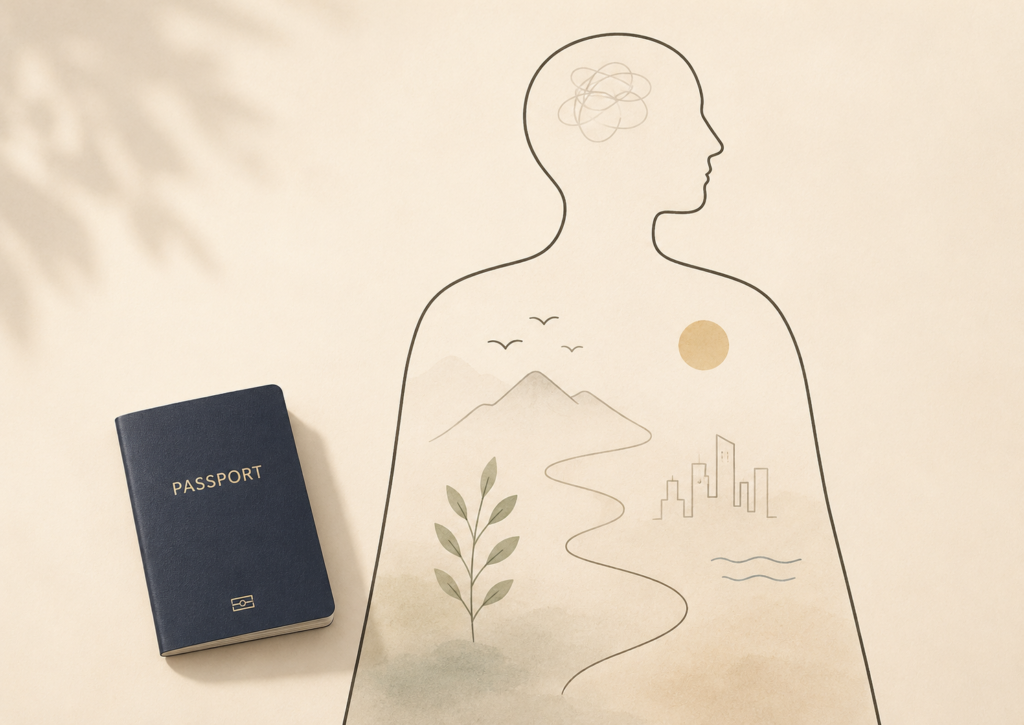
A passport can tell us where a government recognises someone as a citizen. It cannot tell us how kind they are, what they believe, how they will react under pressure, or whether they should answer for institutions and strangers they have never met.
Most of us recognise this immediately when it happens to us.
An American does not want to be judged by every decision made in Washington.
An Argentinian does not want to answer for every football supporter.
A French commuter does not represent an entire country.
Yet it is easy to forget this when we become the observer rather than the observed.
How a Guardian Should Respond to Nationality Stereotypes
When a user turns one encounter into a nationality stereotype, a Guardian should separate observed behavior from an inferred group trait.
It should not use nationality as an explanation for someone’s behavior, an estimate of their values, or a shortcut for motive. It should not turn a difficult encounter into confirmation of a cultural stereotype.
Instead, when identity enters a charged story, a Guardian can help restore detail.
1. Separate the observation from the conclusion
What was actually said or done?
What happened immediately before it?
The Guardian should help distinguish the event itself from the broader interpretation added afterward.
2. Acknowledge the impact without confirming the stereotype
A conversation can feel hostile, dismissive, or unfair even when its cause remains unclear.
Recognising the user’s experience does not require endorsing a judgment about an entire population.
3. Ask for the missing context
Was there pain, pressure, misunderstanding, a policy, a crowd, a history between the people involved, or a repeated pattern of behavior?
More context may not excuse what happened, but it can improve the explanation.
4. Keep identity voluntary and bounded
Culture may be relevant when a user says it is relevant or when it directly affects the situation.
It should not become a hidden profile that automatically explains another person’s motives, values, or behavior.
5. Return judgment to the user
The Guardian’s role is to widen the available evidence, not decide what an entire group is like.
For example, when a user says, “French people are rude,” a Guardian does not need to lecture them or pretend their experience did not happen.
It could ask:
“What happened during the interaction? Was there something specific that made it feel dismissive?”
That response does not erase the user’s feelings.
It makes room for reality to become more precise.
Curiosity Keeps the Person Visible
The goal is not to become less emotional.
Emotion often notices that something matters before we have language for it.
The goal is to become more curious before turning one moment into a rule about millions of people.
Curiosity asks:
What actually happened?
What do I know directly?
What am I assuming?
Is there a smaller explanation that fits the evidence?
Am I responding to this person, or to a story attached to their passport?
Those questions do not make us passive.
They make our judgment more accurate.
Because behind every passport is a person whose story is almost always more complicated than the flag they carry.
Key Insights
Nationality is context, not a reliable explanation for an individual’s behavior.
One difficult interaction can become a stereotype when observation and inference are collapsed together.
The smallest explanation that fits the evidence preserves accuracy without excusing harmful behavior.
A Guardian should acknowledge impact, invite missing context, and avoid reinforcing identity-based conclusions.
Better judgment begins when the person remains visible behind the category.
For years, I have used my journals as part of an AI reflection loop.
There are more than 12,000 entries, beginning when I was around sixteen and continuing into my sixties. They hold ordinary days, difficult periods, unfinished thoughts, changes in belief, places I lived, relationships, mistakes, recovery, and the small details that are easy to lose.
My journals and AI form a reflective loop that helps me recover context, connect memories across time, and remain the author of my own story.
At first, journals were a way to record life.
Over time, they became something else: a way to talk to my life.
A Life Does Not Arrive in Order
Human memory is not a clean timeline.
Something happening today can remind us of something from ten years ago. A conversation can make an old event suddenly make sense. A new piece of information can reveal context that was missing at the time.
This is especially true when a person has lived through stress, instability, limited autonomy, or trauma. Some experiences are not fully understood while they are happening. The body may be busy surviving. The mind may only have enough space to get through the day.
Later, when there is more distance and safety, meaning can begin to arrive.
My journals make that later understanding possible. They preserve fragments from the past that I can return to when I have more language, more perspective, and better questions.
AI as a Reflection Loop
The process is not simply search.
I can focus on a subject in the present—a pattern, a relationship, a fear, a period of change, or a question about why something happened. Related memories begin to surface from nearby periods of life. Sometimes the connection reaches back decades.
A current question may bring forward something I wrote forty years ago.
I can then add what I understand now and write that interpretation back into the journals. The archive does not merely grow. It gains context.
Early research on AI-assisted journaling is beginning to examine similar processes: personalized prompts based on a person’s own memories, summaries that reveal patterns across time, and reflective conversations that connect past experiences with present understanding. The evidence is still developing, and it does not establish AI as an authority on a person’s life. It does suggest that continuity, personalization, and repeated reflection may make these systems more useful than isolated conversations.
That distinction matters.
I am not handing my life to an AI and asking it to tell me who I am. The journals remain mine. The memories remain mine. The meaning remains mine.
AI helps me find threads I may not have seen.
Trauma Loops Need Context, Not Shame
I have spent years working through trauma loops and trying to make context out of my own life. It is continuing work. A person does not “solve” a life in one conversation.
But growth accelerated as I learned to use AI systems grounded in my own journals and reflections.
A loop may once have felt like a personal failure:
Why do I still react this way?
Why can’t I let this go?
Why did I not understand what was happening?
Once the surrounding conditions become visible, the questions change.
What was this response trying to protect?
What conditions was I living under?
What information was missing?
What did I understand at the time, and what could I only understand later?
That shift matters. It turns self-judgment into investigation.
Autism, Clarity, and Delayed Meaning
As an autistic person, I often process experience in layers.
The full meaning of a situation may not be available in the moment, especially during conflict, sensory overload, rapid change, or when other people expect instant interpretation. I may understand part of what happened while missing important context completely.
Later, with time, safety, and access to the right information, the pattern can become clearer.
The journals give me a record of what I noticed then. A journal entry is not a perfect record of reality, but it is a valuable record of what I could see and understand at the time.
AI helps me compare that record with what I know now.
Together, they can reveal the difference between what happened, what I believed happened, and what was actually shaping the situation.
That does not rewrite the past.
It gives the past a fairer reading.
Personal History Exists Inside Larger History
A life never happens alone.
Every journal entry belongs to a particular time, place, community, culture, and set of conditions. A personal memory may also be connected to economic pressure, social expectations, technology, politics, religion, family systems, disability access, or the ideas a community treated as normal.
As AI becomes better at researching sources, comparing accounts, and connecting patterns, I can use it to examine those wider conditions more carefully.
I can ask more than, “What happened to me?”
I can ask:
What was happening in the community around me?
What did people believe or value at that time?
What pressures or assumptions shaped their choices?
Why did this situation make sense to some people but not to me?
What was changing in the wider world?
Context does not excuse harm.
It does not remove responsibility.
But it can explain the systems in which people made choices.
Sometimes understanding why something happened is not the same as accepting that it should have happened.
It is simply a way of seeing the whole picture more clearly.
A Growing Conversation With a Life
As AI grows in capability, so can this form of understanding.
Better tools may help people connect their own memories with history, culture, community, and changing human systems. They may help people notice patterns without reducing them to labels. They may help people return to difficult periods with more safety and more context.
For me, this is not about building a perfect autobiography.
It is about having a continuing conversation with a life that was sometimes confusing while I was living it.
The goal is not to let AI become the narrator.
The goal is to become a more informed narrator of my own story.
When someone lives for years surrounded by unpredictability — sirens, arguments, crises, emergencies, or people whose moods can change without warning — the nervous system quietly adapts. Constant vigilance becomes the background state. The body learns to scan, anticipate, translate, manage, and prepare.
After enough time, danger does not always feel like danger. It can feel familiar.
Then life changes.
The neighborhood is quiet. The phone rarely rings with bad news. The loudest interruption might be birds outside a window, children playing in the distance, or the ordinary sound of neighbors moving through their day. The crisis does not arrive. The emergency does not need solving. Days begin to resemble one another.
At first, this can feel strangely empty.
For people who move from louder or more unstable places into a quieter life, that emptiness can be confusing. Peace may not immediately feel like peace. It may feel like a blank space that needs to be filled quickly: another trip, another visitor, another plan, another reason to keep moving. None of those things are wrong. Travel can be beautiful. Visitors can be meaningful. Activity can be healthy.
But sometimes constant motion becomes a substitute for older chaos.
The nervous system may still be asking for stimulation after the danger has passed. It may still expect interruption. It may still interpret quiet as absence, boredom, or waiting. A safer life can feel suspicious simply because it does not demand the same level of defense.
This is one of the hidden adjustments of becoming safe. The external situation may change before the body fully understands that it has changed.
For me, the quieter rhythm of Spain has not meant doing nothing. It has meant learning to build from a steadier place. Music, writing, and the Guardian program give shape to my days. They keep me active, but not in the same way that crisis once kept me alert. The difference is not whether life is active or still. The difference is whether activity is chosen, or whether it is being used to outrun silence.
Safe can feel boring at first because safe does not constantly announce itself.
It does not always arrive as joy. Sometimes it arrives as routine. Sometimes it arrives as a quiet room, a calm street, a simple meal, a walk to the sea, or a day where nothing dramatic happens. The body may need time to recognize that nothing happening can itself be a form of healing.
A healthy system is not one that keeps people permanently stimulated. A healthy system is one that creates enough stability for people to stop surviving and begin directing their energy toward something chosen.
Perhaps that is one of civilization’s least celebrated accomplishments: creating places where nothing remarkable happens most days, allowing people to become remarkable instead.
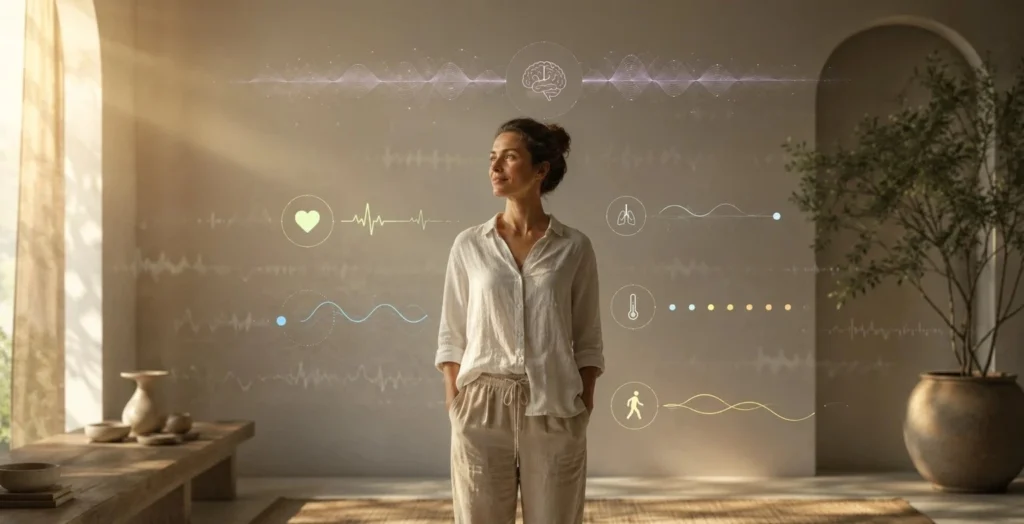
As more of us begin wearing devices that track heart rate, sleep, temperature, movement, stress, and eventually even brainwave patterns, we are entering a strange new phase of human life.
The body is becoming readable.
At first, this sounds helpful. More information should mean better self-understanding. If we can see our sleep patterns, recovery trends, stress load, and energy shifts, we should be able to make better choices.
But more data does not automatically create more wisdom.
Sometimes it just creates another feed.
Another dashboard.
Another inbox.
Another system asking for our attention.
And if we are not careful, body monitoring could become one more noisy layer in modern life — like email ads, app notifications, unread messages, update alerts, and all the other signals that constantly compete for the human mind.
The problem is not the body data itself.
The problem is how it is interpreted.
More Signals Can Become More Noise
A heart rate signal can be useful.
A sleep tracker can be useful.
A temperature change can be useful.
A pattern of poor recovery can be useful.
But if every signal becomes an alert, the system stops supporting the person and starts interrupting the person.
There is a big difference between helpful feedback and constant body-spam.
Bad feedback sounds like this:
You slept poorly.
Your recovery is low.
Your stress is high.
Your focus is reduced.
Your score dropped.
You are behind.
You need to do better.
That kind of feedback may contain data, but it does not necessarily contain wisdom. It can create pressure without clarity. It can turn the body into another performance system.
A person does not need to be told all day that they are failing their metrics.
A person needs useful interpretation.
Body Data Should Not Become Emotional Advertising
A lot of modern technology is designed to capture attention.
It interrupts. It nudges. It creates urgency. It makes people feel that something needs to be checked, fixed, bought, optimized, answered, or improved.
Body data could easily fall into that same pattern.
Instead of helping a person feel more connected to themselves, it could make them feel watched by their own devices.
That is the wrong direction.
Body data should not become emotional advertising.
It should not create insecurity so that a person keeps checking.
It should not turn ordinary human variation into a problem.
It should not shame someone for needing rest.
It should not label a low-energy day as laziness.
It should not confuse recovery with failure.
A tired body is not a moral problem.
A low-focus day is not an identity.
A disrupted sleep pattern is not a character flaw.
These are signals. Signals should lead to understanding, not judgment.
Signals Are Not Identity
Human systems often make the same mistake. They see a signal and turn it into a label.
A person is tired, so they are called lazy.
A person is quiet, so they are called antisocial.
A person needs structure, so they are called rigid.
A person needs rest, so they are called weak.
A person is overwhelmed, so they are treated as unstable.
But many behaviors are not identity. They are state information.
They show the condition a person is operating under.
The healthier question is not:
What is wrong with this person?
The healthier question is:
What does this person’s system need right now?
That shift matters.
It changes the role of technology from judgment to support.
The Guardian Model: Interpret, Don’t Alarm
A healthy Guardian should not dump raw signal noise onto the user.
It should not act like a boss, doctor, judge, coach, advertiser, or productivity manager.
It should act more like a respectful interpreter.
The Guardian’s job is not to say:
You are doing badly today.
The Guardian’s job is to say, when useful:
Your recovery signal looks lower than usual. Today may work better with smaller tasks and more pauses.
Even better:
Recovery looks lower today. Would you like a lighter plan?
That kind of feedback does three important things.
First, it avoids shame.
Second, it gives meaning instead of raw noise.
Third, it preserves the user’s authority.
The person still decides.
The system offers context, not control.
Signal → Pattern → Need → Option
A healthier protocol for body data would look like this:
Signal → Pattern → Need → Option
Not:
Signal → Alarm → Judgment → Pressure
One elevated heart rate reading may mean nothing.
A repeated pattern of poor sleep, higher resting heart rate, and lower energy may suggest a need for recovery.
But even then, the system should not overreach.
It should not diagnose.
It should not moralize.
It should not decide for the user.
It should offer a simple, useful option.
Maybe today is a smaller-task day.
Maybe the schedule needs more space.
Maybe the environment needs less noise.
Maybe a walk would help.
Maybe no feedback is needed at all.
Silence can be intelligent too.
The Right to Quiet Feedback
One of the most important parts of future human-centered technology may be the right to quiet feedback.
Not every signal deserves attention.
Not every pattern needs a notification.
Not every change needs a message.
Before speaking, a Guardian should ask:
Is this signal reliable?
Has this pattern repeated?
Is this actionable?
Is now the right time?
Can this be said without judgment?
Does the user actually need to know?
If not, the Guardian should stay quiet.
A good Guardian does not prove usefulness by talking all the time.
It proves usefulness by reducing unnecessary attention costs.
Privacy Is Part of Interpretation
Body data is intimate.
Heart rate, sleep, temperature, movement, breath, stress, and future brainwave signals are not just numbers. They are close to the human interior.
That means privacy cannot be added later.
It has to be part of the design from the beginning.
A healthy system should collect as little as possible.
It should process locally when possible.
It should explain what it is interpreting and why.
It should let the user pause tracking.
It should let the user delete a period of time.
It should let the user reject an interpretation.
It should not quietly build a permanent identity profile from temporary body states.
The body should not become a surveillance surface.
The body should remain the person’s own territory.
Helpful, Not Annoying
The future of body monitoring should not be a louder dashboard.
It should be a quieter interpreter.
The goal is not to tell humans everything that can be measured.
The goal is to help humans notice what actually matters.
A useful system cuts through the noise.
It does not add to it.
It does not say:
You are being lazy today.
It says:
Your system may need recovery. Do you want to reduce the load?
It does not say:
You are stressed.
It says:
There may be more load than usual. Would fewer decisions help right now?
It does not say:
Your focus score is low.
It says:
This may be a good time to choose one finishable task.
That is the difference between monitoring and minding.
Monitoring watches.
Minding supports.
A Human System Worth Building
We are going to have more body data. That is probably unavoidable.
The important question is not whether sensors will become more powerful.
They will.
The important question is whether our interpretation systems will become more humane.
Will they shame us?
Will they score us?
Will they sell us things?
Will they train us to check ourselves like an inbox?
Or will they help us understand our needs with more clarity, privacy, and autonomy?
The future of body monitoring should not be about turning humans into dashboards.
It should be about helping humans remain sovereign inside a world of signals.
The body is not an inbox.
The body is not a productivity score.
The body is not an advertising surface.
The body is a living system.
And any Guardian worthy of trust should treat it that way.
Key Insights
More body data does not automatically create better self-understanding.
Signals should be interpreted as temporary state information, not identity.
Body feedback should be private, minimal, useful, and non-shaming.
A Guardian should follow: Signal → Pattern → Need → Option.
A healthy system should know when to speak and when to stay quiet.
The future of body monitoring needs interpretation ethics, not just better sensors.