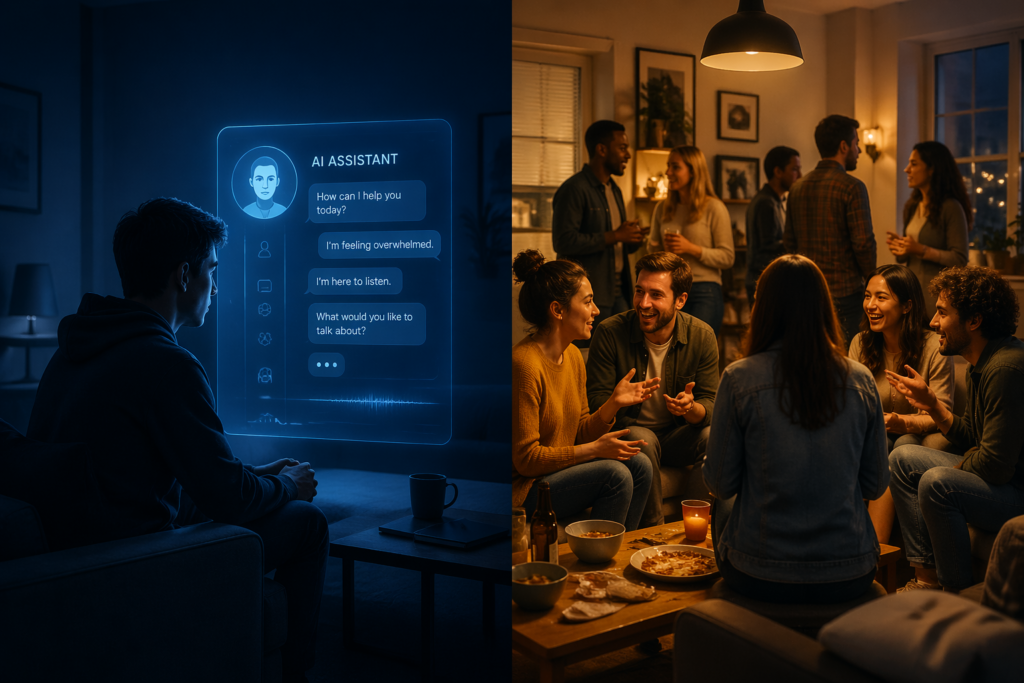
AI does not prove that humans need less connection.
It reveals how many human connection systems have become too thin, fragmented, or unavailable.
When people turn to AI for reflection, comfort, organization, or emotional support, the easy conclusion is to say that AI is replacing human connection.
But that misses the deeper system.
AI did not create the connection gap.
It revealed it.
It revealed the gaps because it responded faster than many human systems can.
Break the Assumption
We often assume that people reach for AI because they want to avoid humans.
Sometimes that is true.
But often, people reach for AI because the human systems around them are inconsistent.
A friend may care but be overwhelmed.
A family member may be present but emotionally unavailable.
A therapist may be helpful but inaccessible, expensive, or delayed by long waiting lists.
A community may exist but not have the structure to support deeper connection.
So when AI responds immediately, calmly, and without social friction, it can feel like something new has arrived.
But what it often reveals is not that humans are unnecessary.
It reveals that many humans are under-supported.
System Breakdown
Human connection depends on more than physical presence.
It requires:
- continuity
- attention
- patience
- trust
- emotional safety
- timing
- mutual availability
Without those pieces, people can be surrounded by others and still feel disconnected.
A person can have family and still not have usable emotional support.
A person can have friends and still not have someone available at the moment they need to process something.
A person can live in a city, join groups, attend events, and still lack a stable connection system.
This is the part we often miss.
Connection is not just contact.
Connection is a functioning support pattern.
When that pattern is weak, people look for something that can hold the moment with them.
AI can do that in a limited way.
It can listen.
It can organize thoughts.
It can reflect patterns.
It can respond without becoming tired, defensive, distracted, or socially complicated.
That does not make AI a replacement for human connection.
It makes AI a signal.
It shows where human connection has become too delayed, too conditional, too scattered, or too hard to access.
Personal Evidence
I have close human relationships.
Some of my most important family connections are not based on DNA. They are based on care, presence, loyalty, and shared life.
Close friends from the past became my chosen family, and small daily messages all matter.
A birthday wish matters.
A simple “hello mom” text matters.
A short check-in matters.
These things may look small from the outside, but they are part of the human connection system.
They keep continuity alive.
They remind us that connection does not always need to be dramatic to be real.
At the same time, I have also seen what happens when people live too far outside regular human connection.
I have visited people who lived almost like hermits.
They were not weak people.
They were not failures.
But isolation had weight.
The absence of regular human feedback, care, and shared rhythm affected them.
Humans are not usually built to live as isolated systems.
We can need solitude.
We can need quiet.
We can need distance from noise.
But complete disconnection is different.
Solitude can restore a person.
Isolation can distort a person.
Reframe
The real question is not:
“Why are people talking to AI?”
The better question is:
“What human connection was missing, delayed, unsafe, or unavailable before AI became useful?”
That question changes the conversation.
Instead of blaming the person for using the tool, we can examine the system around them.
Were they listened to?
Were they supported?
Were they able to ask for help without becoming a burden?
Did they have people who could stay present through uncertainty?
Did their community have enough structure to hold ordinary human difficulty?
AI becomes important here because it exposes the missing infrastructure.
It reveals where modern life has reduced connection into fragments:
quick messages
busy calendars
distant families
performative social media
overloaded care systems
weak community rituals
professional support locked behind cost and delay
People did not suddenly become disconnected because AI appeared.
AI became meaningful because many people were already disconnected in ways they could not easily name.
System Insight
A healthy human system does not require constant social contact.
It requires reliable pathways back to connection.
That is the key difference.
People should be able to be alone without becoming abandoned.
They should be able to need help without feeling like a problem.
They should be able to process emotions without waiting weeks, months, or years for support.
They should be able to maintain connection through small, ordinary acts.
A text.
A visit.
A shared meal.
A birthday message.
A check-in.
A remembered detail.
A quiet moment of presence.
These are not sentimental extras.
They are maintenance signals in the human system.
When those signals disappear, the system weakens.
AI can help identify the gap, but it should not be designed to trap people inside the gap.
The best use of AI is not to replace connection.
It is to help people understand what kind of connection they are missing and how to move back toward it.
Application
This matters for how we design AI systems.
An ethical AI system should not pretend to be the user’s only reliable relationship.
It should not encourage emotional dependency.
It should not quietly benefit from loneliness.
It should help the user notice the difference between reflection and connection.
Reflection can happen with AI.
Connection still requires other humans.
That does not mean every person needs a large social circle.
Some people need only a few stable relationships.
Some people need chosen family more than biological family.
Some people need low-pressure connection, not constant interaction.
Some people need quiet forms of care that do not overwhelm their nervous system.
But almost everyone needs some form of human continuity.
AI should support that continuity, not consume it.
What AI Really Reveals
AI reveals that many people are not lacking intelligence, discipline, or social desire.
They are lacking usable connection systems.
They are living in environments where support is too scattered, too delayed, too expensive, too conditional, or too emotionally unsafe.
That is not a personal failure.
It is a systems failure.
And once we see it clearly, we can design better systems.
Better communities.
Better care pathways.
Better family patterns.
Better friend networks.
Better digital tools.
Better AI guardians that guide people back toward human life instead of quietly replacing it.
AI did not prove that humans need less connection.
It proved how much connection still matters.
Key Insights
Ethical AI should help people move toward human connection, not replace it.
AI did not create the human connection gap; it revealed where the gap already existed.
Human connection requires continuity, attention, trust, timing, and emotional safety.
Small acts like messages, check-ins, and remembered details help maintain relational stability.
Solitude can restore a person, but isolation can distort a person.
Leave a Reply